-
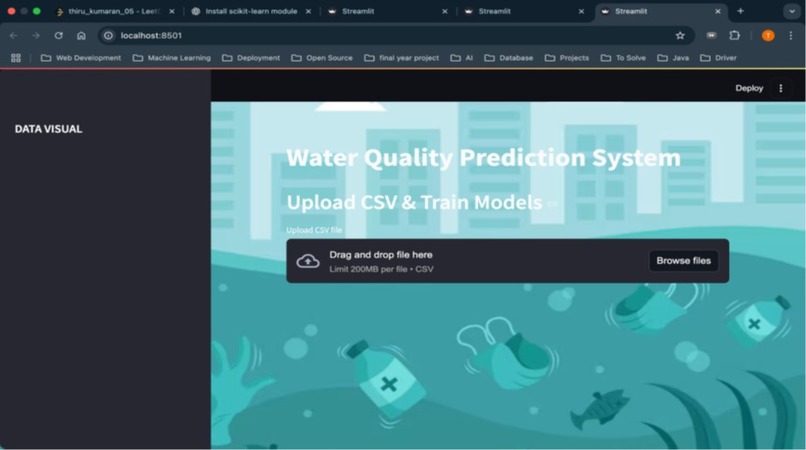
Welcome Page
-
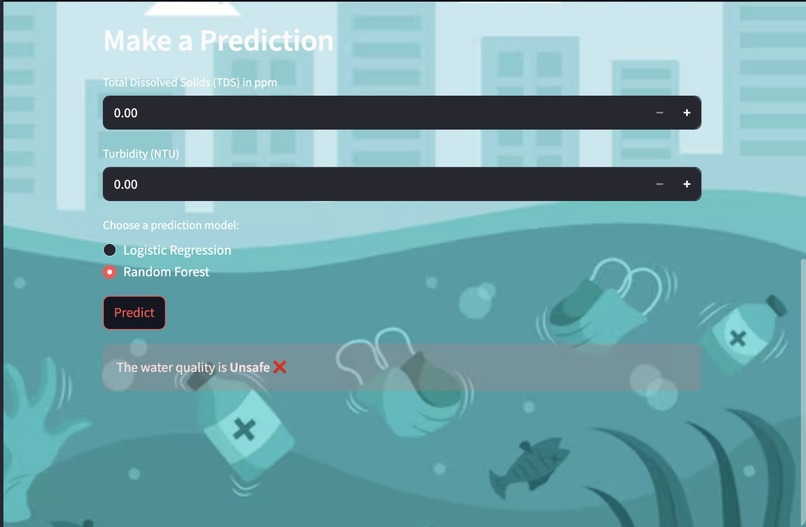
Data Analysis page
-
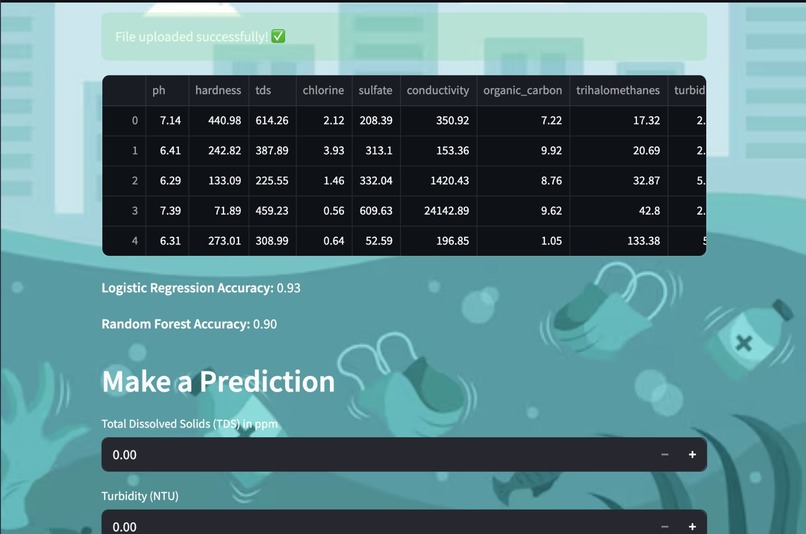
Output Page
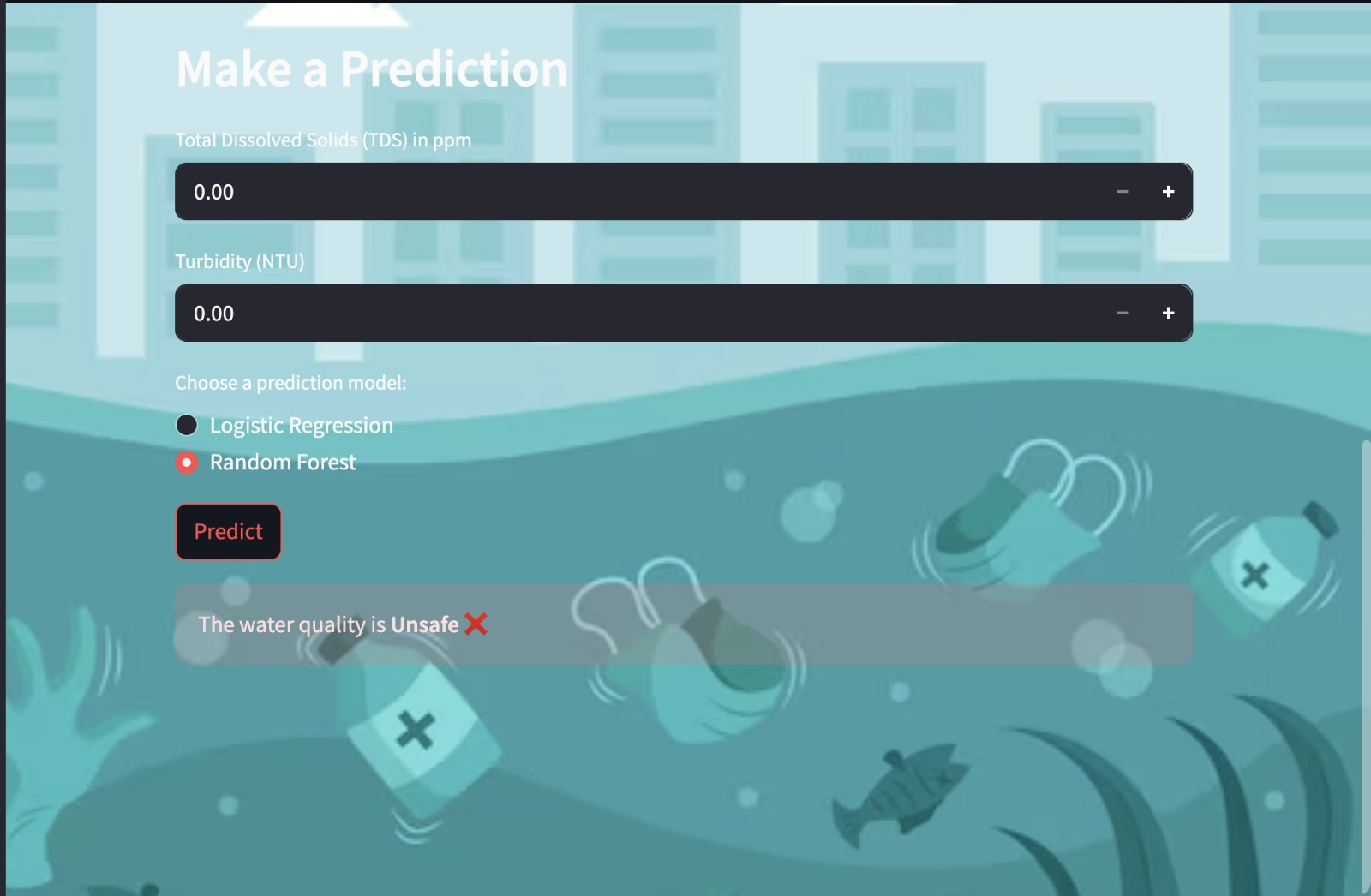
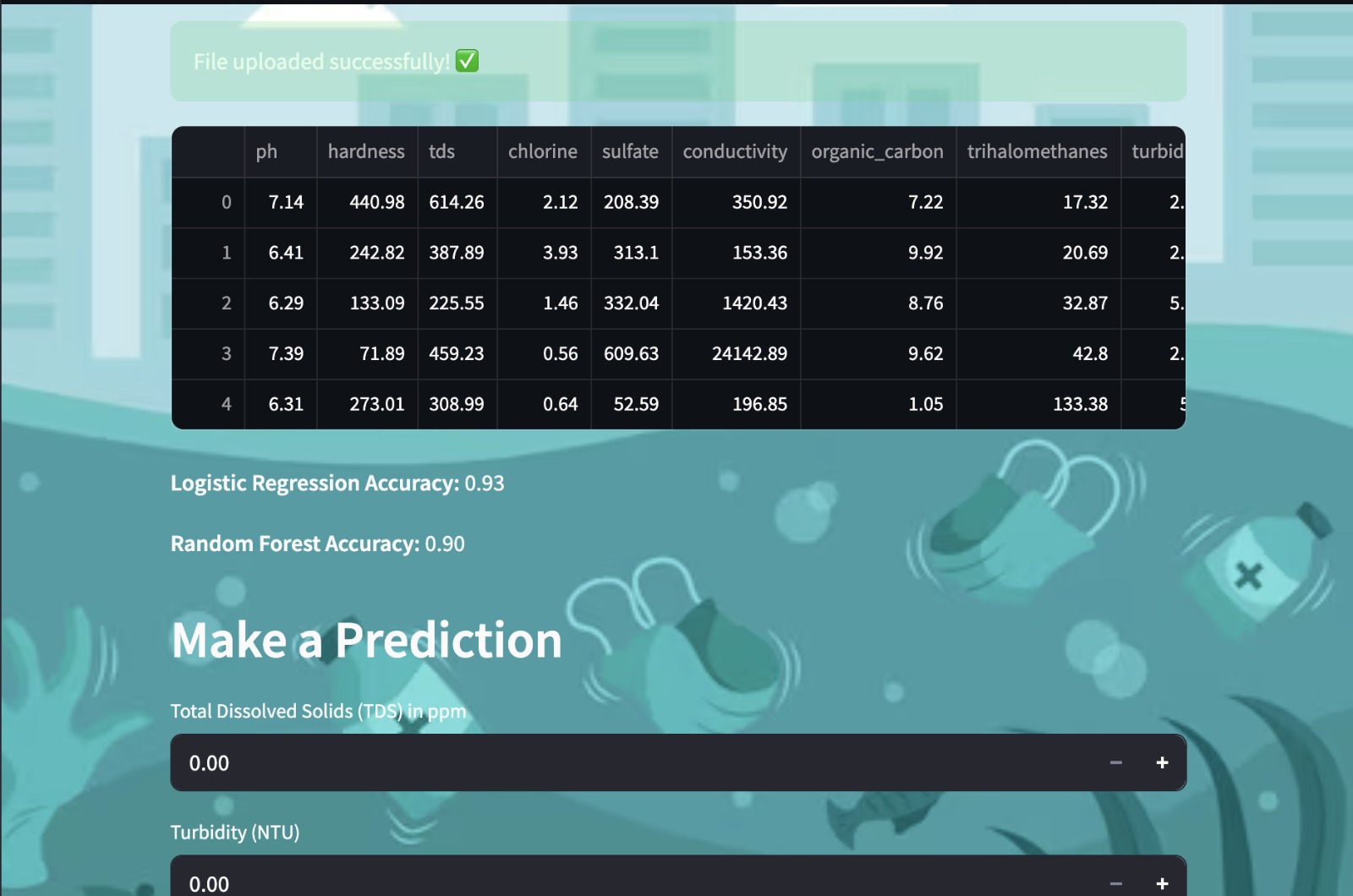
Water is one of the most basic needs of life, yet access to safe and clean water is still a challenge in many areas. Reports of water contamination and its impact on health inspired me to take up this project. I wanted to explore how data can be used to predict water quality and provide meaningful insights that could help in early detection of unsafe water. This project was not only about applying technical skills but also about contributing to a problem that has real social and environmental importance.
What I Learned
1.During the course of the project, I developed both technical and practical skills: 2.Learned to handle real-world datasets, including cleaning and preprocessing messy data. 3.Gained experience in building and comparing machine learning models like Logistic Regression, SVM, and Random Forest. 4.Understood the importance of evaluation metrics such as accuracy, precision, recall, and the F1-score. 5.Improved my ability to visualize data using graphs and dashboards for easier interpretation. 6.Developed the skill of explaining technical outcomes in simple terms that anyone can understand.
How I Built It
The project followed a step-by-step approach: 1.Data Collection: Used datasets with key water quality parameters such as pH, turbidity, dissolved oxygen, conductivity, and BOD. 2.Data Preprocessing: Cleaned and prepared the dataset by handling missing values, scaling, and encoding. 3.Model Development: Applied machine learning algorithms to classify water samples into safe or unsafe categories. 4.Visualization: Designed clear plots and dashboards to present results in an understandable format.
Challenges we ran into
Like any real-world project, this one came with its own challenges: 1.Managing missing and inconsistent data in the dataset. 2.Ensuring that the models did not overfit and could perform well on unseen data. 3.Balancing accuracy with simplicity so that the results remained both reliable and easy to interpret. 4.Translating technical outputs into insights that can actually support decision-making.
Accomplishments that we're proud of
The project successfully produced a working model that predicts water quality with good accuracy. Beyond the results, it gave me hands-on experience in applying data science techniques to a real environmental problem. It strengthened my technical, problem-solving, and communication skills, while also making me realize the impact technology can have on public health and sustainability.
Accomplishments that we're proud of
What we learned
Working on this project gave us valuable exposure to both technical and practical aspects of problem-solving. Some of the key learnings include:
1.Data Handling: How to clean, preprocess, and organize real-world datasets that often contain missing or inconsistent values. 2.Machine Learning Models: Hands-on experience with algorithms such as Logistic Regression, SVM, and Random Forest, and understanding how each performs in classification tasks. 3.Evaluation Metrics: The importance of accuracy, precision, recall, and F1-score in measuring model performance and ensuring reliable predictions. 4.Visualization & Communication: Creating clear dashboards and graphs that make results easy to interpret, even for non-technical audiences. 5.Practical Thinking: How to connect technical results to real-world impact, particularly in improving environmental monitoring and public health.
What's next for Water Quality Prediction Using Artificial Intelligence
While the current system can classify water quality effectively, there is room to expand and improve. Future plans include: 1.IoT Integration: Connecting real-time sensors to collect live water quality data and feed it into the model for instant analysis. 2.Cloud Deployment: Hosting the solution on platforms like AWS or Azure so it can be scaled and accessed remotely by communities and industries. 3.Mobile/Web Application: Building an easy-to-use interface that allows users to check water safety instantly. 4.More Advanced Models: Exploring deep learning techniques for even higher accuracy and better adaptability to complex datasets. 5.Policy & Public Use: Sharing insights with local authorities and environmental organizations to help with early warnings and decision-making.
The vision is to move beyond a student project and transform it into a practical tool that supports cleaner water and healthier lives.

