-
Results

Google drive link for project: https://drive.google.com/drive/folders/1OEhhv73rJH8opLtbEcFr9M-M4gwwnInI?usp=sharing
Inspiration
Everyday an enormous number of water bottles are put into bins while still containing water. Our goal is to incentive investments in a water extraction system for these bottles.
What it does
The CNN can predict if a bottle has water within it from its image.
How we built it
We set out to find ways to minimize resource utilization when determining if a bottle contains a suitable amount of water to justify extraction. We created a convolutional neural network alongside images manually extracted from Google to complete this project.
Approximately 100 images were found and manually labeled as either empty or not. These images were re scaled to 224 x 224 for this project.
Challenges we ran into
Acquiring data for the project.
Accomplishments that we're proud of
Getting an environment setup to do machine learning.
What we learned
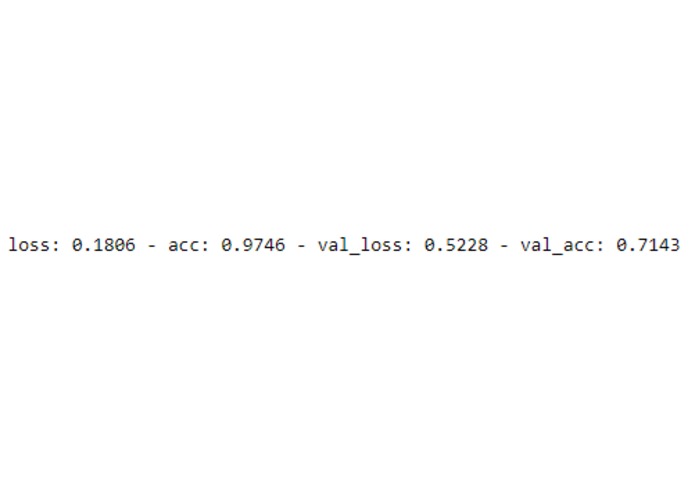
This was the first time we've created a cnn. We achieved an accuracy of ~97% on the training set and ~71% on the validation set. These results were deemed sufficient so we can predict if there is water within a bottle.
What's next for Water Conservation (State Farm)
A major hurdle in any neural network is acquiring data. The data used included situations that a water extraction system would likely face such as crumpled bottles or partially covered bottles. However, it also included situations that likely wouldn’t occur in a more controlled environment such as a variety of background colors and other objects within the image.
The CNN designed only works on individual bottles, future models would contain the ability to judge larger batches at once allowing for further resource conservation.
While more work is needed on this topic we feel it presents an opportunity to mitigate water waste and has future applications.
Built With
- keras

Log in or sign up for Devpost to join the conversation.