Inspiration
Active Ageing Centre (AAC) teams must reach new seniors while sustaining support for those already engaged, with limited staff time and volunteer availability. A Singapore qualitative study of 21 AAC managers and staff identifies manpower constraints and heavy data-entry and reporting work. The operational gap we target is fragmented context: notes, voice recordings, callbacks and commitments spread across different tools. When responsibility changes hands, the incoming worker must reconstruct the senior's latest circumstances, preferences, barriers and agreed next steps before acting. An incomplete handover creates risks of repeated questions, outdated plans and follow-ups without a clear owner. Every transition needs current information, an explicit next action and someone who accepts responsibility for completing it. Coordinators also need to see outstanding work alongside available staff and volunteers to decide where limited manpower should go next. Bringing this context together is essential to protecting continuity of support and keeping more of the team's time available for human contact.
The stakes are real. In Singapore's SIGNS Wave 3a study, a weighted 39.4% of respondents aged 67 and above were at risk of social isolation on the LSNS-6 measure. Sustained human contact matters, and every hour a worker spends rebuilding context is an hour not spent with a senior.
What it does
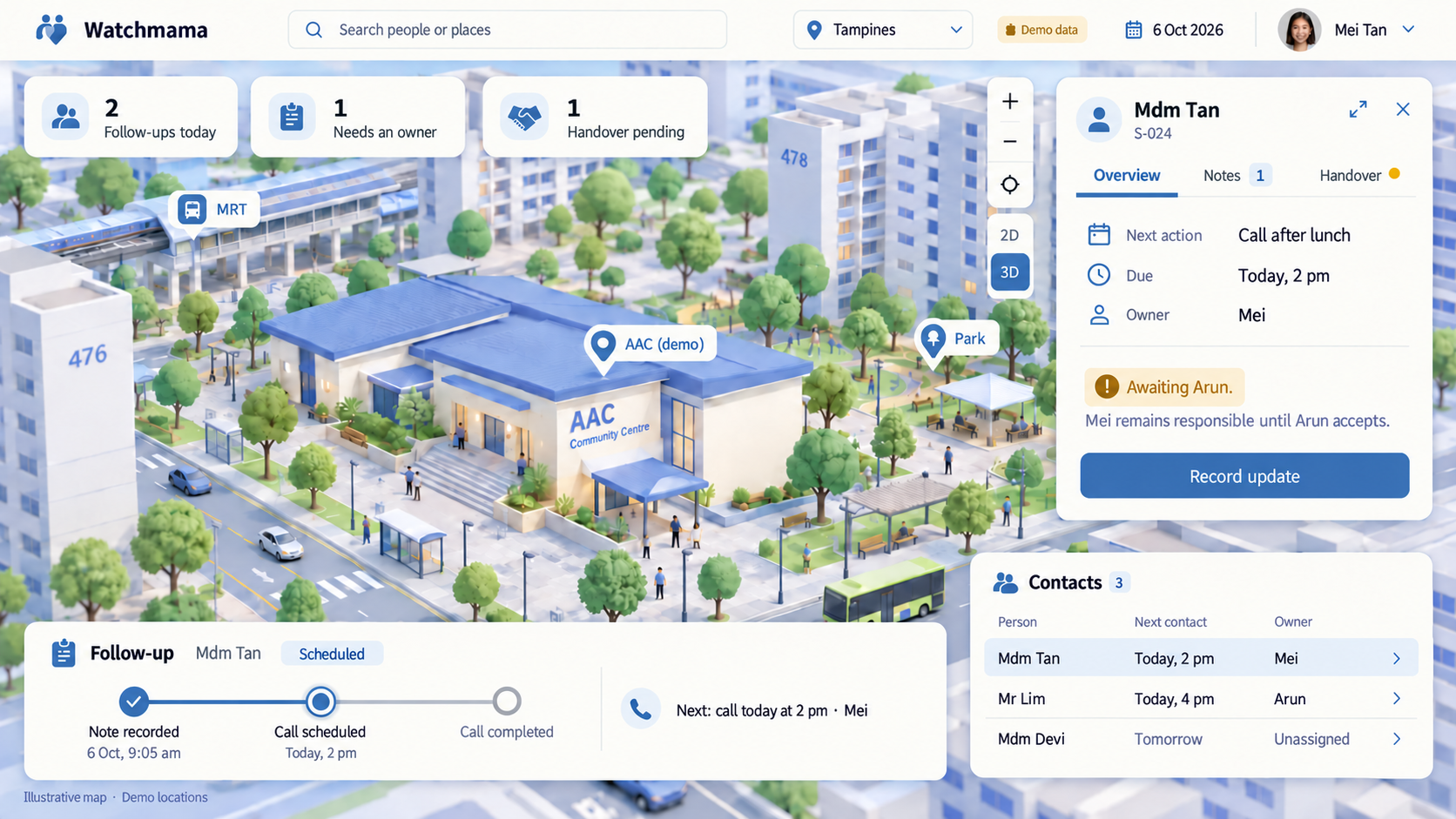
Watchmama is an AI-enabled data intelligence layer over the tools AAC operators already use, bringing approved notes, voice recordings, forms and operational records into one shared dashboard. AI transcribes recordings, structures explicitly stated needs, highlights changes and drafts handover briefs linked to the original evidence for staff review. Once reviewed, that context carries into visit preparation, handovers and outreach planning, reducing the need to reconstruct the same history for each task. Coordinators see due follow-ups, unassigned work, pending handovers and information gaps alongside recorded staff and volunteer availability and skills. They use this view to prioritise support and allocate work, while each handover names a next action, due date and recipient who accepts responsibility. Completed contact and recorded outcomes update the shared history for the next worker. An implemented precedent is Scribe: MDDI reports an average of 36 minutes saved on documentation per conversation. Watchmama connects information capture to reviewed context, accountable action and clearer manpower decisions, with AI supporting the people who deliver care.
The app has four focused tabs:
- Review: pending AI suggestions next to their source passage, with accept, correct, reject or hold, plus identity and date conflicts
- Work ahead: due tasks, owner and acceptance state, feasible worker options, available minutes and uncovered work with the reason
- Handover: a recipient-specific draft with source links and unknowns, its approved version, release and acceptance status
- Area prioritisation: a workspace that puts three labelled dimensions side by side, so a coordinator can pick a community for discovery review or protect due follow-up instead
The area prioritisation workspace combines:
- Structural context: older-resident count and share from SingStat June 2026 and URA Master Plan 2025 boundaries
- Information coverage: recent reviewed contact within the operator's authorised cohort, shown where the denominator is valid
- Feasibility: recorded staff minutes, skills, known due commitments and permitted catchment
Where coverage is unknown, the app says so plainly instead of scoring it as poor outreach, and no area figure is ever applied to an individual.
How we built it
Round 1 is the concept stage: we designed the data path, the review workflow and a two-week Databricks build.
PRIVATE OPERATIONAL PATH
Approved files + source manifest
    --> restricted landing, identity and schema validation
    --> versioned evidence and structured records (Delta)
    --> AI proposals with evidence links --> worker review
    --> reviewed facts + SQL due and workload checks
    --> Databricks App: handover and coordinator decisions
    --> workflow events: assign, accept, attempt, outcome
    --> refresh of the same app views

PUBLIC PATH (kept separate)
SingStat snapshots + URA MP2025 boundaries
    --> public validation and SQL community context
    --> area prioritisation tab
- Stack: Python and SQL, Unity Catalog managed Delta tables and Volumes, one batch Lakeflow pipeline, task-specific AI extraction and a Streamlit Databricks App.
- AI reads only validated evidence. It never touches the raw landing zone. Every suggestion stays pending until a worker reviews it, and a generated handover stays private until its exact version and audience are approved.
- Rules run on reviewed facts. SQL computes due actions, missing owners, stale records and workload limits from reviewed facts and validated records, never from pending AI output.
- Workflow events are separate. Assignment, acceptance, contact attempt and recorded outcome are distinct events, so a plan is never counted as delivered support and a successful contact is measured separately from a completed task.
- Public data stays in its own branch. Demographics never feed a person's record or any individual risk score.
- Write path: the demo serialises workflow writes through one dedicated writer and one Delta event log. For a concurrent real-data pilot, Lakebase or PostgreSQL becomes the workflow store, with committed events mirrored into Delta for analytics.
- Inputs for the sprint: text fixtures of notes and forms, plus clearly fictional operational records for one AAC. Transcription of voice recordings plugs in later as a separate adapter.
Challenges we ran into
- Making public data drive a decision. A demographic map on its own decorates. Pairing structural context with information coverage and feasibility gave it a job: choosing where to run discovery.
- Keeping one version of the truth. We designed reviewed facts to feed visit prep, handover and planning together, so a corrected callback date updates every view.
- Separating ownership from completion. Assigned, accepted, attempted and completed had to be separate events for the counts to mean anything.
- Building on what exists. Case-management systems, Scribe and referral tools stay authoritative for their own records. Watchmama is the layer across them.
Accomplishments that we're proud of
- A clear path from captured information to reviewed context, accountable action and a recorded outcome.
- Handovers that name a next action, due date and recipient, and stay open until that recipient accepts.
- An area prioritisation workspace that makes SingStat and URA data part of a real discovery decision.
- A governed Databricks design where AI drafts and people decide.
- Strong precedents: Scribe's reported 36 minutes saved per conversation shows reviewable AI documentation frees staff time, and Databricks and Virtue Foundation's VF Match uses targeted LLM extraction over more than 25 million web pages across 72 countries. We apply that pattern of narrow extraction and reusable structured data to AAC operations.
What we learned
- Captured information is most valuable when it carries forward into the next action.
- A handover is not finished when it is sent; it is finished when someone accepts it.
- Public data tells you where to look; reviewed operational evidence tells you what the team can do next.
- The honest measure of time saved includes import, review and correction, not just drafting.
What's next for WatchMama
Two-week sprint (12 to 26 October)
- Days 1 to 2: confirm the workspace and permissions, freeze the fictional journey and input contracts.
- Days 3 to 4: load public snapshots and fictional inputs into versioned evidence with validation and quarantine.
- Days 5 to 6: source-linked AI proposals and the human review screen.
- Days 7 to 8: the single-writer workflow for assignment, acceptance, attempt and outcome.
- Days 9 to 10: the four app tabs and role and access tests.
- Remaining time: paired workflow timing, one full journey, one conflict journey and the demo.
Measure it. We will compare Watchmama with the team's best existing workflow, including Scribe output, on total staff time across import, preparation, review, correction and retrieval, and on handover accuracy. Our target is at least 20% lower median total workflow time with no worse correctness, agreed before testing. The size of the saving is what the operator evaluation will confirm.
Watchmama keeps more of the team's time for human contact, and makes sure every follow-up has someone who owns it.

Log in or sign up for Devpost to join the conversation.