-
-
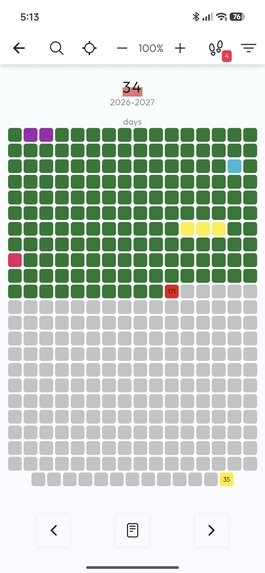
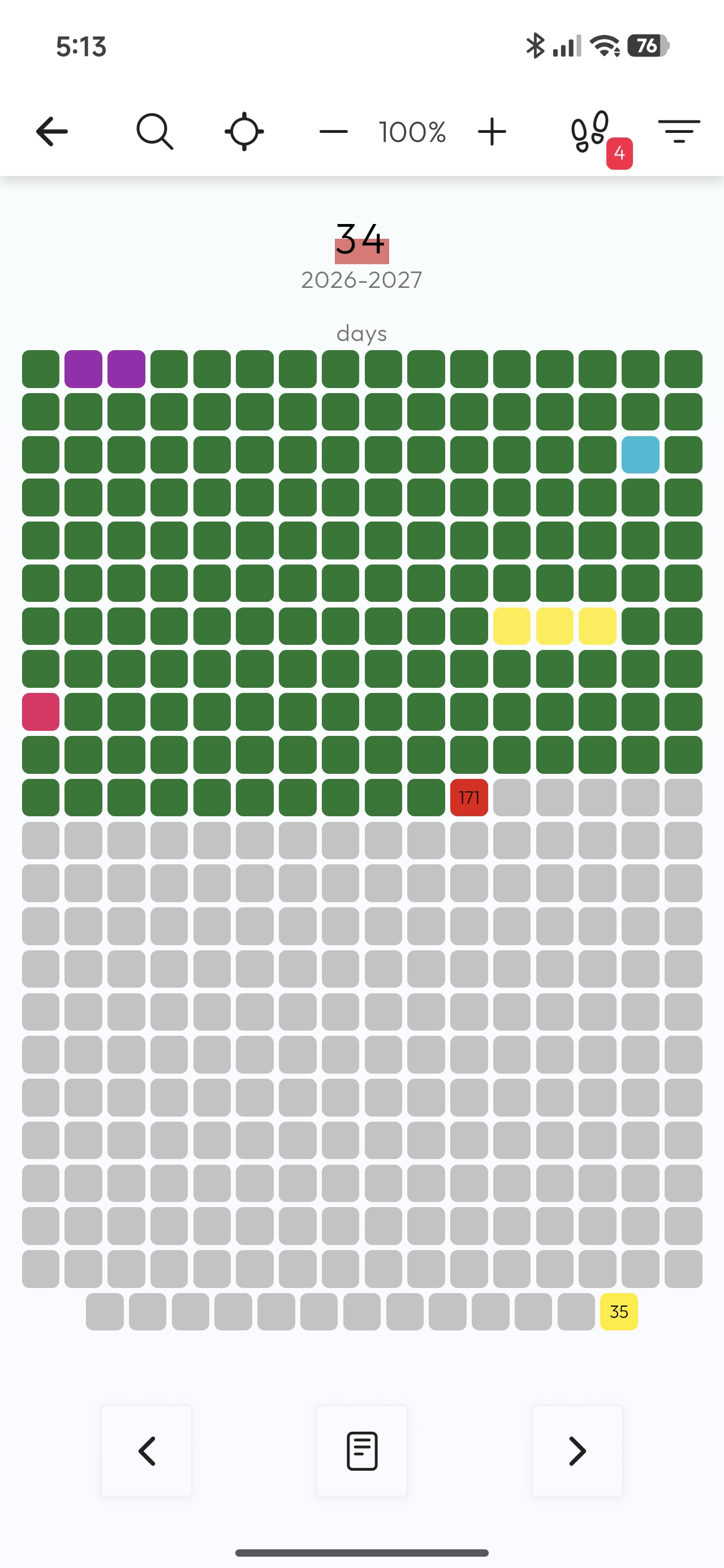
Unframed screenshot from the Android app at 1179×2556, the calendar as it actually looks on a phone.
-
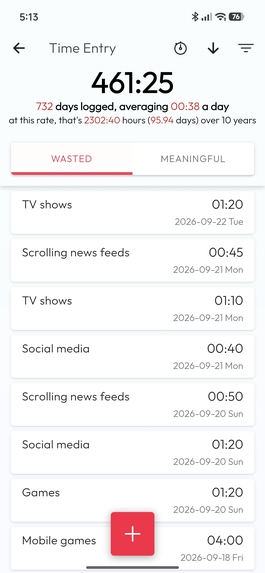
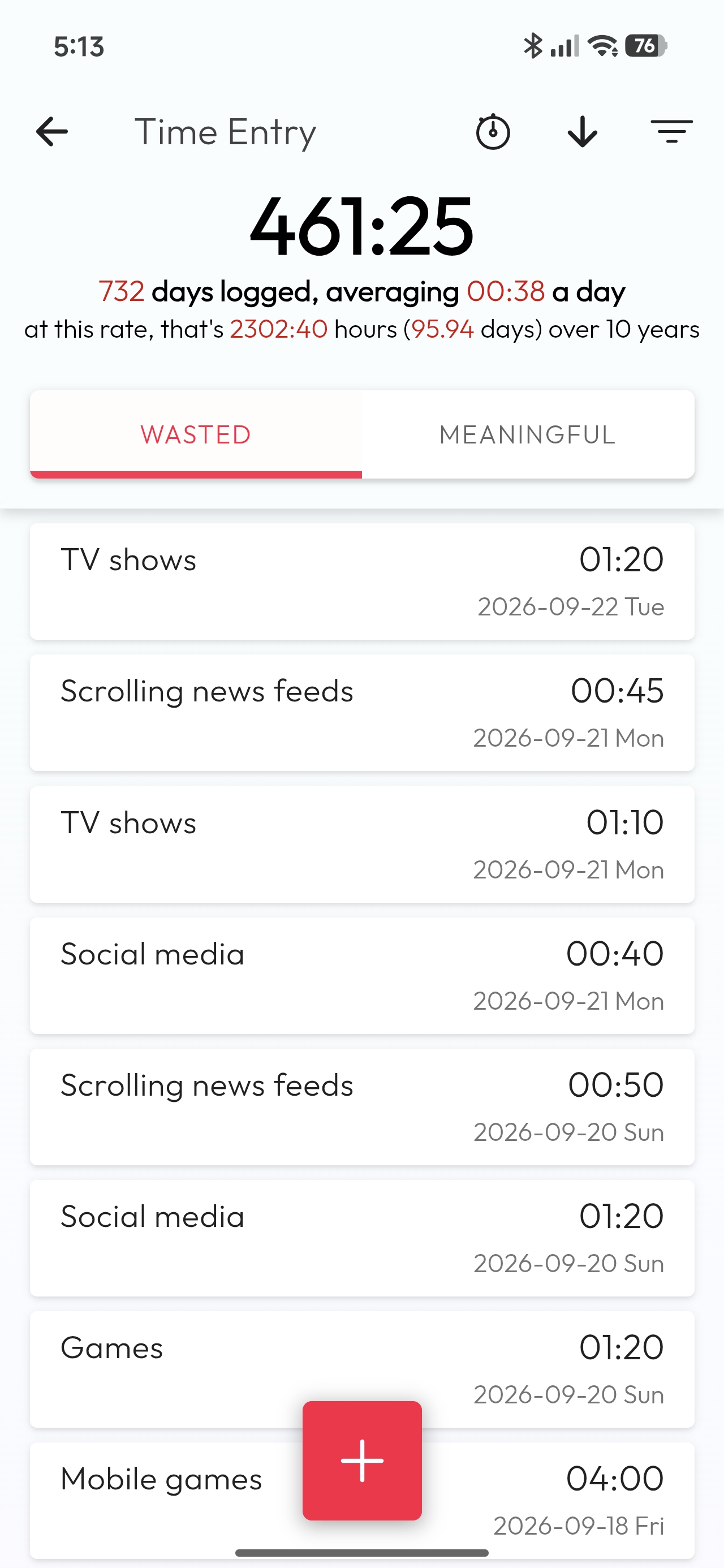
Unframed screenshot from the Android app at 1179×2556, the time entry as it actually looks on a phone.
-
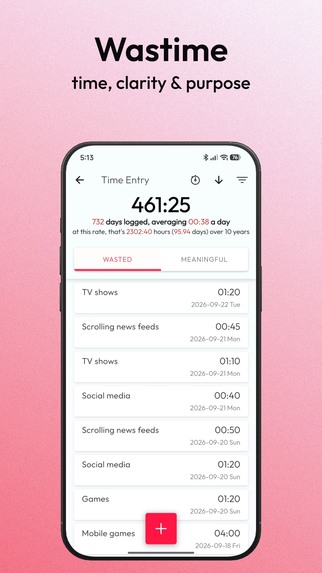
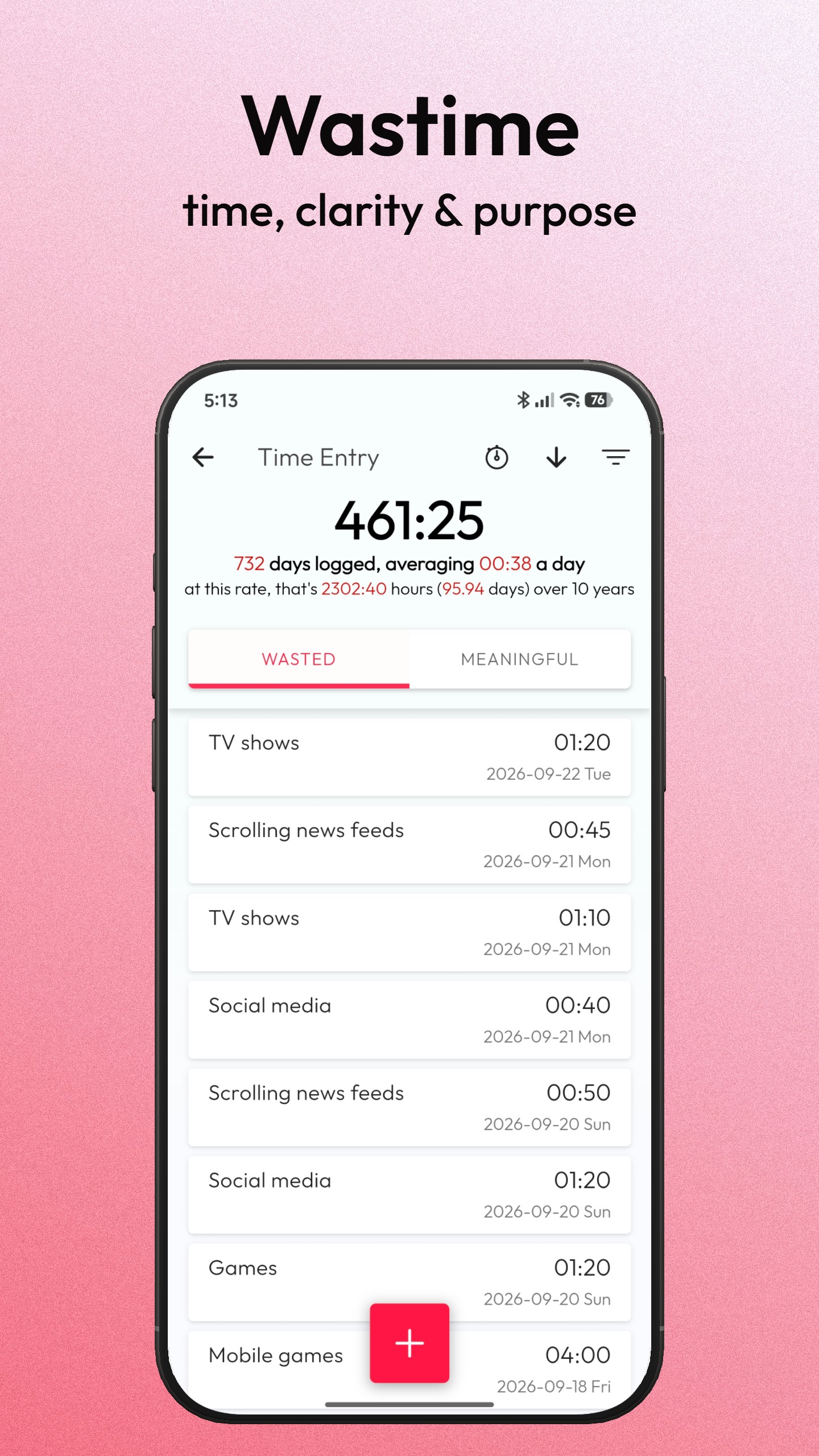
Every entry is marked meaningful or wasted, and the running total shows where your current pace leads over the next ten years.
-
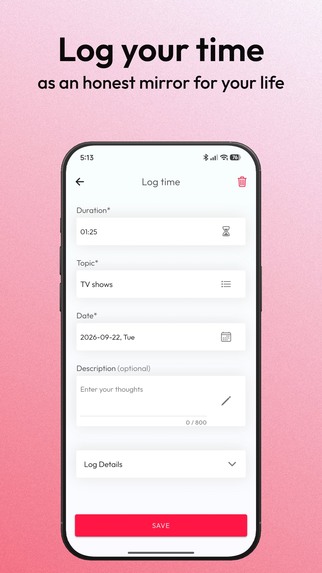
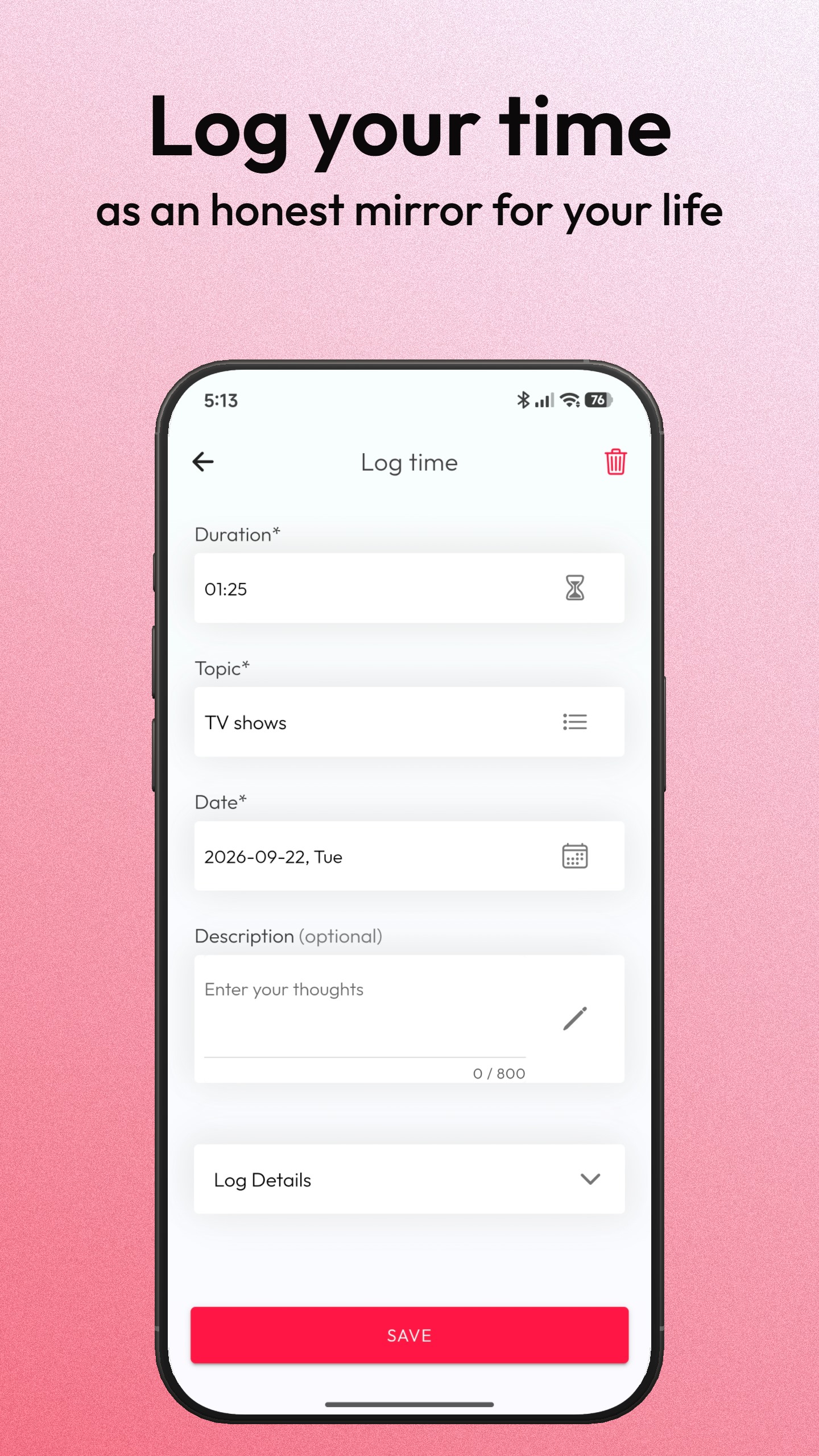
Logging an entry is quick, and the optional note leaves room for whatever you want to remember about that time.
-
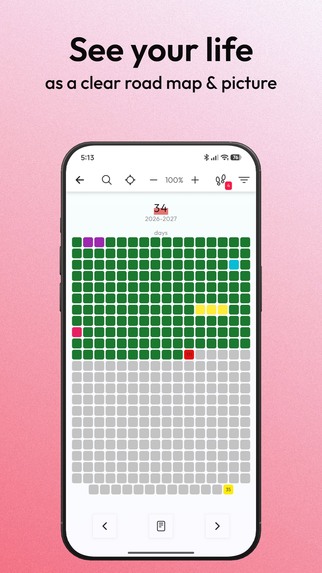
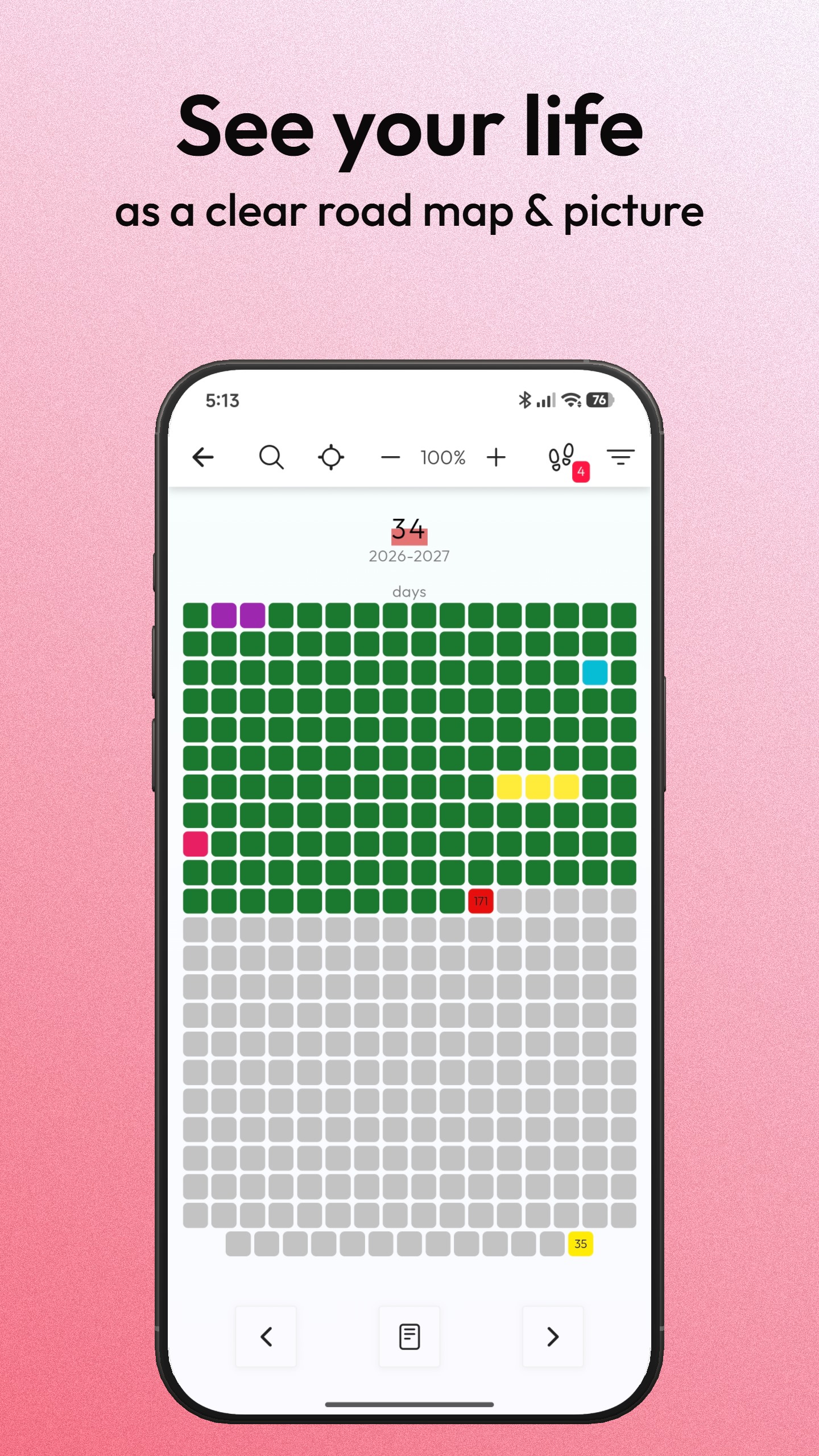
One year of your life laid out day by day, with the days already lived filled in and your milestones marked in their own colors.
-
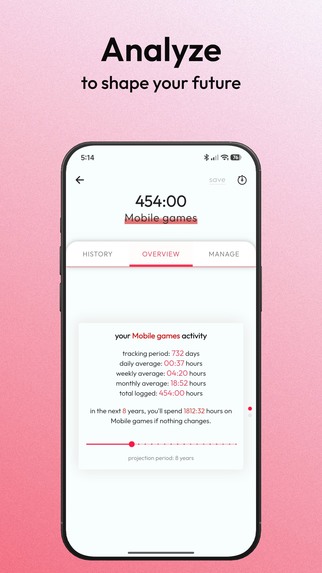
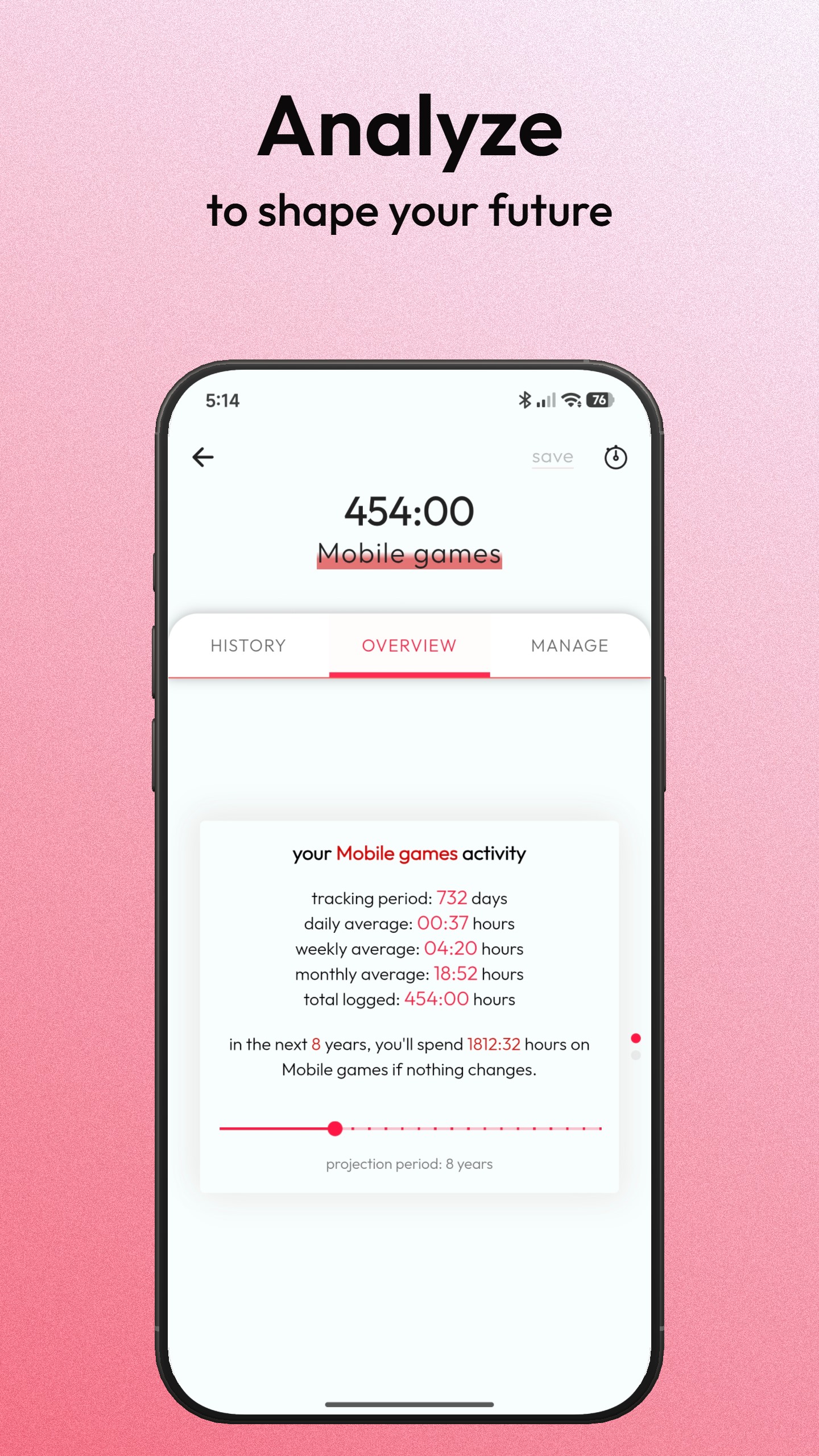
Each topic keeps its own history and averages, along with the hours it would take over the next years if nothing changes.
-
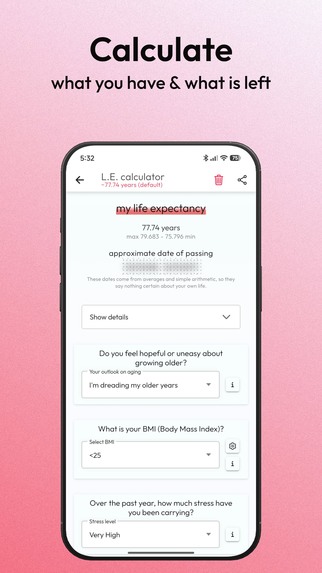
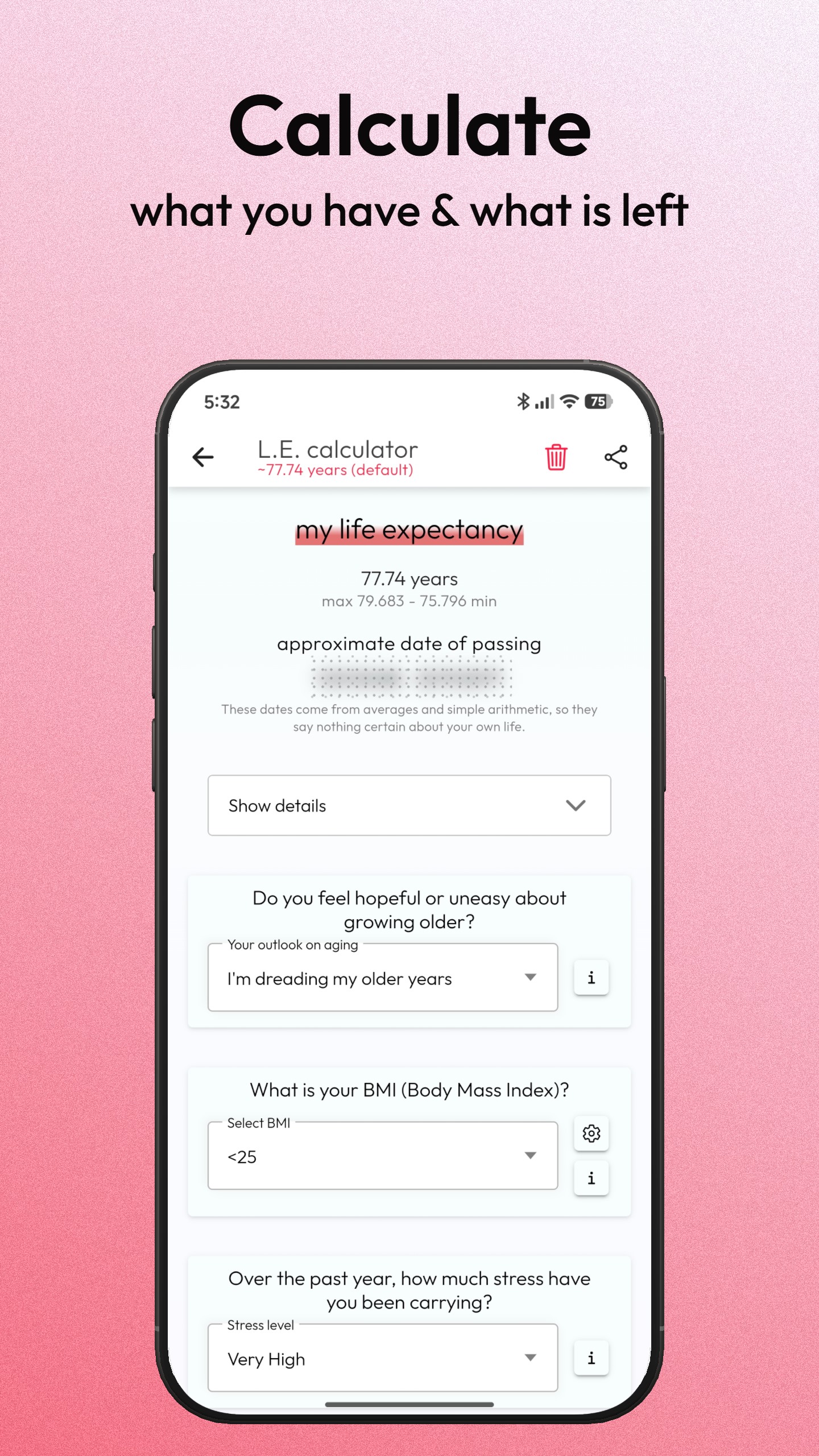
Ten short questions about everyday habits give a rough life expectancy, built from averages that say nothing certain about your own life.
-
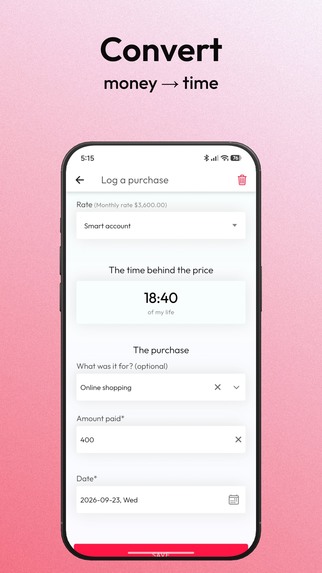
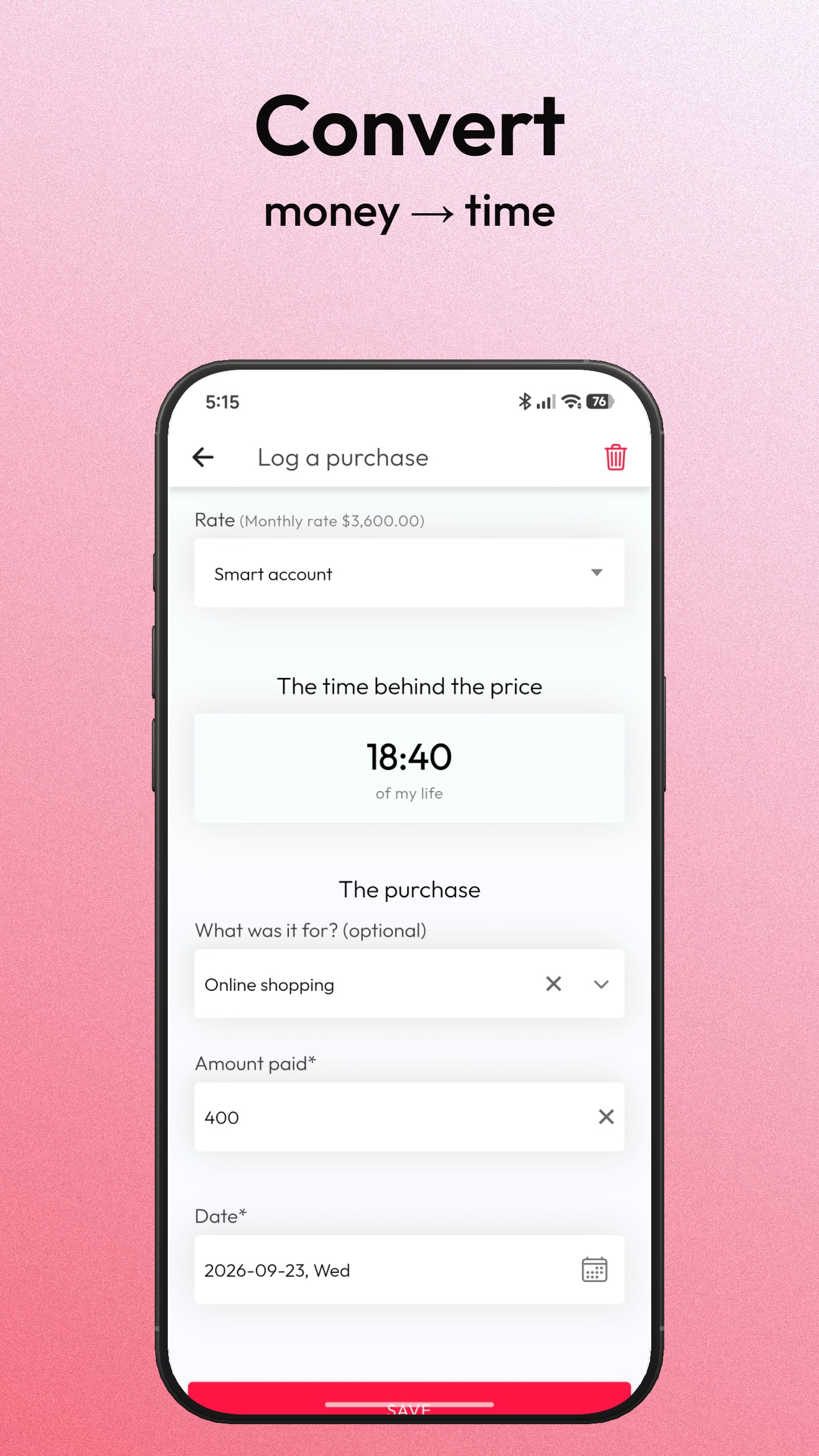
Any price turns into the hours of work behind it, and a history adds up what your spending has come to in time.
-
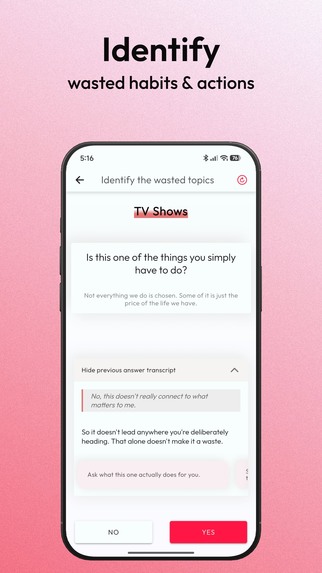
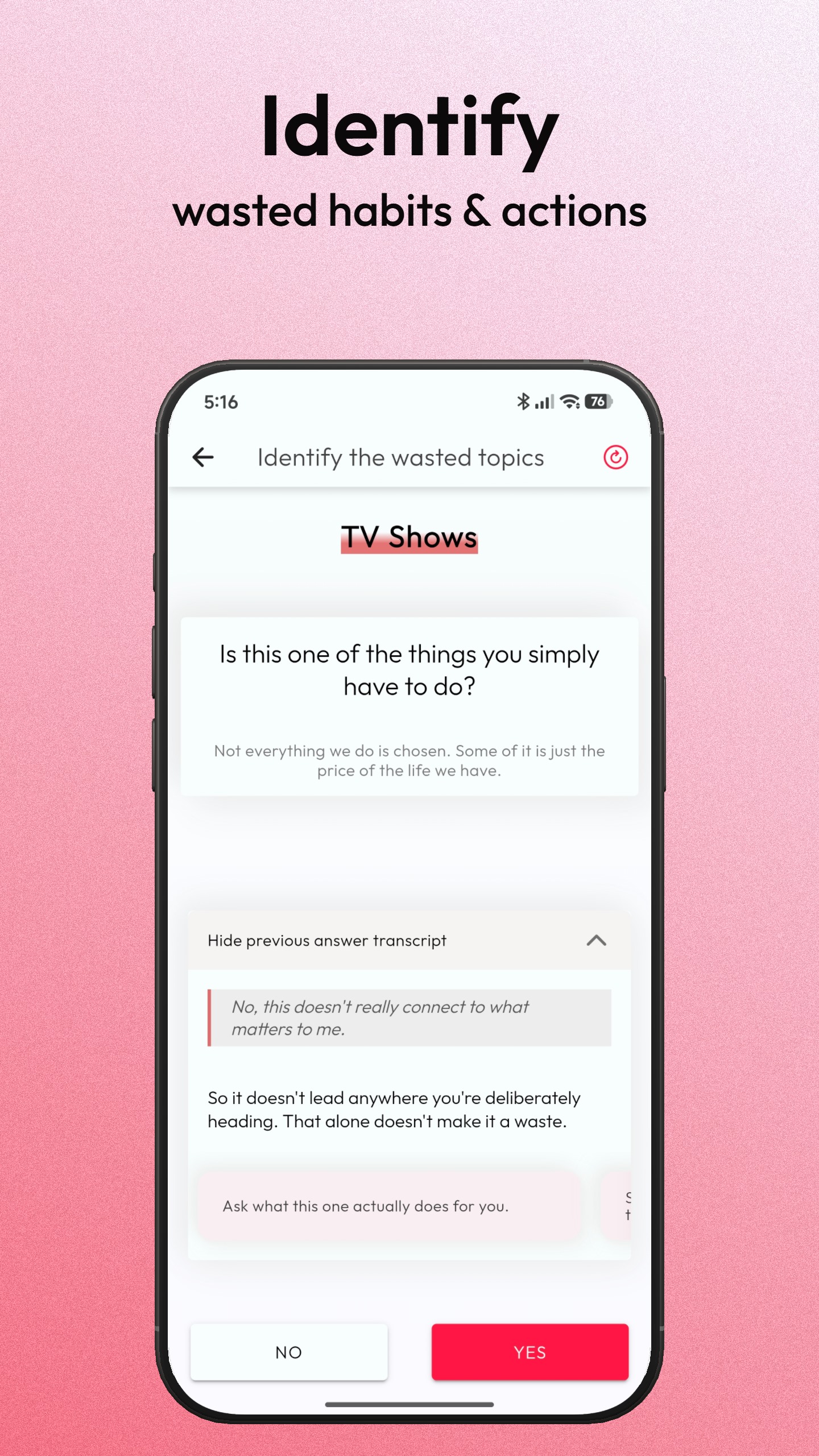
When a habit feels off, a few yes-or-no questions help you work out what it actually does for you, and the conclusion stays with you.
-
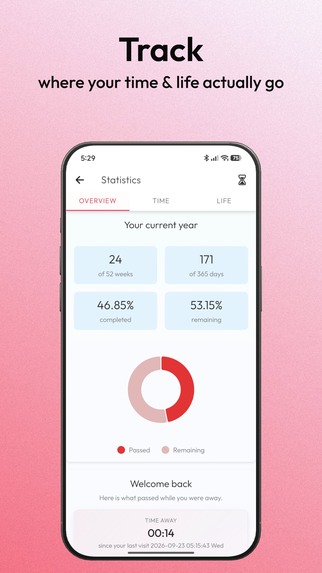
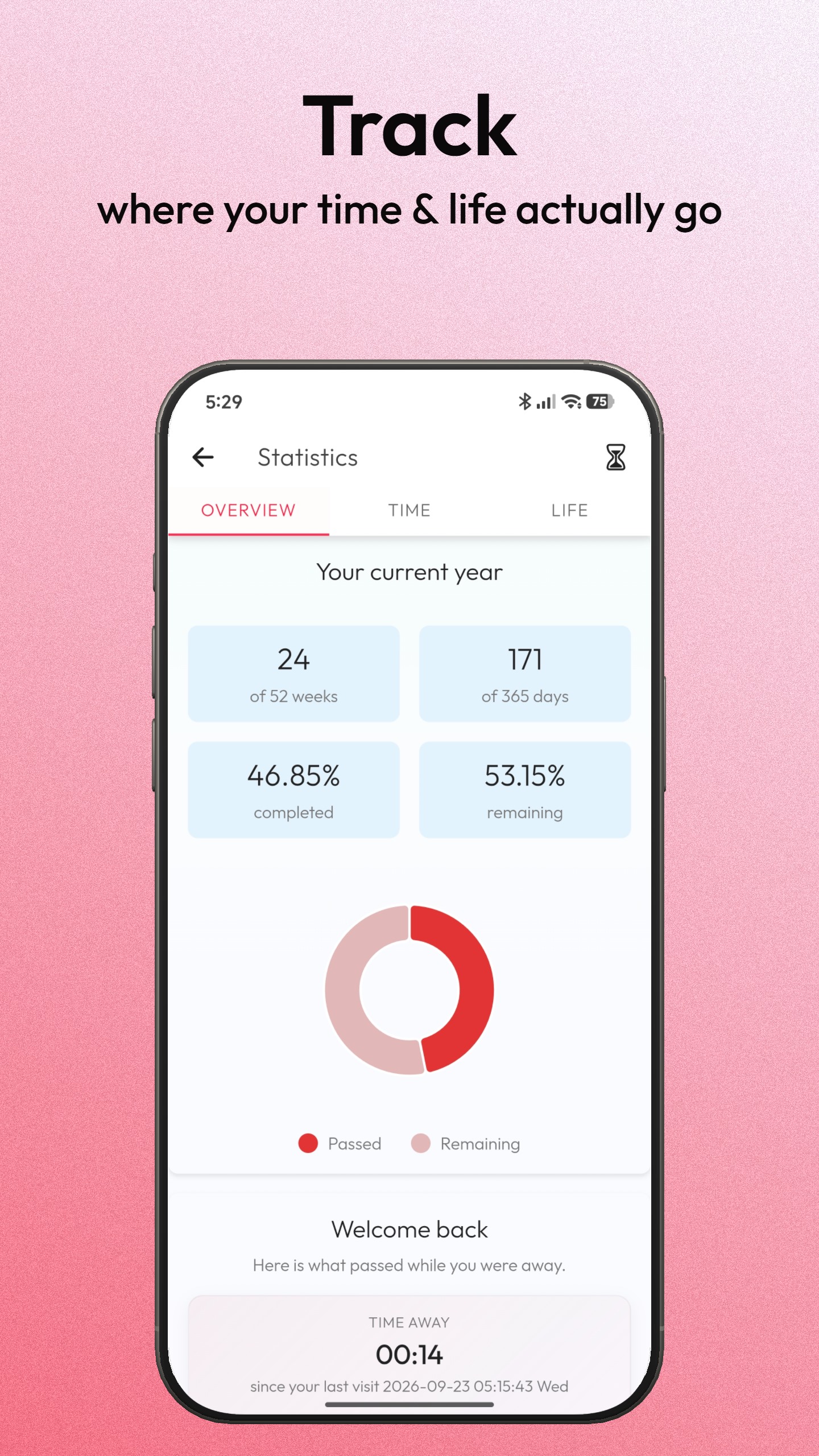
The overview counts how much of the current year has already gone by and greets you with the time that passed since your last visit.
Inspiration
How much time do I waste every day?
That was the whole question. September 2024. I was living abroad, far from home, with a tiredness that had been piling up for a few years, and one day I caught myself swiping through my own days the way you swipe a feed. Morning turned into work, work into tiredness, and the evening dissolved into zoning out. That same month people at my work were let go in a single day, with no warning. It passed me by. In the moment it was just a very bad day, and only later did it become visible that Wastime counts from exactly there.
I started with a paper planner and wrote down where the time actually leaks away. Lost an hour here. A couple more here. And here it's anyone's guess where the whole day went. After about ten days I could see individual days, but the whole picture wasn't coming together. What do these small gaps turn into in a few years? No ready answer was at hand, so I sat down to make a prototype for myself. One button, three inputs, one list. One page.
I can still see the first screen. Only numbers on it and a short line underneath. If I keep pouring 10-15 hours a week into the usual “small stuff”, then over ten years that adds up to more than half a year of life. My first reaction, word for word, was “No f***ing way”. That's when something clicked. The number turned out to be stronger than any inner monologue. Time suddenly had weight.
The app was called Waste back then. Two years later it's Wastime, and the question got wider. Where does time go at all? What in it was alive? How much time do we have? And how much has already passed?
What it does
Wastime is a mirror for your time and your life, built from your own data. No streaks, no motivational quotes, no feed. You put in what you actually do, and the app shows what it adds up to over years.
Inside there are a few tools, and all of them look at the same thing, only the scale changes.
- Calendars lay your whole life out as a grid, one square for one week. You see what's lived, where you are right now and how much may still be ahead. Three views, Life, Years and Ages. Milestones mark the events that shaped you, and Age Stories hold what each year was about.
- Time Diary is the everyday level, a diary of your hours. You log where they go and sort them into Wasted or Meaningful yourself. What counts as wasted, only you decide.
- Calculators. Wasted Calculator takes a small habit all the way to the end and shows the months it turns into. Planning Calculator counts backwards from a goal. 24H Calculator shows how many hours of the day actually stay yours. And Leftover Calculator, the hardest one, counts the time you may still have with the people you love.
- Converter turns the price of a purchase back into the working hours behind it.
- Life Expectancy sets the horizon for everything else. By country, by hand, or with a small calculator.
- Questions. More than 600 of them, and they show up right next to the number you're looking at. A question, I think, is often more useful than an answer.
- Wastime Journey. A story inside the app, written by me, about how each tool appeared and why. You can read it straight through or skip to what pulls you.
The one paid feature is publishing. Your Life calendar becomes a web page with its own address. You pick every Milestone that goes out, one by one, choose whether the page is Link, Public or Private, decide whether your name is on it, and give explicit consent before anything leaves the phone. The paywall for it runs on RevenueCat. Everything else in the app is free, and there are no ads.
How I built it
Alone, in the evenings and on weekends, next to a full-time job. Two years in, it's 2,024 hours and 50 minutes. I know the number to the minute because I log my time in my own app.
Why Ionic and Angular? Fair question. Because that's what I knew. Native, Flutter or React Native would have cost me months of learning before the first screen, and somewhere in the middle I'd most likely have dropped the whole idea. So the first version took one weekend, and on Sunday night it was on my phone. It turned out so simple and so absorbing that some hidden energy woke up in me.
From there the app grew one question at a time. A week in, I wanted to count useful time too, and that's how Wasted and Meaningful appeared. Two weeks in, my wife Krystsina mentioned in passing that there's this thing, a life calendar, one square for one week. I'd heard of such calendars myself, but the one who pushed me was her. I thought, why not, and threw the first grid together in one Sunday evening. From the outside the remark meant nothing. In reality this feature became key in the whole app. Later, digging around the topic, I found that Tim Urban wrote about exactly this calendar back in 2014, in “Your Life in Weeks” on Wait But Why.
Then the calculators, each out of a question I couldn't answer with what I had. Then Questions, because at some point they piled up and needed a place to live. Then the Journey, because the modules kept multiplying and I wanted a way in that explains why, and only then how.
Privacy was a design decision from the very start. Everything works offline. Entries, calculations and notes sit on your device and don't go anywhere on their own. The network is needed only for actions you start yourself, like publishing a calendar. The app asks you to sign in for the first time only at the publish screen, because a page that goes out into the world needs an owner who can take it down. Data Backup exports everything into one file you keep. Delete account takes the account and its cloud data down for good.
RevenueCat handles the purchase behind that one publishing flow.
Challenges I ran into
The hardest part was never the code.
Leftover Calculator counts how much time you may still have face to face with a particular person. My mom lives far away. When I first tried to explain the idea behind this calculator to my wife, I choked up and couldn't finish. While such a thought stays a calculation, it lives somewhere apart from you, almost like a task. Say it out loud, and it's about a concrete person. The calculator got built. I still wouldn't recommend it to everyone.
The second challenge was tone. An app called Wastime can very easily sound like a verdict. So the app never decides for you what was wasted. You sort your own hours, and an evening show can be Meaningful if that's what it was for you. I don't believe in the approach where “if you're not productive, then you're doing something wrong”. A completely lazy weekend is a normal part of a life that's alive. The app just shows how many such hours piled up over the week. What you're willing to live with is your choice alone.
The third was writing. Wastime Journey is a long text inside the app, in Russian and in English, one thought per page, every page held to about 900 characters. It took longer than some of the modules, and it's still being finished page by page. I’ve never had the knack for writing books, blogging, or working with text, so this is probably my biggest challenge.
And the boring one. Two years of evenings, more then 2000 hours, and then the release itself. Android is live in Google Play. iOS is in App Store review as I write this.
Accomplishments that I'm proud of
- The app helped me first. It pulled at least one person out of the swamp, so it's already not for nothing.
- Underneath, Wastime is a philosophical tool, and an incredibly complicated one. It has to be opened gradually, layer by layer. I still get surprised at how I manage to tie together things this different, when under every one of them lies one and the same thing, your time and mine. It's one of those cases when you look at all of it and think, “wow, did I really make all this?”
- The honesty and openness of the whole app. I was making it to help myself. And probably that's exactly why it came out as something other people can lean on too.
- Wastime has no dark patterns. No ads, no streaks, no endless feed, no notifications that beg you back. To be honest, it's an app that wants you to close it. In a good scenario you come in, see the reflection of your time you needed, understand something about yourself and go back to life beyond the screen.
What I learned
- Start with the tools you have. Angular was enough for the first weekend, and the first weekend was what mattered.
- A number is stronger than an inner monologue. You can tell yourself for years that the hours go somewhere wrong and do nothing. A concrete shape in front of you is harder to wave off.
- What's lost, only you decide. And not everything you once counted as lost or plain bad stays that way. Sometimes it turns out to be the best thing that could have happened to you.
- You can't add days. But depth to the day you have, you can sometimes give back.
Why I think this counts as social good
Let me name the problem first, the one a person runs into today.
The old ways of coping stop working in the world we now live in. Work gets automated, and people get let go in a single day, I've seen it from the inside. Loneliness. Loss of meaning, when life is full to the brim and there's less and less of the feeling of life left in it. And depression, which by now looks like the disease of the age, and it's only getting worse.
Wastime is my small answer to that. It doesn't fix any of it. It gives a person an honest picture of their own life, without anyone deciding for them what mattered. It can take back control of our lives and allow us to face reality. It brings the people they love back into the count, and after Leftover Calculator “not now” sounds different. It keeps their life data on their own phone. And everything except publishing is free and works without an account or the internet, so it costs nothing to try and nothing to walk away from.
I think people are going to need support and help. The problems are already huge, and I'm among the people who ran into them. So I'll dare to assume that in the coming years help will be needed like never before. I won't claim my app helps everyone, or even most. But some people, sometimes and in some places. Of that I'm sure.
And if each of us takes one small step against what today's world does to us, and each of us helps the person next to them, then together we might make this world a little happier and a little better.
What's next for Wastime
- iOS, as soon as review lets it through.
- Wastime Journey, part by part.
- The Calendar. It became the key feature by accident, and the list of ideas behind it is longer than the list of features I've shipped.
As a kid, somewhere between four and eight, I was building a time machine out of old TV remotes, old circuit boards and whatever wires I could find. My mom came over once and said that when I launch it, I should come get her, and we'd do it together. I never launched it. But a small app about time, I did build.
Keep feeling.
Built With
- .net
- android
- angular.js
- azure
- capacitor
- echarts
- firebase
- ionic
- quill
- revenuecat
- sqlcipher
- sqlite
- typescript


Log in or sign up for Devpost to join the conversation.