-
-
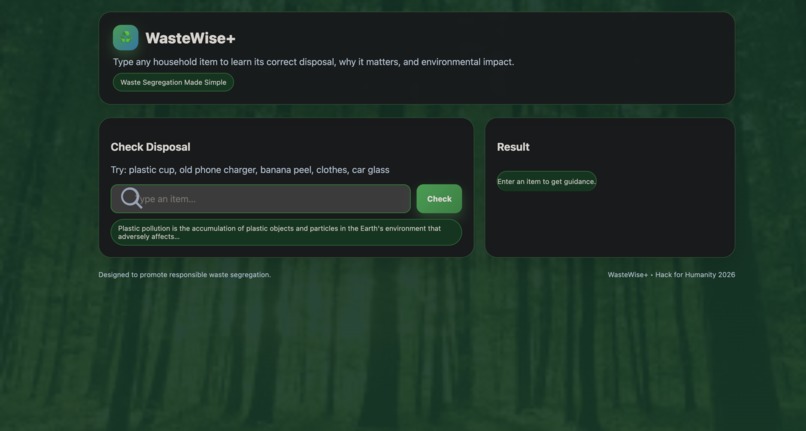
Type an item, get the correct disposal bin — WasteWise+ in action
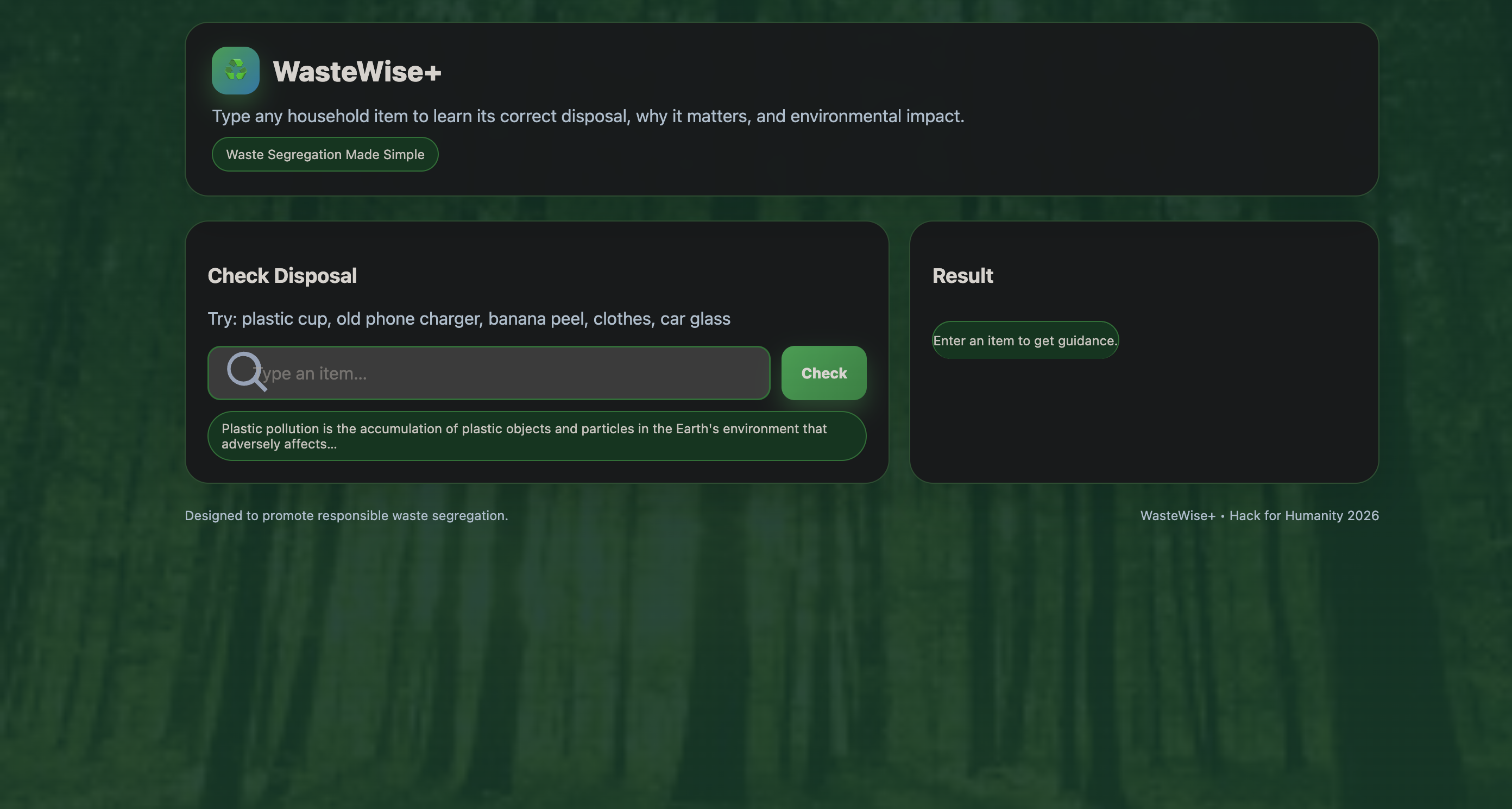
About the Project
Inspiration
Incorrect waste segregation is a common everyday problem. People often do not know which bin an item belongs to (Wet, Dry, Recycle, or E-waste). This leads to recyclable materials being contaminated and sent to landfills, increasing pollution and environmental damage. WasteWise+ was inspired by these real-life moments of confusion at disposal points, where a simple and instant guide could help people make better disposal choices.
How the Project Is Used (Use Cases)
WasteWise+ is designed for everyday users who want quick guidance for waste disposal.
Use Case 1: Household Waste
A person disposes an item at home.
Example:
Input = "plastic cup"
Output = Recycle BinUse Case 2: Hostel / College Bins
Students dispose waste in shared bins.
Example:
Input = "banana peel"
Output = Wet BinUse Case 3: Electronic Waste
A user wants to dispose of small electronics safely.
Example:
Input = "old phone charger"
Output = E-waste Bin
How I Built It
WasteWise+ is a lightweight web application built using HTML, CSS, and vanilla JavaScript.
The disposal guidance system combines local rule-based classification with an external environmental information API to provide educational context to users.
- Frontend = HTML + CSS
- Logic = JavaScript
- External Data = Environmental information API (REST)
Disposal Classification Logic (Rule-Based)
$$ \text{Category} = f(\text{User Input}) $$
$$ f(\text{User Input}) \rightarrow {\text{Wet}, \text{Dry}, \text{Recycle}, \text{E-waste}} $$
API Integration (Environmental Information)
$$ \text{EcoFact} = \text{API_Response}(\text{Topic}) $$
Example:
$$ \text{API_Response}("plastic_pollution") \rightarrow \text{Short Environmental Summary} $$
What I Learned
- Integrating REST APIs using
fetch()in JavaScript - Handling asynchronous data using Promises (
.then()) - Designing rule-based classification systems
- Building a complete front-end web application without a backend
Challenges Faced
- Handling API failures and network errors
- Designing a fallback system when API responses are unavailable
- Mapping free-text user input to predefined waste categories
- Ensuring good UI/UX while keeping the app lightweight
Future Improvements
- Computer vision for item recognition (camera input)
- City-specific disposal rules using location APIs
- Multilingual support
- User profiles and history tracking


Log in or sign up for Devpost to join the conversation.