-
-
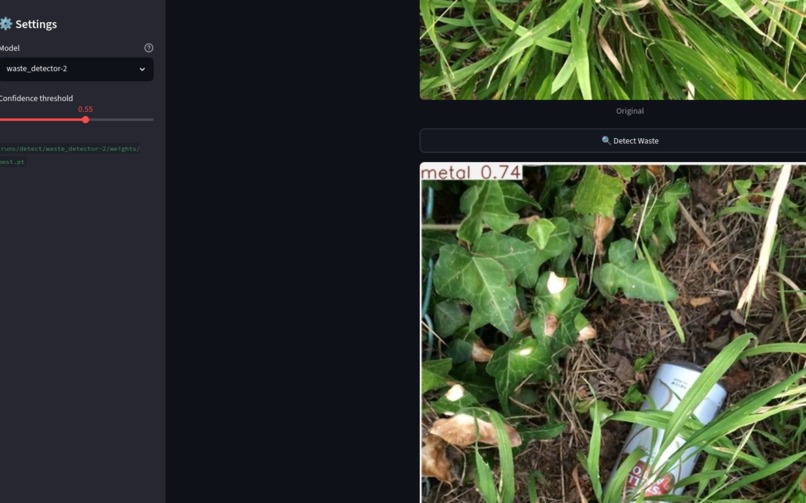
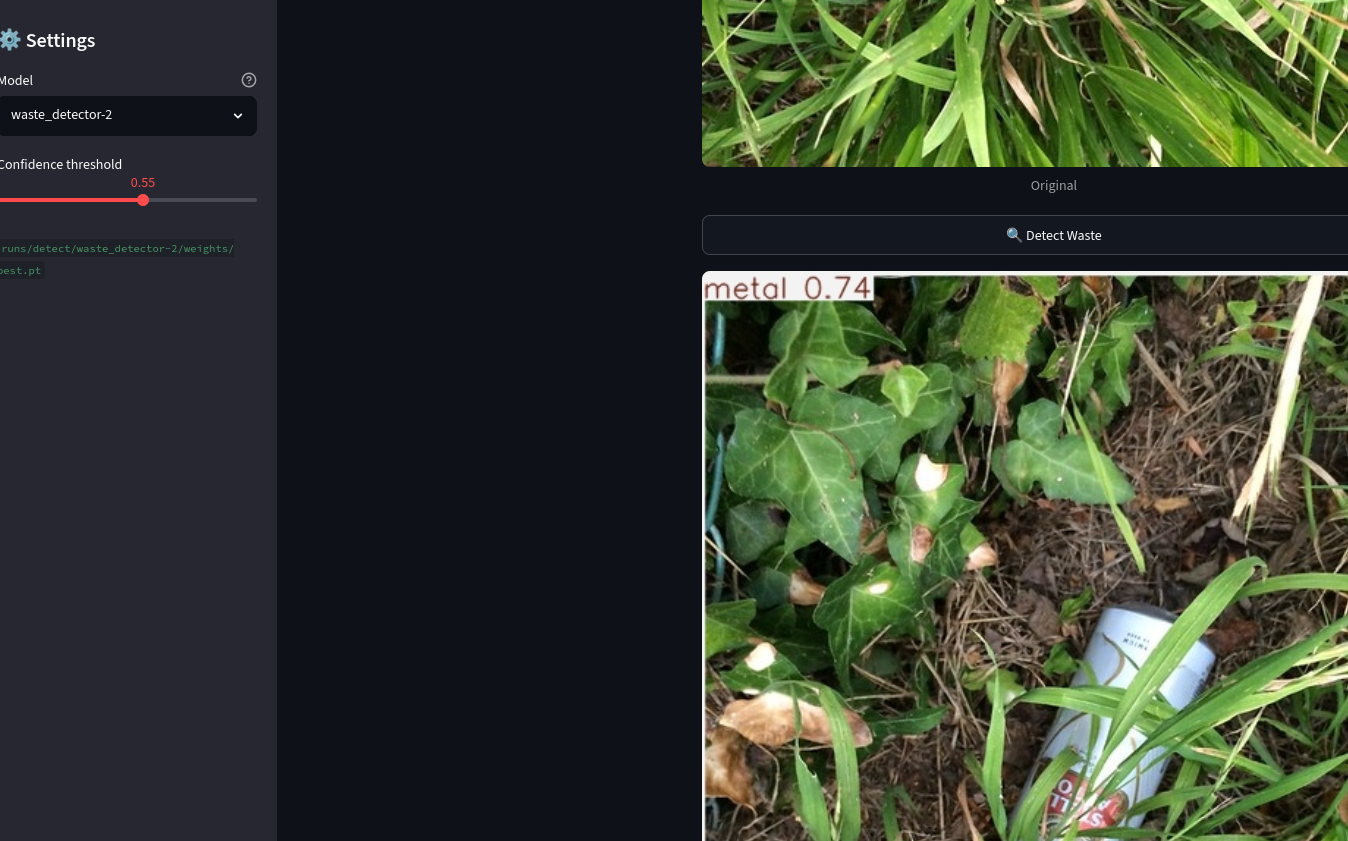
after uploading a image of waste , model will label it
Inspiration
Recycling-bin confusion sends tonnes of recyclables to landfill every year. We wanted to make correct sorting as simple as pointing a camera.
What it does
WasteSight identifies waste type (plastic, glass, metal, paper, cardboard, trash) from a photo or live video. It draws labelled bounding boxes and confidence scores in a browser‑based app.
How we built it
We merged TrashNet and the TACO dataset using a custom COCO‑to‑YOLO converter, then fine‑tuned YOLOv8n for 30 epochs. The Streamlit frontend runs inference with auto‑discovered weights for one‑click detection.
Challenges we ran into
Converting TACO’s COCO JSON annotations to YOLO’s per‑file format, remapping 60 fine‑grained classes to 6 supercategories, and downloading ~1500 Flickr images with retries were the hardest parts.
Accomplishments that we're proud of
A 6.2 MB model achieves 99.4% mAP across all categories, with every class above 99% precision/recall. The entire pipeline—dataset to web app—runs with just three commands.
What we learned
Data pipeline quality determines model accuracy more than architecture tuning. YOLOv8n’s transfer learning is remarkably fast, and weak‑label approximations (whole‑image boxes) still yield state‑of‑the‑art results.
What's next for WasteSight
Public Streamlit Cloud deployment, a FastAPI endpoint for integrations, TFLite export for on‑device apps, and Raspberry Pi‑powered smart bins with city‑specific disposal rules.

Log in or sign up for Devpost to join the conversation.