"𝐁𝐮𝐢𝐥𝐭 𝐞𝐧𝐭𝐢𝐫𝐞𝐥𝐲 𝐝𝐮𝐫𝐢𝐧𝐠 𝐭𝐡𝐞 𝐡𝐚𝐜𝐤𝐚𝐭𝐡𝐨𝐧 𝐰𝐢𝐧𝐝𝐨𝐰 — 𝐧𝐨 𝐩𝐫𝐞-𝐞𝐱𝐢𝐬𝐭𝐢𝐧𝐠 𝐜𝐨𝐝𝐞, 𝐜𝐨𝐫𝐩𝐮𝐬, 𝐨𝐫 𝐝𝐞𝐬𝐢𝐠𝐧."
Inspiration
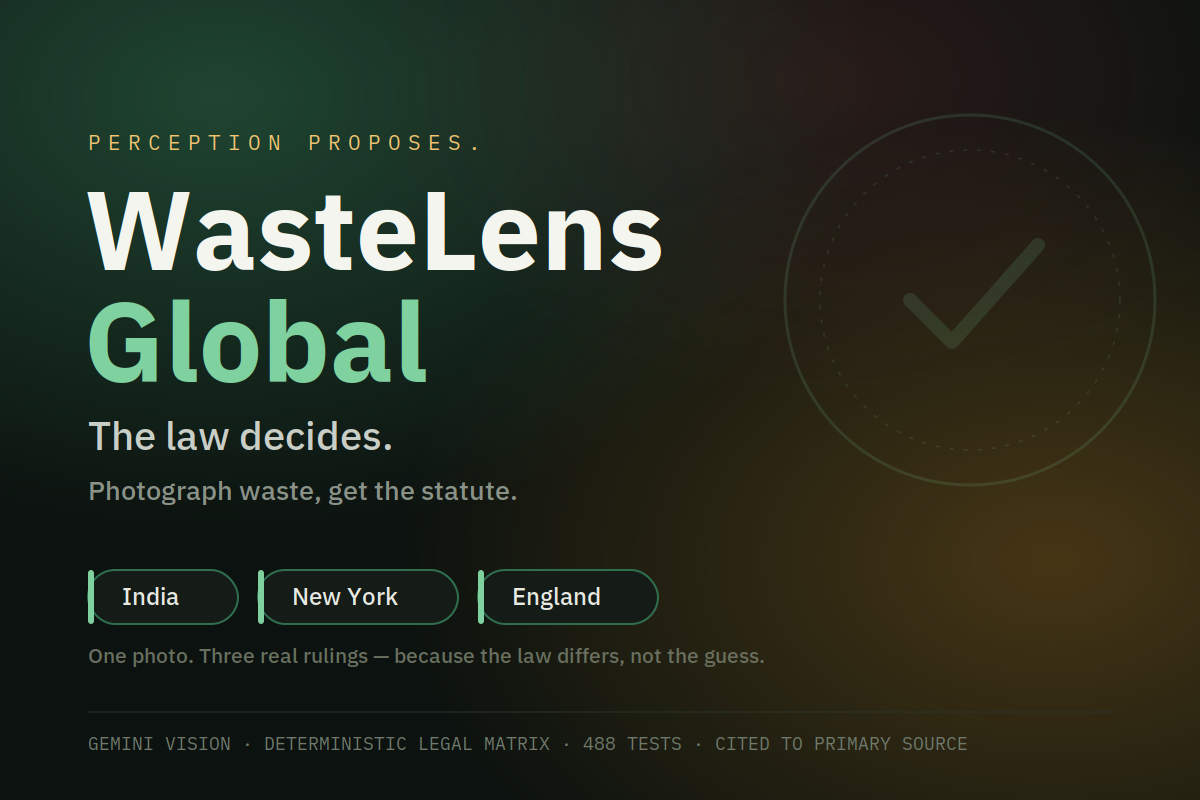
Days before this hackathon opened, Greater Chennai Corporation made four-way waste segregation legally mandatory across all 200 wards, enforcing India's brand-new Solid Waste Management Rules, 2026. That's not a hypothetical — it's a real, current law most residents don't know exists, and it isn't the only one: New York and England have their own separate, currently-changing rules for the exact same everyday objects. We asked: what does a single object legally require, right now, depending on where you are?
What it does
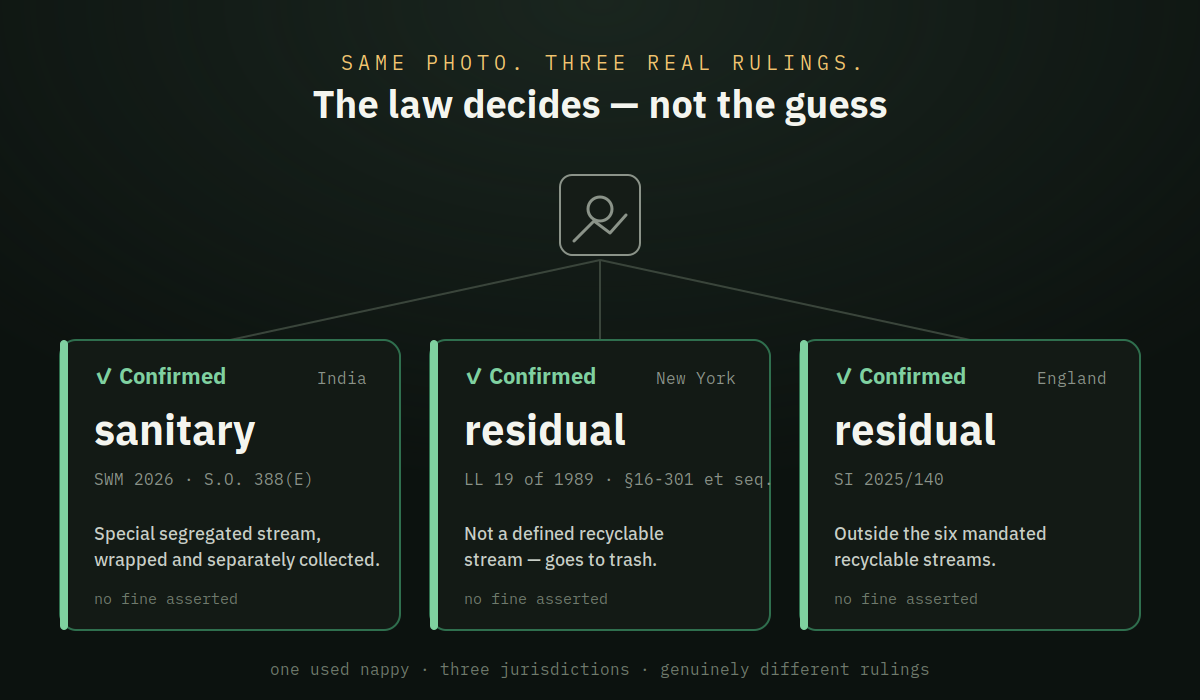
Photograph an item — or use the live camera scanner — and WasteLens Global tells you exactly which bin it belongs in, under India's SWM Rules 2026, New York City's Local Law 19/85, or England's Simpler Recycling regulations (SI 2025/140). Switch jurisdiction on the same photo and watch the verdict change, because the law changed, not our guess. When there's no verified rule for an item, the app says so explicitly instead of inventing an answer.
How we built it
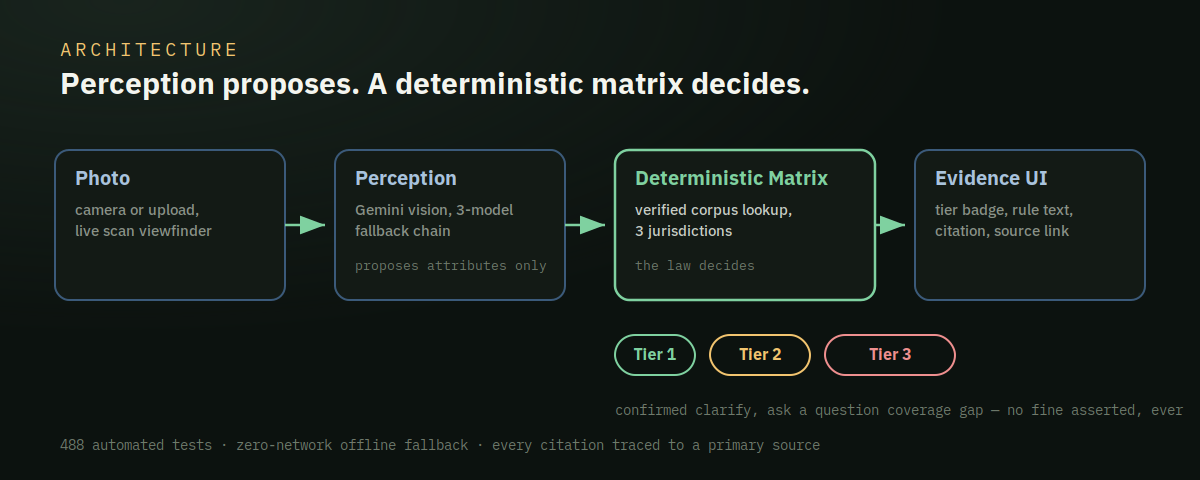
Perception (Gemini, with an automatic multi-model fallback chain for reliability) only proposes attributes. A deterministic rules matrix — not a language model — makes the actual legal call, looked up against a hand-verified corpus of ~28 rows across three jurisdictions, each cited to its real government source. This split matters: a chat model gives you its best guess from training data, which can be years stale (we caught ourselves nearly citing a superseded 2016 Indian rule instead of the real 2026 one). Our matrix gives the same, citable answer every time, and refuses cleanly when it isn't sure. A live camera mode (getUserMedia + TensorFlow.js/coco-ssd, fully client-side) adds real-time object detection as a viewfinder aid — the actual legal verdict still always goes through the same verified pipeline.
Challenges we ran into
Almost every "obviously current" legal citation we started with turned out to be stale within a day of checking it against the primary source — a superseded Indian rule, a New York penalty figure that turned out to be struck/deleted text from an amendment, an England household compliance date we'd assumed applied a year earlier than it actually does. Verifying against government primary sources directly, not memory or a single secondary source, was most of the real engineering work.
Accomplishments we're proud of
A deterministic legal engine with 488 automated tests, a three-model perception fallback chain with real measured before/after latency, an honest offline mode that never fabricates a verdict, and a corpus where every fine field defaults to null unless a specific verified figure survived source-checking.
What we learned
How fast "current" law actually moves, why deterministic lookups beat generative guessing for anything with legal weight, and that verifying a citation against its primary source is a completely different skill than writing code that looks plausible.
What's next
Real end-to-end accuracy numbers against live perception, more jurisdictions, and a community-reported map of problem disposal spots.
Built With
- coco-ssd
- gemini-api
- getusermedia
- nextjs
- react
- tailwindcss
- tensorflow-js
- typescript
- vercel

Log in or sign up for Devpost to join the conversation.