Inspiration
The inspiration for WasteLens came from a simple, universal moment of confusion: standing over the recycling and compost bins and having to guess. This small doubt, when repeated by millions, leads to massive contamination in our waste streams. I wanted to build a tool that could eliminate that guesswork and make the right environmental choice the easiest one.
What it does
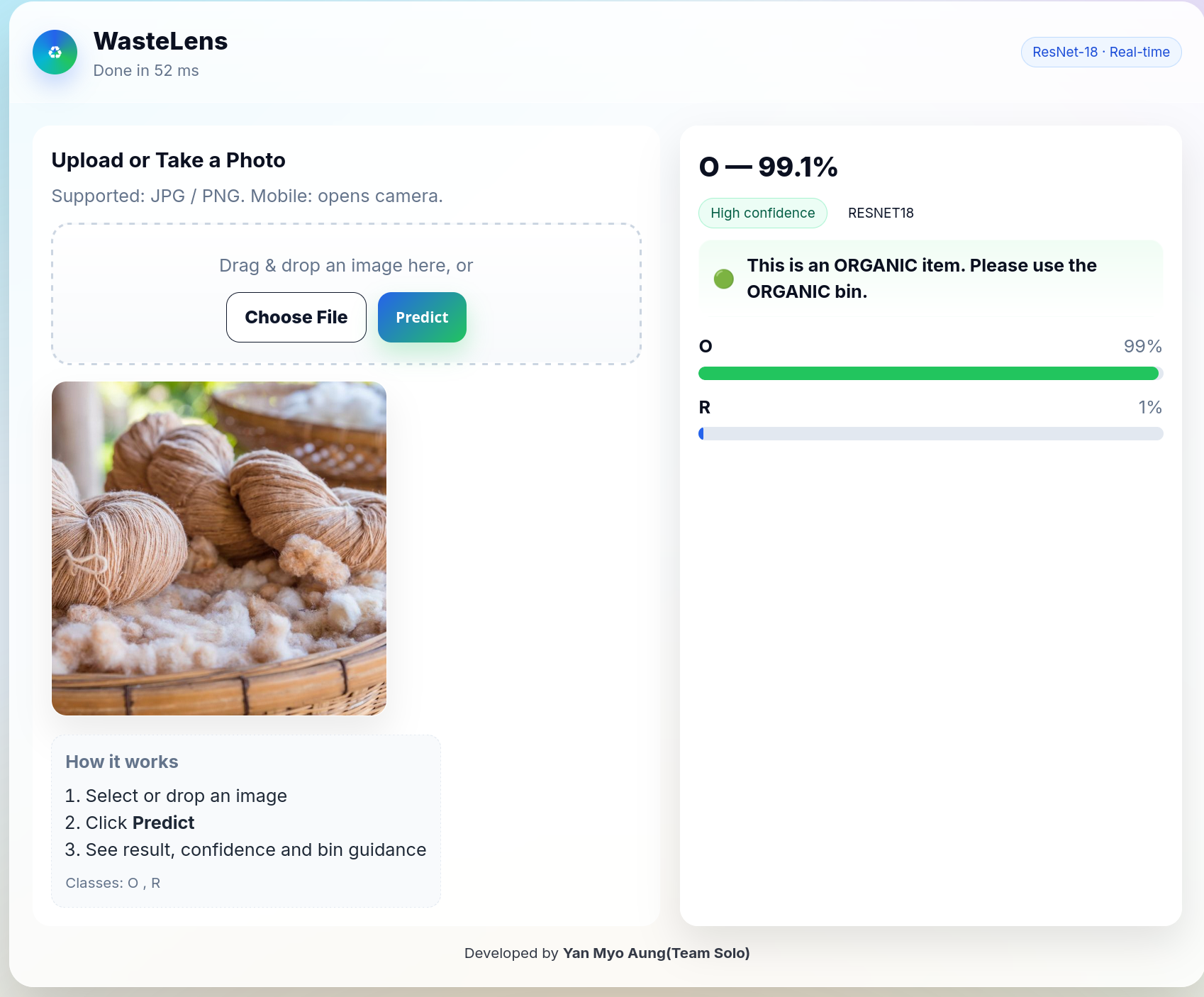
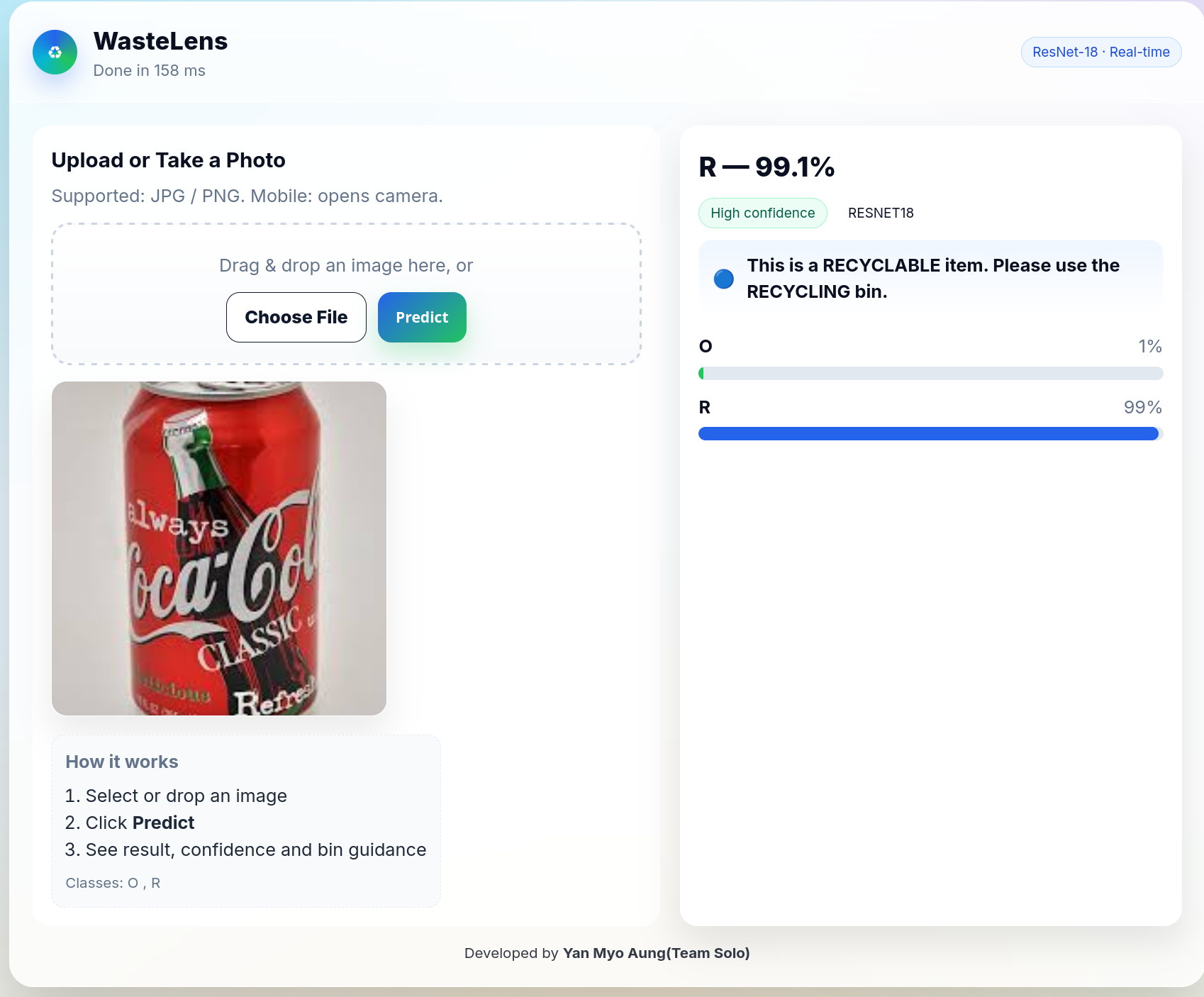
WasteLens is a simple web app that acts as an intelligent eye for your waste. You upload or take a photo of an item, and the app uses a machine learning model to instantly classify it as either Organic or Recyclable. It provides a clear, immediate answer to help you sort correctly every time.
How we built it
I built this project as a full-stack AI application. The core is a ResNet-18 computer vision model, fine-tuned on a custom dataset of waste images using PyTorch. This model is served via a lightweight FastAPI back-end in Python. The front-end is a clean HTML and JavaScript interface that communicates with the back-end to provide an interactive user experience.
Challenges we ran into
The biggest challenge was performance optimization. The initial AI model was too slow for a real-time web application, so I had to research and implement techniques to increase inference speed without significantly hurting accuracy. Another hurdle was ensuring smooth integration between the back-end and the front-end, especially making predictions display quickly and reliably.
Accomplishments that we're proud of
This project was a crash course in the entire machine learning project lifecycle. I learned not just about training a model, but also about the practical challenges of deployment and optimization. I gained valuable experience running a PyTorch model in production, exposing it through a simple web service, and building a responsive front-end to interact with it. It solidified my understanding of how to take a project from concept to a working product.
What we learned
This project showed me the full journey of taking an ML model from research to application. I learned about data preprocessing, training, and evaluation, but also how to connect the model to a web interface so that anyone can use it easily. Building both the back-end inference service and the front-end helped me understand the “last mile” of machine learning projects, turning a trained model into a usable tool.
What’s next for WasteLens
The next step is to combine WasteLens with Federated Learning. Instead of relying on a single centralized dataset, multiple users and institutions could collaboratively train and improve the model without sharing raw images. This would both protect user privacy and allow the system to continuously adapt to new waste types and environments. Beyond FL, I plan to expand the classification categories (Glass, Metal, Hazardous Waste), refine the UI for accessibility, and explore deployment on edge devices so WasteLens can run offline in schools, public spaces, or developing regions.


Log in or sign up for Devpost to join the conversation.