-
-
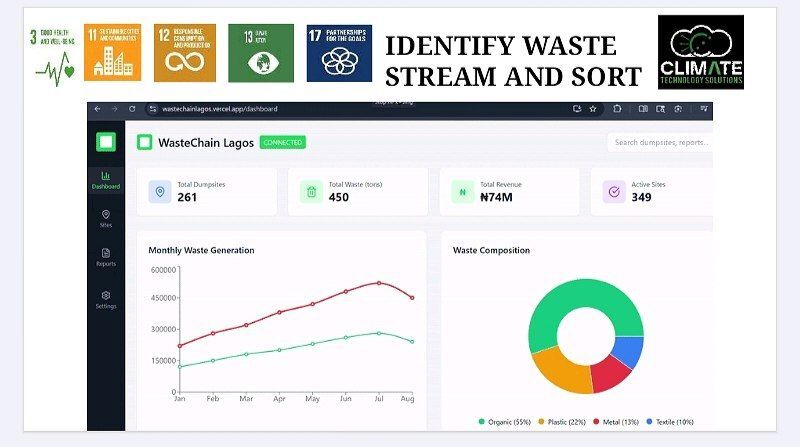
Wastechain
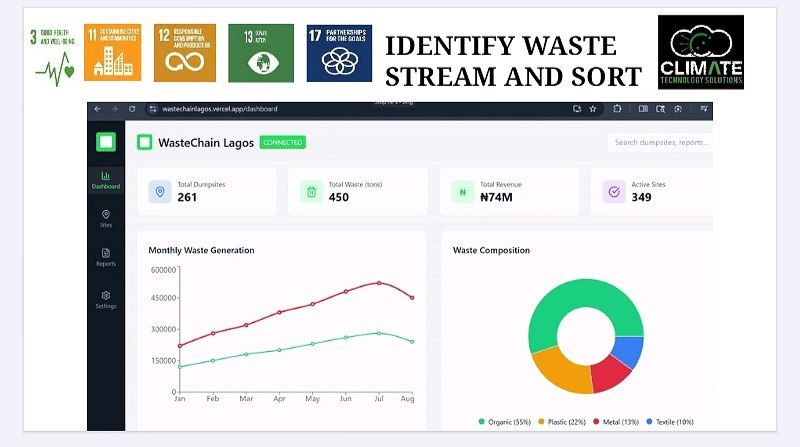
See Demo https://wastechainlagos.vercel.app/
Email: [email protected]
Password:123456
Inspiration
Across Sub-Saharan Africa, rapid urbanisation, growing waste volumes, inadequate collection infrastructure, and limited waste-tracking systems create significant environmental and public health challenges. Poorly managed waste can contaminate waterways, degrade urban environments, and contribute to greenhouse gas emissions.
At the same time, fragmented data and limited transparency make it difficult for communities, waste collectors, recycling businesses, and public institutions to coordinate waste-management activities and measure their environmental impact.
WasteChain was conceived to explore how artificial intelligence (AI), geospatial intelligence, and blockchain technology can work together to address these challenges.
Lagos, Nigeria, serves as our initial case study. As a major African megacity experiencing considerable pressure on its waste-management infrastructure, Lagos provides a relevant setting for exploring how digital technologies can support waste-hotspot identification, collection planning, waste traceability, and climate-impact monitoring.
Our vision extends beyond a single city: to develop an adaptable, technology-enabled approach to waste management that can support climate action across Sub-Saharan Africa.
What it does
WasteChain is an AI-powered, geospatial waste-management platform designed to improve waste visibility, traceability, and environmental accountability.
Using Lagos as its initial case study, the project explores how digital technologies can help stakeholders identify potential waste hotspots, improve collection planning, document waste diversion, and establish a stronger connection between waste-management activities and climate outcomes.
The platform focuses on five key areas: Geospatial waste mapping: Uses spatial data and satellite imagery to support the identification and mapping of potential waste hotspots.
Intelligent analysis: Explores AI-assisted geospatial techniques to analyse environmental data and support more informed waste-management decisions.
Collection planning: Uses location intelligence and urban road-network information to help stakeholders assess accessibility and prioritise interventions.
Blockchain-enabled traceability: Explores blockchain-based records for documenting waste collection, recycling, and diversion activities. Climate-impact monitoring: Establishes a pathway towards transparent environmental reporting by connecting documented waste-diversion activities with appropriate emissions-accounting methodologies.
By bringing these capabilities together, WasteChain aims to help communities, waste collectors, recycling businesses, and public institutions make better-informed decisions and strengthen accountability throughout the waste-management process.
How we built it
WasteChain brings together geospatial data analysis, AI-assisted image analysis, open-source mapping, and blockchain technology concepts.
Our geospatial workflow draws on Sentinel-2 satellite imagery and OpenStreetMap data to explore environmental patterns and the spatial distribution of potential waste hotspots.
We use or explore tools including: Python: For data processing and analytical workflows. Sentinel-2: For satellite imagery and environmental observation. SAMGeo: For AI-assisted geospatial image segmentation. OSMnx: For analysing urban street networks and spatial accessibility.
OpenStreetMap: For open geographic data and mapping. Ethereum and Green Tokens: For exploring blockchain-based environmental records and waste-diversion traceability.
Challenges we ran into
One of our primary challenges was addressing the complexity of urban waste management through fragmented datasets. Satellite imagery and open geographic information provide valuable insights, but they do not automatically confirm the presence of waste at a particular location. Reliable ground-truth data and field validation are important for improving the accuracy of waste-hotspot identification.
A second challenge was connecting digital records to real-world activities. Blockchain can preserve transaction records, but it cannot independently establish whether the information entered into the system is accurate. A credible implementation requires verification procedures, reliable data sources, and safeguards against duplicate or misleading records.
We also recognised the difficulty of translating waste-diversion activities into defensible climate-impact estimates. Emissions benefits depend on factors such as waste composition, baseline disposal practices, transportation, and treatment methods. Developing a credible climate-accounting approach therefore requires transparent assumptions and appropriate measurement methodologies.
Finally, designing for Sub-Saharan Africa requires consideration of different infrastructure conditions, informal waste economies, data gaps, affordability, and stakeholder trust. These realities reinforced the importance of building a solution that can adapt to local needs rather than assuming that one implementation will work identically everywhere.
Accomplishments that we're proud of
We are proud to have developed the WasteChain concept into a technology-driven project that brings together geospatial intelligence, AI-assisted analysis, and blockchain-enabled traceability to address an important climate and urban-development challenge.
Our key accomplishments include: A working project demonstration: Making the WasteChain concept accessible through an online demonstration.
An open-source development foundation: Establishing a GitHub repository to document and support further development.
A geospatial technology approach: Bringing together satellite imagery, geographic data, image segmentation, and urban network analysis within the project's technical direction.
A climate-accountability framework: Exploring how blockchain-based records could support more transparent documentation of waste collection and diversion activities.
A scalable regional vision: Framing Lagos as an initial case study for a solution intended to address waste-management challenges across Sub-Saharan Africa.
We are particularly proud of approaching waste management as both an urban infrastructure challenge and a climate-accountability opportunity. WasteChain explores how digital technologies can help connect the identification of environmental problems with better-coordinated interventions and more transparent reporting.
What we learned
Developing WasteChain has reinforced that effective climate technology depends on more than combining emerging technologies. It requires understanding the problem, the quality of available data, the needs of users, and the mechanisms through which digital information can translate into real-world action.
We learned that geospatial intelligence can help identify where interventions may be needed, but reliable validation is essential. We also learned that blockchain can support transparent records, but trustworthy climate claims depend on credible underlying data and sound measurement methodologies.
Another important lesson is that waste management is not solely a technical problem. It involves public infrastructure, livelihoods, informal collection networks, institutional coordination, and community participation.
These lessons shape our approach to WasteChain: develop technology around practical urban needs, distinguish verified results from estimates, and design for local realities while maintaining the potential for regional adaptation.
What's next for Wastechain
Our next priority is to strengthen the platform's technical capabilities and assess how it could operate within real-world waste-management systems.
We plan to focus on five areas: Improve waste-hotspot identification: Strengthen geospatial analysis through better-quality datasets, field observations, and validation methods.
Develop traceability workflows: Advance the blockchain proof of concept towards a practical system for recording and verifying waste collection, recycling, and diversion activities. Strengthen climate-impact measurement: Develop a transparent methodology for estimating emissions reductions associated with documented waste-diversion activities.
Engage implementation partners: Explore collaboration with waste collectors, recycling businesses, community organisations, researchers, and relevant public institutions in Lagos.
Prepare for regional adaptation: Investigate how WasteChain could be adapted to other Sub-Saharan African cities according to their local waste streams, infrastructure, regulations, and data availability. Our long-term ambition is to make WasteChain a practical digital infrastructure for more transparent, accountable, and climate-responsive waste management across Sub-Saharan Africa.
Starting with Lagos, Nigeria, we want to demonstrate how AI, geospatial intelligence, and blockchain can help turn waste data into coordinated action and coordinated action into measurable climate progress.
Built With
- ai
- blockchain
- gis
- java
- machine-learning
- osmnx
- python
- samgeo
- sentinel

Log in or sign up for Devpost to join the conversation.