-
-
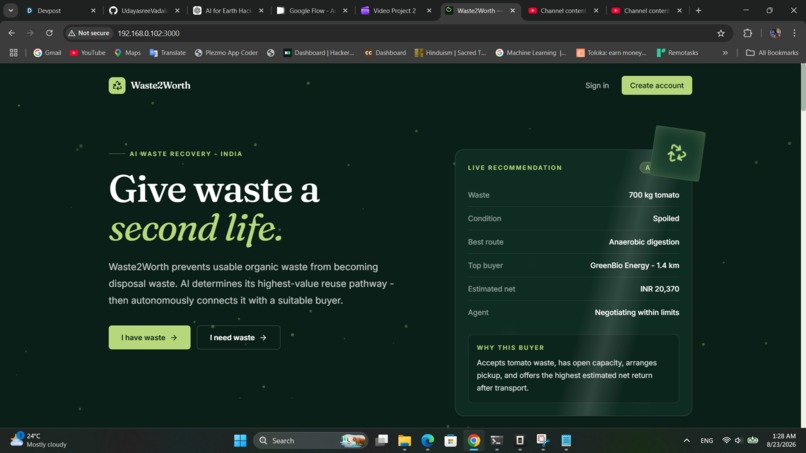
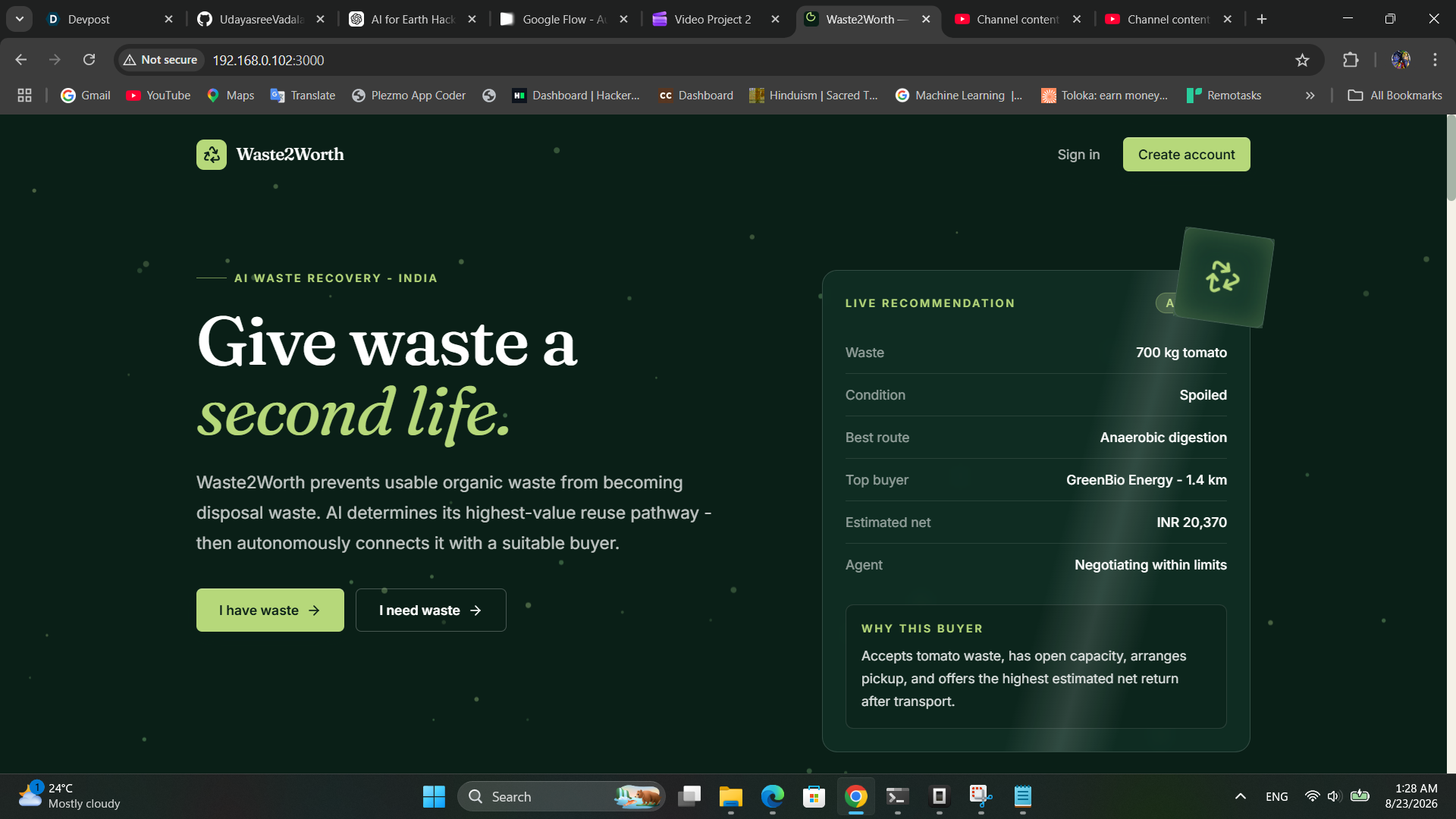
Home page
-
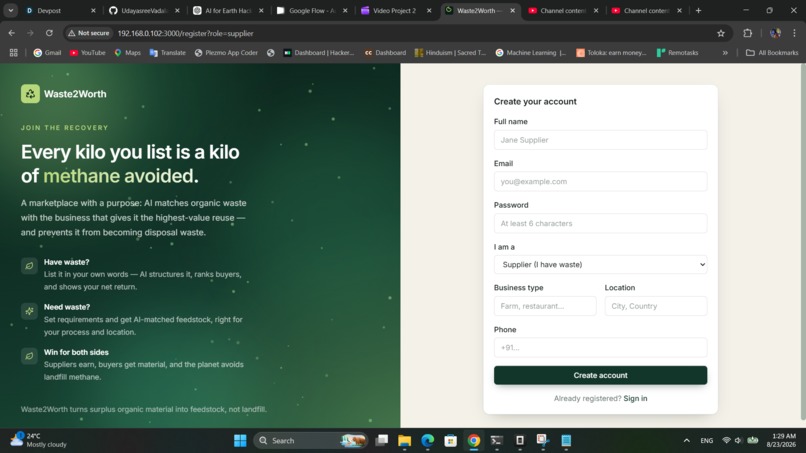
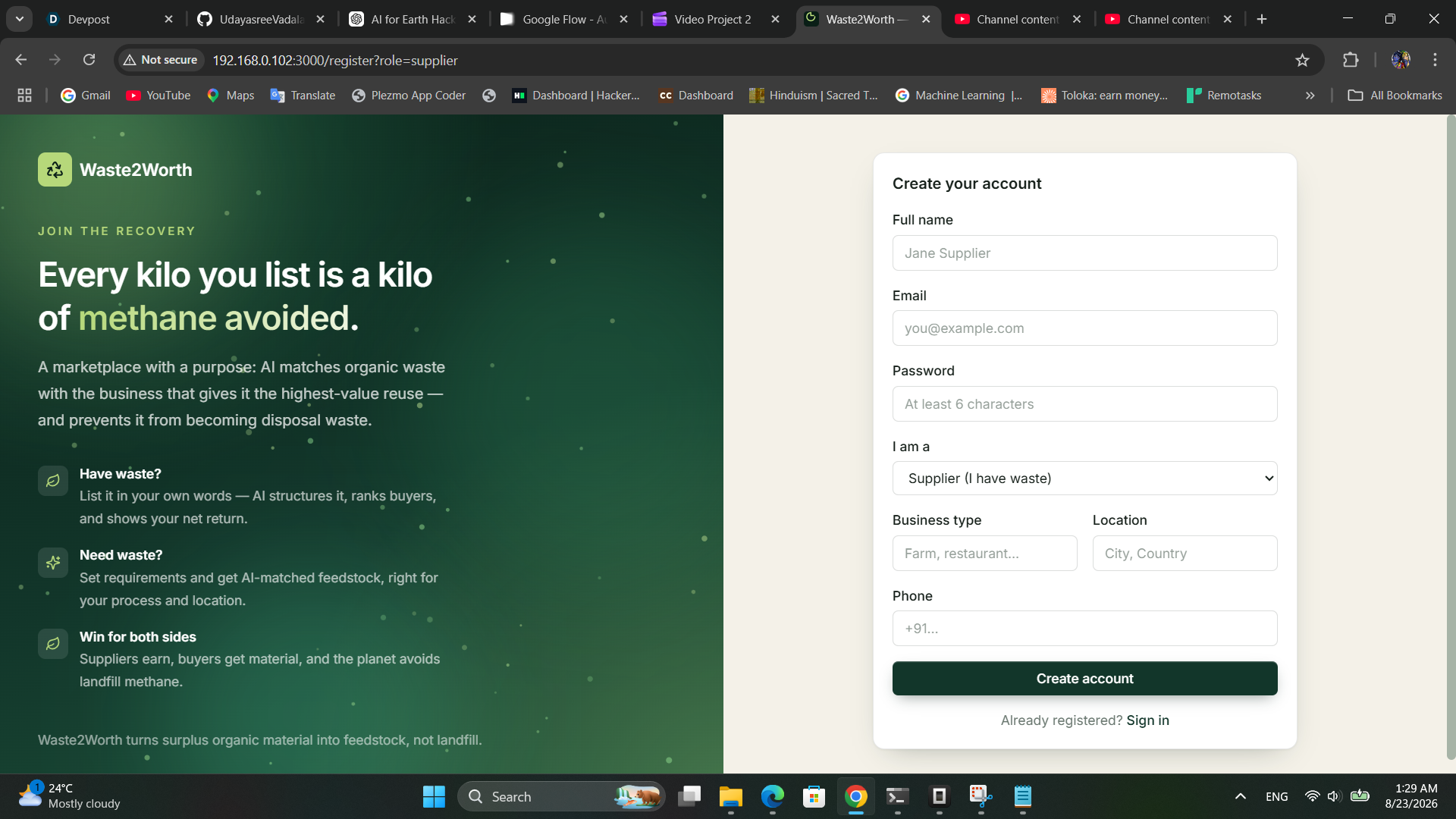
Register/Login
-
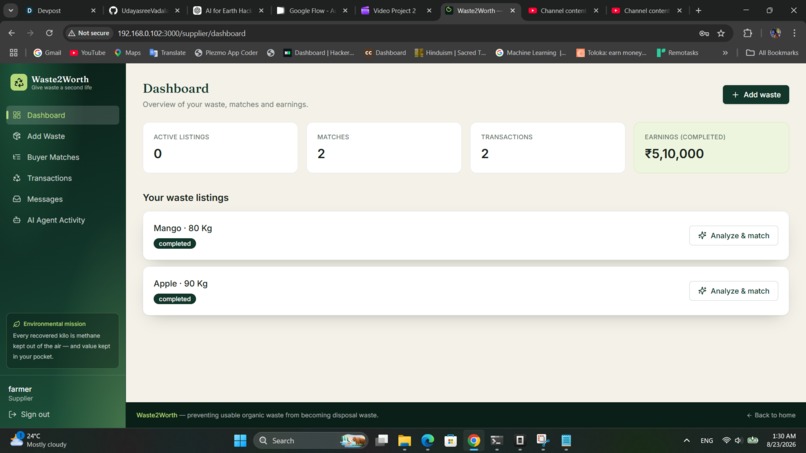
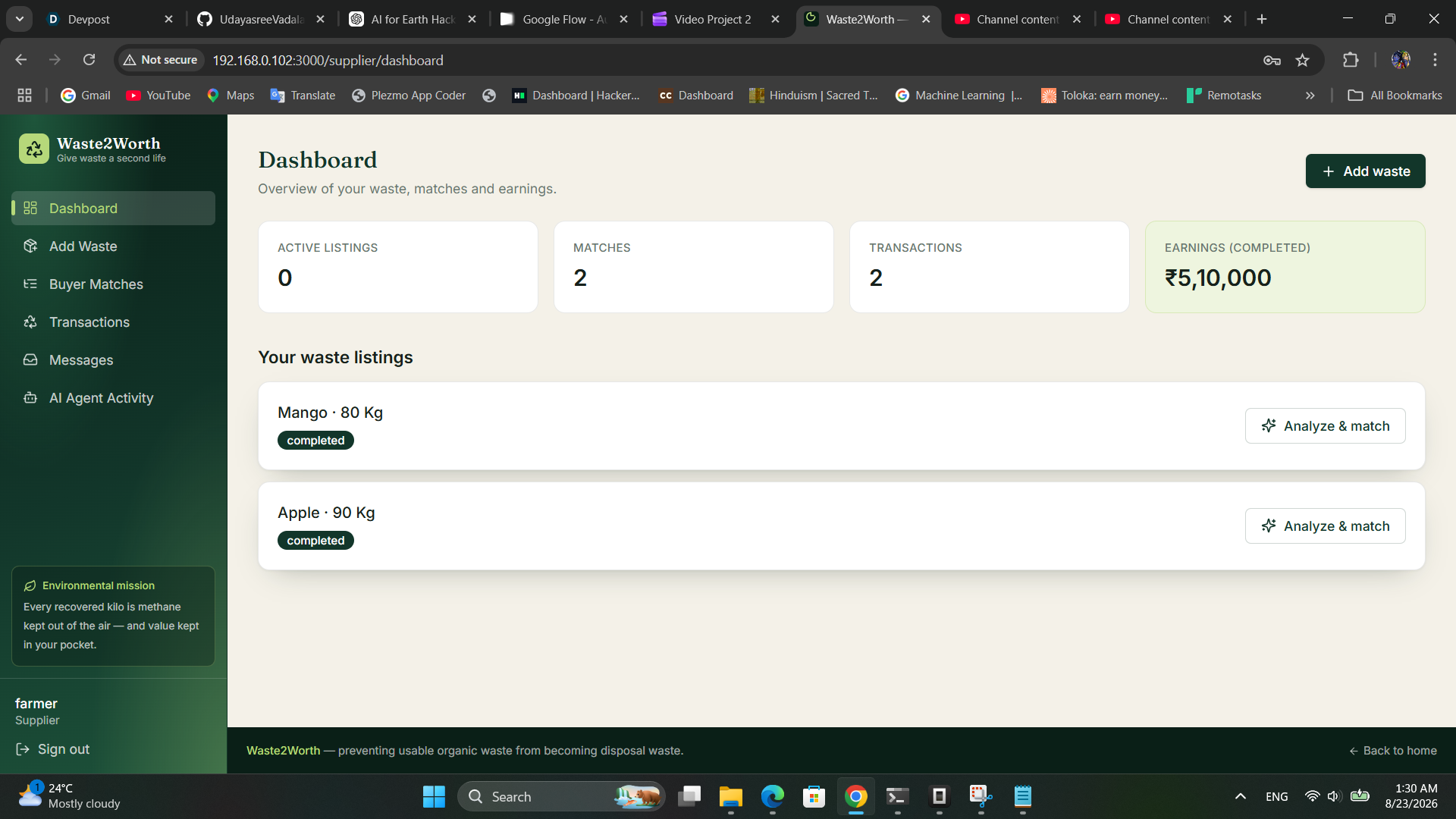
Seller Dashboard
-
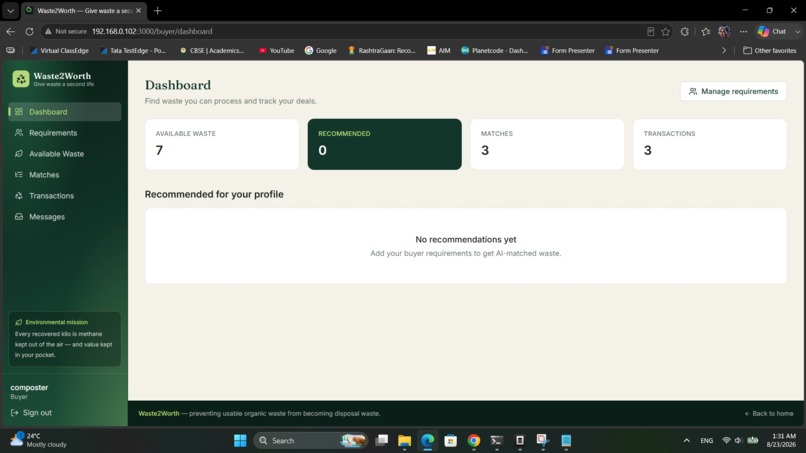
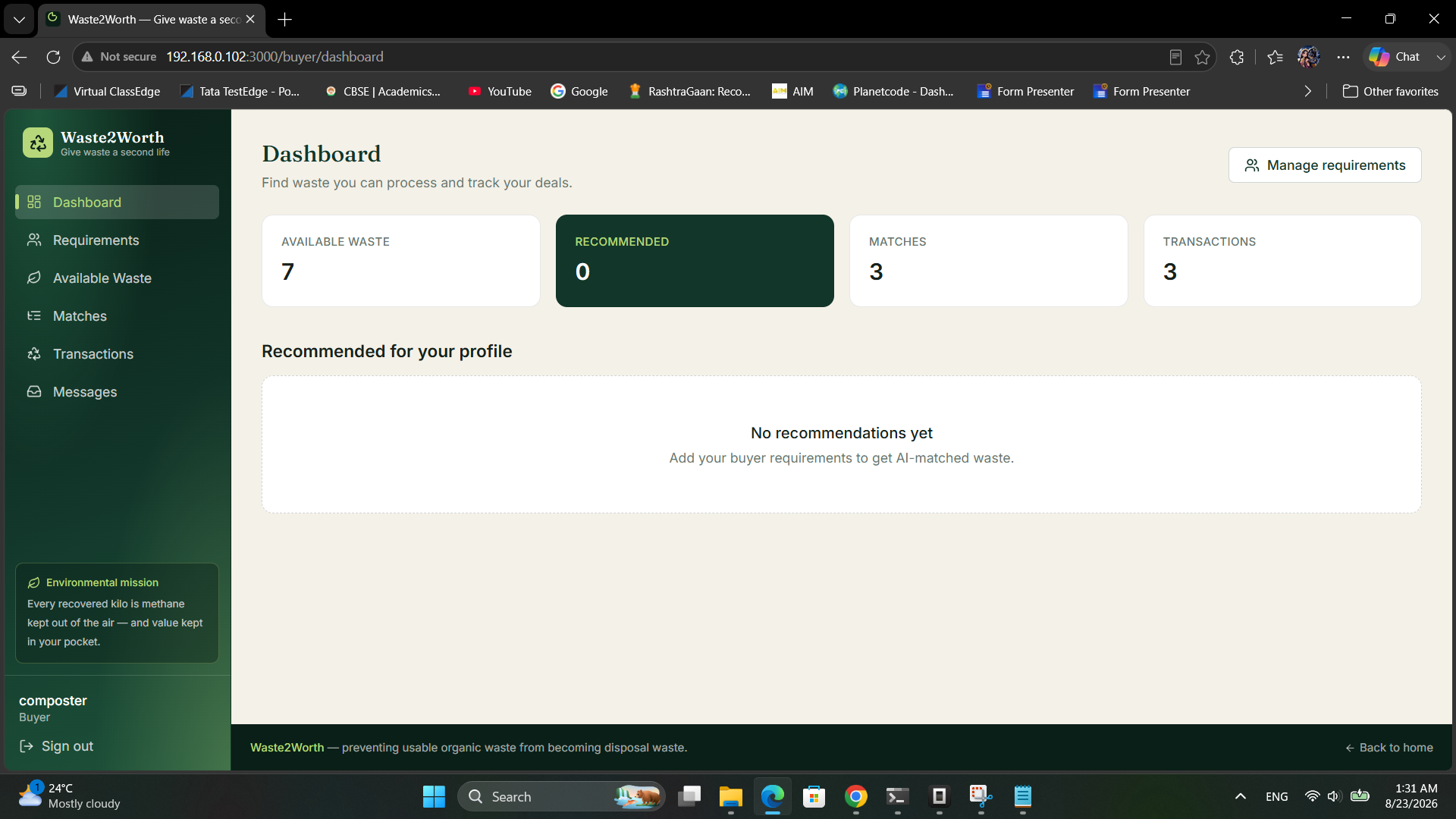
Buyer Dashboard
Inspiration
We started with a simple observation: a lot of what we call “waste” still has value.
Imagine a farmer who grows vegetables to sell. Some produce becomes overripe, damaged, or simply doesn't meet market standards. It may have no value to the farmer anymore, so it gets thrown away.
But what if someone else could use it?
The farmer loses potential income, while the same material can end up contributing to a much larger waste and environmental problem.
And this isn't limited to farmers. Restaurants, markets, food businesses, and other organizations face the same problem: they have materials they don't need, while somewhere else, someone may actually need those materials.
That led us to our central question:
What if waste wasn't actually waste?
We wanted to build something that didn't just help people dispose of waste, but helped them discover what it could become and who could use it.
What it does
Waste2Worth is an AI-powered circular waste platform that connects people who have usable waste with people who can give it a second life.
A supplier can list their waste, and Waste2Worth uses AI to analyze its characteristics and identify potential reuse or processing pathways.
It then finds and ranks potential buyers by considering factors such as:
- Waste requirements
- Buyer capacity
- Location and distance
- Pickup availability
- Pricing
- Overall suitability
But Waste2Worth goes beyond simply matching buyers and sellers.
Once a supplier approves a match, an AI agent can communicate with the buyer, evaluate offers against the supplier's constraints, and negotiate on their behalf.
The complete workflow is:
Waste → AI Analysis → Reuse Opportunities → Buyer Matching → Human Approval → AI Negotiation → Productive Reuse
The goal is simple: move waste away from disposal and toward its next useful purpose.
How we built it
We built Waste2Worth as a combination of an AI-powered waste intelligence system, a buyer-matching platform, and an agentic transaction workflow.
AI is used for the parts of the system where reasoning and decision-making provide real value:
- Understanding and structuring waste information
- Identifying potential reuse pathways
- Discovering suitable buyers
- Ranking potential matches
- Evaluating offers
- Supporting negotiation
We designed the agent with a human-in-the-loop approach. The supplier remains in control and must approve a buyer before the agent can act on their behalf.
We also implemented the transaction flow as a structured state-based process rather than treating the agent as a simple conversational chatbot. This allows actions such as approvals, offers, counteroffers, and deal completion to be tracked and validated.
Challenges we ran into
One of our biggest challenges was making sure that AI was actually necessary.
It would have been easy to build a normal waste marketplace and add a chatbot on top. We wanted something more meaningful.
We therefore asked:
“What becomes significantly harder if we remove the AI?”
That pushed us toward using AI for waste analysis, reuse discovery, matching, ranking, and negotiation instead of using it purely for conversation.
Another challenge was designing the autonomous negotiation workflow.
An AI agent negotiating on behalf of a supplier cannot simply make arbitrary decisions. We had to think about supplier constraints, approval mechanisms, valid offers, counteroffers, and transaction states.
Balancing automation with human control became an important part of the architecture.
Accomplishments that we're proud of
We're proud that Waste2Worth goes beyond being a concept or a simple marketplace.
We built an end-to-end working workflow where AI is involved from the moment waste is listed through the point where a potential transaction can be completed.
We're particularly proud of the AI agent component.
Instead of stopping at:
“Here is a buyer who might be interested.”
Waste2Worth can continue the workflow:
Find → Match → Approve → Communicate → Evaluate → Negotiate → Complete
We're also proud that the system was built around validation and safeguards rather than allowing an agent to act without constraints.
Most importantly, we were able to connect the economic value of waste with its environmental value in one system.
What we learned
Building Waste2Worth taught us that solving an environmental problem isn't only about identifying the problem or building a prediction model.
The harder part is turning intelligence into action.
AI can identify what waste might be useful for.
AI can find someone who needs it.
But the real potential appears when those capabilities are connected into a workflow that can actually move the material toward reuse.
We also learned that autonomous agents work best when they have clear objectives, constraints, and human oversight.
Most importantly, we learned to think about waste differently.
Instead of asking:
“How do we dispose of this?”
we started asking:
“Who could use this?”
What's next for Waste2Worth
Waste2Worth is currently a working MVP, but we see several directions for taking it further.
Environmental impact tracking
We want to quantify the environmental impact of recovered waste, including waste diverted from disposal and estimated emissions or resource savings using transparent methodologies.
Expanding beyond organic waste
The same model could be extended to other waste streams such as agricultural residues, packaging materials, industrial by-products, and other recoverable materials.
More capable environmental agents
We want agents to handle more of the operational workflow while maintaining appropriate human approval and safety constraints.
Smarter local matching
Future versions could incorporate real-time logistics, transportation costs, collection routes, and geographic constraints to make recovery economically and environmentally efficient.
Building a circular network
Our long-term vision is a network where farmers, businesses, markets, processors, and recyclers can continuously exchange resources that would otherwise become waste.
We don't want to make waste disposal more efficient.
We want to make disposal less necessary.
Built With
- agents
- ai
- ai/ml
- api
- css
- fastapi
- generative
- javascript
- llm
- python
- react
- rest
- typescript


Log in or sign up for Devpost to join the conversation.