Inspiration
Every day, millions of meals are thrown away by restaurants, hotels, and bakeries, while nearby communities struggle with hunger. The problem is not only the lack of food — it is the lack of coordination and intelligent systems to redistribute surplus food before it spoils.
We were inspired to build Waste2Meal AI to bridge this gap. Our goal is to use artificial intelligence to predict surplus food, connect food donors with nearby shelters, and ensure that good food reaches people instead of landfills.
What it does
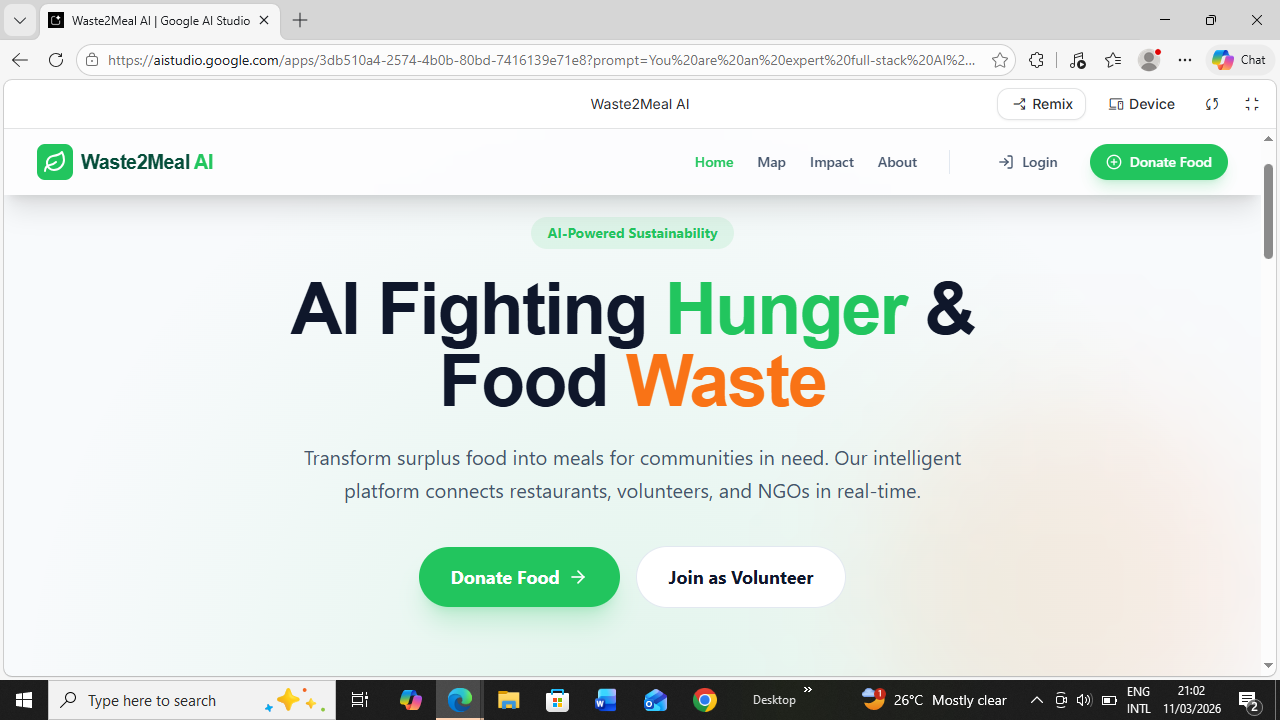
Waste2Meal AI is an intelligent platform that connects restaurants, NGOs, shelters, and volunteers to redistribute surplus food efficiently.
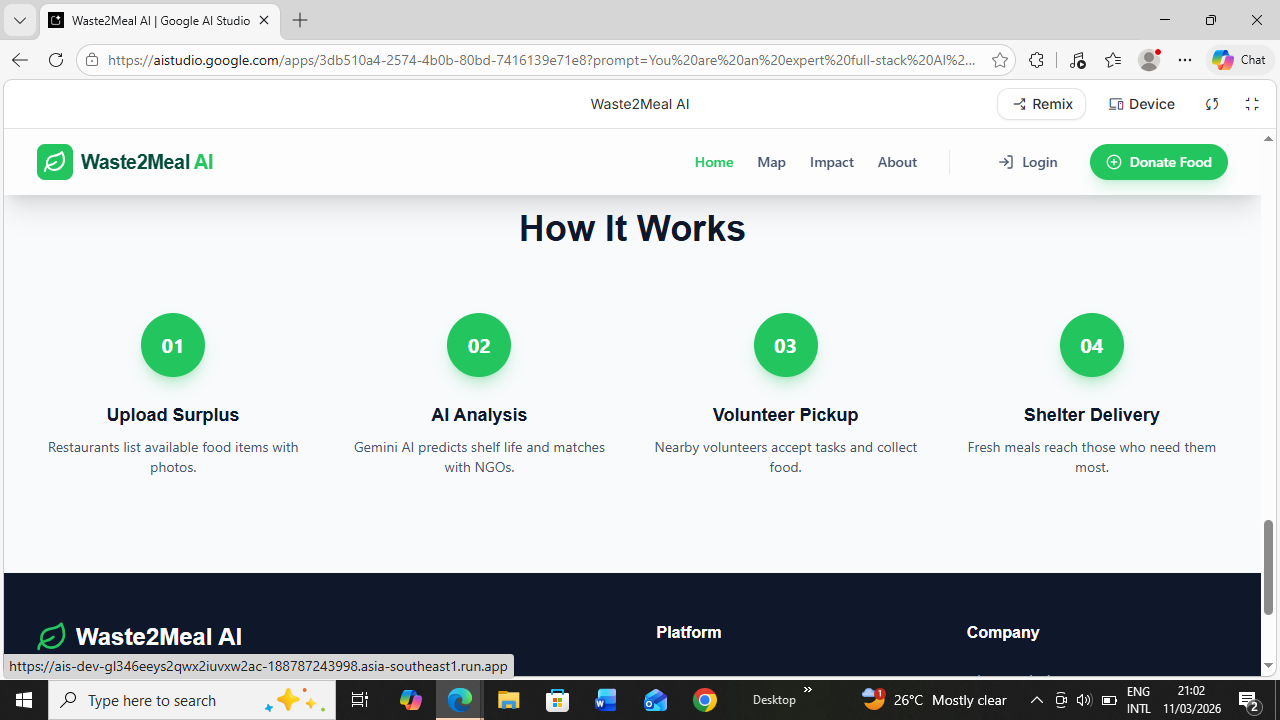
The platform allows restaurants to upload leftover food information, including type, quantity, and pickup time. The system then analyzes the food using AI and recommends safe distribution time and nearby organizations that need it.
Key features include:
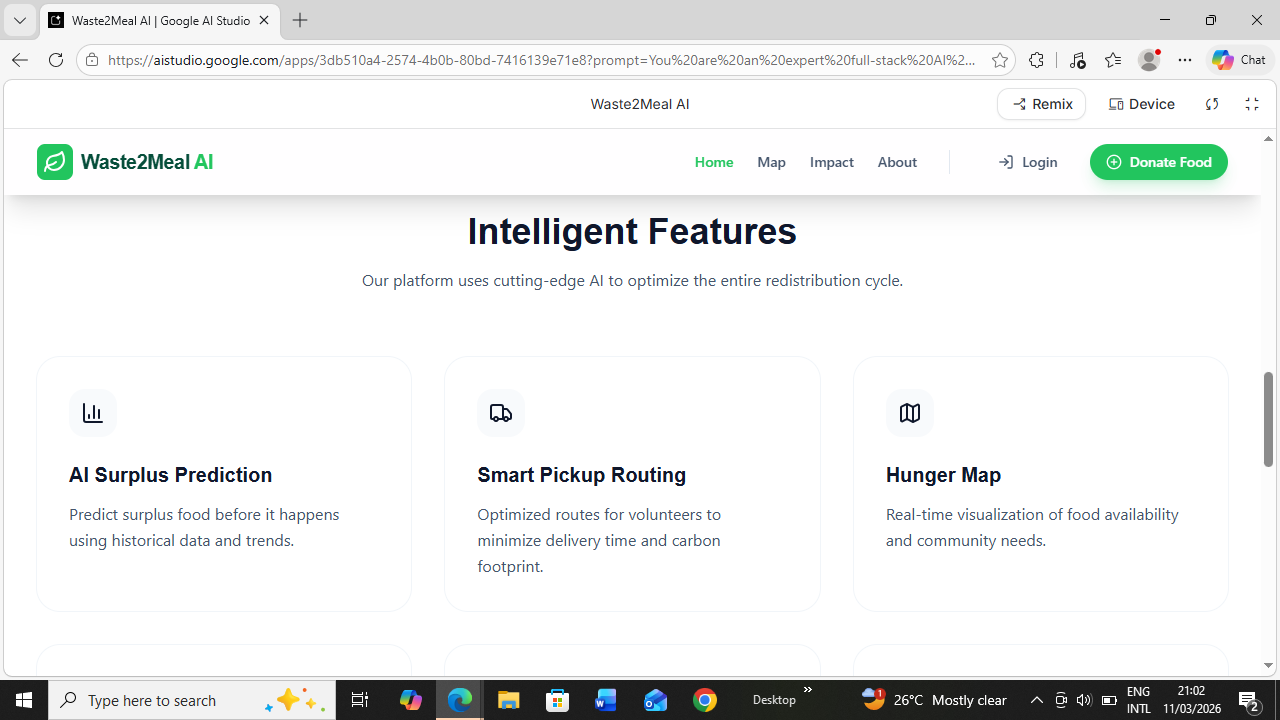
AI prediction of surplus food availability
Food safety and shelf-life analysis
Smart matching between donors and shelters
Volunteer pickup coordination
Real-time hunger map showing communities in need
Impact dashboard tracking meals saved and food waste reduced
The platform transforms surplus food into meals for people who need it most.
How we built it
We developed Waste2Meal AI as a multipage web application.
Frontend was built using HTML, CSS, and JavaScript to create a clean and responsive user interface.
The backend was built using Python with a lightweight web framework to handle food submissions, user roles, and system logic.
Artificial intelligence capabilities were integrated using Google Gemini, which analyzes food data to estimate shelf life, assess safety, and recommend distribution timing.
We also integrated location-based visualization using map APIs to display food donation locations and shelters that require meals.
The result is a simple but powerful prototype demonstrating how AI can coordinate food redistribution.
Challenges we ran into
One of the biggest challenges was designing a system that balances simplicity with real-world functionality. Food redistribution involves logistics, safety, and timing, which required careful planning.
Another challenge was structuring the AI prompts so that the system could realistically analyze food data and provide meaningful recommendations.
We also focused on creating an interface that could be easily used by restaurants, NGOs, and volunteers with different technical backgrounds.
Accomplishments that we're proud of
We are proud of building a platform that addresses two global problems at once: food waste and hunger.
Our prototype demonstrates how AI can be used not just for automation but for meaningful social impact. We successfully created a working concept that connects food donors, volunteers, and communities in need through a single platform.
Most importantly, Waste2Meal AI shows how technology can transform waste into opportunity and support more sustainable communities.
What we learned
Through this project, we learned how artificial intelligence can support humanitarian solutions and improve resource distribution.
We also gained valuable experience in designing AI-assisted systems that combine data analysis, logistics planning, and user interaction.
The project reinforced the importance of building technology that solves real problems and creates measurable impact.
What's next for Waste2Meal AI
Our next step is to expand Waste2Meal AI into a fully scalable platform.
Future improvements include:
Advanced AI models for predicting daily food surplus patterns
Automated route optimization for volunteers
Partnerships with restaurants and food banks
Mobile application for real-time pickup alerts
Integration with smart city sustainability programs
Our long-term vision is to deploy Waste2Meal AI globally and help cities reduce food waste while ensuring that surplus food reaches communities that need it most.


Log in or sign up for Devpost to join the conversation.