-
-
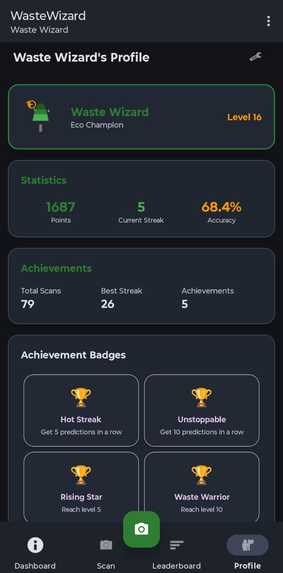
Personal Profile
-
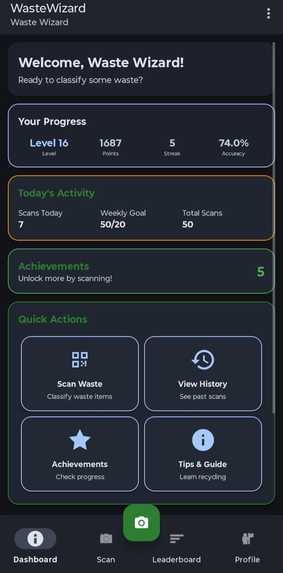
Main Dashboard
-
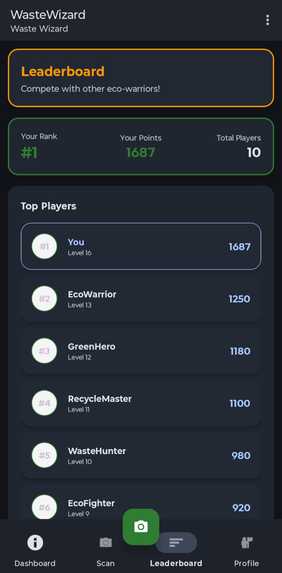
Leaderboard
-
-
-
-


Inspiration
The inspiration for WasteWizard came from the challenge many people face in correctly sorting waste. Improper recycling contaminates waste streams and harms the environment. We wanted to build an intelligent, user-friendly tool that uses AI to make waste management simple and accessible for everyone, promoting better recycling habits and providing clear educational tips.
What it does
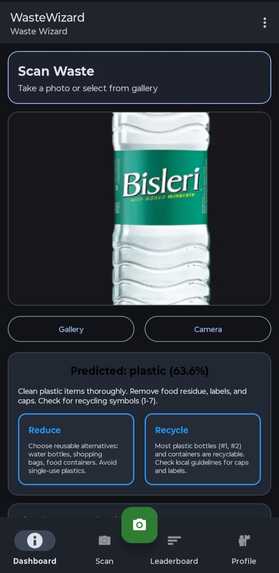
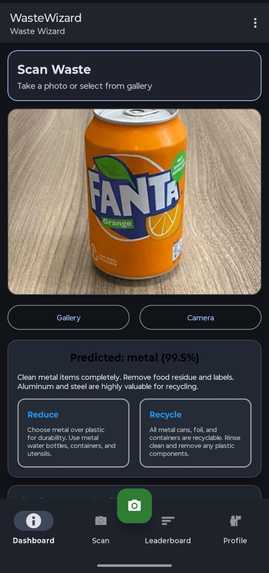
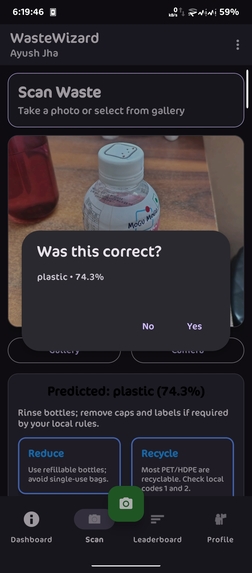
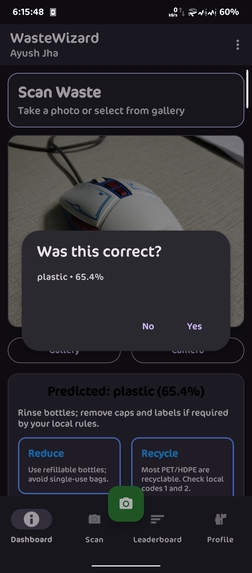
WasteWizard is an intelligent Android app that classifies waste in real-time.
- Users can take a photo with their camera or upload one from their gallery.
- The app's built-in AI model identifies the material and sorts it into one of five categories: Plastic, Glass, Metal, Paper, or Cardboard.
- Based on the classification, the app instantly provides the user with personalized tips on how to reduce that type of waste and specific guidelines on how to recycle it correctly.
How we built it
We built WasteWizard as a native Android application using Java in Android Studio.
- Machine Learning: The core of the app is a TensorFlow Lite model. We used a custom-trained Convolutional Neural Network (CNN) that takes 180x180 RGB images as input. All inference is done on-device for great speed and to protect user privacy (no images are uploaded to a server).
- User Interface: The UI was built using Material Design 3 to create a modern, clean, and responsive interface that supports both light and dark themes.
- App Logic: We used the Android CameraX library for a real-time camera preview and MediaStore for selecting images from the gallery. ML inference is run on a background thread to keep the UI smooth and responsive.
Challenges we ran into
One of the main challenges was training an accurate AI model. We needed a diverse dataset of waste images in various conditions (different lighting, backgrounds, and angles) to ensure the model could generalize well. Another challenge was optimizing the model using TensorFlow Lite to be small and fast enough for a mobile app without sacrificing too much accuracy. Finally, handling Android's camera permissions and managing bitmap memory efficiently to prevent app crashes was a significant technical hurdle.
Accomplishments that we're proud of
We're proud of creating a fast, fully on-device AI application that solves a real-world problem. The instant classification (less than a second) and the clean, intuitive Material Design 3 interface work together seamlessly. We are also proud of the educational component—the app doesn't just classify, it teaches users how to recycle and reduce, which can lead to a positive environmental impact.
What we learned
This project was a deep dive into practical machine learning deployment. We learned the complete pipeline: from training a CNN in Python to converting and optimizing it for mobile with TensorFlow Lite. We also gained significant experience in modern Android development, including using CameraX, managing app permissions, and implementing Material Design 3 guidelines for a polished, professional-looking app.
What's next for WasteWizard
We have many plans for WasteWizard! Our next step is to expand the model to include more waste categories, such as organic waste, e-waste, and different types of plastics (e.g., PET vs. HDPE). We also plan to add a feature that uses the user's location to provide local recycling guidelines, as rules can vary significantly from one city to another.

Log in or sign up for Devpost to join the conversation.