-
-
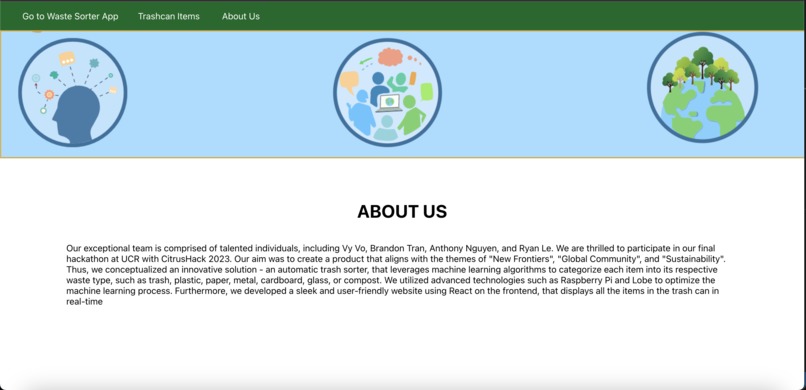
Website homepage
-
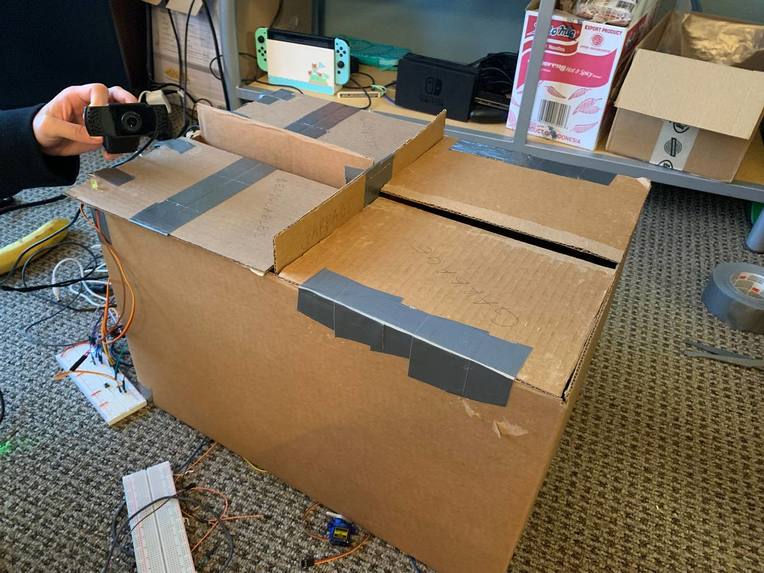
Smart trash can with camera
-
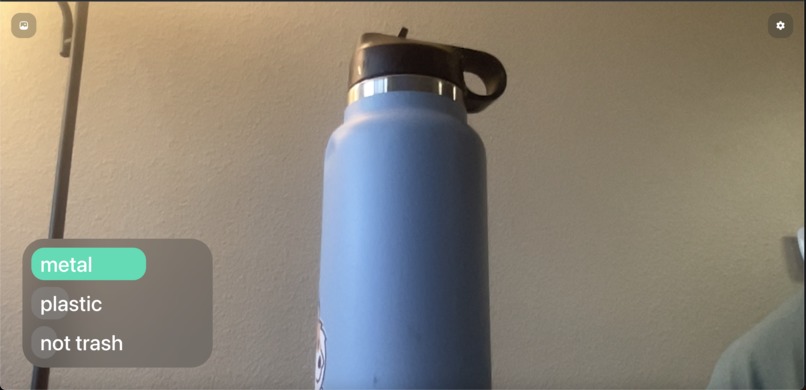
Live test


Inspiration
The EPA estimates that 75% of all waste is recyclable. Thousands/millions of trash go to landfill when it could be recycled. Based on statistics, the US only recycles 5% of its plastic waste. Therefore, we created a solution to this by creating an ML waste sorter that will assist homeowners, businesses, and garbage collectors/sorters in sorting out the waste between compost, recycles, and trash.
What it does
The waste sorter sorts waste by recyclables, composts, and trash. By pressing a button, the camera captures and image of the waste and lets the user know what type of waste it is, so the user can dispose of it accordingly.
How we built it
We used an ML software to train the model to learn the difference between recyclables (plastic, cardboard, glass, metal), compost, and more to categorize the type of waste. We used a raspberry pi and cardboard boxes to make a prototype trashcan that is sectioned into categories. The lids of the categories are automated to open when the user needs to throw away recyclables or compost.
We also created a website version that classifies the waste as well. From a business and customer perspective, we created this product as a home waste sorter. We implemented the browser/website version of this product so that users could try out the feature online before making the purchase. Of course, the website would have limited features compared to the physical trashcan/sorter that customers would be purchasing.
Challenges we ran into
We ran into many challenges with this project. It was difficult to train the ML because we needed a large dataset. At first, the accuracy rate was only 64%, which means that it would classify the objects wrong most of the time. We overcame this by looking for large datasets and adding more pictures to train the ML.
We ran into a lot of challenges with hardware as well. We tried to plan out all of the materials needed for our product and order them ahead of time; however, sometimes we need more materials than what we expected. I had to drive back an forth between my apartment and the solarium to look for materials, but no luck :(( I had to ask around for the materials and make last minute trips to walmart to look for components. It's rough when Amazon is the only place with electrical components, but even the one day shipping is too late :'). I think planning ahead and being prepared for hardware does not always go right.
It was also our first time working with ML and TensorFlow, so we ran into many issues getting the dataset to the website platform. One of the largest issues I ran into was converting the machine learning model to integrate with our website platform. The Lobe AI tool that we used to generate the machine learning model exported the model as a layered model, but our website platform required a graph model to work. The process of converting the model from one to the other proved to be very challenging, and it didn't work on many operating systems as well. Even after converting the model to a graph model, I still had to tweak the file so that it would work with the website as well. Modifying the model to maintain its potency while working with our react app definitely proved to be a challenge.
Accomplishments that we're proud of
We are proud that we got the ML to train with an accuracy rate of 94%. In addition to this, we are quite proud that we were able to combine all of our group's interests into one project. One of us wanted to work with react, another person wanted to create a website and work on frontend, another member wanted to work with AI/ML, and our last member wanted to do hardware and build a physical product.
What we learned
We learned to set up and use a raspberry pi for the first time. In addition to this, we learned to use Lobe, a software to train ML, and use the Tensor Flow model to classify wastes. We also learned and refreshed ourselves on react, setting up a server, and creating a website with functional front/backend.
What's next for Waste Sorter
We hope to add more features to the trashcan. We hope to add an indicator/notifcation for when the trashcan capacity is full to let the user know to take out the trash. In addition to this, there are many smart home products integrated with apps, so we hope to add an app for our smart trashcan to have statistics on how much when helped the environment and notifications on a full trashcan. In addition we hope to add a camera viewer inside the trashcan to show the user what waste has been thrown into the bin. This might help the user know if they had accidentally thrown their valuables or items that they might want to retrieve back again.


Log in or sign up for Devpost to join the conversation.