Inspiration
What it doesIn rapidly growing urban hubs like Hyderabad, municipal waste management is a massive challenge. While industrial recycling plants exist, the vital informal waste ecosystem—powered by thousands of local ragpickers and kabadiwalas (aggregators)—remains completely fragmented. They handle over $60\%$ of recycled materials but face predatory middleman pricing, unsafe conditions, and an absolute lack of data tracking.We were inspired by a simple question: How do you build a state-of-the-art, auditable waste traceability supply chain when the most critical stakeholders don't have smartphones, internet access, or formal bank accounts? We designed TraceWaste to meet these workers exactly where they are, transforming a chaotic, opaque process into a transparent, data-driven "Waste Intelligence Network."
How we built it
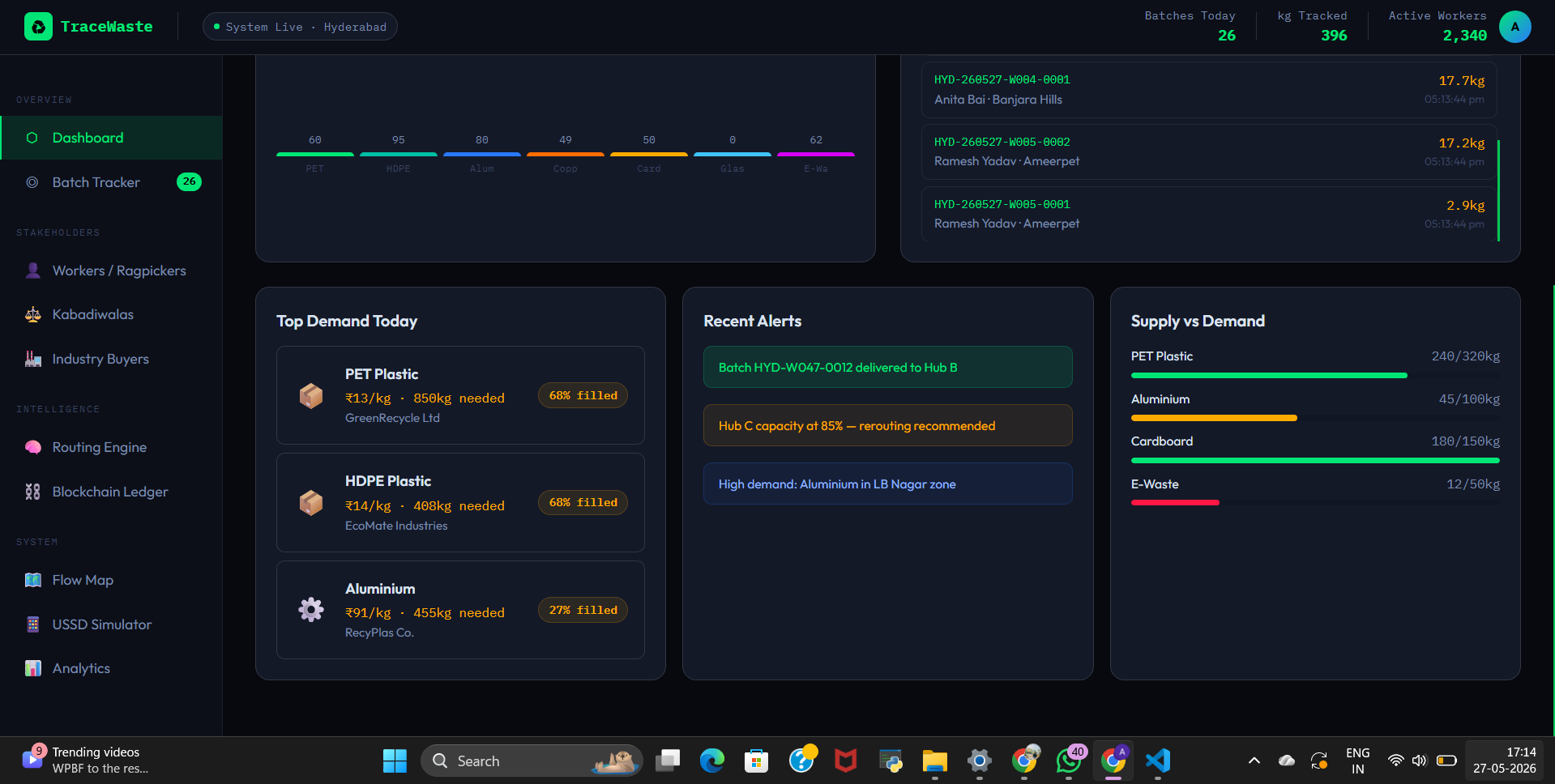
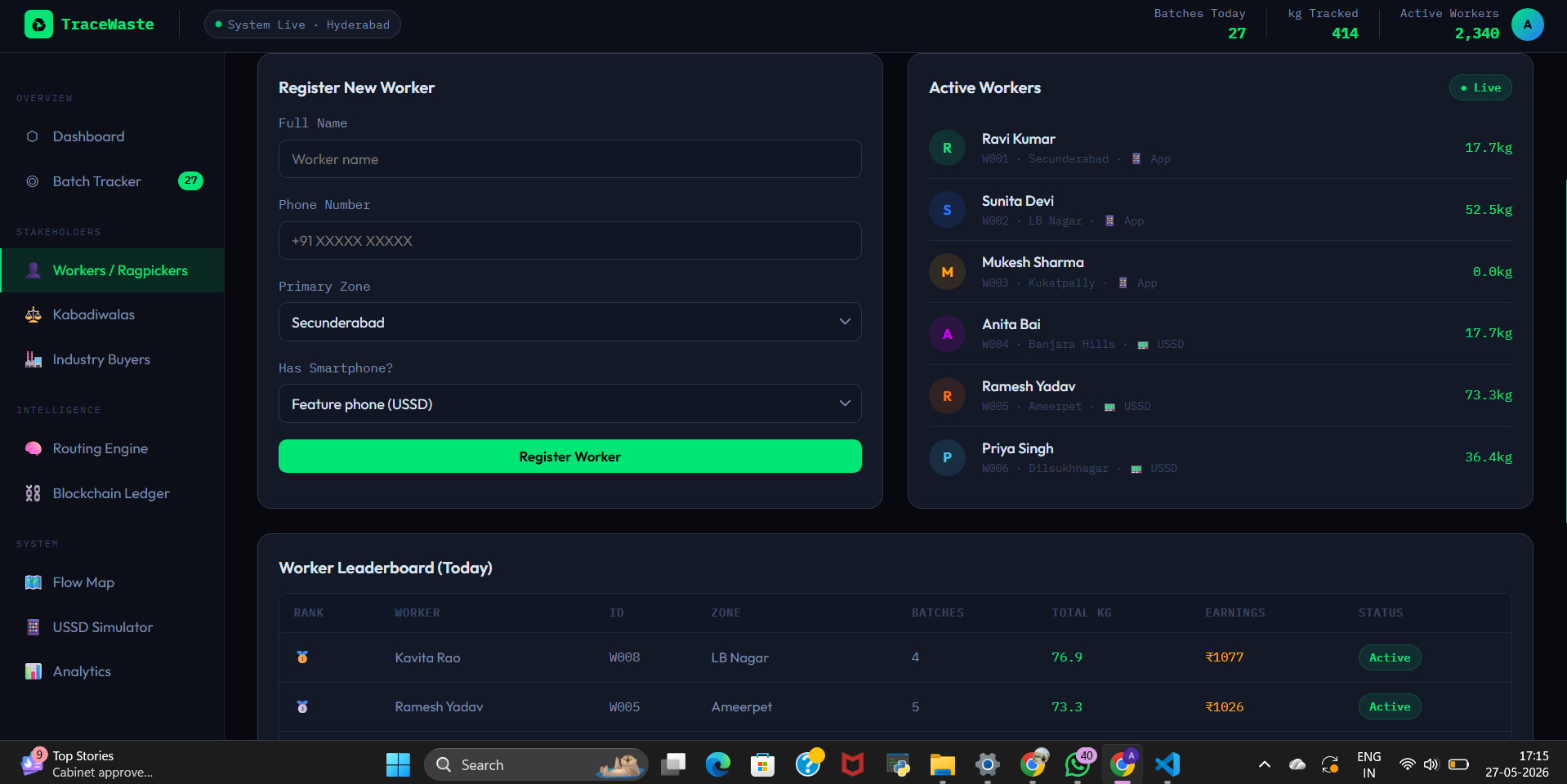
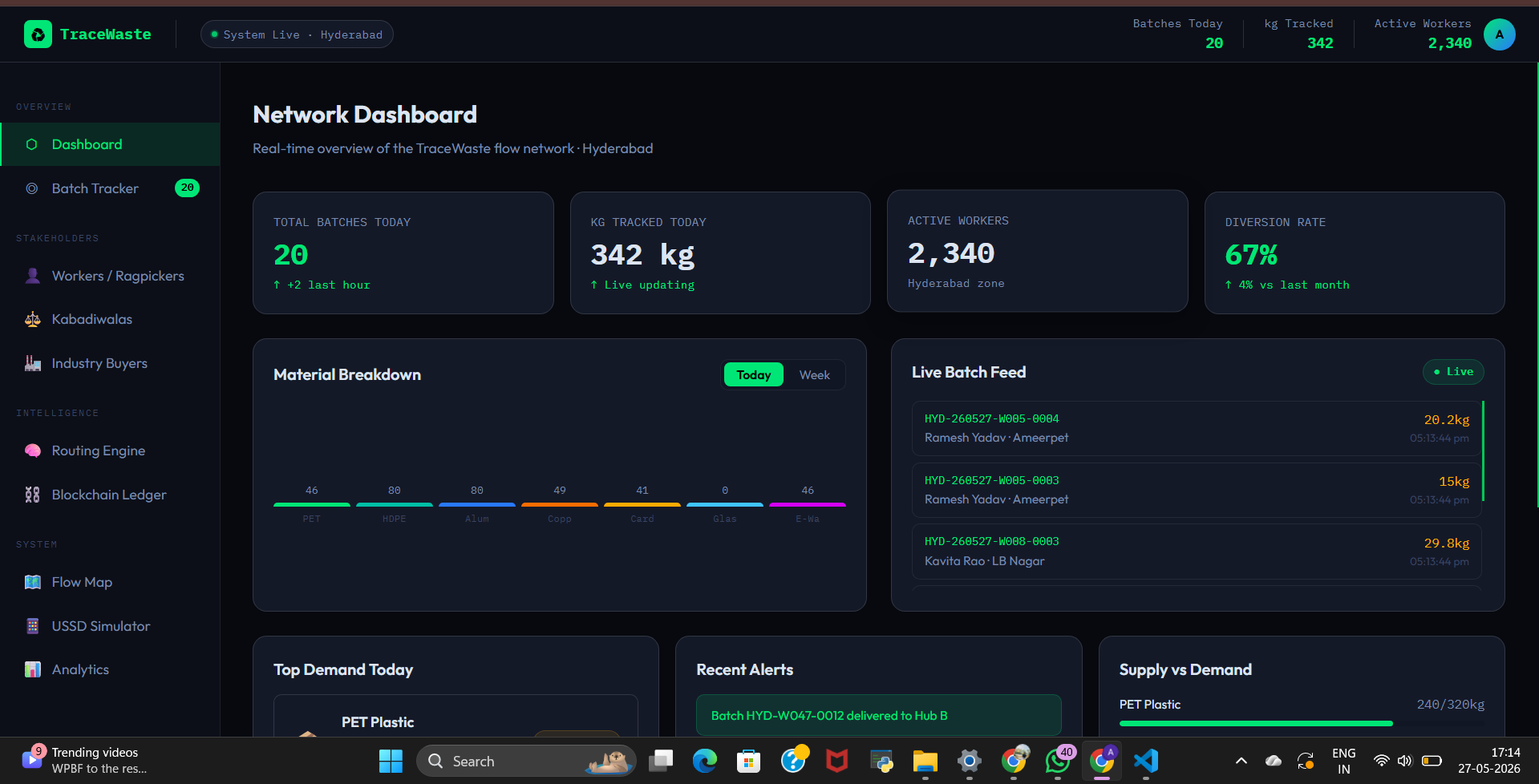
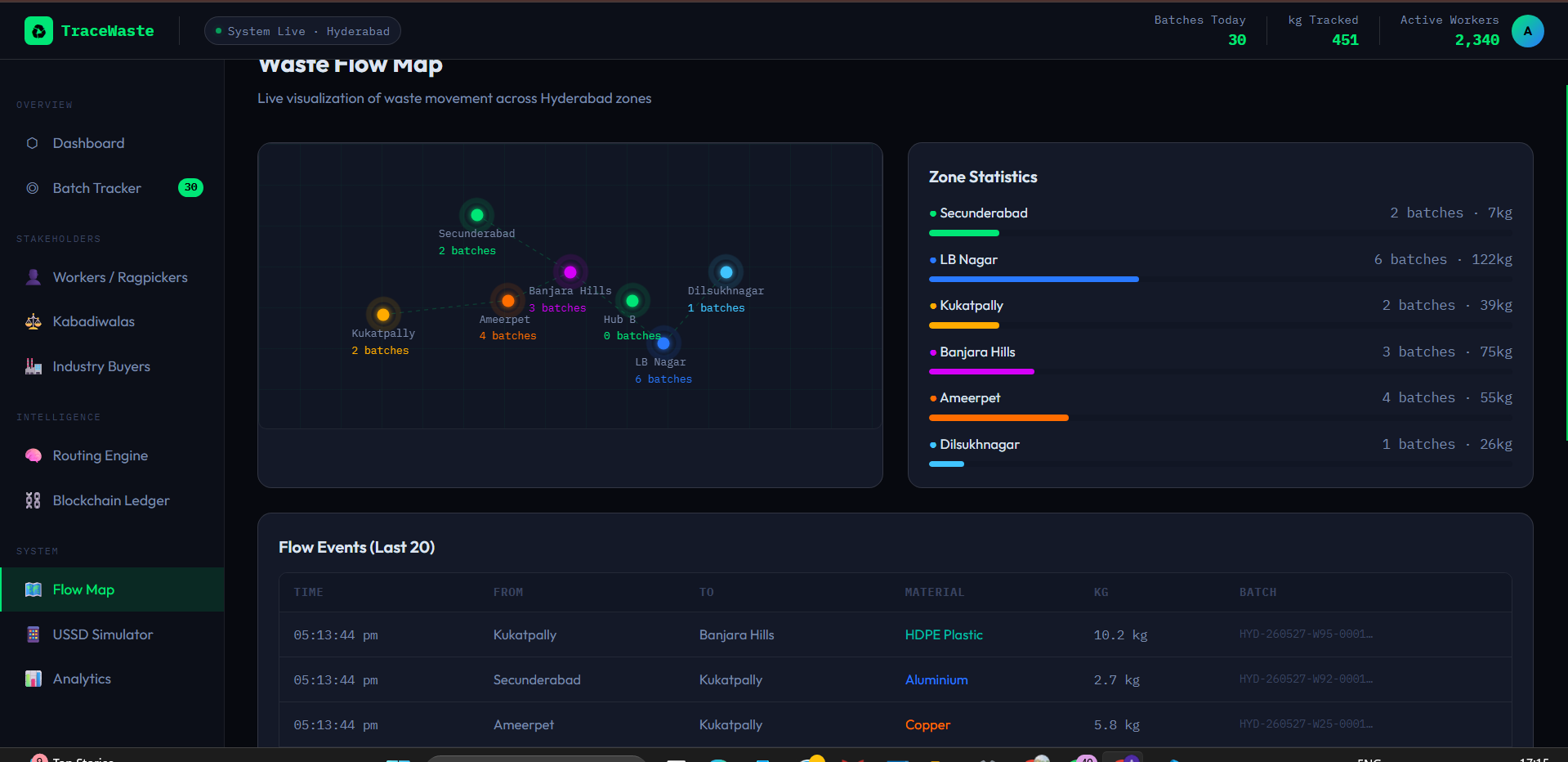
We engineered TraceWaste as an offline-first, highly scalable, multi-tier software architecture designed to withstand real-world structural constraints:The Low-Tech Gateway (USSD/SMS): For informal ragpickers, we built an interactive USSD simulator. Workers can dial a quick code on any basic feature phone to instantly log collected material types and weights without using cellular data.Unique Batch Tracking & Dual-Signoffs: Every collection generates an algorithmic tracking string:$$\text{BATCH_ID} = [\text{Zone}]-[\text{Date}]-[\text{Worker_ID}]-[\text{Sequence}]$$Handoffs to aggregators (kabadiwalas) require visual QR validation or mutual confirmations, eliminating data spoofing.The Frontend & Visual Simulation Engine: We engineered an extensive, real-time dashboard featuring live supply-vs-demand matching graphs, a simulated cryptographic blockchain ledger, a live geographic flow map of Hyderabad zones, and automated analytical reports tracking Extended Producer Responsibility (EPR) metrics.
Challenges we ran into
Overcoming the Digital Divide: Our biggest obstacle was avoiding a "high-tech bubble." Early concepts relied heavily on smartphone native apps, which would completely exclude the actual ragpickers. We had to strip our UX design back to its bare essentials, iterating until the entire logging process could successfully run over a 160-character network SMS frame.
Data Consistency & Real-Time Math: Synchronizing rapid data entries from separate asynchronous sources while keeping our supply-demand meters dynamically accurate was a complex state-management challenge. We resolved this by establishing automated interval-based reconciliation worker scripts that constantly check and lock the live system balances.
Accomplishments that we're proud of
TraceWaste proves that sustainability tech doesn't need to replace informal workers to optimize a city's supply chain—it just needs to empower them. By combining ultra-accessible mobile entry points with a secure corporate ledger, we pave the way for a truly circular economy.
What we learned
Building TraceWaste pushed us to think deeply about system design under extreme operational limits, blending social responsibility with hard mathematics:Designing for Graceful Degradation: Systems shouldn't break when the internet does. We learned how to build an offline-first data model that caches local ward inputs on basic tablets, seamlessly reconciling with the central registry when a network connection is re-established.Algorithmic Demand Optimization: Instead of workers randomly guessing what to gather, we learned to implement a pull-based supply chain routing system. If an industrial plant registers an urgent demand for PET plastic, the routing engine pushes targeted notifications out to nearby collection zones.Cryptographic Ledger Mechanics: We integrated a permissioned blockchain concept where every block recalculates an absolute SHA-256 state change hash based on historical batch data:$$\text{Hash}{\text{new}} = \text{SHA-256}(\text{Index} + \text{Timestamp} + \text{Data} + \text{Hash}{\text{previous}})$$This mathematically guarantees that data logged at the collection point cannot be retroactively manipulated by corporate buyers.

Log in or sign up for Devpost to join the conversation.