Inspiration
\(\LaTeX\) is a great typesetting system, but it is famously rather arcane to program in when writing packages. This has been improved somewhat by \(\text{Lua}\TeX\), which embeds the Lua scripting language inside the \(\TeX\) engine, but what if you want to use libraries written in a different language?
What it does
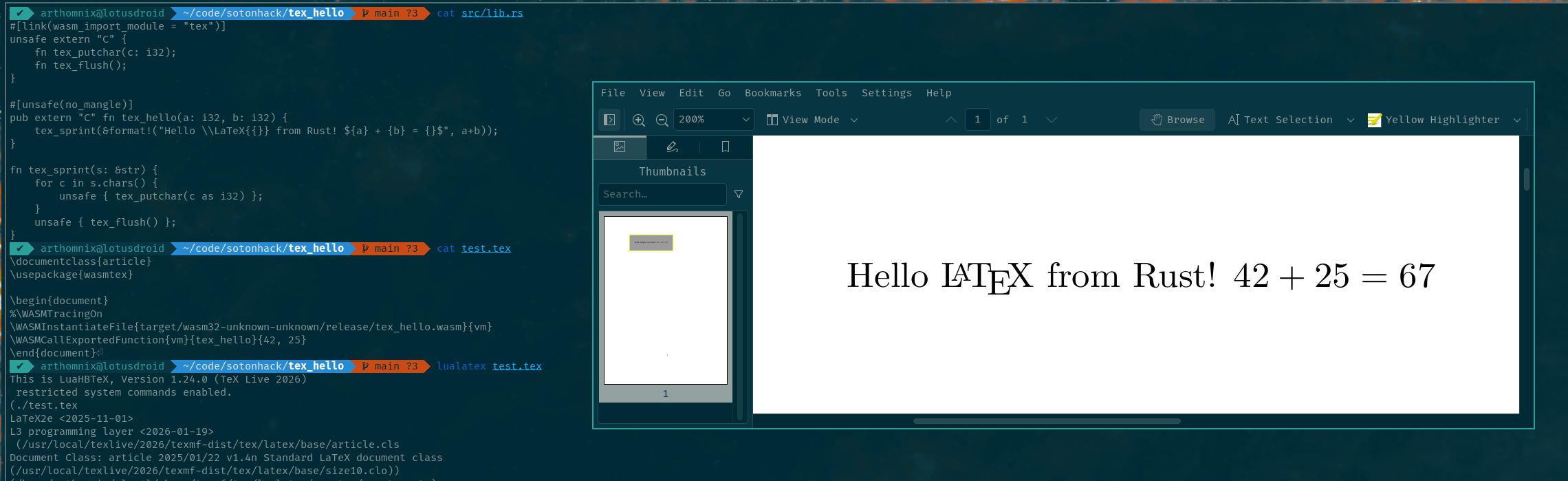
\(\text{wasm}\TeX\) embeds a WebAssembly interpreter in \(\LaTeX\), allowing libraries and programs from a wide range of programming languages to be used from within \(\LaTeX\) packages and documents.
How we built it
The main component of \(\text{wasm}\TeX\) is a WebAssembly intepreter written in pure Lua 5.3 (lwasmlib). \(\text{wasm}\TeX\) then provides a \(\LaTeX\) package which loads the Lua library and provides a \(\LaTeX\) interface for loading WebAssembly binaries and calling functions.
Challenges we ran into
Lua is certainly not the best language for writing a WebAssembly interpreter. It uses one-indexed arrays, whereas everything in WebAssembly is zero-indexed, leading to difficult to debug off-by-one errors; it also only has one integer type, making support for all of WebAssembly's integer instructions difficult. \(\text{wasm}\TeX\) currently doesn't implement a few unsigned 64-bit integer instructions or any floating-point instructions, but this is still enough to run many programs and libraries.
Accomplishments that we're proud of
It feels pretty cool to have gone from nothing to having a WebAssembly interpreter capable of running real Rust programs, working by myself with no AI assistance!
What we learned
- Lua isn't a great language for implementing a WebAssembly interpreter (although it's better than trying to do it in \(\TeX\) itself...)
What's next for \(\text{wasm}\TeX\)
Implementing the remaining missing instructions, more modern WebAssembly extensions, finding all of the bugs that are undoubtedly still in there, building out the \(\LaTeX\) interface some more, ...
