Inspiration
Care for an elderly Muslim parent is almost never organized in one place. It is split across relatives, doctors, pharmacists, and support workers, and coordinated through WhatsApp threads that bury important updates, memory, verbal handoffs, and separate personal calendars that no one else can see. On top of that, Muslim families often struggle to find and coordinate care that respects language, halal diet, prayer schedule, modesty, and caregiver-gender preference — and these preferences usually live in someone's head, re-explained every time a new caregiver, nurse, or family member gets involved.
We kept coming back to one uncomfortable truth: in almost every existing tool, the elder is the last person consulted about their own care. They may not want to be a burden. They may not want to "command" their children. And in that silence, they can lose their voice entirely in decisions about their own life — especially for immigrant elders, who are already at higher risk of isolation, depression, and disconnection from community.
We wanted to build something that flips that dynamic: a system where the elder — whom we call the Circle Lead — is the author of their own care, not a passive subject of it.
What it does
Wasl (وصل), which means "connection" in Arabic, is a privacy-first, culturally adaptive coordination platform for Muslim families managing an elder's everyday support — appointments, meals, transport, finances, prayer, and community connection, plus medication reminders (never medical decisions).
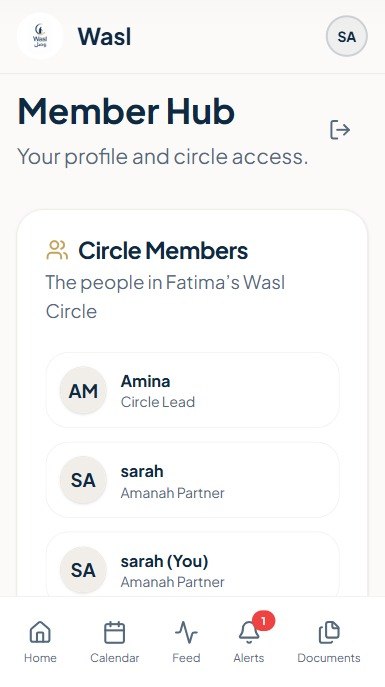
At the center is the Circle Lead (the elder), surrounded by their Wasl Circle: Amanah Partners (family members), Nurse/Professional Partners (paid or visiting caregivers), and Companions (mosque volunteers, neighbors, community members). One subscription supports up to two Circle Leads and multiple partners, reflecting real households where a couple or an elder and an in-law are cared for together.
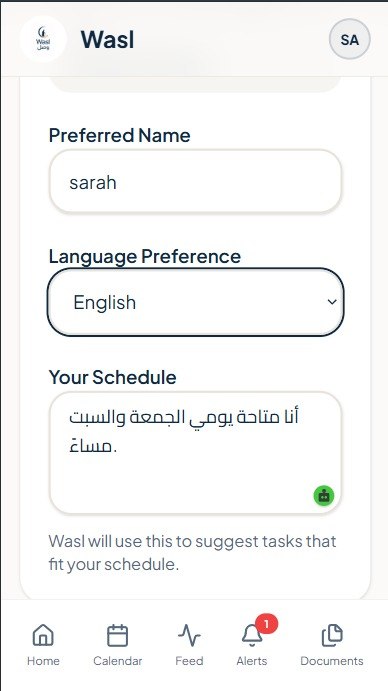
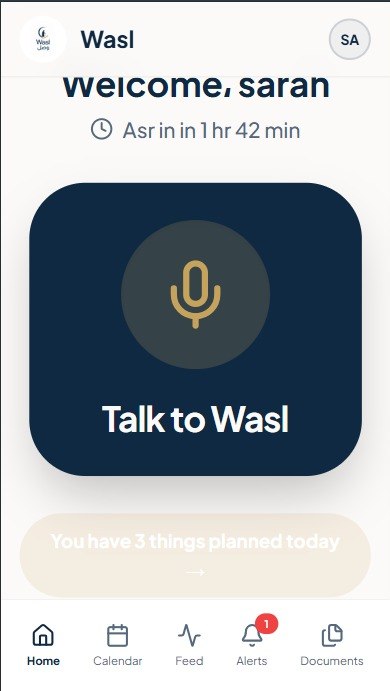
The core interaction is a Wasl Companion Agent that speaks to the Circle Lead by their preferred name, in their preferred language, using a greeting style they chose — never assumed. The elder talks to the agent the way they'd talk to a trusted person: "I need someone to take me to the pharmacy on Thursday." The agent checks the shared calendar and every Amanah Partner's stated availability, finds a match, drafts a task, and confirms it with the elder before anything is created. If no one is available, it explains why in plain, respectful language instead of failing silently.
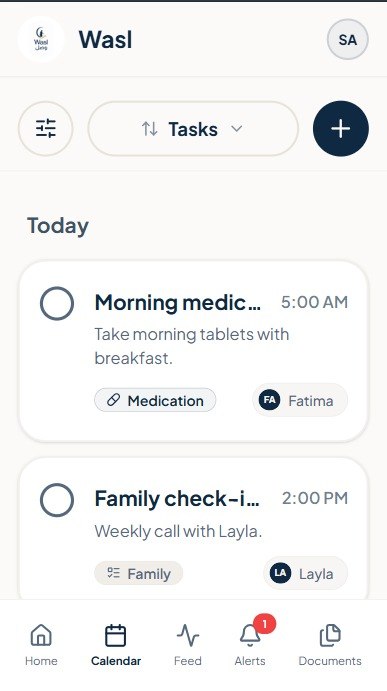
From there, every task has an owner, a status, and a due time — Not assigned, In progress, Done — and every handoff between caregivers produces a structured note: what happened, what's next, who should know. Preferences like diet, modesty, caregiver-gender comfort, and prayer times are structured data that attach automatically to relevant tasks, instead of being re-explained to every new person who joins the circle.
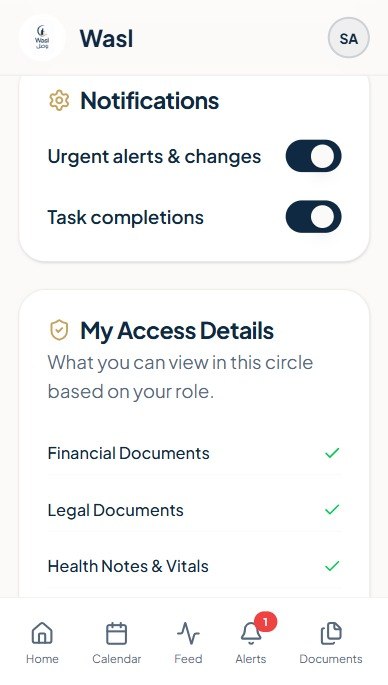
Access is role-based and consent-driven. Nurses and Companions only see what they're assigned. Financial and legal documents are never visible by default to anyone but the Circle Lead. And critically, the elder — or a Care Coordinator the elder explicitly designates, based on their own physical and mental capacity — controls who can grant or revoke access to what. Nothing about "Muslim-friendly" is one fixed setting; every cultural and faith preference is optional, editable, and authored by the elder themselves.
How we built it
We started from the MuslimHacks Elderly Care brief and worked backward from three constraints in the challenge: no diagnosis, dosage, or medical triage; consent-first handling of sensitive information; and cultural preferences that must be individual, never assumed.
We wrote a full product requirements document defining the role system (Circle Lead, Amanah Partner, Care Coordinator, Nurse/Professional Partner, Companion, Circle Owner), a granular data-access matrix separating daily tasks, preferences, medication reminders, financial documents, legal documents, health notes, and location/wearable data — and made the access rules themselves configurable per Circle at onboarding, since a fully independent elder and an elder with more support needs require different defaults.
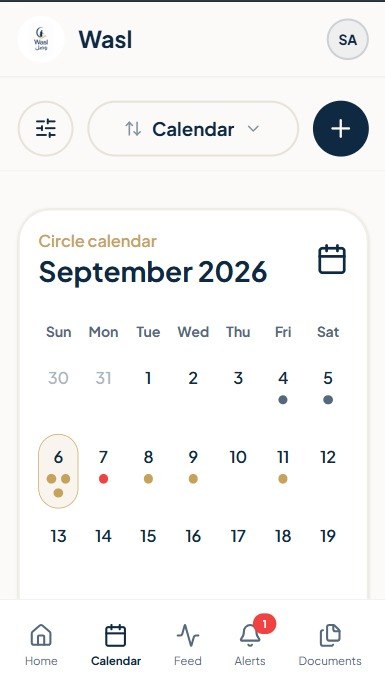
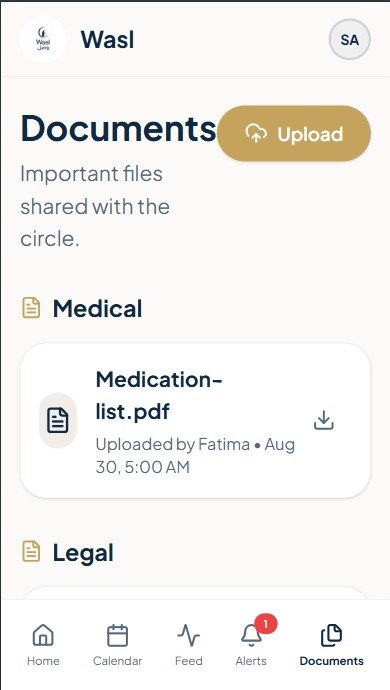
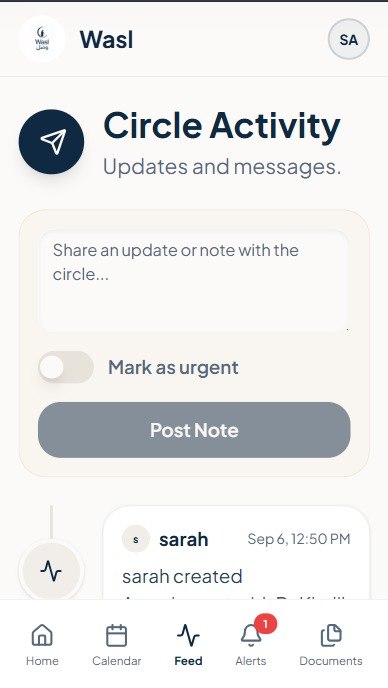
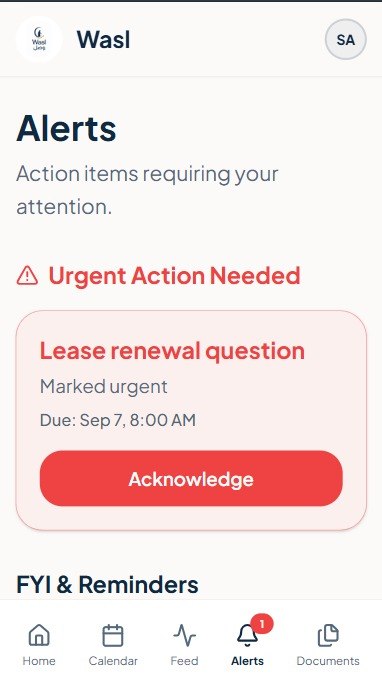
The information architecture follows a simple mobile tab bar: Home (today's tasks plus the always-visible Agent button), Calendar (events and tasks, each with custom labels like Legal, Financial, Medical appointment, or Community/Islamic event), Feed (status changes, device signals, and manual notes explicitly flagged Urgent or Routine by their author), Alerts (unassigned tasks ranked by urgency), Chat (direct and task-linked messaging), and Documents (photo/PDF uploads with mandatory category tagging, stored encrypted in the cloud, never locally).
We designed the agent's conversational scaffolding directly around dignity: "How are you today?", "Would you like me to let someone know?", "Is this for today or another day?" — and hard-coded a refusal pattern so it never gives medical, dosage, or diagnostic advice, redirecting any health question to the elder's nurse or doctor, and routing anything resembling an emergency straight to an emergency-services prompt.
Challenges we ran into
The hardest problem wasn't technical — it was naming and framing. Early drafts used words like "caregiver," "elderly," and "care," and we realized those words alone can feel clinical, hierarchical, or even upsetting to the very people we were designing for. We iterated repeatedly on role names until we landed on Circle Lead and Amanah Partner — language that centers autonomy and trust instead of dependency.
A closely related challenge was avoiding the trap the brief explicitly warned against: treating "Muslim-friendly" as one setting. It would have been easy to hard-code assumptions — a fixed greeting, a fixed diet default, a fixed notion of modesty. Instead, every one of those fields had to be optional, blank-by-default, and edited only by the elder, which meant redesigning onboarding multiple times so that nothing about a person's faith or culture is ever assumed on their behalf.
We also had to carefully design how an elder asks for help without feeling like they're commanding their family. We built the agent to frame requests as "letting the circle know" rather than issuing demands, and to let family members proactively "offer to help" rather than only reacting to asks — a subtle but important shift in tone that took several rounds of rewriting.
Finally, defining the access-control model was genuinely difficult: who can see financial documents, who can edit a preference after a doctor's recommendation, who holds the authority to revoke someone's access if the elder's own capacity changes over time. We ultimately made authority itself configurable at subscription time, letting the elder choose whether they retain full control or delegate it to a trusted Care Coordinator.
Accomplishments that we're proud of
We're proud that dignity is not a slogan in this product — it's enforced in the data model itself. Every sensitive category (financial, legal, health notes, location) requires explicit, granular, revocable consent, consistent with PIPEDA's meaningful-consent principle and Québec's Law 25 requirements for express consent on sensitive personal information.
We're proud of the competitive analysis we did against real products — ianacare, Lotsa Helping Hands, Care.com, Papa, Medisafe, CareZone, Apple Watch, and CarePredict — and identified a genuine, durable differentiator: none of them treat cultural and faith preference as a structured system primitive that flows automatically into task-matching, and none of them give the elder their own voice through a conversational agent designed explicitly around their dignity.
We're also proud of designing a system that stays deliberately behind medical decision-making rather than in front of it — reminders and adherence logging only, never diagnosis or dosage guidance — which keeps the product genuinely safe to use while still solving a real coordination gap that purpose-built medical apps don't touch.
What we learned
We learned that respectful language is a design decision with real technical consequences — the words "caregiver" versus "Amanah Partner," or "elderly person" versus "Circle Lead," changed how we built permissions, onboarding flows, and even the agent's conversational scaffolding.
We learned that privacy and consent can't be bolted on at the end of a project; they have to be a first-class part of the data model from the very first schema decision, especially when handling financial, legal, and health-adjacent information for a population that may have varying capacity to manage their own consent over time.
We also learned how much coordination failure in real families comes down to invisible ownership — tasks nobody explicitly owns, handoffs nobody wrote down — and that solving that problem is less about clever AI and more about simple, consistent structure: every task has a status, an owner, and a note for whoever comes next.
What's next for Wasl — Connected Care, with Dignity
Our immediate next step is a pilot with a small group of Muslim families in Montréal who have an elder at home, starting with activation and enrollment tracking, then expanding toward roughly 100 families to measure engagement, retention, and real changes in workload and ease of use through structured surveys.
On the product side, we plan to move from a text-first agent to a fully voice-first experience as the default interaction mode, expand wearable integrations beyond a mocked location signal (building on optional, elder-consented device pairing), and extend our language support beyond the Arabic, English, Persian, and French we're launching with.
Longer term, we want Wasl to become the layer that sits after a caregiver is hired — whether through a mosque network, a community referral, or a marketplace like Care.com or Papa — coordinating everyday life around that relationship with the elder's preferences, privacy, and voice built in from day one, and helping more families make at-home, nurse-supported care a real, dignified, and affordable alternative to a nursing home.
Built With
- ai
- llm
- replit


Log in or sign up for Devpost to join the conversation.