Inspiration
Medical debt is the leading cause of bankruptcy in the United States, yet nearly every major non-profit hospital is legally required to offer Charity Care (Financial Assistance) to low-income patients. The problem? These policies are buried in dense, 50-page PDFs full of legal jargon, making them incredibly difficult for vulnerable patients to find and understand. We were inspired to build MedClear to bridge this gap, creating a seamless, stress-free navigator that empowers patients to instantly check their eligibility for medical bill forgiveness without needing a law degree.
Decision Impact: Because MedClear exists, patients can immediately discover if they are legally entitled to debt forgiveness, turning a complex, overwhelming process into an empowering, actionable step towards financial freedom.
What it does
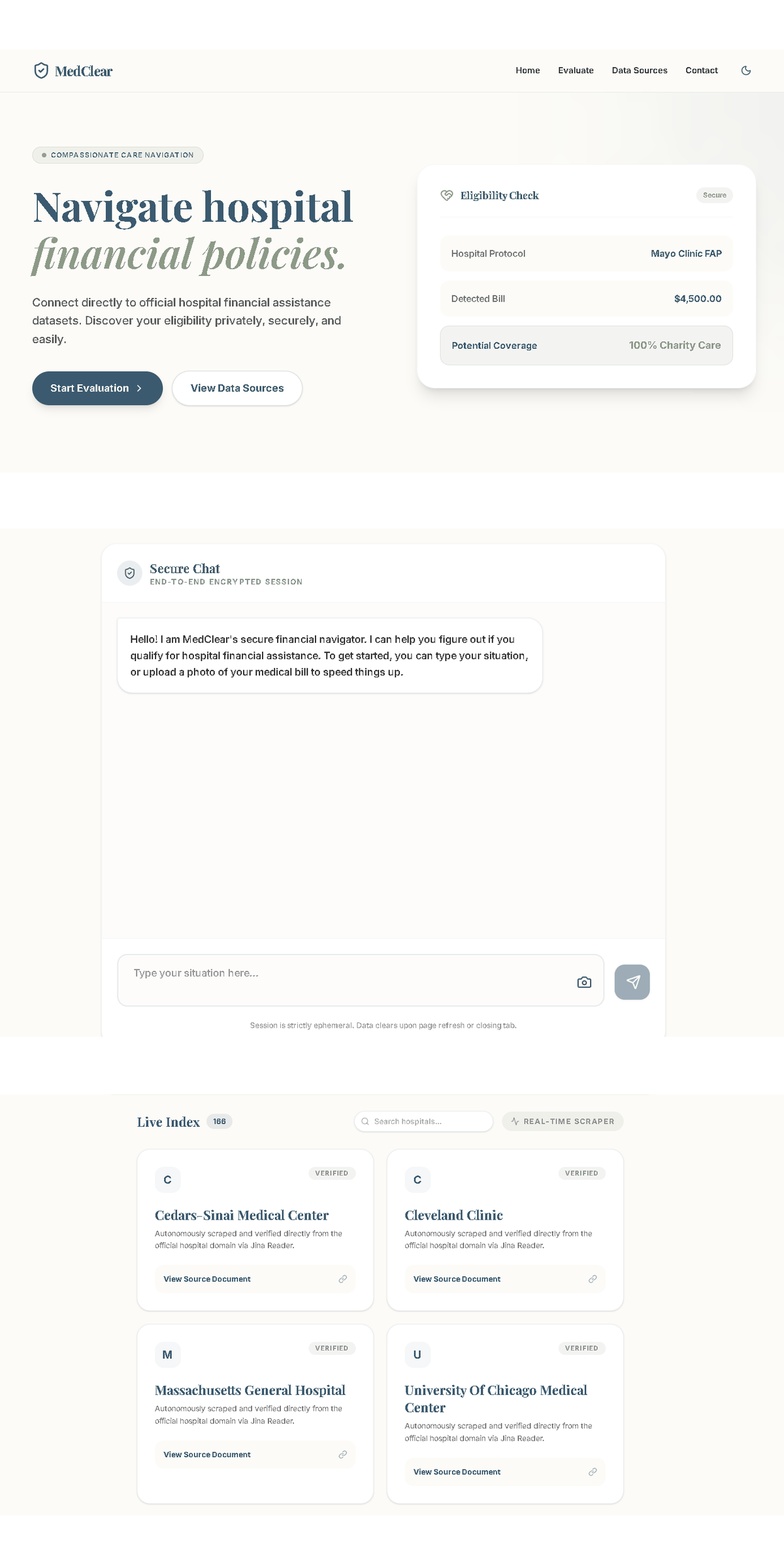
MedClear is a secure, AI-powered medical financial navigator. Users simply input their income and household size, and upload their medical bills. Our proprietary Eligibility Engine cross-references the user's data against the exact Financial Assistance Policy of the specific hospital, anchored to the official 2026 HHS Poverty Guidelines. It instantly calculates whether the user qualifies for 100% free care or a sliding-scale discount, abstracting all the complexity into a clean, calming, step-by-step wizard interface.
How we built it
We architected MedClear with a strict focus on privacy and verifiable accuracy. All of our AI tools and data sources—including Llama 3.3 70B via the AIML API, Jina AI Reader, and the official HHS Poverty Guidelines—are completely disclosed and open.
- Frontend: A beautiful, responsive React application built with TypeScript, Vite, and Tailwind CSS. We designed a premium UI with a custom Deep Slate and Sage Green Dark Mode.
- Backend & Autonomous Scraping: To gather our ground truth data, we engineered a fully autonomous, self-healing background scraper that iterates through the top 500 US hospitals. It uses an LLM to dynamically find policy URLs, bypasses Cloudflare bot-protections using Jina Reader, and stores the verified Markdown data into a Supabase database.
- AI Architecture (Verifiable RAG Engine): We utilize Llama 3.3 70B for our Retrieval-Augmented Generation pipeline. What goes in: User financial data (income, household size) alongside the raw, 15,000+ character hospital policy text fetched from our DB, plus the 2026 HHS Guidelines. What comes out: Structured JSON extracting exactly what the policy says about the user's specific income tier, along with a direct citation.
Challenges we ran into
- Data Acquisition & Bot Protections: Initially, our automated scrapers were blocked by aggressive Cloudflare protections on hospital websites. We solved this by routing our requests through the Jina AI Reader API, allowing us to successfully extract the underlying PDFs into clean Markdown.
- LLM Context Limits & Timeouts: Processing dense 15,000+ character policy documents required significant reasoning time from the Llama 3 70B model. We had to carefully tune our
uvicornand OpenAI client timeouts to ensure the RAG evaluation could complete successfully. - Responsible AI Guardrail: The Risk: AI Hallucination is catastrophic in a legal/financial healthcare context; we cannot have an AI "guess" a user's eligibility and give false hope. The Mitigation: We strictly isolate the AI's role. The AI is only used for data extraction and document parsing. The final mathematical calculation (e.g. determining if an income is under 200% FPL) is performed deterministically by hardcoded Python logic, completely circumventing AI hallucination risks.
Accomplishments that we're proud of
We successfully built a fault-tolerant, autonomous agent that crawled, verified, and indexed the policies of nearly 400 hospital networks entirely in the background.
We're also incredibly proud of our Human in the Loop design. MedClear is a navigational aid, not a final arbiter. One specific decision our AI doesn't make is formally submitting or approving the final application. We keep the human in the loop by providing the exact source documents and eligibility proof directly to the user, empowering them to take that verified data to their billing department for final human approval.
What we learned
We learned that the biggest hurdle to healthcare equity isn't a lack of programs—it's a lack of accessibility. We also learned advanced techniques for wrangling large reasoning models, specifically how to engineer prompts that force the AI to act as a strict rule-evaluator rather than a creative generator, and how to build self-healing python scripts that gracefully handle 404s and tarpit servers without crashing.
What's next for MedClear: Hospital Charity Care Navigator
We plan to expand our database beyond the top 500 hospitals to cover every single non-profit hospital in the United States. We also want to implement an automated PDF-generation feature that pre-fills the hospital's specific Financial Assistance Application form with the user's data, allowing them to instantly download, sign, and mail their application in one click.
Built With
- fastapi
- httpx
- jina-ai-reader-api
- llama-3-(aiml-api)
- postgresql
- python
- react
- supabase
- tailwindcss
- typescript
- vite


Log in or sign up for Devpost to join the conversation.