-
-
hero-section
-
Seven-ai agents
Inspiration
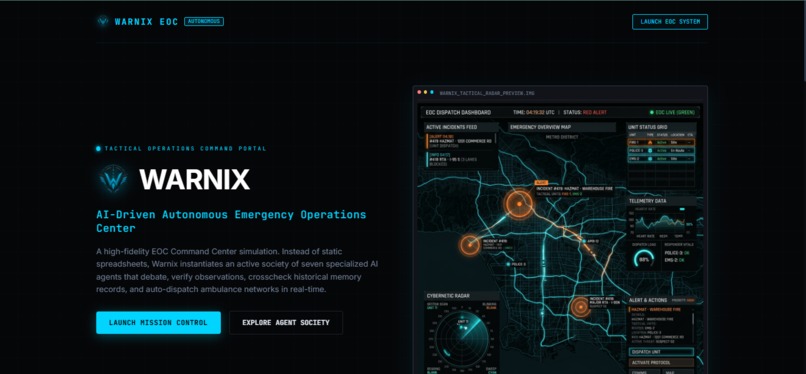
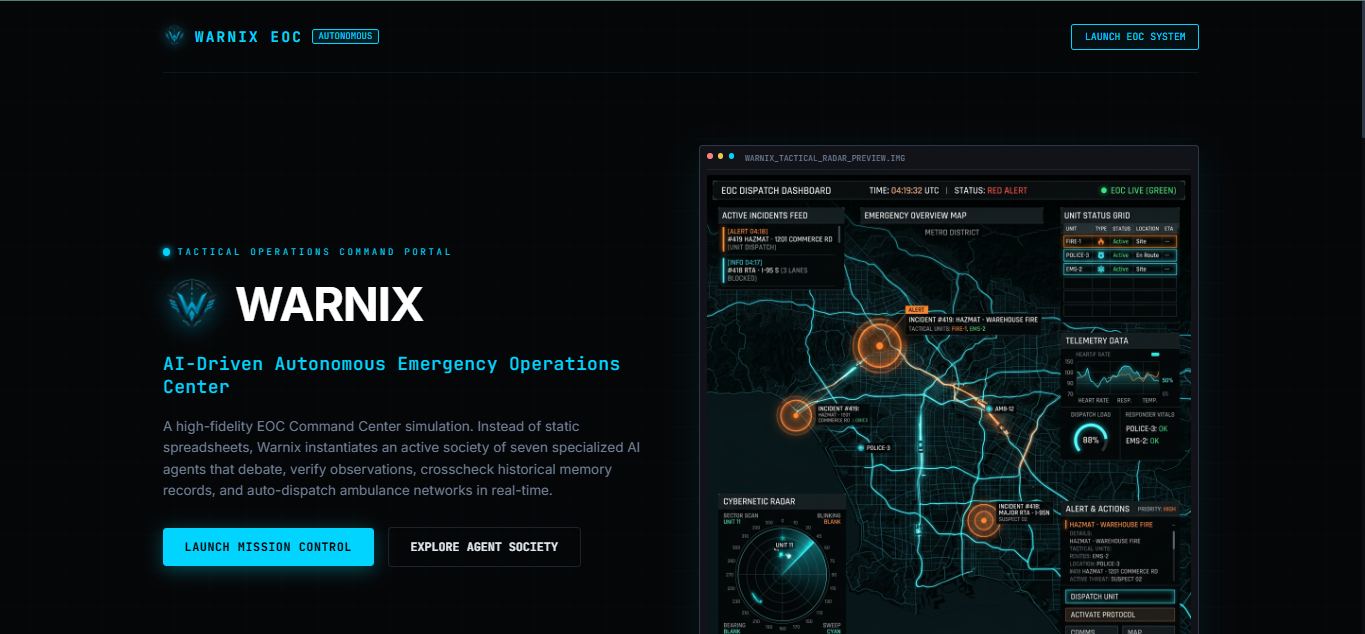
Emergency response is a race against time, but dispatcher operations are historically plagued by sequential queues, human communication lag, and data silos. Warnix was inspired by NASA Mission Control telemetry design to build an autonomous emergency operations center (EOC). Instead of standard workflow bots, Warnix models a collaborative society of 7 specialized AI agents that deliberate, skeptically cross-check observations, negotiate resource contention, and self-dispatch responder units.
What it does
Warnix is an autonomous Emergency Operations Center (EOC) powered by Qwen Cloud that helps emergency coordinators process incidents faster and more intelligently.
Citizens can submit emergency reports through a public reporting portal, including incident details, location, and supporting evidence.
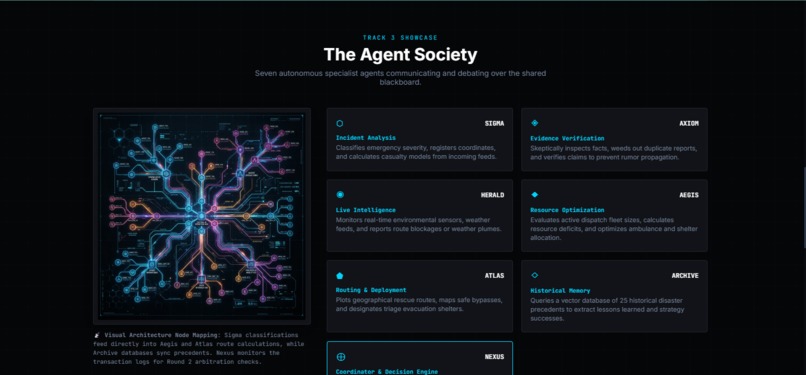
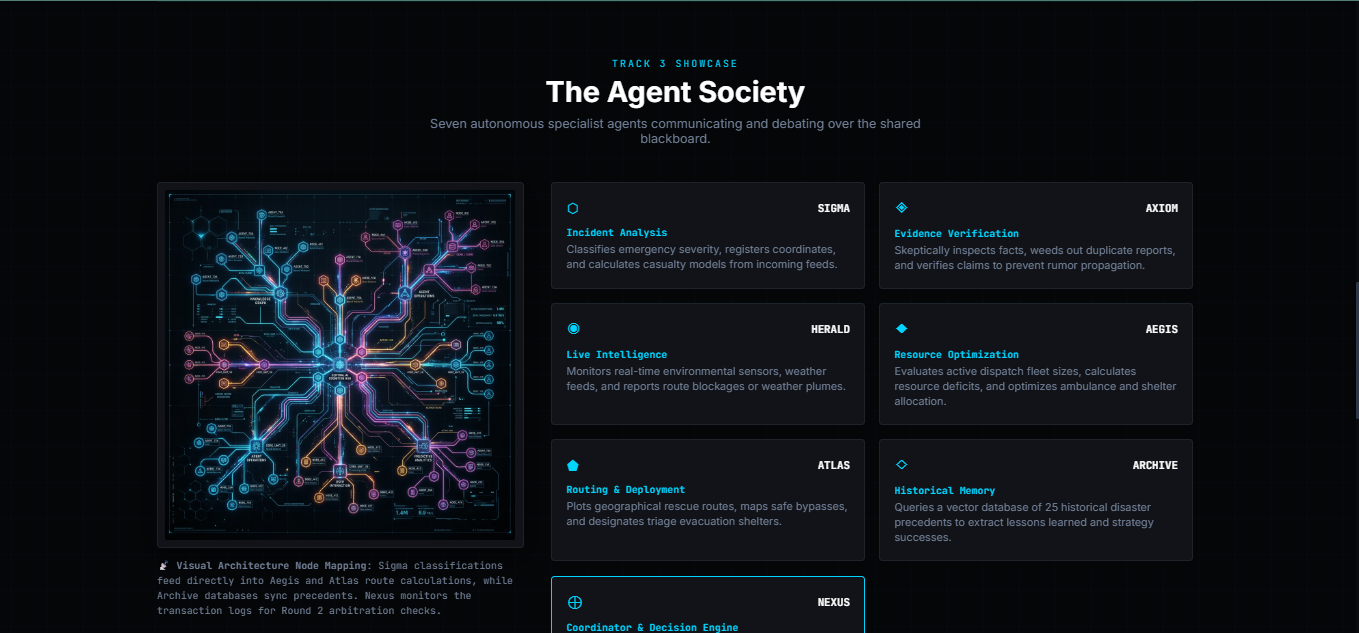
Once a report is received, Warnix creates a collaborative society of seven specialized AI agents:
SIGMA analyzes the incident and estimates severity. AXIOM validates evidence and detects duplicates. HERALD monitors environmental conditions and route hazards. AEGIS evaluates responder availability and resource constraints. ATLAS plans safe deployment routes using GIS mapping. ARCHIVE retrieves historical disaster precedents. NEXUS coordinates deliberation, resolves disagreements, and produces the final explainable recommendation.
Instead of relying on a single AI response, the agents debate through multiple reasoning rounds using a shared blackboard memory before presenting a recommendation to the human commander.
The commander can then approve, reject, override, recall, resolve, archive, or continue deliberation while every action is permanently logged for auditability.
How we built it
Challenges we ran into
- Neon Idle Dropouts: Neon's AWS serverless pooled nodes disconnect idle DB links. We resolved this by configuring Prisma with transaction pooling query parameters (
pgbouncer=trueand custom timeouts). - LLM Hang Protection: Network lags could block background runner threads. We implemented
AbortControllertimeouts of 15 seconds, allowing agents to degrade gracefully into local offline fail-safes without blocking EOC telemetry. - Leaflet Coordinate Safety: Map render crashes occurred when incoming feeds had missing or malformed GPS parameters. We wrote type-safe coordinate validators to shield the GIS rendering layer. ## Accomplishments that we're proud of We're particularly proud that Warnix feels like a real Emergency Operations Center rather than a simple AI demo.
Some highlights include:
A complete seven-agent collaborative architecture powered by Qwen. Explainable AI showing how decisions were reached. Human-in-the-loop command controls. Interactive GIS incident visualization. Real-time streaming updates across the dashboard. Audit-safe incident lifecycle management. A polished Mission Control interface inspired by professional operations centers.
Most importantly, we transformed AI reasoning into something operators can understand, review, and trust.
What we learned
I mastered robust edge-case handling in server-sent event systems, learned how to coordinate socratic debate consensus among Qwen agents, and gained deep experience deploying high-performance Next.js servers on Alibaba Cloud ECS.
What's next for Warnix
Our vision is to evolve Warnix into a production-ready emergency coordination platform.
Future plans include:
Integration with live weather, satellite, and traffic APIs. Voice and multilingual emergency reporting. Drone and IoT sensor integration. Predictive disaster forecasting using historical patterns. Real-time responder tracking. Mobile applications for field responders. Geographic expansion supporting multiple emergency operations centers simultaneously. Fine-tuned Qwen models specialized for disaster response reasoning.
Ultimately, we envision Warnix becoming an intelligent decision-support platform that helps emergency teams respond faster, coordinate better, and save more lives.
Built With
- alibaba-cloud-ecs
- leaflet-gis
- neon-postgresql
- next.js
- prisma
- qwen-cloud
- qwen-plus
- react
- server-sent-events
- typescript


Log in or sign up for Devpost to join the conversation.