Inspiration
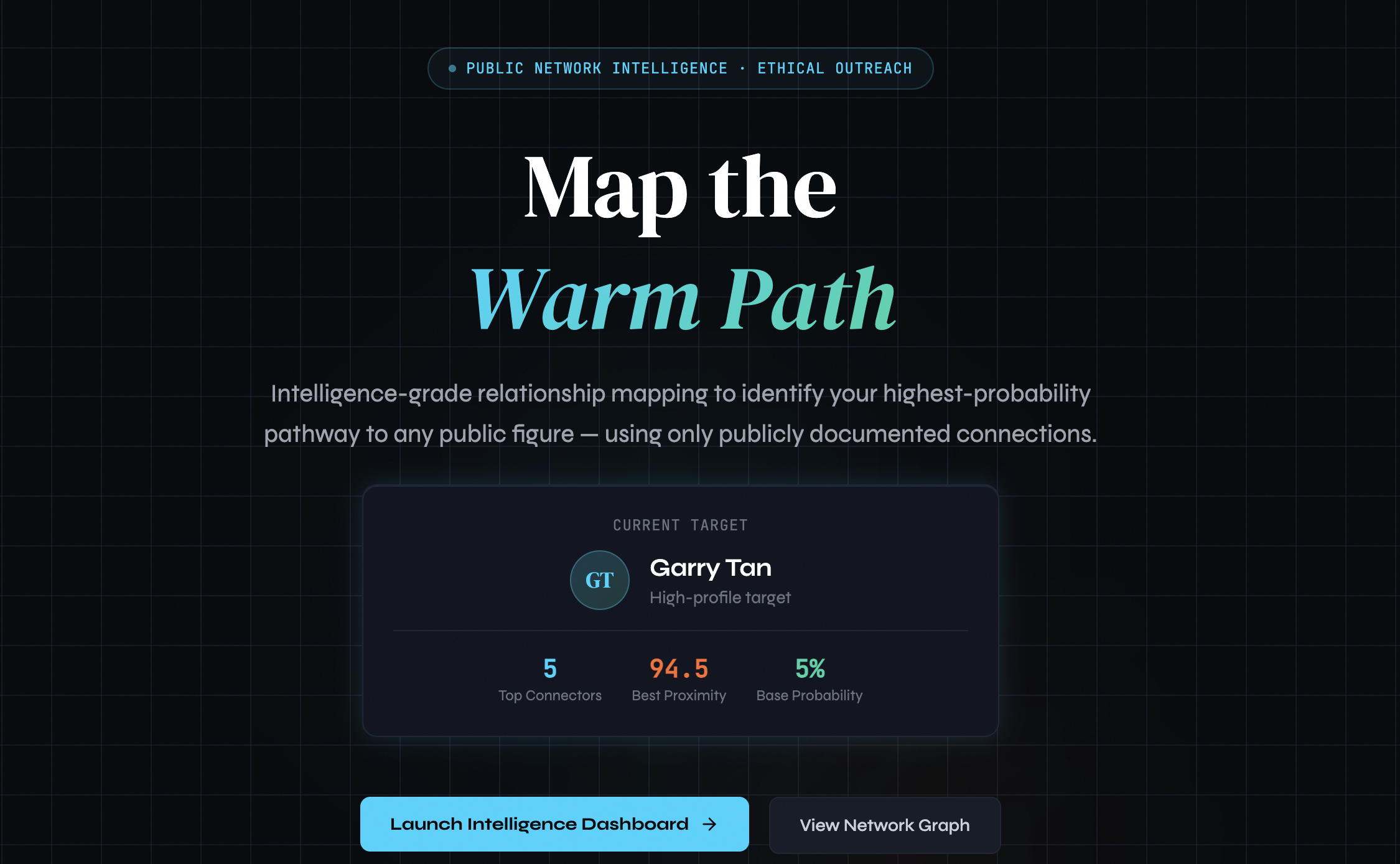
The hackathon challenged us to rethink how access actually works. Instead of relying on cold outreach or luck, we asked a different question: what if reaching someone influential is fundamentally a network problem? In real life, opportunities often come through shared affiliations, partnerships, and trusted introductions. That insight led to WarmPath, a tool designed to identify the strongest possible connection path using publicly visible relationships.
What it does
WarmPath models people and organizations as a graph where nodes represent entities and edges represent public relationships. It uses Anthropic's Claude API to research a target's public network and identify the most credible connectors, then ranks them using a weighted scoring function that considers relationship strength, accessibility, and proximity.
The system prioritizes shorter, stronger, and more recent ties. Instead of suggesting random outreach, it surfaces the warmest and most credible path for strategic communication and lets you send outreach emails directly from the platform.
How we built it
- Frontend: Next.js, React, TypeScript, Tailwind CSS, Framer Motion
- Graph Visualization: D3.js
- Backend/Database: Supabase (PostgreSQL with row-level security)
- AI Engine: Anthropic Claude API for real-time public relationship research
- Email Outreach: Nodemailer with Gmail SMTP
- Deployment: Vercel
Supabase stores entities and relationships in PostgreSQL tables structured to behave like a graph. Claude powers the AI Intelligence engine, researching public relationships and generating ranked connector strategies in real time.
Challenges we ran into
- Simulating graph traversal efficiently in SQL without native graph database tooling
- Designing a scoring system that meaningfully differentiates strong ties from weak ones, which required multiple iterations
- Working around Supabase's row-level security policies to ensure features like outreach logging worked for both authenticated and unauthenticated users, which led us to build server-side API routes with admin-level access
- Carefully defining ethical constraints to ensure the system only uses publicly available data and does not promote invasive behavior
Accomplishments that we're proud of
- Built a functional relationship intelligence engine within a short hackathon timeframe
- The Supabase schema is scalable, the Claude-powered ranking logic produces realistic results, and the interface is clean and intuitive
- WarmPath promotes thoughtful, strategic outreach rather than spam or manipulation
- Users can go from research to sending an actual email in a single workflow
What we learned
We learned that access is often about structure rather than visibility. Modeling relationships as a graph clarified how influence flows and how quickly it decays across longer chains. We also gained deeper experience optimizing relational databases for graph-like problems, integrating LLMs into real-time research workflows, and designing algorithms under time pressure.
What's next for WarmPath
Next we plan to move beyond heuristic weighting and incorporate formal probability models to estimate introduction likelihood:
- Markov Chain Model where each relationship transition has a probability value and the overall path likelihood is the product of transition probabilities
- Bayesian Inference to update edge probabilities based on observed outcomes such as response rates
- Personalized PageRank to model influence diffusion through the network for global node ranking
- Stochastic Block Models to detect community structure and predict latent ties
- Logistic Regression / Gradient-Boosted Models to learn edge strength from historical interaction data
These additions would transform WarmPath from a scoring engine into a probabilistic relationship intelligence system grounded in network science.
Built With
- anthropic-claude-api
- d3.js
- framer-motion
- gmail-smtp
- lucide
- next.js
- node.js
- nodemailer
- postgresql
- react
- supabase
- tailwind-css
- typescript
- vercel


Log in or sign up for Devpost to join the conversation.