Inspiration
- Every screen-time app makes you set the limits. Nobody knows their limits in advance.
- You always dismiss the alert you configured yourself.
- What actually stops a doomscroll is a person. Screen Time has never texted your friend.
What it does
- No setup. No limits, no schedules, no blocklists.
- Learns your baseline. 14 days of your own sessions per app. "Too long" is relative to you.
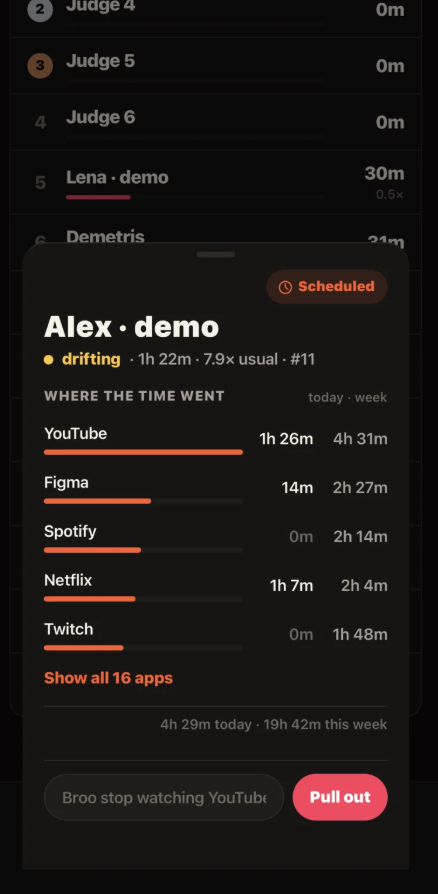
- Decides every 30 seconds. Stay quiet, nudge you, or escalate to a friend.
- Picks the right friend. The one most likely to get through to you at this hour.
- Friends pull you out. One tap. Your phone buzzes and the feed stops loading.
- Speaks. Nudges play in an ElevenLabs voice, not another silent banner.
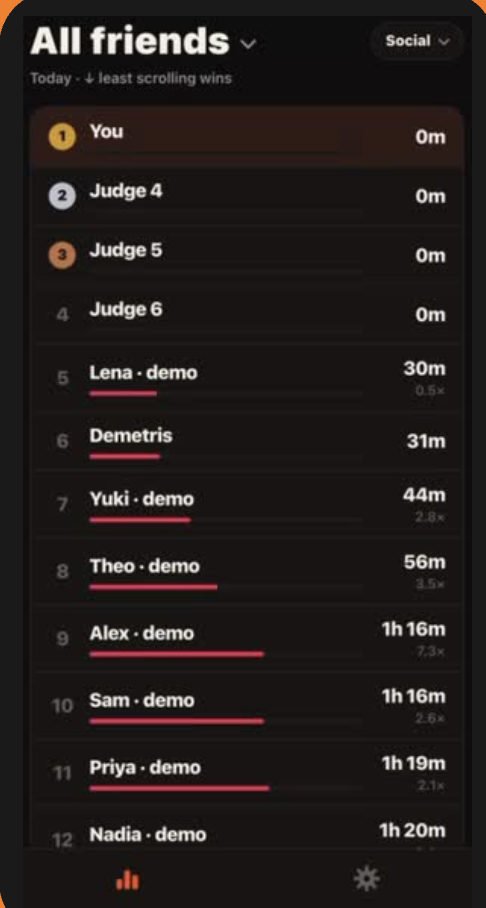
- Leaderboards. Least scrolling wins. Most focus wins.
How we built it
The agent
- A plain function scores each open session
fine / drifting / problemfrom your p50/p90 session length, time of day, and today's total. The model never decides whether something is anomalous. - Claude Opus 5 decides what to do about it and writes the line you read, as structured JSON.
- Guardrails are in code, not the prompt: one nudge per 20 min, never escalate before a nudge fails, 2 escalations a day max, never escalate to a friend who is themselves doomscrolling. On any model failure it falls back to a deterministic policy.
- Choosing the friend is a bandit. Each friend has a Beta posterior per 4-hour bucket; we Thompson-sample. Outcomes score themselves: did the session end within 5 minutes?
Getting screen time off an iPhone with no paid Apple account
- Screen Time APIs need a paid developer account. We had none, so we built two capture paths:
- iOS Shortcuts automations — "when Instagram opens/closes, POST here". Exact session boundaries, no App Store.
- An encrypted-DNS profile pointing the phone at our own AdGuard Home. That's also what makes a pull-out real: we block that one service for that one phone and the feed stops loading.
Notifications with no Apple account
- An installable PWA plus Web Push. Real lock-screen notifications on four iPhones, no App Store, no developer account.
Stack: Python, FastAPI, SQLAlchemy, SQLite · Expo / React Native exported to web · ElevenLabs · AdGuard Home (DNS-over-HTTPS) · nginx + DigitalOcean.
Challenges we ran into
- No paid Apple account. Both capture paths above exist because of that one constraint.
- We spammed ourselves with ~50 notifications. An escalation with no available friend fell back to a nudge and skipped the cooldown. Now it holds quiet instead.
- One duplicate row silently killed the agent. A failed insert rolled back the whole tick, every 5 seconds, for hours. No crash, no alert, just an agent that had stopped thinking.
- iOS refuses to play audio a page starts. Our voice nudges generated perfectly and played never.
Accomplishments
- Real screen-time capture and real push notifications on stock iPhones, with no paid Apple account and nothing from an App Store.
- A pull-out that isn't a suggestion — the feed actually stops.
- An LLM in the loop that can't spam you, because every hard limit is enforced around it.
What we learned
- Put the model where judgment is needed and nowhere else. Detecting an anomaly is a function. Knowing that 40 minutes at 2am means something different than 40 minutes at lunch is a model.
- Every spam bug we had was in our code around the model, not the model.
- Platform limits are design input. "No paid Apple account" produced a better idea than the entitlement would have.
What's next
- Verified humans as partners, so your accountability partner can't be a bot.
- A real time-series database for the minute-level data.
- Learn the message that works on you, not just the friend.
Built With
python fastapi sqlalchemy sqlite typescript react-native expo pwa
claude anthropic elevenlabs web-push adguard-home dns-over-https
ios-shortcuts nginx digitalocean
Try it out
https://nudge.aegist.dev — tap "Continue as guest (demo)". You land in a group with the team (marked "hacker") and can pull us out of our own apps. It really does buzz our phones. Add to Home Screen for notifications.
Built With
- claude
- claude-api
- claude-code
- next.js
- node.js
- pdf.js
- react
- serper-api
- tailwind-css
- typescript


Log in or sign up for Devpost to join the conversation.