-
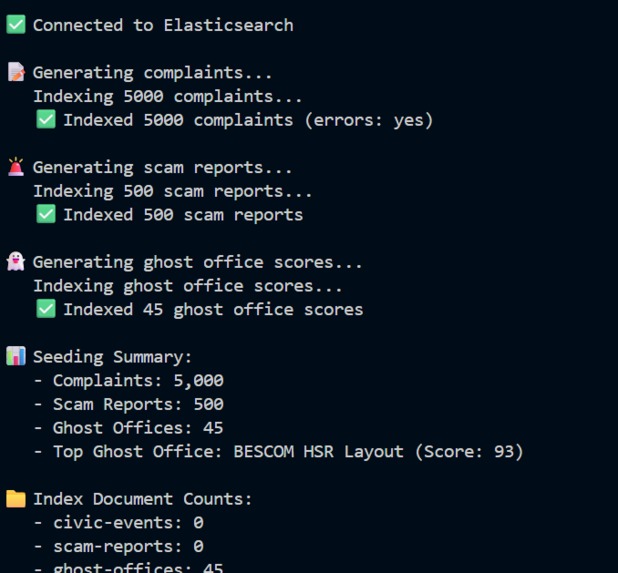
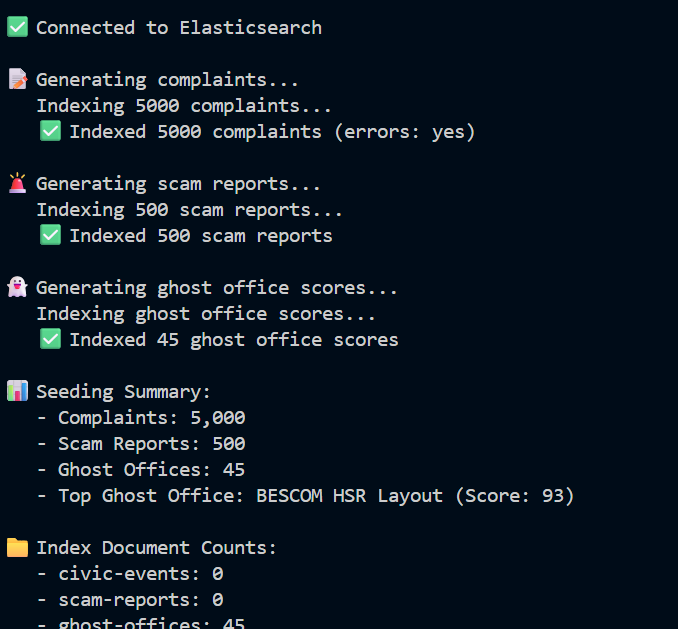
Seeding
WardWatch — Observability for Bengaluru’s Civic Infrastructure
Inspiration
Living in Bengaluru means constantly dealing with fragmented civic systems. A simple issue like a water leakage, power outage, or road complaint can bounce between BBMP, BWSSB, BESCOM, and local ward offices for days or even weeks without accountability. Most citizens don’t know:
- where their complaint is stuck,
- who is responsible,
- or whether any real action is happening.
At the same time, outages and civic disruptions often create confusion that scammers exploit through fake payment links, phishing SMSes, and impersonation calls targeting residents and elderly citizens.
I realized this is fundamentally an observability problem.
Modern engineering teams use observability platforms to trace failures across distributed systems. I asked ourselves:
What if Bengaluru’s civic infrastructure could be monitored the same way?
That idea became WardWatch.
What It Does
WardWatch is an Elastic-powered civic observability platform that tracks how civic complaints move across departments and identifies where accountability disappears.
Instead of treating complaints as isolated tickets, WardWatch reconstructs the full lifecycle of a civic issue:
- where it was routed,
- how long it remained inactive,
- whether it entered escalation loops,
- and whether suspicious activity emerged nearby.
The platform also detects civic fraud patterns during outages by correlating:
- scam reports,
- outage notices,
- geographic clusters,
- and suspicious payment requests.
For example:
If a BESCOM outage occurs in a ward and multiple users report fake electricity payment SMSes in the same area, WardWatch flags it as a potential coordinated scam spike.
How I Built It
I modeled civic complaints like distributed system traces.
Using Elastic, I built a unified operational intelligence layer for civic workflows.
Elastic Stack
I used:
- Elasticsearch for storing and correlating civic events
- Kibana for dashboards and observability visualizations
- Elastic Maps for geo intelligence and ward-level heatmaps
- Vector Search (kNN) for semantic complaint similarity
- Ingest Pipelines for normalizing messy civic data
- Aggregations and transforms for ghost office scoring
- Watchers and alerts for anomaly detection workflows
AWS
I integrated:
- AWS Bedrock (Claude + Titan embeddings) for summaries and semantic retrieval
- AWS Lambda for event-driven anomaly scans
- Amazon S3 for civic document and report storage
- EventBridge for scheduled workflows
- CloudWatch for monitoring
- SNS for alert notifications
Orchestration Layer
I implemented an OpenClaw-inspired orchestration workflow where specialized agents handle:
- complaint tracing,
- fraud analysis,
- escalation recommendations,
- and civic intelligence summaries.
Key Features
Ghost Office Detection
WardWatch identifies “Ghost Offices” — accountability dead zones where complaints stagnate, endlessly transfer between departments, or silently disappear.
Civic Trace Reconstruction
I visualize complaint journeys like observability traces:
Citizen → BBMP → BWSSB → Ward Office → No Activity

TrustLens Fraud Intelligence

Users can verify suspicious civic-related payment messages and links during outages and disruptions.

Geo Intelligence

Ward-level heatmaps reveal:

unresolved complaint clusters,
outage zones,
and scam hotspots across Bengaluru.
Actionable Outputs

Every insight leads to a concrete next step:

escalation recommendations,
RTI draft generation,
responsible department identification,
and fraud reporting guidance.
Challenges We Faced

One of the biggest challenges was designing a system that felt operationally realistic instead of becoming “just another chatbot.”

We had to rethink civic governance as a distributed system and map observability concepts like traces, anomaly detection, and event correlation into real-world civic workflows.

Another challenge was handling fragmented and inconsistent civic data. Different departments use different formats, statuses, and naming conventions, so building ingest pipelines and normalized event schemas became a core part of the architecture.

Balancing security, actionability, and simplicity was also difficult. We wanted scam detection to feel grounded and useful without turning the project into generic cybersecurity software.

What We Learned

Through WardWatch, we learned how observability engineering principles can extend far beyond traditional software systems.

We explored:

event-driven architectures,
Elastic-based analytics,
semantic retrieval pipelines,
geo intelligence,
and multi-step orchestration workflows for public infrastructure systems.

Most importantly, we learned that civic technology becomes far more impactful when it doesn’t just provide information — but exposes accountability gaps and helps citizens take action.

Future Scope

I envision WardWatch evolving into:

a real-time civic observability platform for Indian cities,
multilingual citizen assistance,
predictive civic failure analysis,
ward-level accountability scoring,
and direct integrations with official grievance systems.

In the future, WardWatch could help not only citizens, but also municipal bodies identify operational bottlenecks, improve transparency, and respond proactively to infrastructure failures.

Built With
Next.js
TypeScript
TailwindCSS
FastAPI
Elasticsearch
Elastic Vector Search
AWS Bedrock
AWS Lambda
Amazon S3
Amazon EventBridge
Amazon CloudWatch
Amazon SNS
OpenClaw-inspired orchestration
Python
Docker
REST APIs
Built With
- amazon-sns
- amazon-web-services
- bedrock
- elastic
- iam
- javascript
- next
- react
- s3
- sonnet


Log in or sign up for Devpost to join the conversation.