Inspiration
I run a few small services on one VM. Monitoring wakes me up; it does not do anything. And the thing it wakes me up for is almost always the same four steps, in the same order: is the process actually running, what does the log say, what deployed recently, does the smallest reversible act fix it. At 3am, on a phone, I am a slow and error-prone shell script.
The reason nobody automates those four steps is that the automation is scarier than the outage. An agent with a shell on a production box is a new and worse problem. So I built the boundaries first and the agent second. Warden is what is left when you decide, up front, that the agent does not get to choose what it is allowed to do, and does not get to decide whether it worked.
What it does
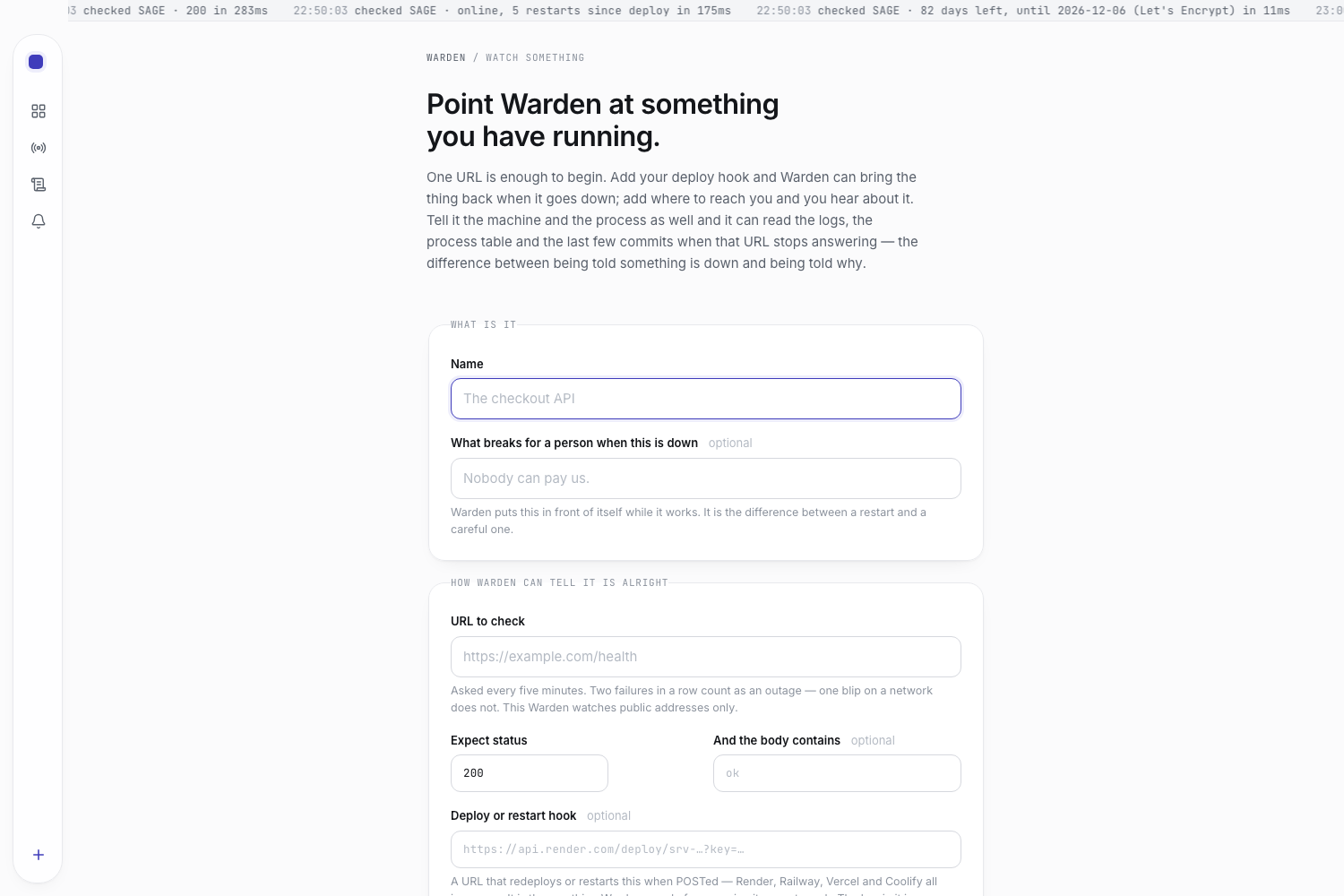
You give Warden three things, and only the first is required: a URL, your deploy hook (Render, Railway, Vercel, Fly and Coolify each issue one; none of them has an on-call engineer), and where to reach you. It watches the URL on a clock, with nobody present. When a check has failed its threshold number of times in a row — two, by default, so one blip is not an outage — it opens an incident and hands it straight to an agent. A service that is only a URL is diagnosed over the network: does the name resolve, what answers, is it a proxy's error page or the app's own — and it is brought back by its deploy hook when the rules allow, then checked again before Warden says it is back. A webhook can be given at registration, so a stranger who hands over a URL hears about the first problem rather than finding it in the morning.
The agent investigates: the process table, the logs, recent commits, the diff of a suspicious one, a specific file the evidence pointed it at. It gets ten looks, because the service is down while it reads. Then it must commit to a cause and say how sure it is.
If it is sure enough, a second agent picks the smallest act the diagnosis supports and asks to do it. What happens next is not the agent's decision. A per-service policy, written by a human, either allows it, refuses it and names the rule that refused it, or stops the run and asks — a real halt, held in the database, resumable hours later from another process.
Then the part that makes it a product instead of a demo: Warden re-runs the exact check that failed. A clean reading closes the incident and its id is stored as the proof. Anything else and the incident escalates, saying plainly that Warden acted but is not calling this fixed.
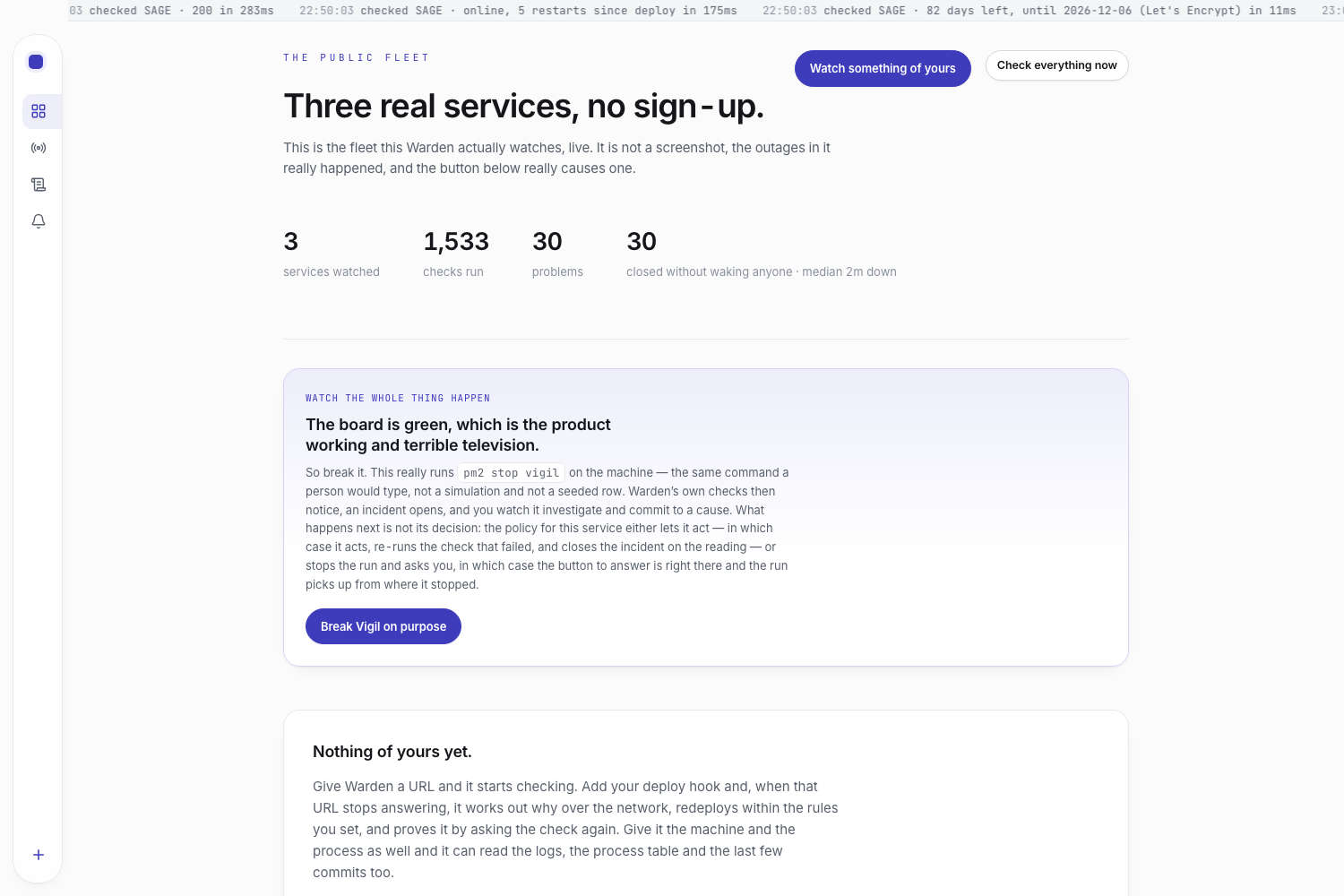
Judges: there is a button on the front page that breaks it. A working operator has a boring
board, which is a real presentation problem, and the honest answer to it is a real outage rather
than a video. If the fleet is quiet, Break Vigil on purpose on /fleet runs pm2 stop vigil on the
actual machine; Warden's own checks notice, an incident opens, and you land on it with the run streaming.
Ninety seconds, nothing recorded. Which service that button may touch is one function with the
reasons written down and its own test file — never SAGE, never Warden's own console, never anything
a visitor registered — and stopping is still not one of Warden's own operations.
There is a front door, a dashboard you live in, and a way back in. The landing is one arc in five
scenes with a live panel beside the words that is the real fleet. The app sits behind a hover-expand
rail — /fleet for what is happening now, /incidents for what has gone wrong, /activity for
every operation with the rule that permitted it, /settings for where Warden reaches you. And
because there is no account to lose, /start issues a recovery key: the signed cookie written
down, so a cleared browser or a second laptop is not the end of your fleet.
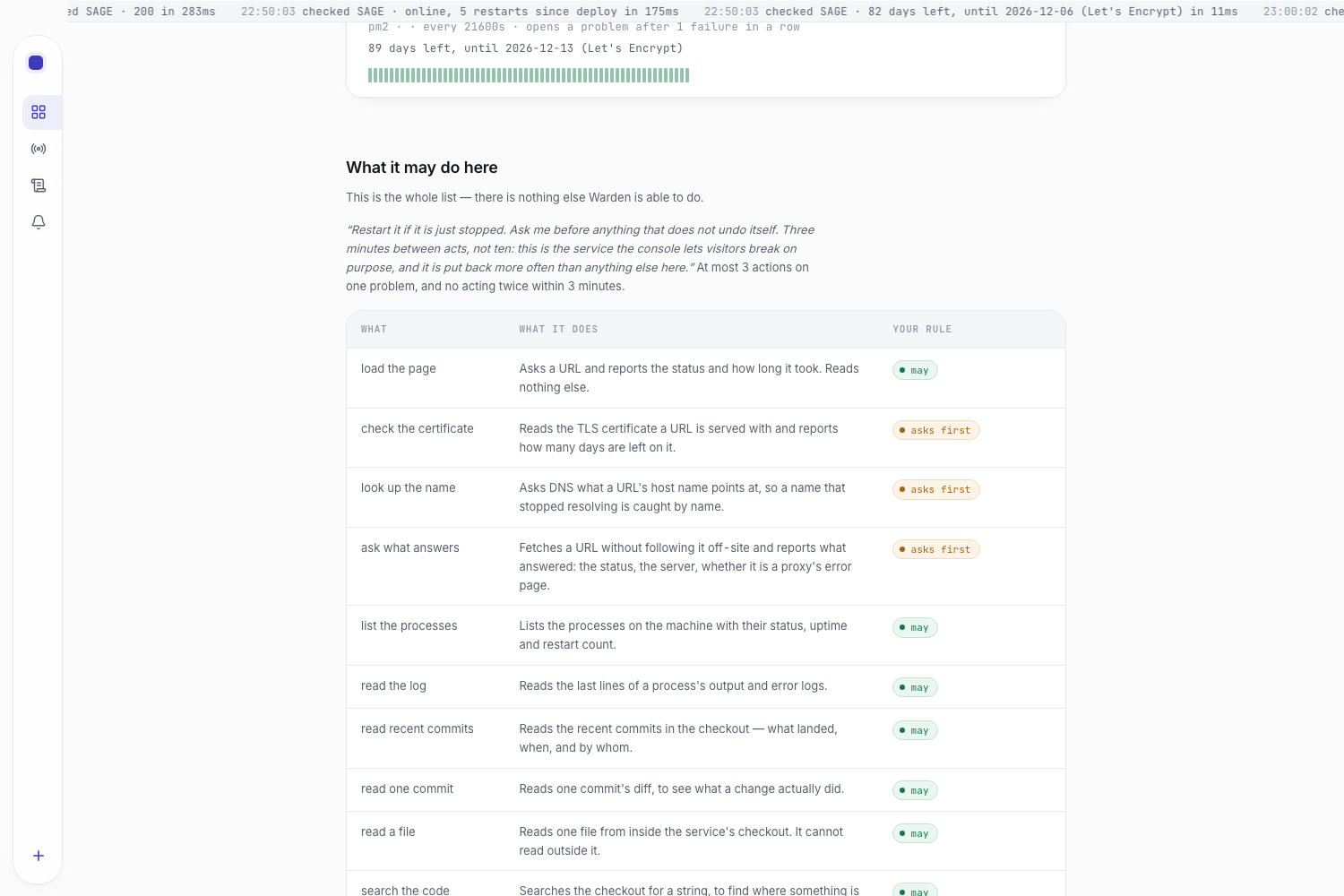
And you can use it on your own things in under a minute. Press Watch something of yours, give it a URL, and that is the sign-up: a signed cookie makes the service yours and the next sweep picks it up. Everything after that is in the console — the policy editor, where all twenty operations sit with a sentence each saying what granting it actually means, with the four forbidden ones shown locked rather than hidden; adding and retiring checks; check it now, which streams each probe as it answers; and the page where you say how Warden should reach you when it stops. There is a CLI and it does the same things, because the same functions are behind both, but nothing about running Warden requires a terminal.
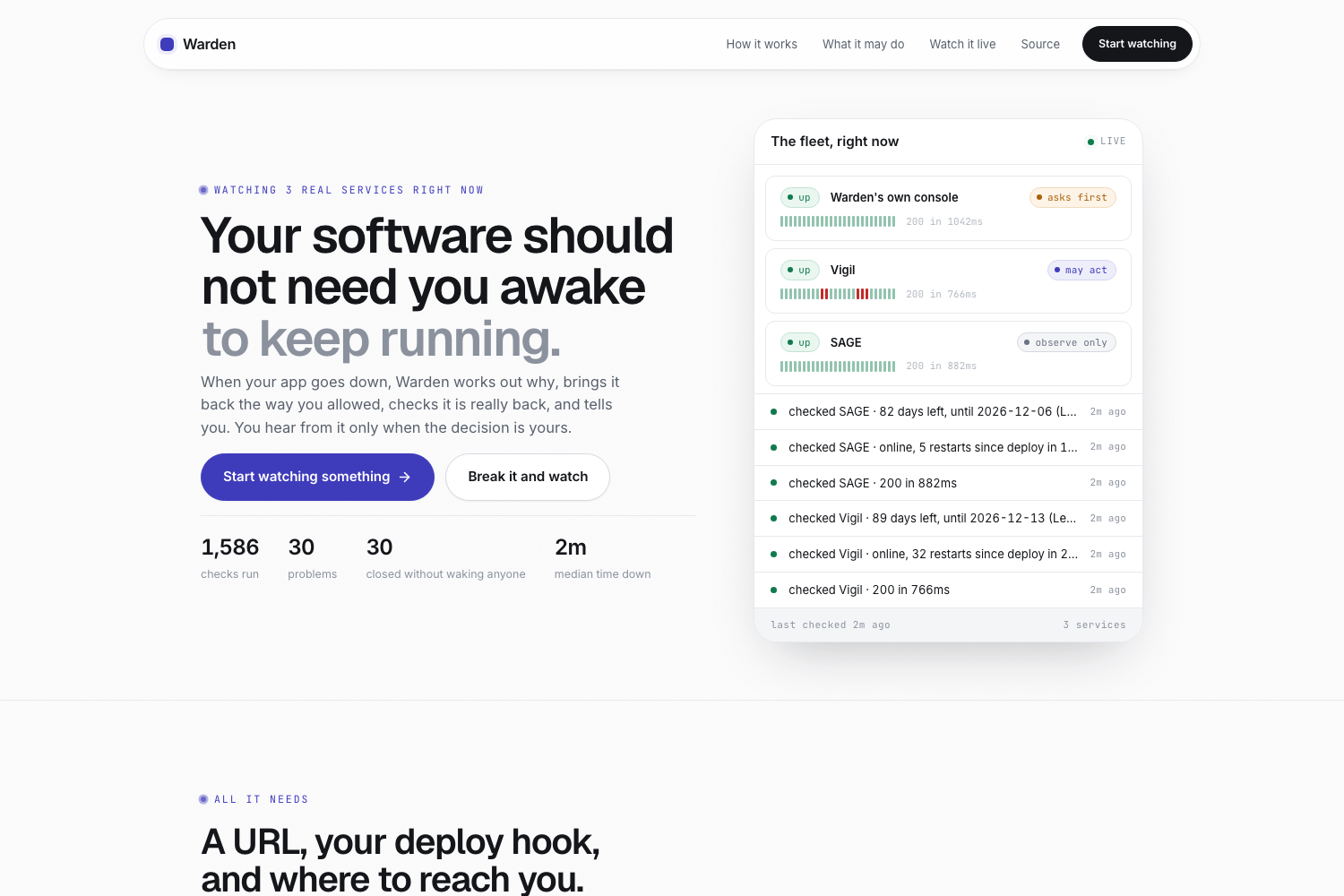
It is currently watching three real services on one VM — its own console, a public site called
Vigil, and SAGE, which belongs to someone else and is registered OBSERVE_ONLY: every read allowed,
every act refused by name, action cap zero. That last one is the product in one card. You can point
an operator at something you are allowed to look at and not allowed to touch, and the policy is
where you say so. Those three are public to watch and writable by nobody — canEdit has no branch
for them, which is the only reason it is safe to leave the fleet open.
When it stops, it tells you. An address is a URL it POSTs to, so a Slack or Discord incoming webhook works with nothing to install, and so does anything you wrote yourself. It sends when it stopped to ask you, when it acted and the check still fails, and when it is handing the problem back — and only to addresses that asked for everything does it mention something it already fixed, because that is news, not an interruption.
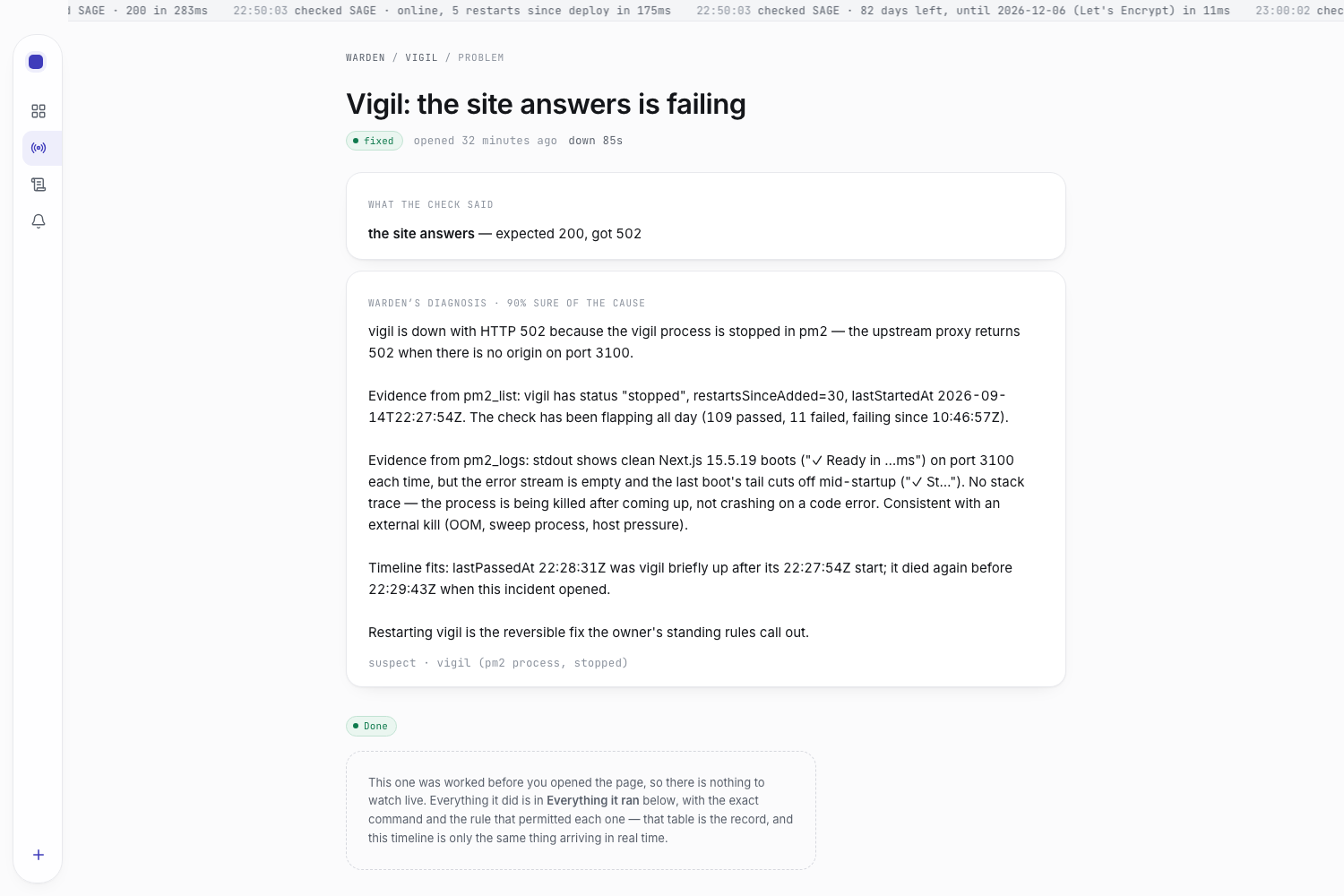
A real run, from the audit table on the live site: Vigil was stopped on purpose. Warden read the
process table, both log streams and the recent commits, and diagnosed a stopped process at 85%
confidence — saying plainly that it could not name the trigger from the logs, and citing a standing
rule a person had left behind on an earlier incident — the policy returned allow under rule policy-may, it ran
pm2 start vigil in 371ms, re-ran the failing probe, got 200 in 207ms, and closed the incident
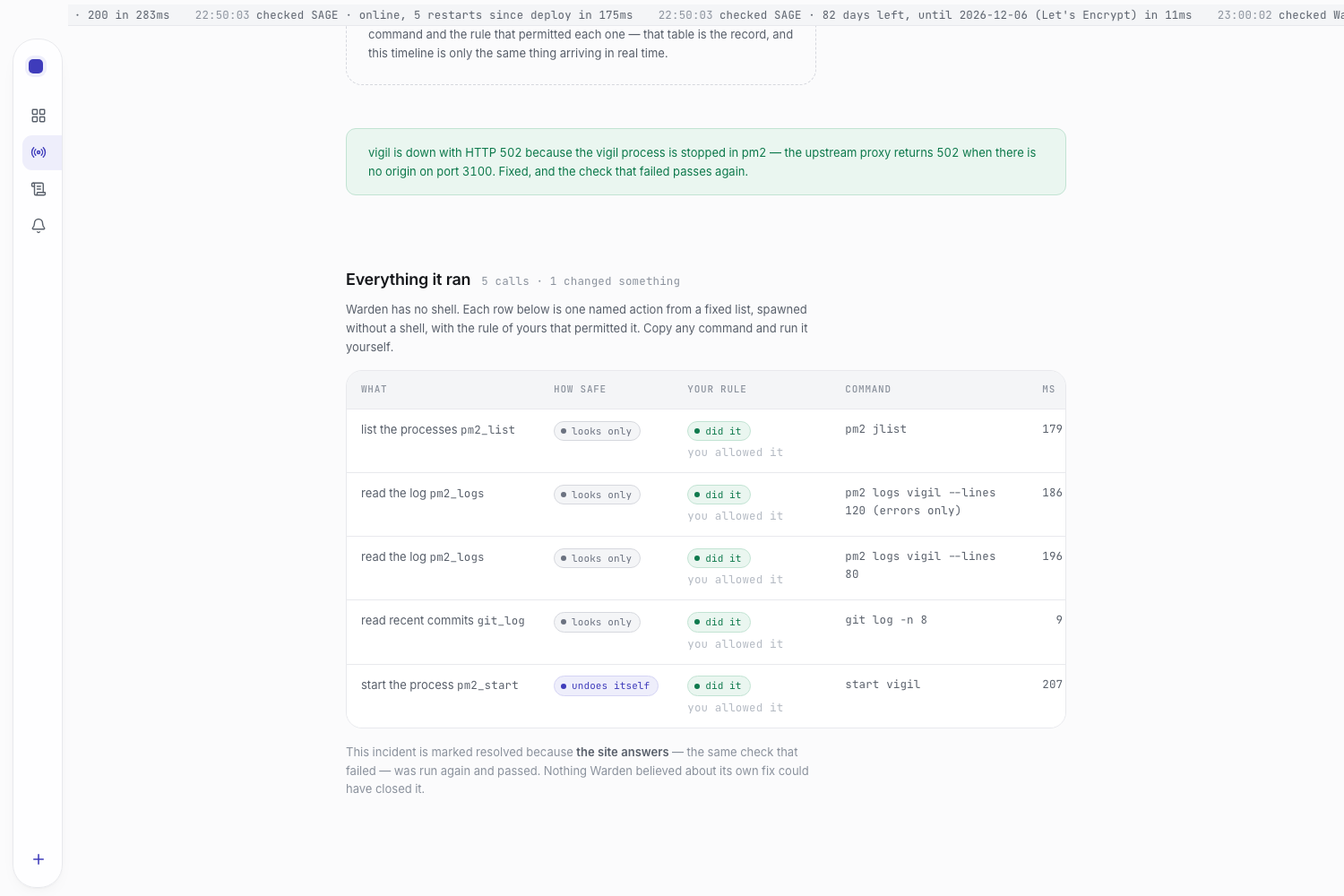
after 60 seconds down. One row in that audit table is a refusal: it tried to read the pm2 log file,
which lives outside the service's checkout, and the operation refused it.
What I had to get right before any of that could ship
Letting a browser write to this changed the threat model completely. Until then, registering a service meant editing a file on the machine Warden runs on, so whoever did it already had a shell there. Three boundaries, with a test file that attacks each one:
- A probe is a server-side fetch on a timer, which is the shape of every SSRF ever written. The
cloud metadata addresses are refused on every instance, always — there is no configuration that
turns that off, because the thing on the other end is the machine's own credentials. Everything
else private is refused unless the operator opts in. Node keeps the brackets on an IPv6 hostname,
so
[fd00:ec2::254]slipped past the always-refuse rule until a test caught it. - A form never names an ssh key file. Keys are chosen by nickname from a list the operator configured on the server; the path never touches the browser. Unset — which is what the public instance runs — the console can register services watched over http but cannot reach a machine.
- A policy arriving from a form is sanitised before it is stored. Not because
decide()would ever honour a forbidden operation — it refuses them by risk, whatever the policy says — but because a stored policy claiming to grantdelete_datawould be rendered as granted, and somebody would reasonably believe they had granted it.
How I built it
Warden is built on the Strands Agents SDK (TypeScript), and the SDK's shape is the product's
shape. One incident is a Strands Graph with two agents — investigate and remedy — joined by a
conditional edge whose handler reads the live incident context and returns false unless a
diagnosis has been recorded with confidence ≥ 0.5. Warden cannot act on a hunch, because a hunch
never reaches the agent that can act.
The diagnosis is a tool call (record_diagnosis), not a structuredOutputSchema on the final
message, because three other things need to read it mid-run: the graph's edge, the act guard, and
the incident row.
When the policy says ask, the act tool raises context.interrupt() from inside the
callback. The run genuinely stops — stopReason: "interrupt" — and the question is written to a
decisions table. When a human answers, possibly hours later and certainly in another process, the
answer comes back as InterruptResponseContent and the agent finishes the thought it was
having; a SessionManager + LocalFileStorage is what lets the conversation outlive the
process.
The rules that no policy can switch off live in BeforeToolCallEvent / AfterToolCallEvent
hooks: no operation that does not exist, no acting before diagnosing, no second go at the same act,
no acting past a refusal. An InterventionHandler (TwoHandsOnly) states the same boundary
declaratively — six tools are allowed, anything whose name suggests a shell is denied. Model calls
across every live incident go through one queue implemented as InvokeModelStage middleware, so
the fan-out stays and a rate-limited gateway sees a bounded queue.
Amazon Bedrock is wired as the primary candidate of a Strands ModelRouter with a
FallbackStrategy behind it, with prompt caching on, and switches on with BEDROCK_MODEL_ID.
The deployed instance is not on Bedrock — it runs MiniMax-M3 through an OpenAI-compatible endpoint —
and the console prints which model actually ran each pass so the screen cannot claim otherwise.
Underneath all of it: Warden has no shell. It invokes one of 20 named operations from a fixed
catalogue, arguments validated by zod, spawned with execFile. Four of them (db_migrate,
delete_data, rotate_secret, destroy_infra) are declared forbidden rather than omitted, so the
product can show you the line — and decide() refuses forbidden risk before it consults the policy
at all, so no policy can grant them.
The sweep is pm2 cron every ten minutes; the console is Next.js with the run streaming over SSE; the ledger is SQLite through drizzle. 327 tests across 20 files, about a second, fully offline.
Challenges I ran into
A retry strategy cannot be shared. I constructed one DefaultModelRetryStrategy and attached it
to both agents. The SDK binds a strategy to the agent that owns it; the second agent got an error
rather than a retry. It is a factory function now.
The gateway's cost cap is a reservation, not a bill. Requests were failing with
429 quota exceeded (cap 0.5) before any tokens were generated. The gateway reserves
max_tokens × price against a per-request ceiling up front — a request asking for 8000 tokens was
refused while the identical one asking for 4000 went through. Nothing Warden writes is long, so the
ceiling costs nothing and a 429 costs a whole pass.
A guard that refused its own tool call. The no-second-go rule records an op:args signature
when an act is attempted and refuses a second attempt. The hook ran twice for one call, so the act
tripped its own guard and Warden refused to do the thing it had just decided to do. The signature is
keyed on toolUseId now: the call that created the entry is not refused by its own entry.
An agent that read its own last words. The remedy agent's session, which exists so a halted run can be resumed, survived into a fresh attempt at the same incident. It read its own earlier "I could not do anything here" and said it again, with more confidence the second time. The session is now cleared on a new attempt and kept on a resume — the distinction is the whole feature.
pm2's restart count is cumulative. The agent read "4 restarts" as a crash loop and refused to start a process that was simply stopped. What actually answers that question is Warden's own reading history for the failing check, which is now handed to the investigator explicitly.
The halt fired for the first time in production, and could not be answered. A restart fell
inside the cooldown, the policy returned ask, the run stopped holding the question — all correct.
Answering it threw Agent is in an interrupted state. The Strands interrupt id was held in an
in-memory map keyed by incident, and the id is generated inside the tool call that halts, in
whatever process is running then: the cron sweep, which prints the question and exits. The answer
arrives minutes later in the web app, a different process with an empty map, so the code fell back
to resuming with a prompt — which the SDK rightly refuses. Every test passed, because every test
halted and resumed inside one process, which is the one arrangement production never has. The
session on disk had the answer the whole time: initialize() replays it and the restored agent
knows which interrupt it is holding. If you build human-in-the-loop on Strands, assume from the
first line that the process raising an interrupt is not the process that answers it.
Opening the console opened a door I had already closed once. A service with no ssh key runs its
operations locally, and repo is chosen by whoever registers the service — so a stranger could
register {repo: "/home/ubuntu/warden", process: "warden"} and point read_file at Warden's own
checkout, where the .env is. The path containment in operations.ts is no defence, because the
containment is relative to a repo the attacker named. It was a real hole on my own instance for
about an hour and I verified it there before fixing it. The general shape is worth more than the
specific bug: every boundary in a system was drawn against an assumption about who is on the other
side of it, and none of them re-derive themselves when you let a new kind of person in.
macOS unix sockets are capped near 104 bytes. ssh connection multiplexing died with
unix_listener: path too long on every single call, because the default ControlPath combines the
per-user TMPDIR with ssh's %C hash. A deliberately short path fixed it, and an investigation that
makes a dozen remote calls in a minute stopped paying a handshake for each one.
Accomplishments I'm proud of
The verification step. It would have been easy — and more impressive-looking in a demo — to let the agent report success. Instead an incident can only be closed by re-running the same probe that opened it, in code, with no model involved, and the reading's id is stored on the incident as the proof. The number the console shows for "down" is measured to that reading, not to the moment of the fix, which is the number an agent would prefer to report.
The red-team test. src/agent/__tests__/gates.test.ts takes a deliberately jailbroken sequence and
pushes each call through the real hook and the real tool callback, with execFile replaced by a
recorder and fetch by a spy that throws. After each attempt it asserts that nothing was spawned,
nothing left the machine, no model was called, and no row was written. Then it runs a control that
does all four, because a red-team test passing against a broken harness proves nothing.
And two bugs the test suite found on its own, both invisible from the outside: the AfterToolCall
hook read only textBlock while the act tool returns an object, so "no acting past a refusal"
never armed in production; and the sweep still read row.restarts after the parser renamed the field,
so every healthy reading rendered as "online, undefined restarts".
What I learned
An autonomous agent is mostly a question about who decides. I kept finding that the interesting work was not the prompt — it was moving a decision out of the model and into code where it could be tested: what may happen (the policy), whether it worked (the probe), what has already been tried (the actions table rather than the agent's memory), how long something was down (measured to a reading).
The corollary is that a good prompt is mostly a description of the boundaries the code already enforces. Every time I found myself writing "you must not…" into a system prompt, that was the signal to write it as a hook instead.
I also learned that honest escalation is a feature, not a fallback. The agent's give_up tool
exists so that "here is what I found, here is what I tried, here is what you need to do" is a
first-class outcome. An operator that escalates well at 3am has done a night's work.
What's next
- Move the deployed instance onto Bedrock and make the
ModelRouterfallback earn its keep in production rather than in configuration. - Exercise the disruptive path:
redeploy_previousisaskin the default policy and has not yet been the thing that fixed a real outage. - More probe kinds — a queue depth, a disk threshold. The certificate check that was on this list is built, and it turned out to be the most interesting one: it is the only check here that fails before anything is broken, and the only thing Warden can do properly for a service that is nothing but a URL.
- Something better than a signed cookie for identity. It is enough to keep one visitor's services out of another's hands and it is not an account: clear the cookie and they are unreachable.
- A second host, so the ssh path is tested somewhere other than the machine that also runs Warden.
For the judges
Live, no sign-up, nothing to install: https://getwarden.vercel.app (a clean front door that proxies to the machine the operator runs on) — and the board
itself is one click away at /fleet, public on purpose.
The claim you should be most sceptical of is "the policy is code, not a prompt". This command is the answer, and it needs no API key, no network and no model:
npm install --legacy-peer-deps
npx vitest run src/agent/__tests__/gates.test.ts
Three things to look at first, in this order:
- An incident page on the live site. Scroll to Everything it ran. Every row is one named operation with its risk, the policy verdict, the rule that decided it, the exact command and the exit time. Copy any command and run it yourself. At the bottom: the incident is resolved because the same check that failed was run again and passed.
src/lib/ops/policy.ts— about 150 lines, one pure function.decide()has no clock, no model and no network, which is whypolicy.test.tscan prove every branch of it by hand. Note the order of the branches: unknown before anything, forbidden before the policy is consulted at all,neverbeatingmay, caps last.src/agent/__tests__/gates.test.ts— the red team, described above. Then the control at the bottom of the file, which does the legitimate thing through the same harness.
If you want to watch it work end to end, the CLI prints the same run the console streams:
npx tsx --env-file=.env scripts/warden.ts register
npx tsx --env-file=.env scripts/warden.ts sweep
npx tsx --env-file=.env scripts/warden.ts handle <incidentId>
Honest limitations
- The deployed instance is not on Bedrock. Bedrock is wired as the primary of a
ModelRouterwith aFallbackStrategyand switches on withBEDROCK_MODEL_ID; the live instance runs MiniMax-M3 through an OpenAI-compatible gateway, and the console says which model ran. - It has fixed one class of failure in production: a process that is down. The catalogue can also run tests and roll back to the previous build. Neither has closed a real incident yet.
- The halt has fired once on the live fleet. A restart fell inside the cooldown, the rules said ask, the run stopped holding the question in the database, and the answer came minutes later from a different process: act in 318 ms, the check re-run and passed, closed after 17 minutes. Once is a proof, not a track record.
- Confidence is the model's self-report. The 0.5 floor keeps the obviously unsure from acting. It does not make a confident wrong answer right — that is what the probe is for, afterwards.
- One VM, three services, SQLite, no sign-up. Anything you register yourself sits behind a signed cookie. That is enough for what this is and would not be enough for a product with customers.
- This repository began on 8 September 2026 as a different product and was re-aimed twice. The git history is public and intact. The design tokens, the drizzle ledger shape, the SSE console and the Strands plumbing were carried forward; the catalogue, the policy, the guards, the graph, the verification step and every test named here are new.

Log in or sign up for Devpost to join the conversation.