
Inspiration
I run a small ERP (FastAPI + Postgres, double-entry ledger, Indian GST) on my own. A wrong number in a dashboard query or a missing tenant check reaches someone's books. Coding agents now write plausible fixes in minutes, so the bottleneck has moved from writing the fix to trusting it: a green test the agent wrote proves nothing if that test would have passed without the fix. I wanted an agent whose second half exists to doubt the first, and that shows its evidence instead of narrating confidence.
What it does
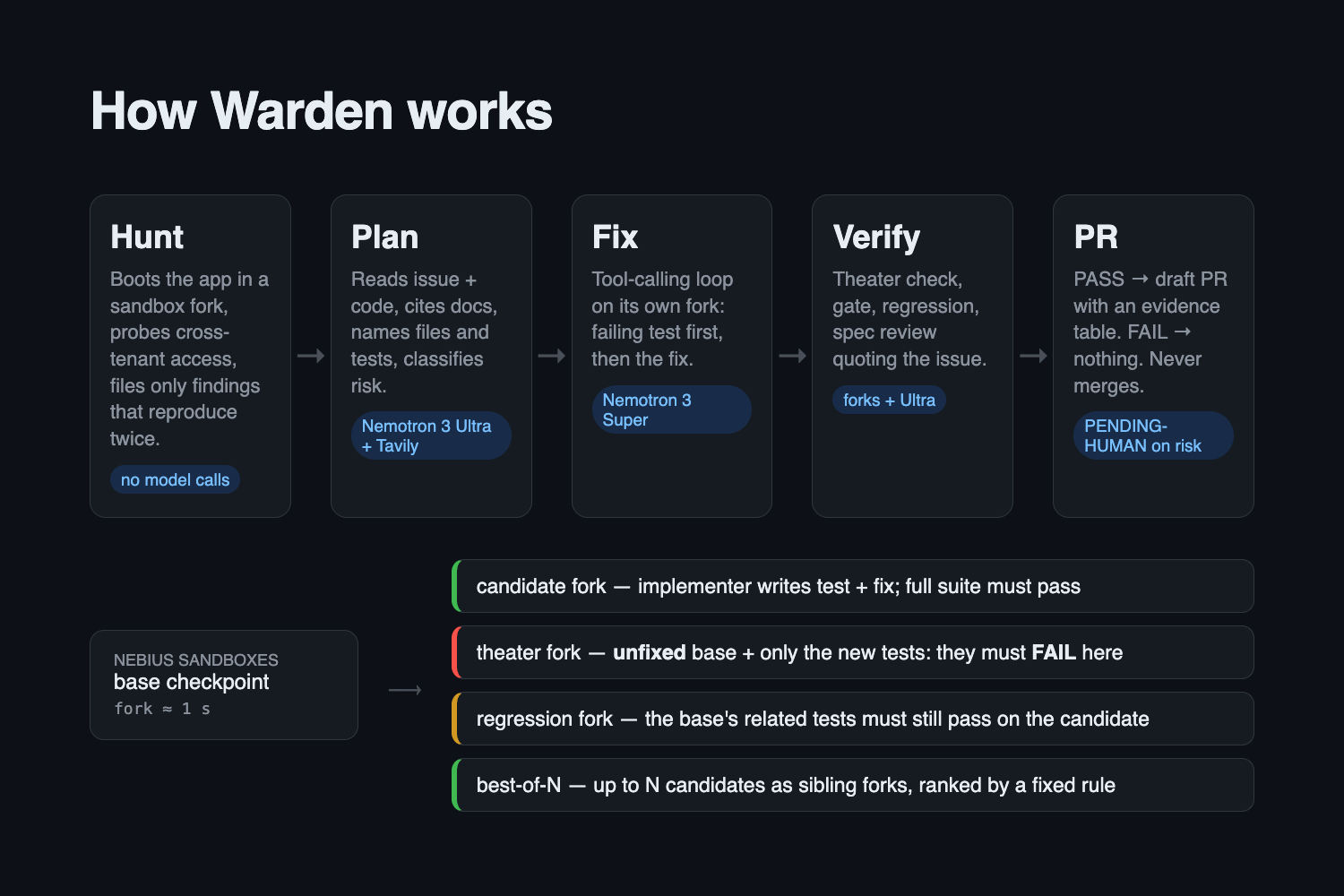
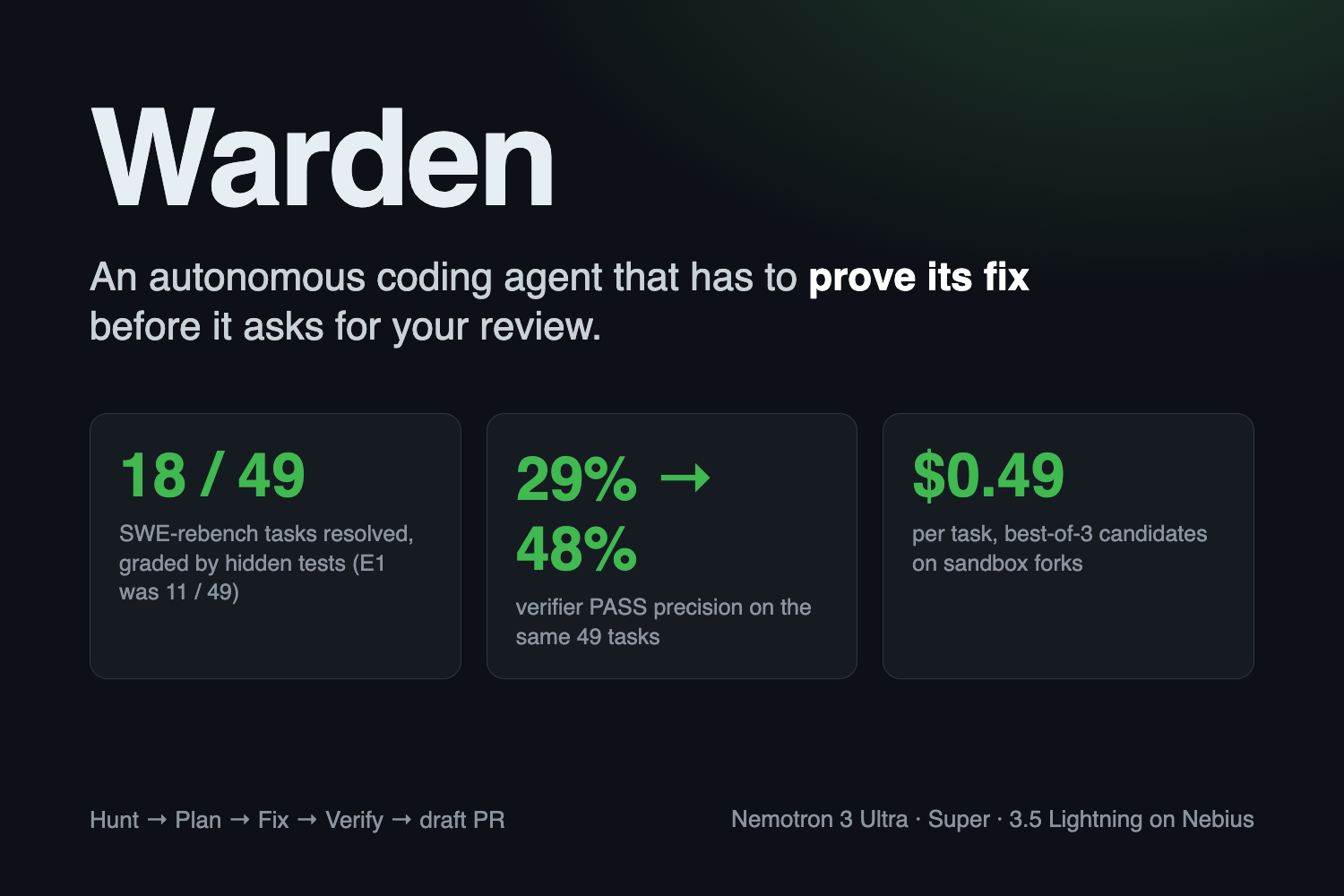
Warden runs Hunt → Plan → Fix → Verify → PR on one issue:
- Hunt (one axis so far, IDOR / cross-tenant): boots the app in a sandbox fork, signs up two tenants, enumerates id-taking endpoints from
/openapi.json, probes cross-org reads and cross-firm writes, and files an issue only for findings that reproduce twice. It uses no model calls. - Plan: Nemotron 3 Ultra reads the issue and the code in the sandbox, cites docs found with Tavily, names the files and tests, and classifies risk (money / tax / schema / security).
- Fix: Nemotron 3 Super, in a tool-calling loop on its own fork of a base sandbox checkpoint, writes a failing test first, then the fix.
- Verify: the implementer's word is never evidence. A candidate is FAIL unless:
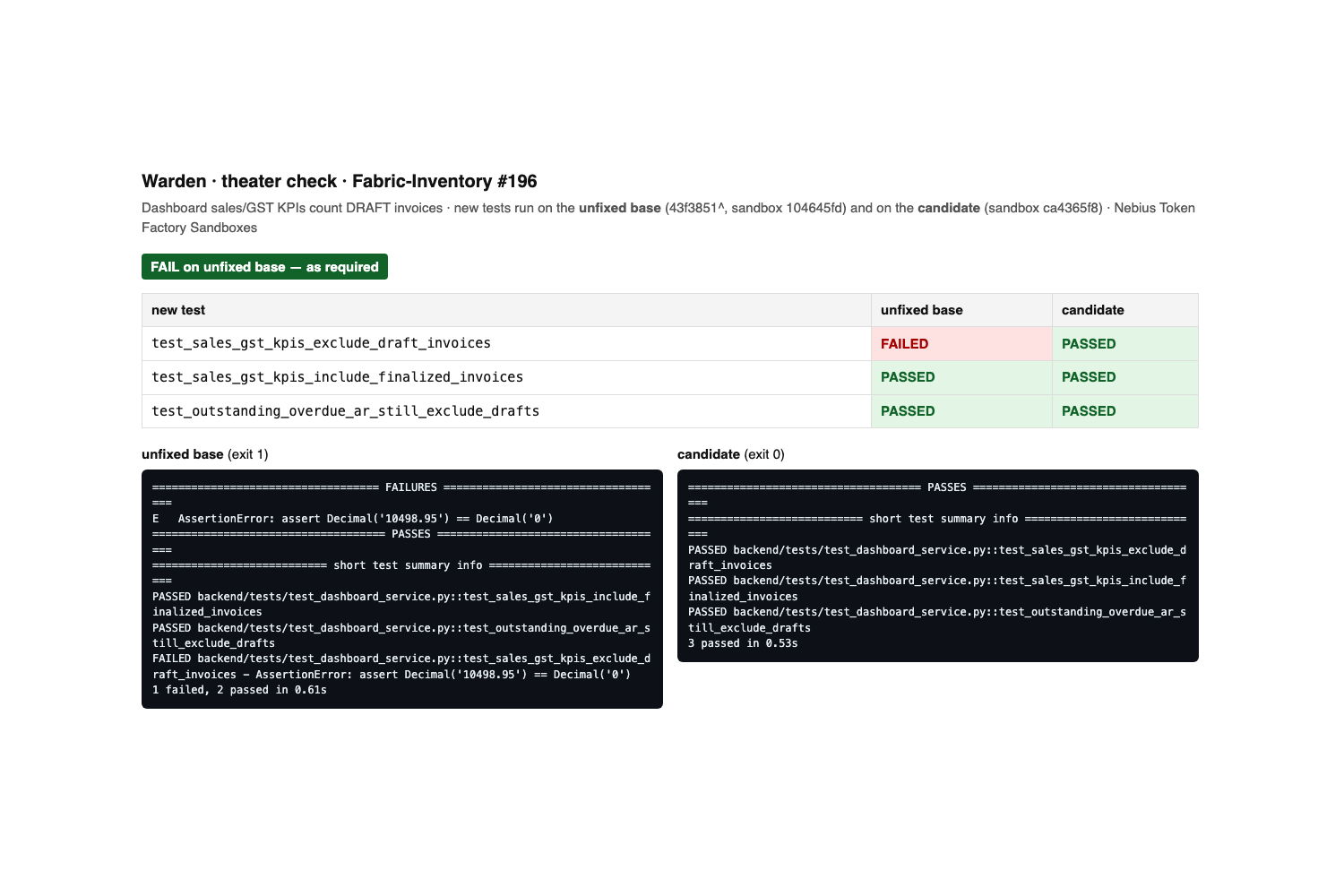
- the new tests fail on a fork of the unfixed base (the theater check);
- the suite and configured lint / type / migration / OpenAPI checks pass;
- the base's related tests still pass on the candidate;
- an Ultra spec review finds every behaviour the issue states implemented, quoting the issue verbatim.
Best-of-N runs up to N candidates on separate forks and picks one by a fixed rule.
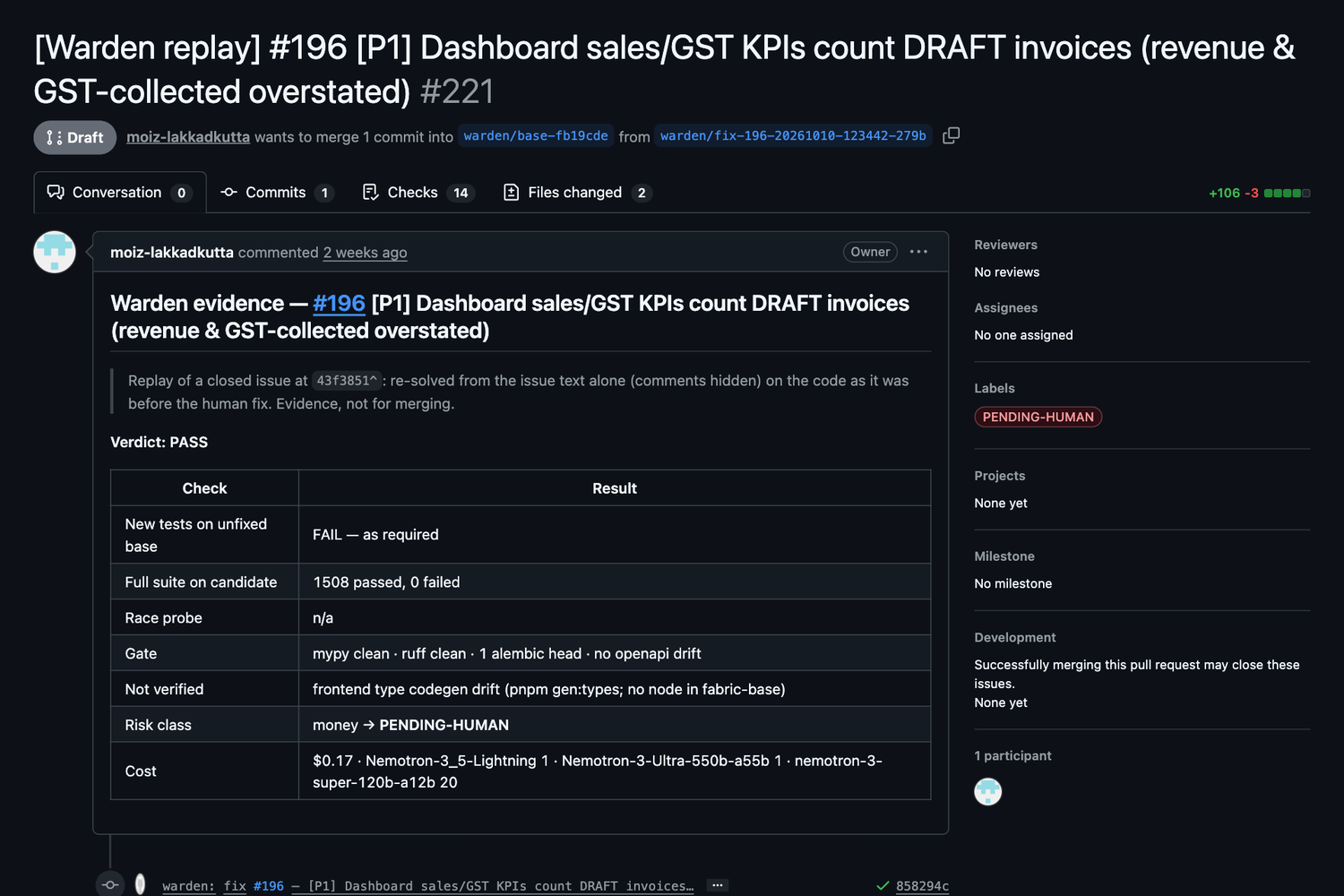
- PR: a PASS opens a draft PR whose body is the evidence table: each claim, the check behind it, and what was not verified. Risky changes are labelled
PENDING-HUMAN. A FAIL opens nothing. Warden never merges.
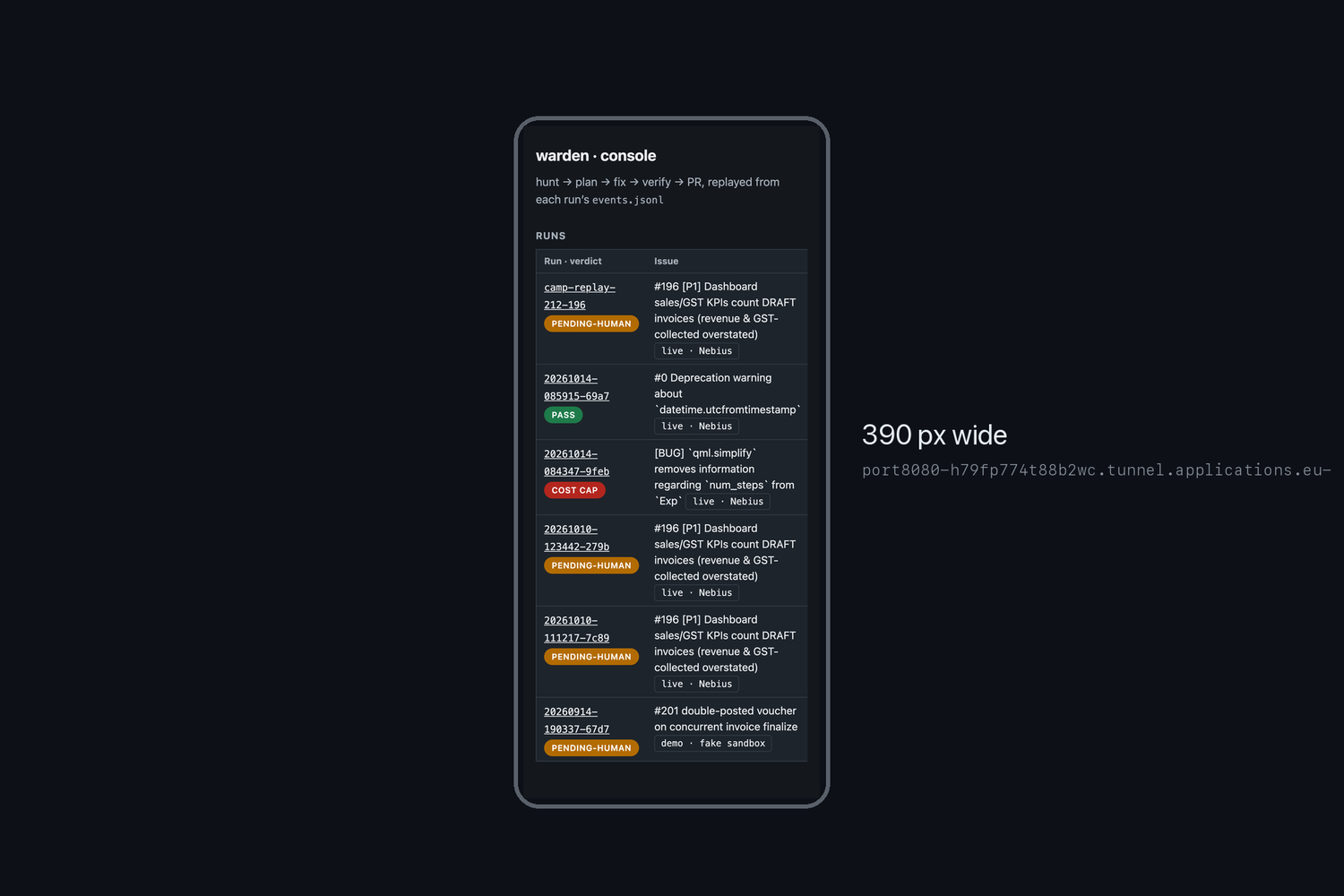
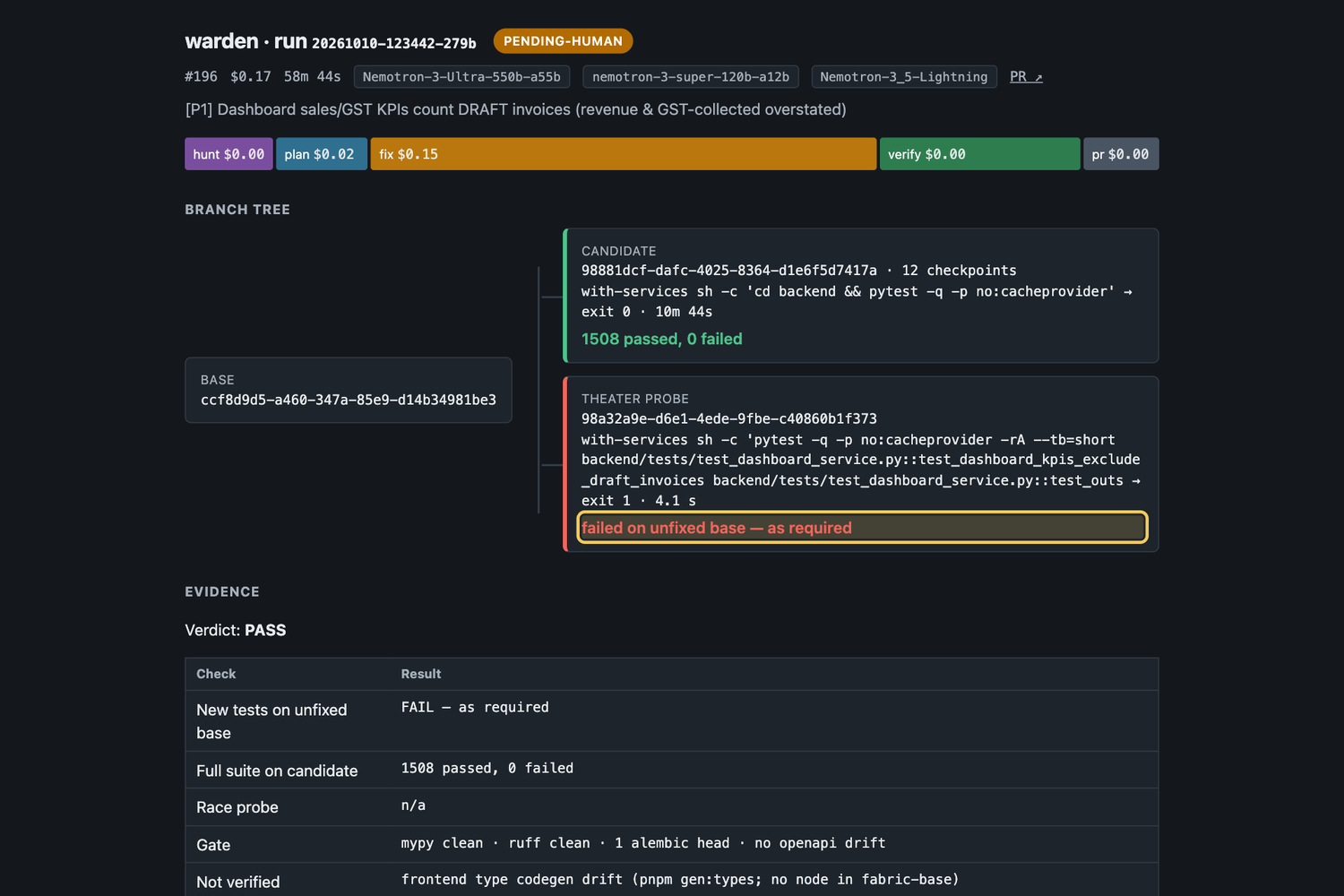
Every model call and sandbox step goes to events.jsonl with tokens, cost and time. warden console renders it as a page with the phase timeline, the fork tree, and the evidence table, and that console is live on Nebius. It also runs as a GitHub Action: label an issue warden and it opens a draft PR or comments why it didn't.
Try it (no keys needed)
- Live console on a Nebius Serverless AI endpoint: https://port8080-h79fp774t88b2wc.tunnel.applications.eu-west2.nebius.cloud/ · the run behind draft PR #221, with its sandbox fork tree, per-call cost and evidence table: https://port8080-h79fp774t88b2wc.tunnel.applications.eu-west2.nebius.cloud/20261010-123442-279b/
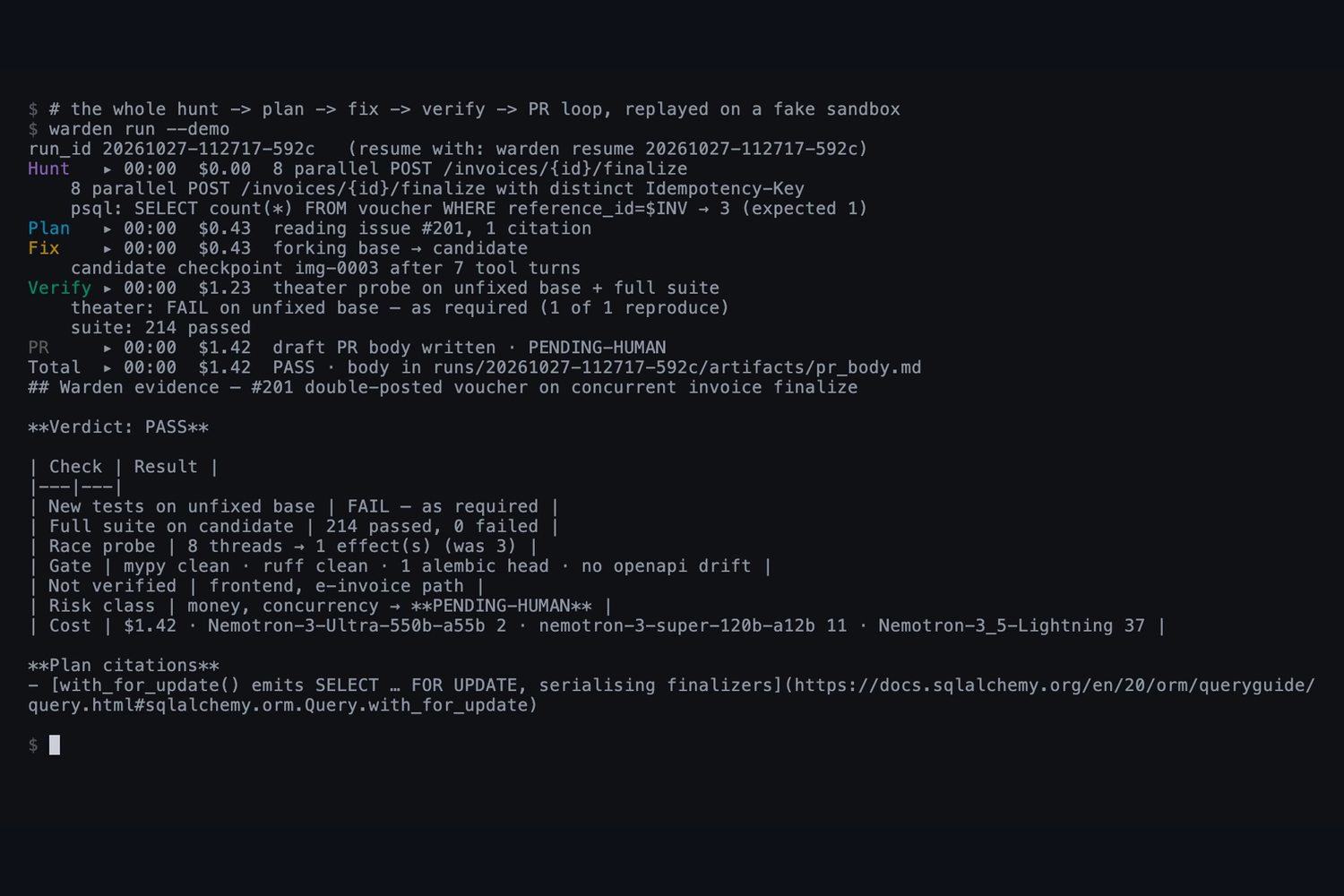
- Run the loop locally on a fake sandbox, in about a minute:
uv tool install git+https://github.com/moiz-lakkadkutta/warden, thenwarden run --demoandwarden console. - A live run (needs a Token Factory key and Sandboxes beta access): one SWE-rebench task with a $1 cap,
warden eval --n 1 --budget 1. Steps are in the README under "Try it".
Who it's for: small teams and solo maintainers of code where a wrong fix costs money (ERP, billing, invoicing, multi-tenant SaaS), who use coding agents but cannot afford to review every agent PR line by line. Warden does the doubting first and hands them a draft PR with its evidence, or nothing.
What makes Warden different
Many agents now fix code and run tests in a sandbox. Warden's verifier asks a harder question, and it is tested on real code:
- It proves the test is real. New tests must fail on a fork of the unfixed base (the theater check). A test that passes without the fix doesn't count; it rejected 14, then 10, such tests across our two SWE-rebench runs, and eight wrong-reason failures on Fabric.
- It finds bugs too. The Hunter boots the app in a sandbox fork and confirms cross-tenant holes twice before filing an issue, for $0 of model spend.
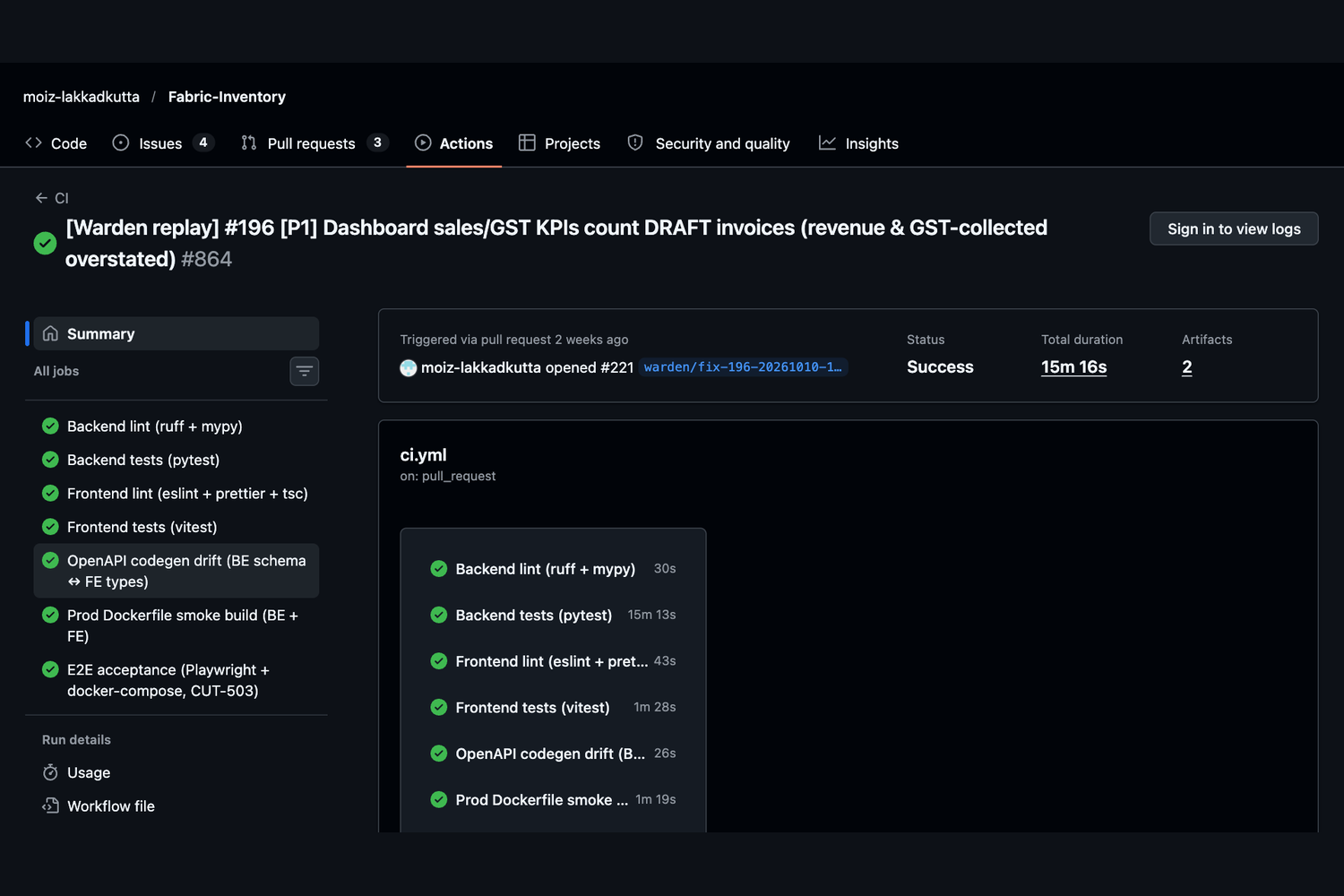
- It works on a production codebase, not only a benchmark. A real draft PR on a live ERP (#221), with that repo's own CI 7/7 green.
- It publishes its own error rate. The verifier's PASS precision (48%) and its 1-of-9 result on the ERP campaign are in the README, next to the 18/49.
- You can install it today. It's a GitHub Action: label an issue
warden, get a draft PR or a comment explaining why not. No token ever enters a sandbox, and Warden never merges. - Every run can be inspected. A live console on a Nebius Serverless endpoint shows each run's fork tree, cost and evidence.
How we built it
- Nebius Token Factory (OpenAI-compatible API) serves every model call: JSON-schema structured output for every plan, verdict and finding (pydantic schemas), and native function calling for the implementer loop.
- NVIDIA Nemotron, routed by role (set by env, swappable without code changes):
- Nemotron 3 Ultra (
nvidia/Nemotron-3-Ultra-550b-a55b) plans and writes the spec-review verdict, where reasoning and adversarial judgement matter; - Nemotron 3 Super (
nvidia/nemotron-3-super-120b-a12b) is the implementer: 19 of 19 tool calls well-formed on the first Fabric fix, at about a third of Ultra's cost; - Nemotron 3.5 Lightning (
nvidia/Nemotron-3_5-Lightning) handles small structured tasks such as research queries and parsing.
- Nemotron 3 Ultra (
- Nebius Token Factory Sandboxes: every run is an immutable checkpoint, and two runs from one checkpoint are a fork (about 1 s each in our measurements). The fork tree is the verifier: the candidate, the theater check on the unfixed base, the regression check, and N best-of-N candidates are all siblings of the same base, and the gate runs on disposable forks, so the candidate is never modified. The patch leaves the sandbox via
git format-patchand is pushed from the host, so no token ever enters a sandbox. - Preloaded SWE-rebench images on Sandboxes:
warden evalplans, fixes and verifies on the task image, then grades with the dataset's hidden tests, which the agent never sees. - Nebius Serverless AI endpoint + Container Registry: the run console is a read-only FastAPI app shipped as a non-root image to Nebius Container Registry and run on a
cpu-d3endpoint (ops/deploy-console.sh). - Python 3.12,
uv, typer-slim, pydantic, a plain state machine (no agent framework),mypy --strict, offline tests against a fake sandbox, and CI that replays a recorded run.
Challenges we ran into
- A PASS on under-specified issues. On SWE-rebench our verifier's first PASS precision was 4 of 14 (29%). Of the 10 false PASSes, 8 needed an API, message or name the issue never states; a verifier that reads only the issue cannot catch those. The 2 real misses (a repro that used a different exception class or resource kind than the issue's own example) we did fix.
- Nemotron 3 Super on large files. On Fabric's 900-line test files Super re-read files or re-sent them whole past the completion limit, and in the first 15 campaign attempts it called
finishin only 2. We changed the tools (200-line read pages, no whole-file rewrite over 300 lines, an edit mode that withholds read tools when it loops, auto-finish of a checked green candidate). Loops went down, but PASS on those issues did not go up. - Sandboxes beta transport. 7 of 49 E1 tasks first ended in a timed-out or dropped operation poll, and
run()stdout is cut silently at 65,535 bytes, which once made a correct patch grade as unresolved. We added retries and chunked reads, re-ran the affected tasks, and logged both inFEEDBACK.mdwith numbers. - Honest hunting. On current Fabric the Hunter finds no cross-tenant hole, because the known one was fixed. Rather than inflate a non-finding, we replayed the commit before the fix (
--at d9c37cb^): there it confirmed the cross-firm write on 6 endpoints and filed #225 and #227. The fix step then failed on both. The verifier rejected every candidate and no PR was opened, which is the safety property working, but it is not a fix.
Accomplishments that we're proud of
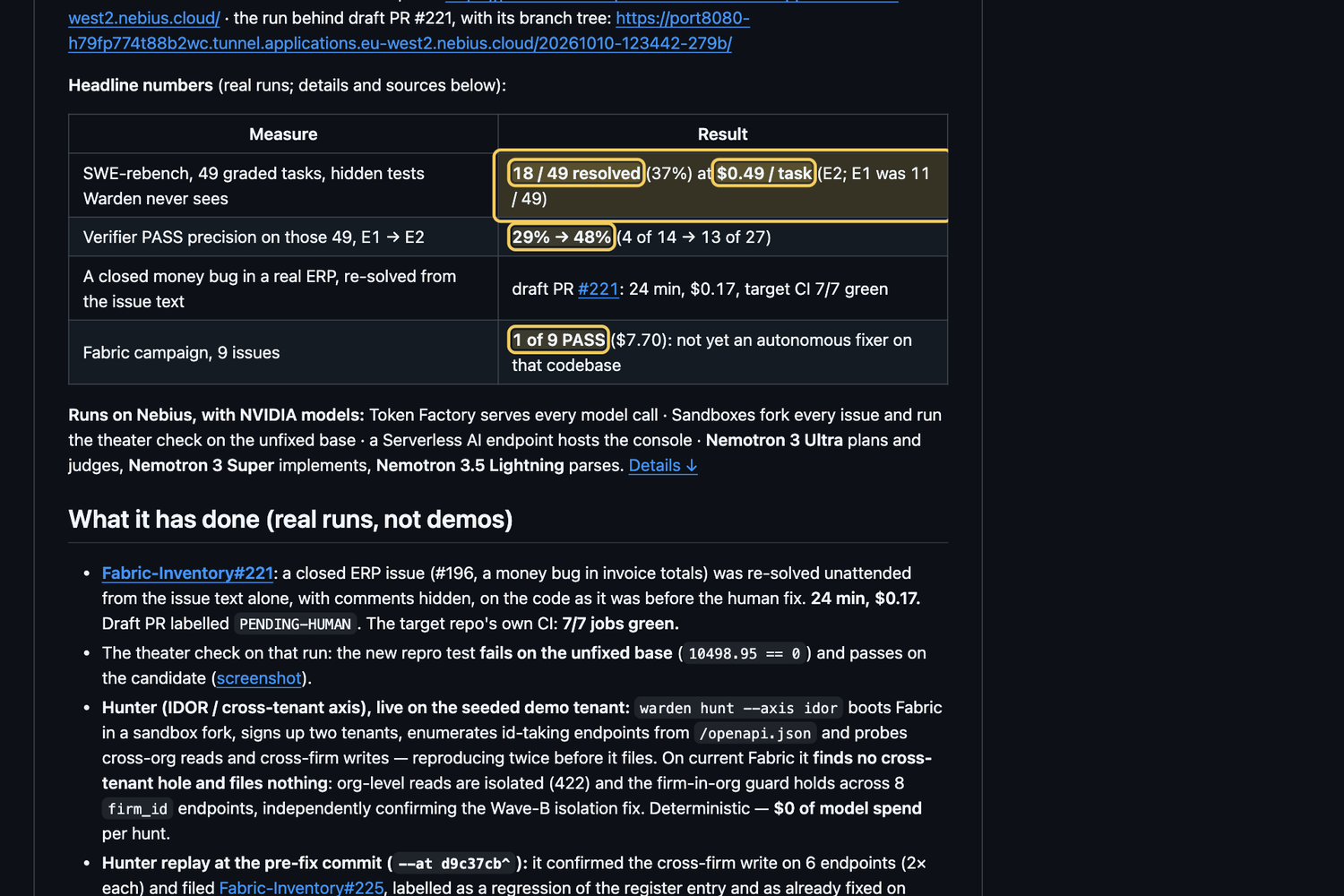
- A real draft PR from issue text alone: Fabric-Inventory#221. A closed money bug was re-solved unattended, with comments hidden, on the code before the human fix, for $0.17, and the target repo's own CI went 7/7 green. Its repro test fails on the unfixed base (
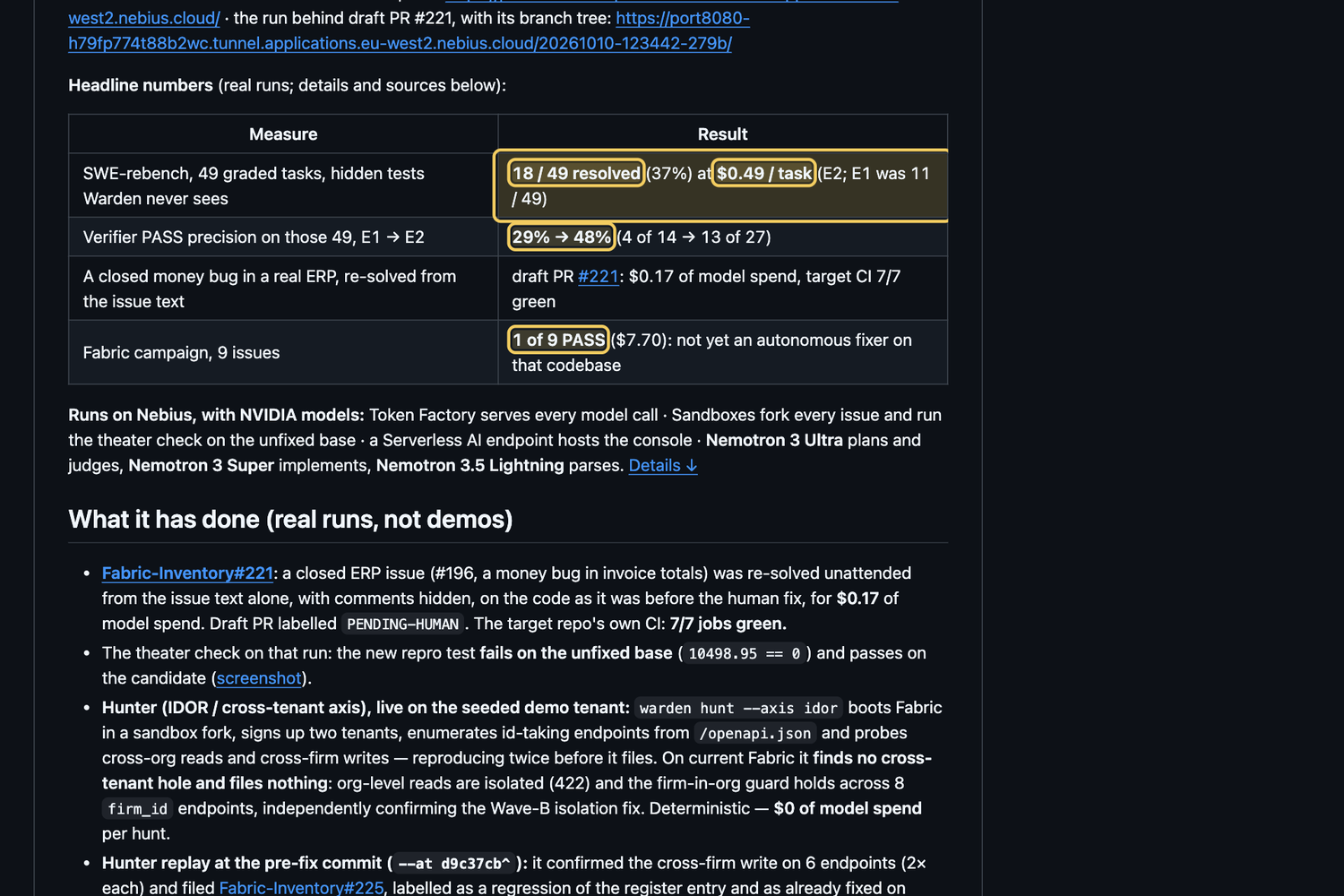
10498.95 == 0) and passes on the candidate. - A measured number, with its error bars: 18 / 49 SWE-rebench tasks resolved (37%, 95% CI 25–51%) at $0.49 per task, $24.16 in total, up from 11 / 49 (22%) on the same tasks a week earlier, with the verifier's false-PASS rate printed next to it rather than hidden.
- Verifier PASS precision 29% → 48% on those 49 tasks (4 of 14 → 13 of 27 PASS accepted by the hidden tests) after the spec review learned to check the issue's own artefact, a guard-only test stopped counting as a repro, and a valid repro with a red check goes back once (62% on the 15 tasks first marked PASS).
- The theater check works: it rejected 14 and then 10 new tests that already passed without the fix, and on Fabric it rejected eight tests that failed for the wrong reason.
- Nothing unsafe shipped: no FAIL produced a branch or a PR, and every money or tax issue was labelled
PENDING-HUMAN.
What we learned
- Fork-per-step is the right primitive for verification. "Run the new tests on the unfixed code" is one line when sandboxes fork in about a second. Without forks it is a rebuild.
- Precision is the metric that matters for trust, and it has a ceiling set by the issue text. Once a hidden test demands something the issue never says, no issue-reading verifier can catch it. The honest output is "PASS is evidence, not proof" and a draft PR.
- Model sizing by role pays off. Ultra's judgement is worth its price on one plan and one verdict per issue. Super's well-formed tool calls are worth more in a 60-turn loop than raw strength. Lightning is cheap, but it reasons by default, which makes it slower than expected for a router.
- A benchmark win is not a codebase win. On a real ERP the campaign passed 1 of 9 issues ($7.70, 29 attempts). That is the number that tells us what to build next.
What's next for Warden
- Make the implementer reliable on large real-world files (Fabric campaign: 1 of 9 today).
- More Hunter axes: race (concurrent finalize → duplicate vouchers), money, malformed input and flow are designed but not built (only the IDOR axis runs today); frontend is not covered.
- A concurrency check in verify and a migration downgrade round-trip in the gate.
- Spend the verifier's doubt where it matters: when the spec review sees an under-specified behaviour, say so in the PR instead of passing it.
- Run on more repos than Fabric and the SWE-rebench sample, and publish each run's console page.
Built With
- claude
- fastapi
- github-action
- nebius-container-registry
- nebius-sandboxes
- nebius-serverless-ai-endpoints
- nebius-token-factory
- nvidia-nemotron-3-super
- nvidia-nemotron-3-ultra
- nvidia-nemotron-3.5-lightning
- pydantic
- python
- tavily
- uv

Log in or sign up for Devpost to join the conversation.