-
-
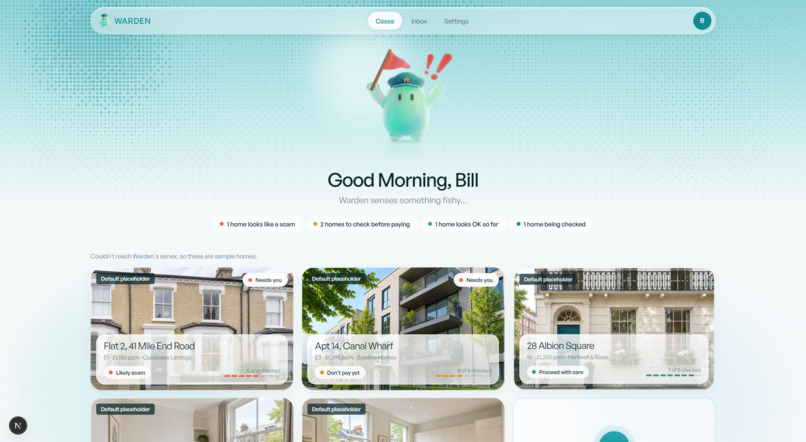
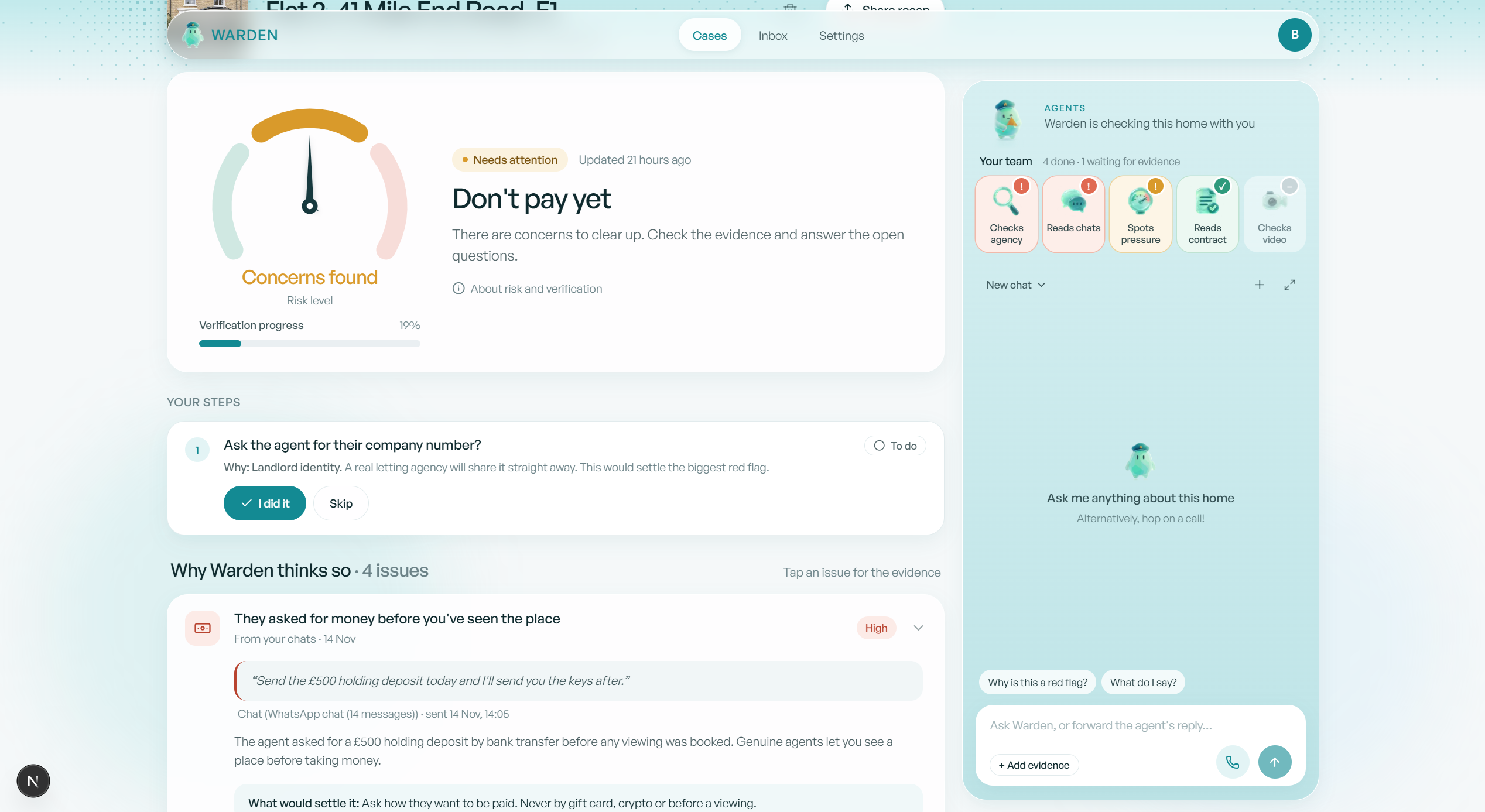
The app Dashboard
-
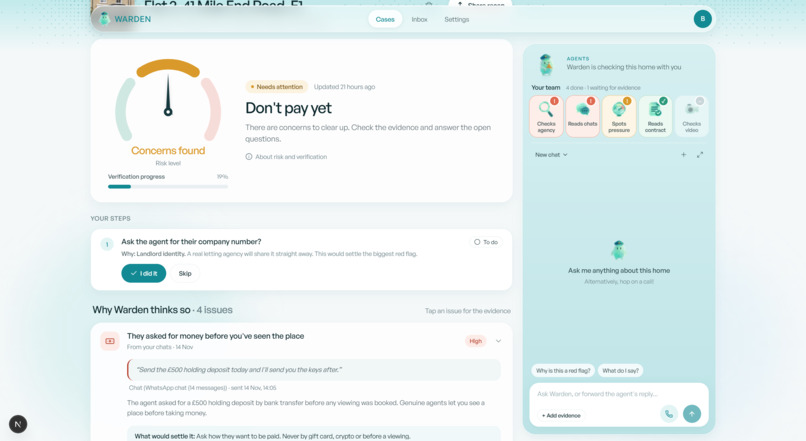
Warden analysis
-
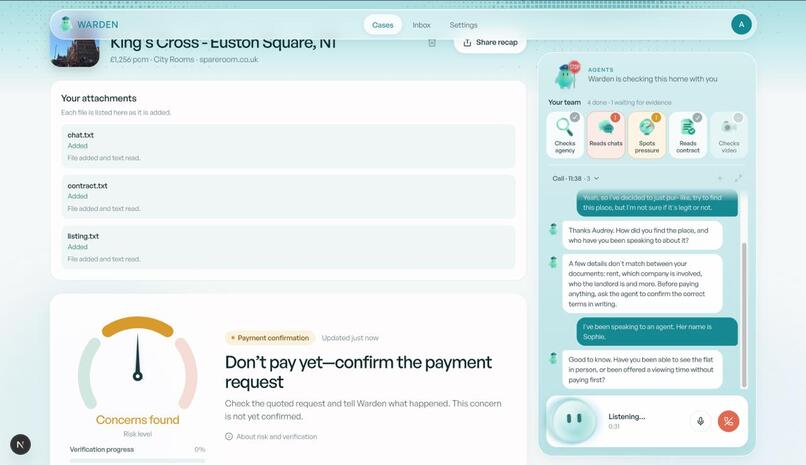
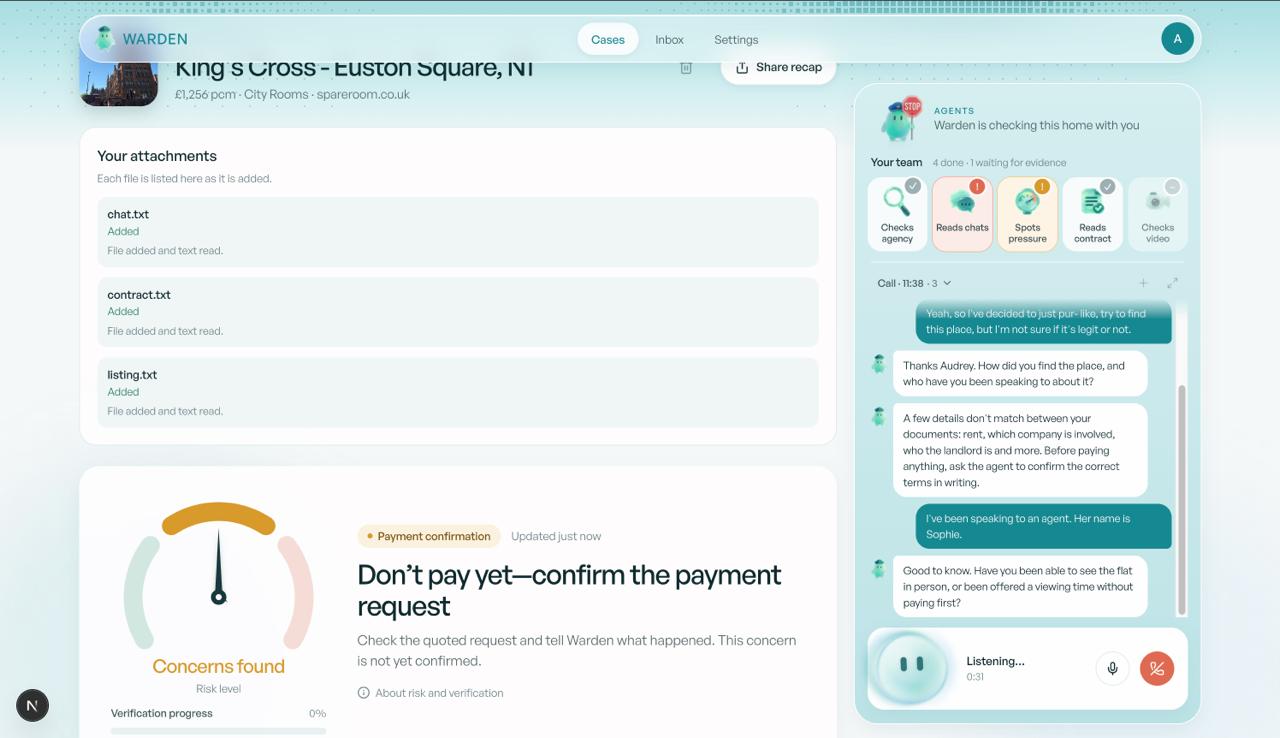
Warden speaking
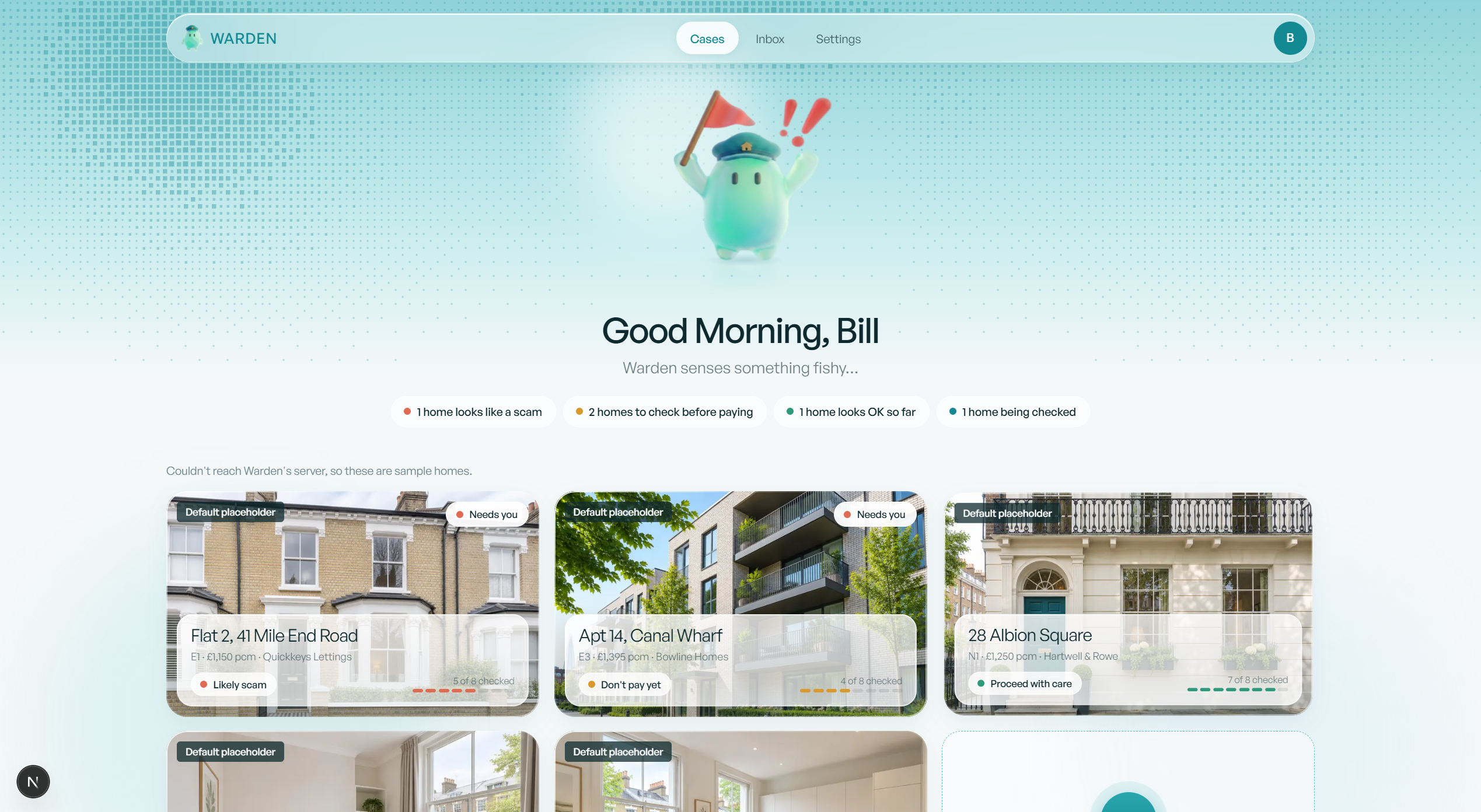
Warden
AI agents that help catch rental scams before users pay
Imperial AI Hackathon · Autonomous Agents track · Figma and Linkup
Team: Danny, Georgi, Bill, Audrey
Problem
Finding a flat in London is stressful enough without having to navigate rental scams. Anyone can be a target, especially people moving to an unfamiliar city for work or study.
Fake listings, demands to pay before a viewing, fabricated agency names and pressure to transfer money quickly can appear across WhatsApp, email and calls. A stressed user may not have the time or experience to check the agency, contract and messages thoroughly.
Solution
This is where Warden comes to the rescue.
Warden is a multi-agent assistant that works alongside the platforms users already use, including SpareRoom, Rightmove, WhatsApp and email.
- Bring the evidence together. The user pastes the listing link and uploads what the agent sends: chats, contracts, emails and other documents.
- Let specialists investigate. Dedicated agents check the messages, contract, pressure tactics and agency’s Companies House record, reporting findings with supporting evidence.
- Get useful next steps. The orchestrator coordinates cross-source comparisons and asks focused questions to resolve uncertainty.
- Build verification through evidence. Every case begins unverified. Progress increases only as checks are supported by evidence.
- Talk it through. Users can answer questions in chat or by voice, with their answers feeding back into the same investigation.
Warden gives users someone in their corner while flat hunting, helping them understand what needs checking before they hand over money.
Design choices
- Real evidence only. Rules catch known scam patterns, while AI identifies additional concerns. AI-generated message findings are rejected unless their quotations appear word for word in the supplied conversation.
- Behaviour, not circumstances. A landlord living abroad does not, by itself, establish a scam. Refusing to arrange a viewing is a concern worth investigating.
- Facts versus feelings. Pressure tactics such as urgency, scarcity and flattery are identified separately from factual claims. The user’s own desperation never counts against the property.
- Explainable decisions. Scoring and verdict rules are explicit code. AI interprets evidence and helps phrase questions, while risk and verification progress are displayed separately.
- Independent agents. Checker agents do not communicate directly with each other. They return reports to a shared case coordinated by the orchestrator, allowing us to develop components in parallel.
- Confirmation before escalation. When messages appear to demand payment before a viewing, Warden asks the user to confirm the request before using that payment concern to trigger an immediate scam verdict.
How we used Figma
- We designed the brand, Warden mascot and high-fidelity screens in Figma, including the homes grid, individual case dashboard and agents panel.
- We built the web app from those frames, translating Figma components into code.
- The mascot responds to the case state, helping communicate concerns and progress through colour and expression.
- The design brings evidence, outstanding questions and next steps into one understandable experience.
[Audrey: add design process and Figma link.]
How we used Linkup
- Reading listings. When property platforms block direct requests, Linkup helps retrieve listing content and populate details such as the agency, rent, address and deposit.
- Checking agencies. Linkup search looks for scam reports, negative reviews and redress-scheme membership, and searches for reports associated with an agent’s phone number.
- Citing sources. Web findings link to their supporting sources. Unavailable checks are surfaced rather than treated as successful verification.
Issues we encountered and how we tackled them
- Pasted chats lost their structure. Messages sometimes arrived as one block of text without clear senders. We built a parser to reconstruct individual messages.
- Partial addresses caused false mismatches. Property sites often display only part of a postcode. We tightened address comparisons to avoid treating incomplete information as a contradiction.
- Some genuine listings still trigger warnings. The pressure and pricing checker still flags a few genuine low-rent examples. These remain a focus for further refinement.
- Parallel development required coordination. Merging four people’s work overnight meant agreeing on shared interfaces and testing how the components behaved together.
Results
In an initial-round evaluation of 40 synthetic cases, all 11 scam-labelled cases raised at least one concern, and none of the 17 genuine cases received a “likely scam” verdict.
Most cases remained open for further questions. The labels are unreviewed, so these results are an early development check—not a real-world accuracy benchmark.
Further work
- Add analysis of property-viewing videos.
- Strengthen handling of sensitive personal data and protection against prompt injection.
- Evaluate complete, multi-turn conversations using independently reviewed labels.
- Improve false-alarm handling for legitimate but unusual rental situations.
- Support genuine agents in providing verification evidence up front.
Built With
- claude
- codex
- css
- elevenlabs
- fastapi
- figma
- javascript
- linkup
- mongodb
- next
- python
- react
- typescript
- weave
