-
-
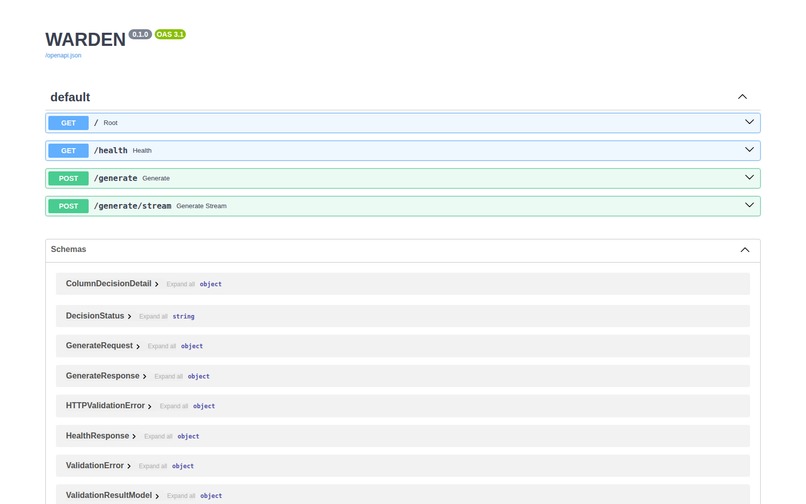
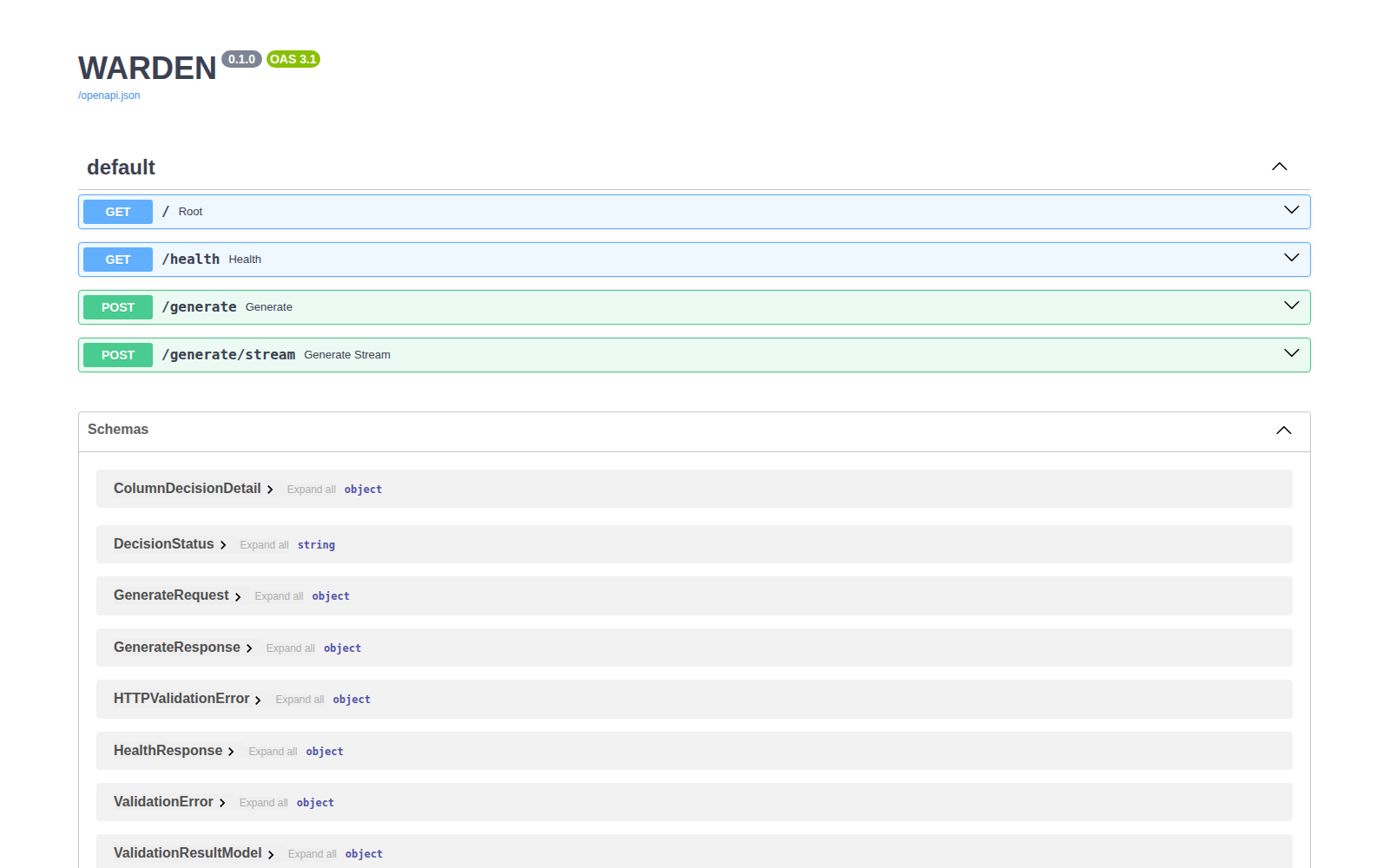
API docs
-
-
-
-
-
-
-
-
Inspiration
Every day, engineers prompt LLMs to "write me a pipeline for this table" — and the model happily generates code that reads nothing about the data. It doesn't know the column is PII. It doesn't know the field is a restricted glossary term. It doesn't know the table is governed by a compliance policy. The result is the new normal: fluent, confident, and catastrophically unsafe data code.
We wanted to prove the opposite is possible. Not by adding more guardrails on the output side, but by starting on the right side — the catalog. What if an agent refused to write a single line before understanding the data it was about to touch? What if governance wasn't a review step at the end, but the first thing the agent reads?
That's WARDEN: governance-aware code generation, where the DataHub catalog is not a nice-to-have lookup — it is the source of truth the agent is built around.
What it does
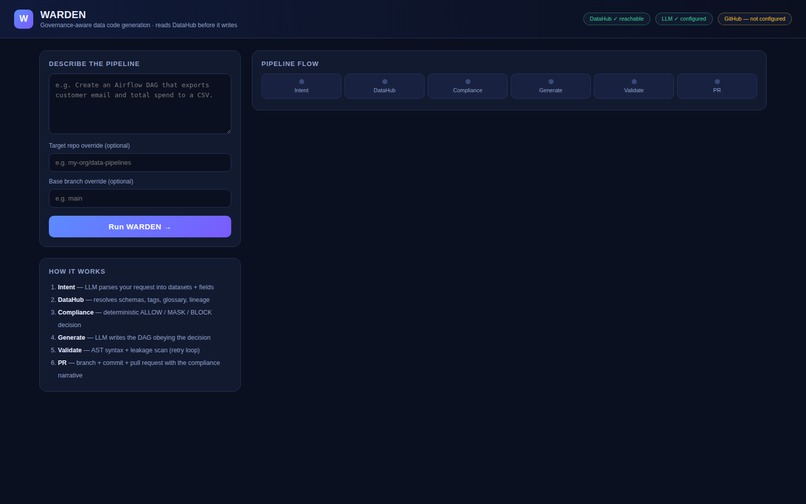
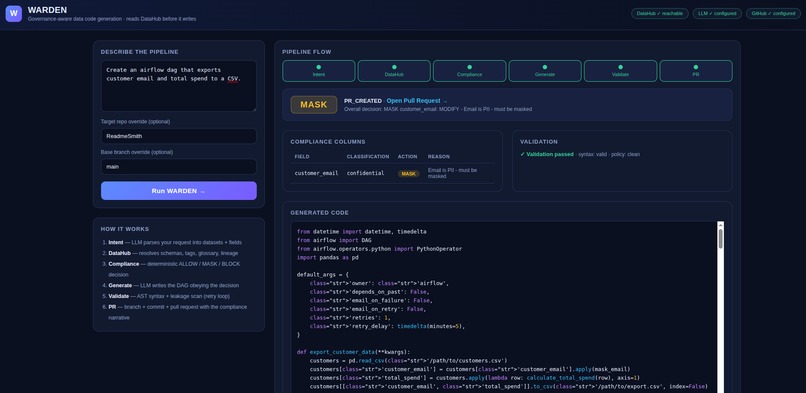
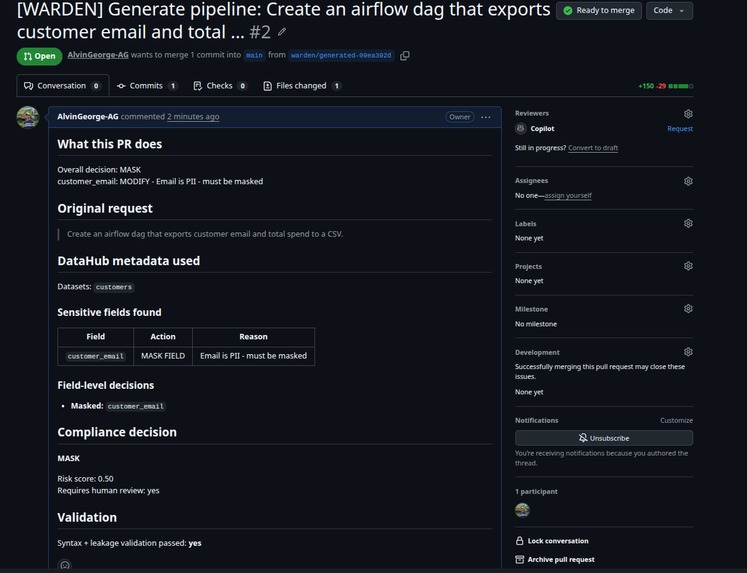
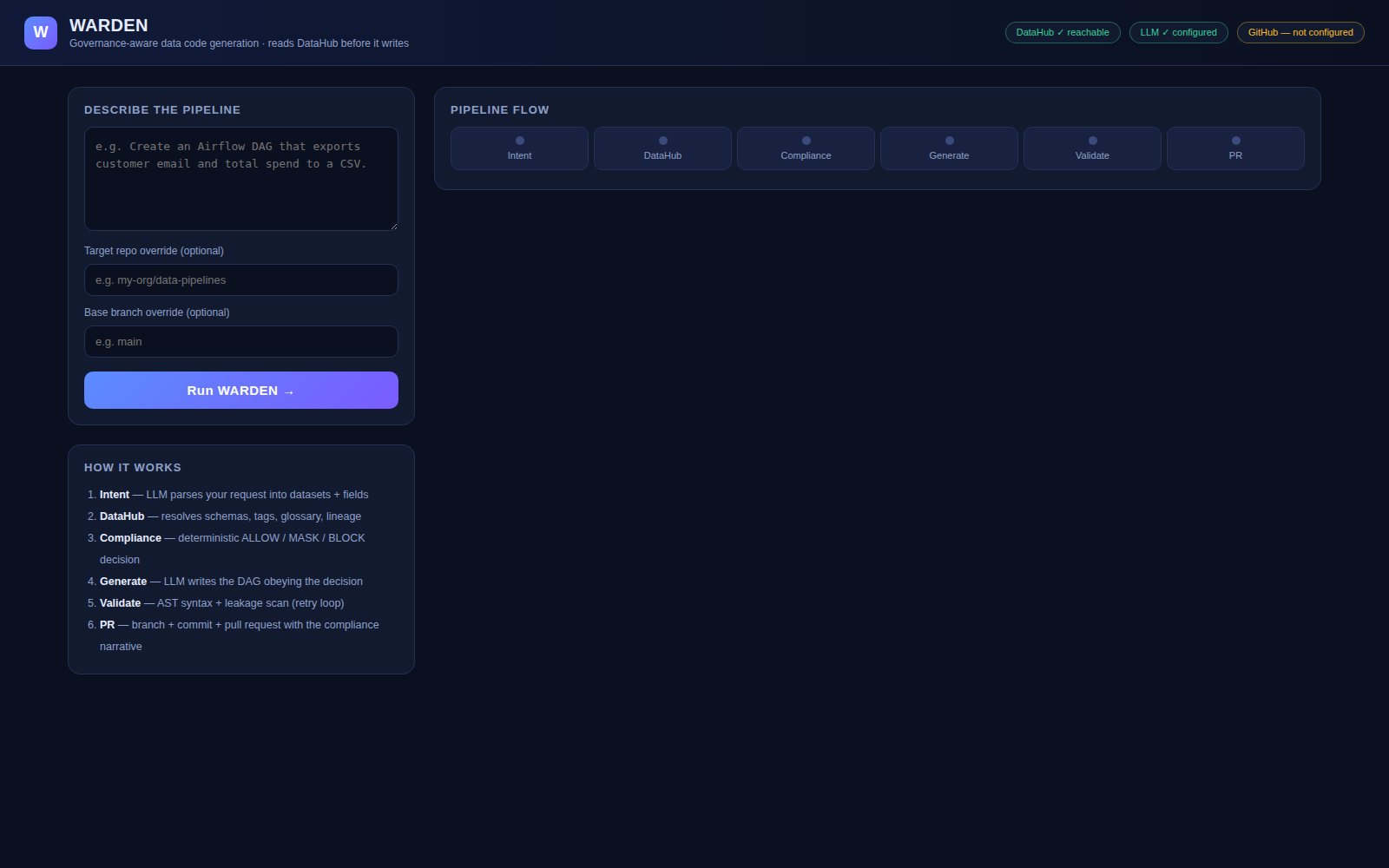
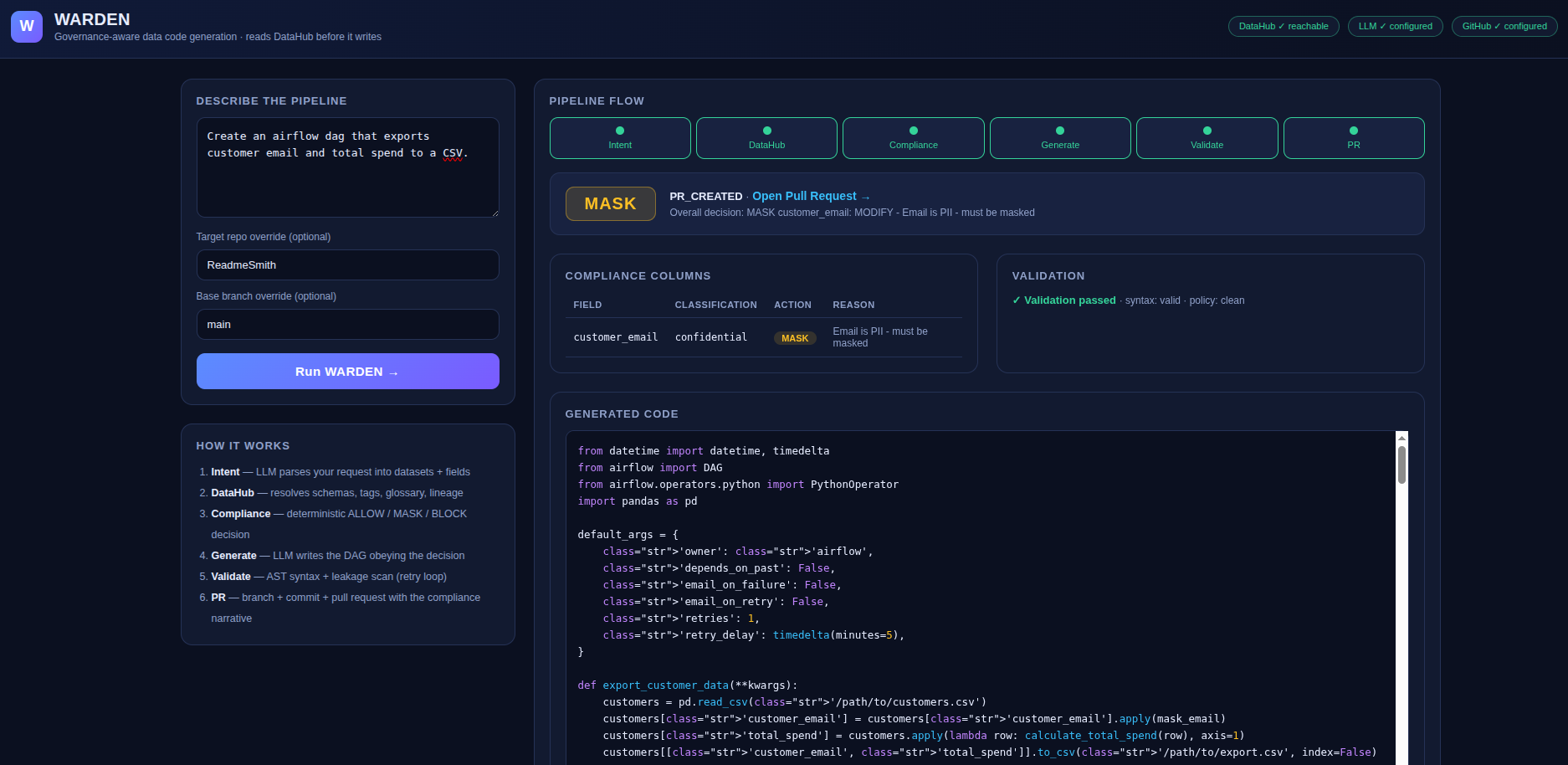
WARDEN is a DataHub-powered AI agent that generates compliance-aware data pipelines and delivers them as ready-to-merge GitHub pull requests.
Give it a plain-English request:
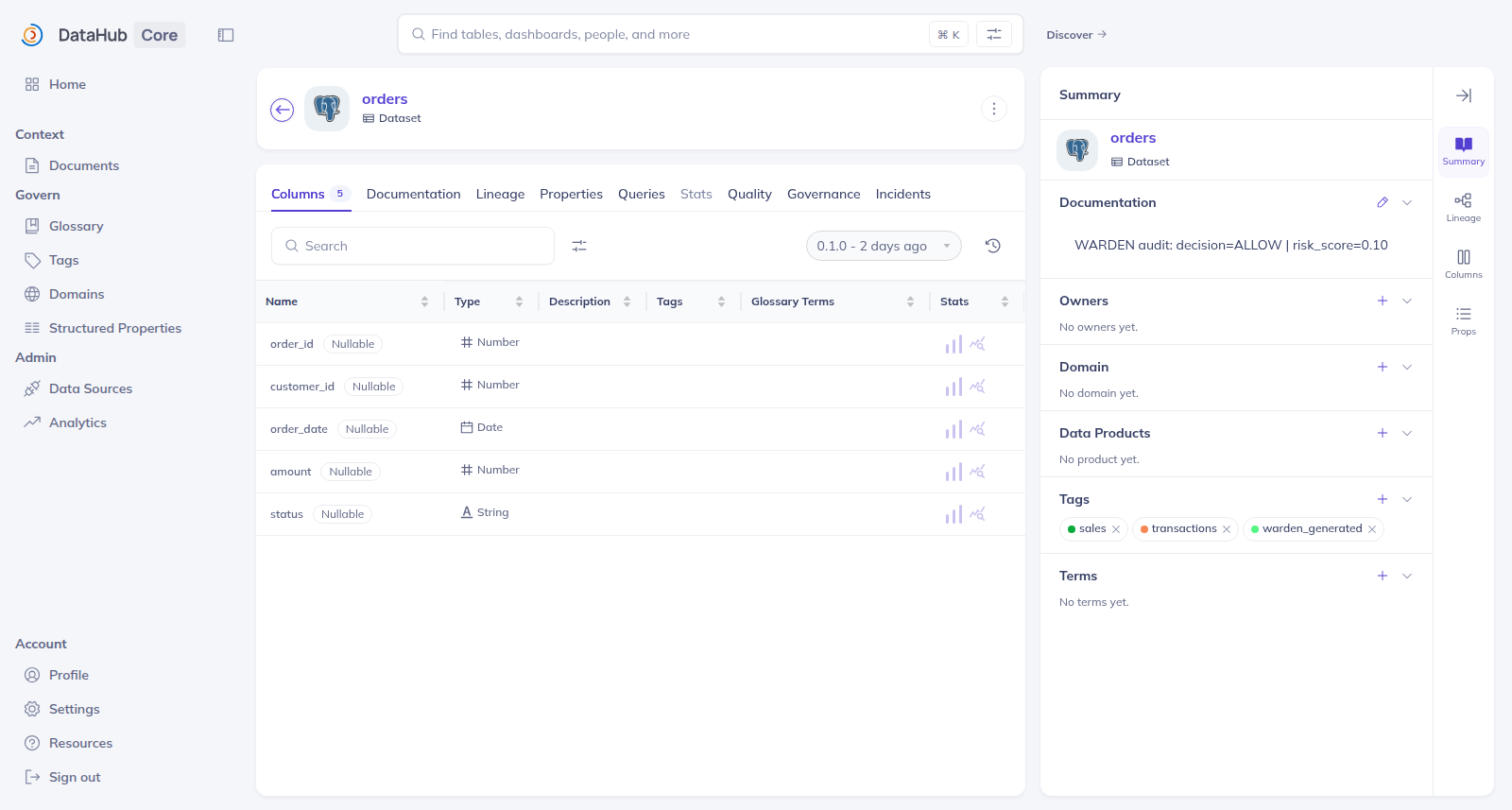
Create an airflow_dag that aggregates order amount from the orders dataset by order_date
and WARDEN will:
- Resolve intent — turn your sentence into a structured request (dataset, fields, operation, pipeline type).
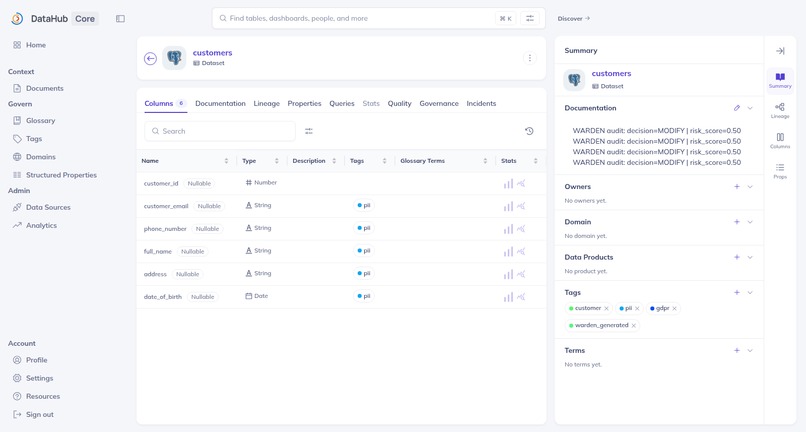
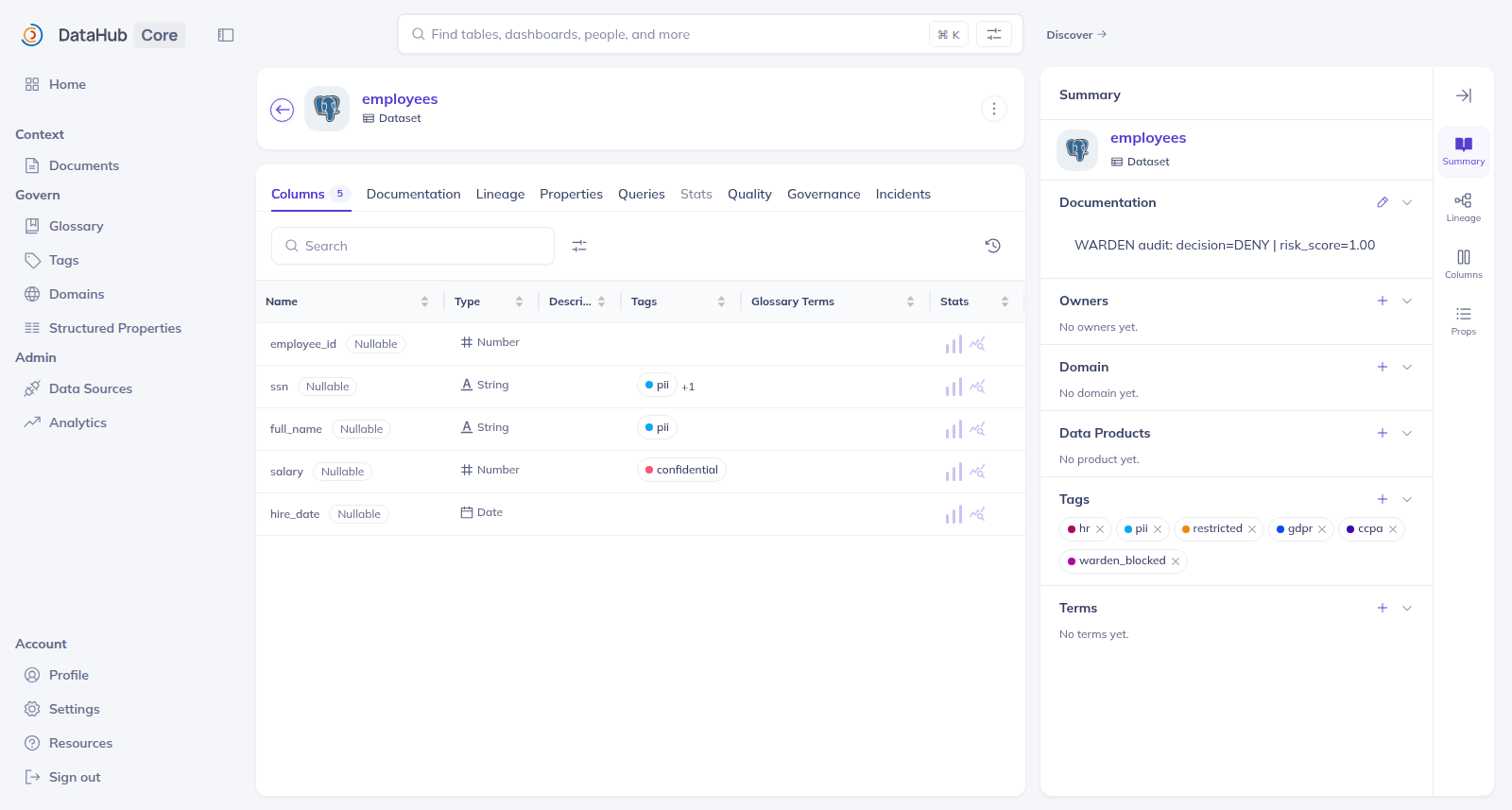
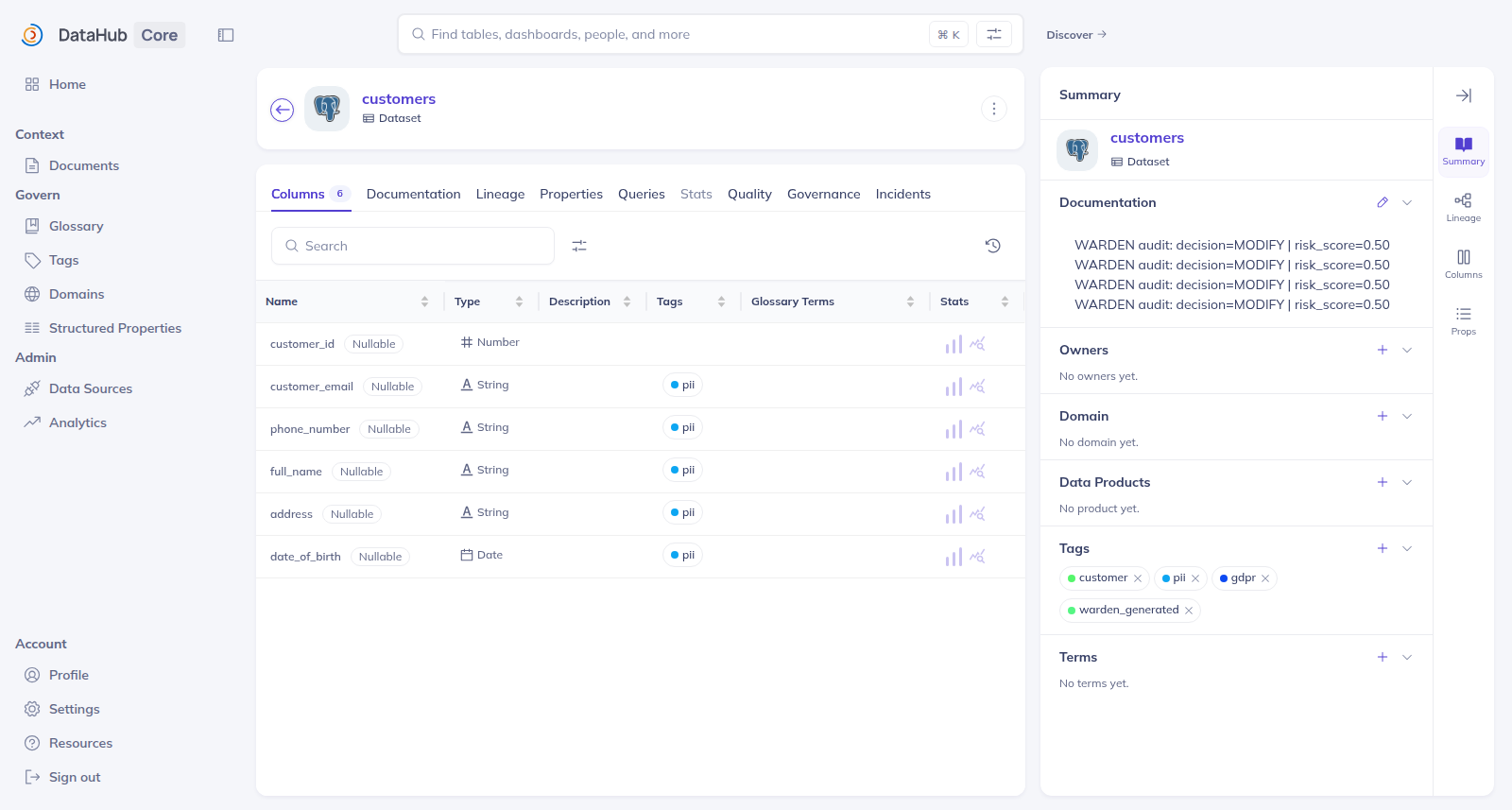
- Read the catalog first — resolve a real DataHub URN, then pull its schema, semantic tags, glossary terms, and lineage from the DataHub GMS GraphQL API.
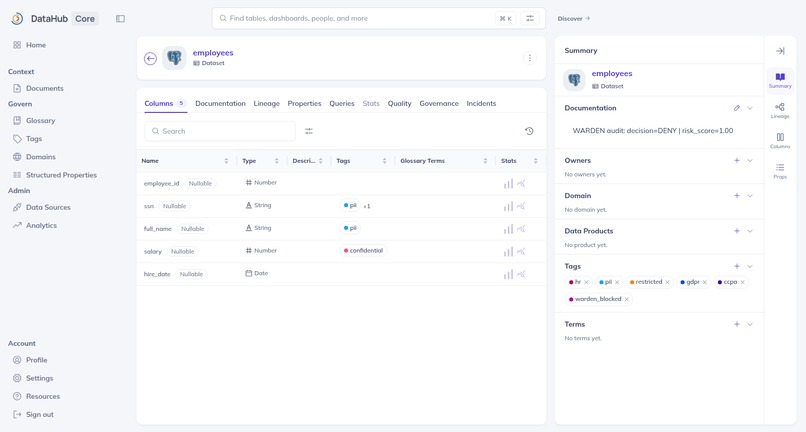
- Classify every field — attach tags like
pii,restricted, orwarden_generatedto each column. - Enforce deterministically — run a rules-based compliance engine that returns one of three verdicts:
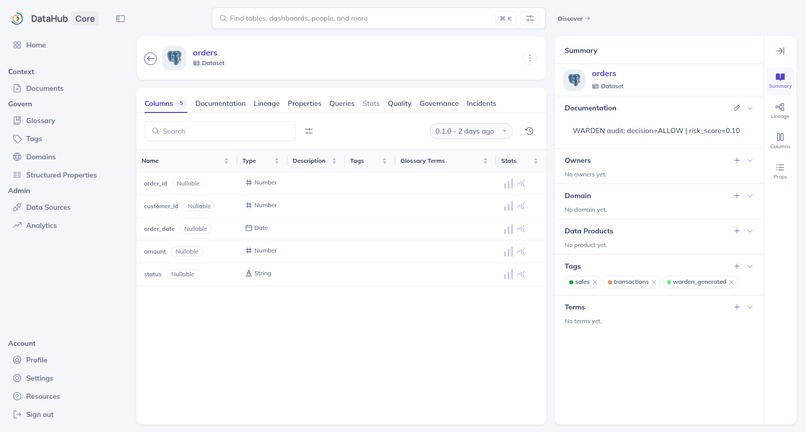
- ALLOW → generate the DAG and open a pull request
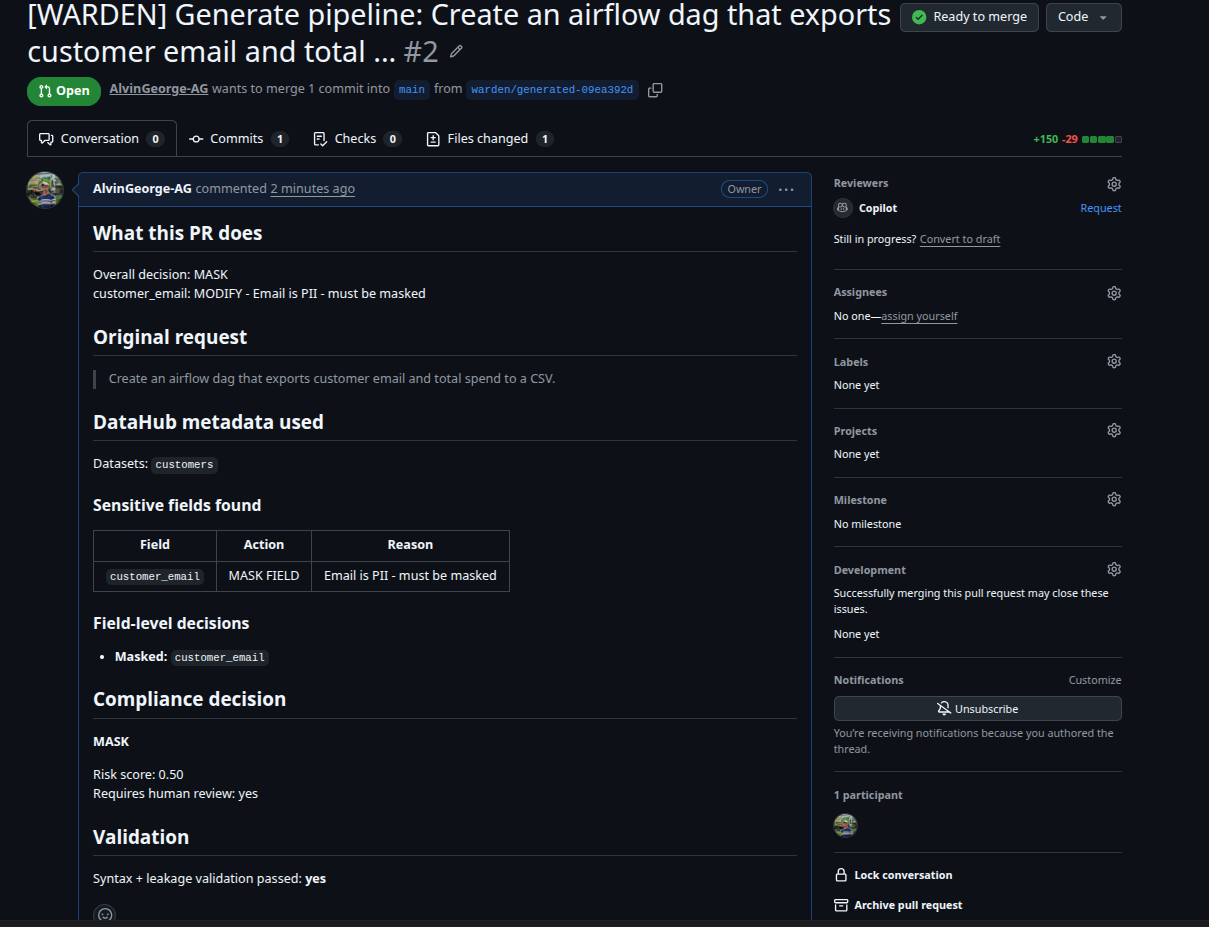
- MASK → wrap sensitive columns in a real, canonical masking function, then open the PR
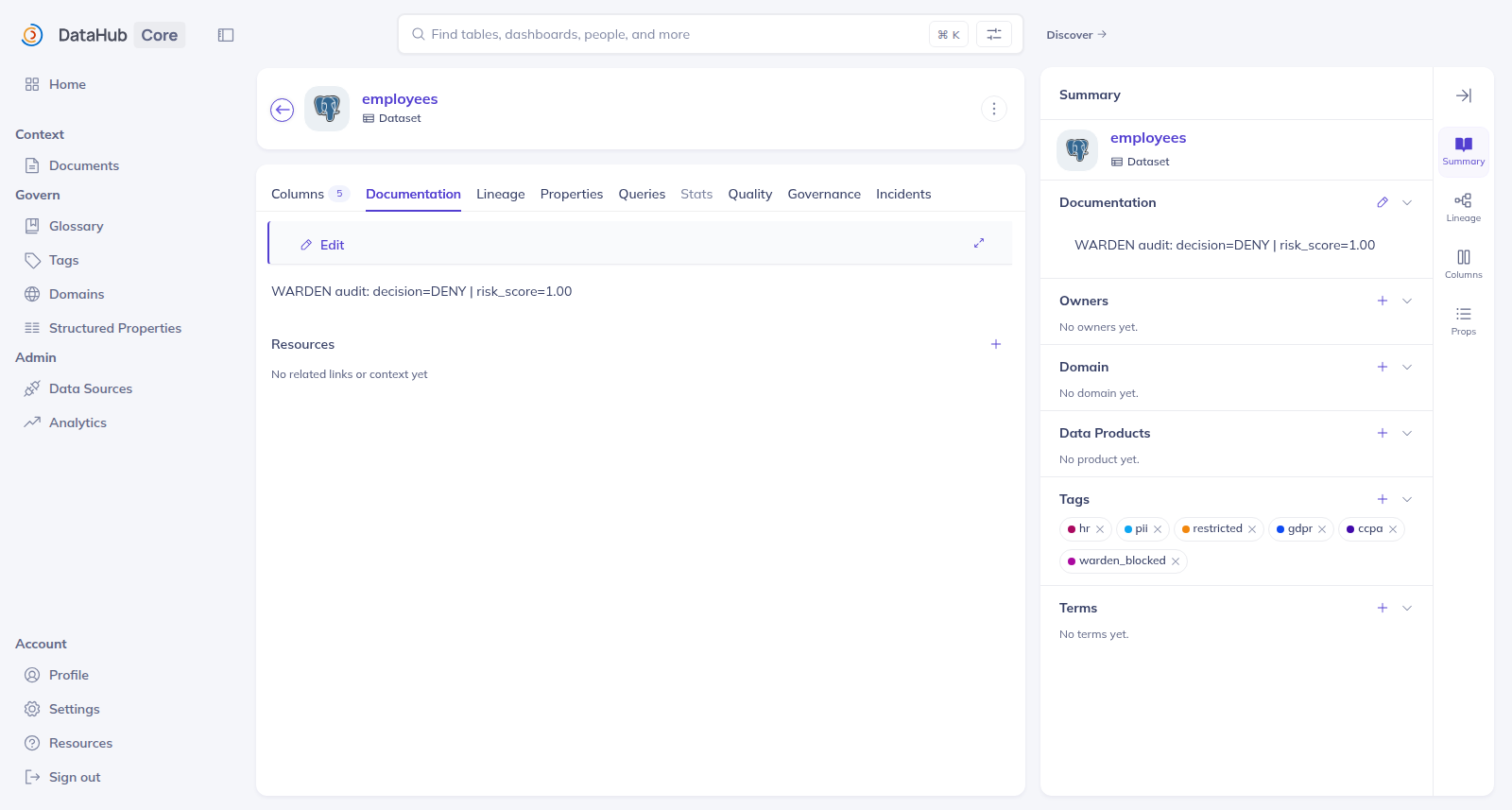
- BLOCK → generate nothing, open nothing, and explain exactly which metadata rule made it unsafe
- Validate the code — Python AST validation for correctness and a leakage validator to guarantee masked columns never appear in outputs.
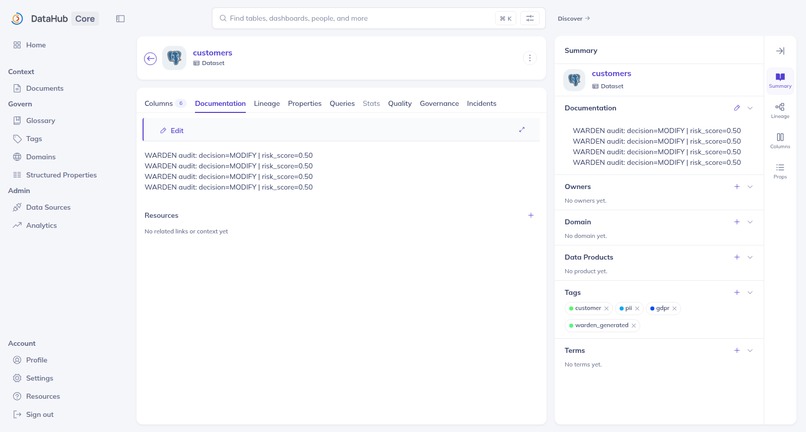
- Write the audit back to DataHub — tag the source dataset (
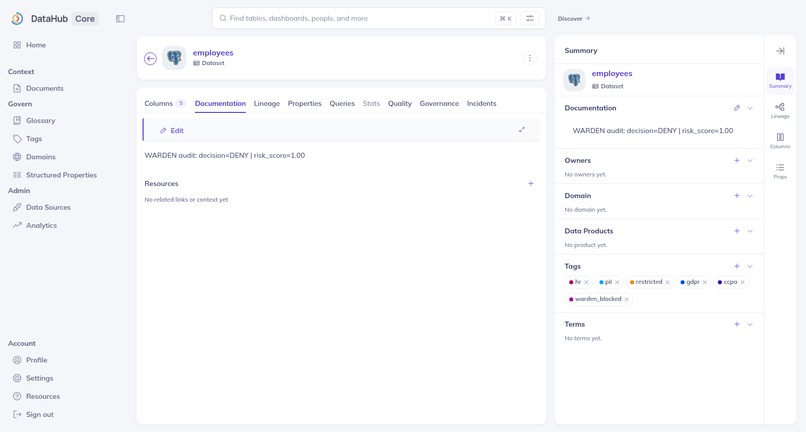
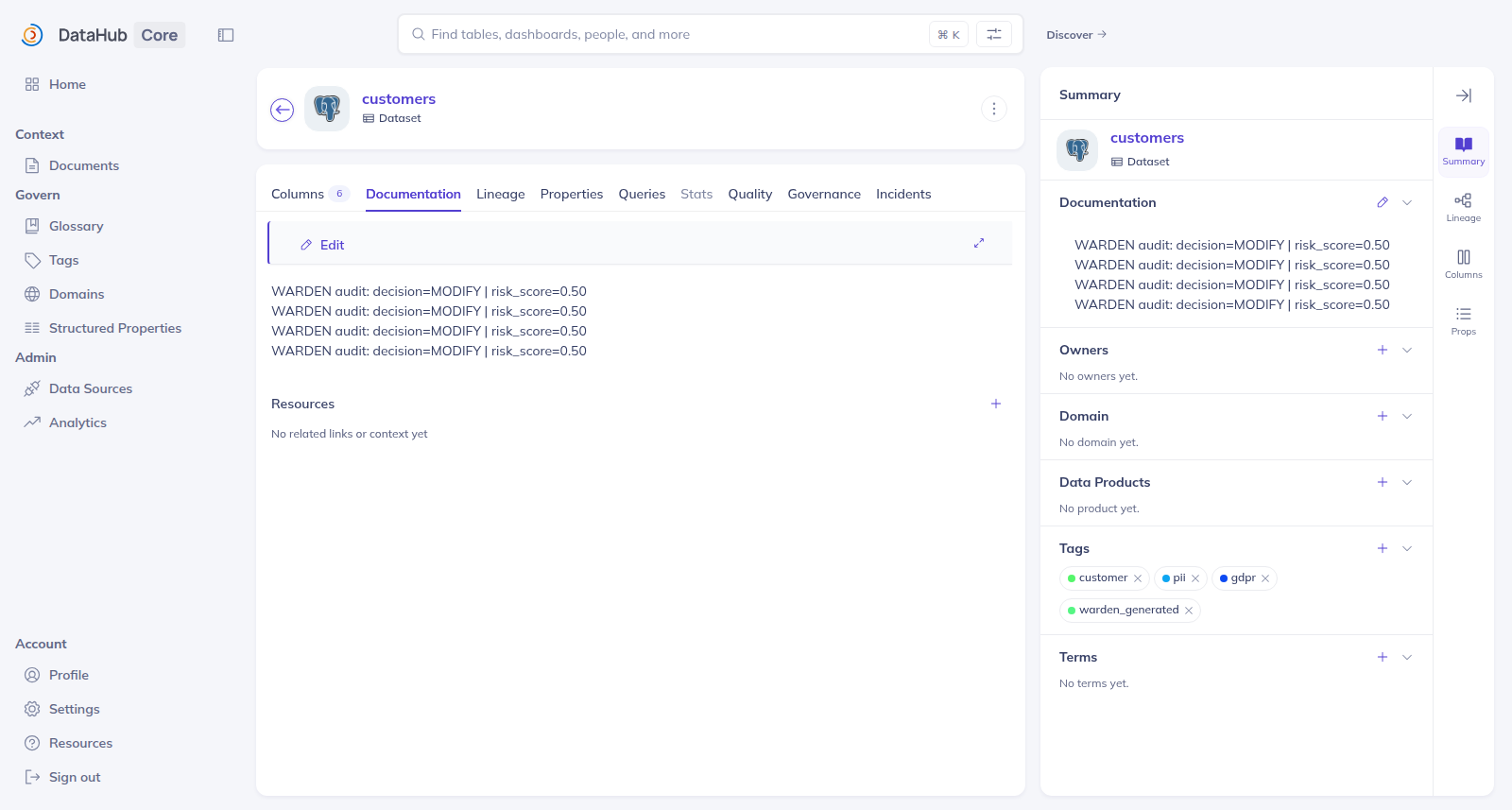
warden_generated,warden_blocked) and append an audit note with the PR link, so the next human or agent inherits the knowledge.
Every PR carries the full governance story: the original request, datasets used, per-field decisions, risk scores, and validation verdict.
How we built it
Stack: FastAPI backend + vanilla-JS UI, DataHub GMS GraphQL for catalog reads and write-back, GitHub REST API for PR automation, Apache Airflow (via airflow-dag-parser) for generated code, edge-tts for narration, and headless Chrome driven over CDP for the demo screenshots.
The compliance core. Decisions come from a rules engine over catalog metadata. Each field gets a risk score and a verdict; the engine is deterministic and explainable — no LLM in the hot path for whether to block:
$$R(\text{field}) = \max_{\text{rule } r} \big( w_r \cdot \mathbb{1}[\text{field matches rule } r] \big)$$
The catalog-first generator. The LLM is only invoked after catalog resolution, and every generated field references the resolved, classified schema. Validation is layered: an AST validator catches broken code, a leakage validator proves masked/restricted fields can't leak into outputs.
Real write-back. Tags land on real DataHub datasets via GMS GraphQL; audit notes are appended to dataset documentation. It's not a demo loop — the state actually persists in the graph.
Hardening the PR path. Writing files to a real repo surfaced a classic bug: overwriting an existing file needs the current SHA. We added get_file_sha() + SHA payloads to upload_file(), then locked it in with regression tests — the suite grew to 122 passing tests.
Demo production. We made the whole pipeline runnable in an offline demo mode and produced the demo video with real, live PRs — one ALLOW, one MASK — and a genuine BLOCK that created no PR.
Challenges we ran into
- The catalog is a graph, not a spreadsheet. Datasets have URNs, owners, sibling sets, tag attachments, glossary terms, and lineage edges — each a different GraphQL entity. Teaching the agent to resolve a URN and read all of it correctly was most of the battle.
- GitHub's SHA check.
createon an existing file returns 422. Diagnosing and fixing it required deep-API debugging (get_file_sha()+ SHA-aware uploads) and tests to keep it fixed. - PII masking that's actually safe. Masking in a string template is easy; proving (and demoing) that a masked field can't leak through downstream operators required a dedicated leakage validator.
- Demoing honesty. It's tempting to fake a BLOCK. We demoed a real one against live metadata — and you can see in the video that no PR exists.
- Determinism vs. model noise. If a compliance verdict depends on the model, it's not compliance. We kept the LLM out of the decision path entirely.
Accomplishments that we're proud of
- A compliance engine whose verdicts are explainable — every BLOCK/MASK tells you the exact metadata rule that triggered it.
- Real, persistent governance write-back to DataHub, not a mocked graph.
- 122 passing tests on governance, code generation, masking, validation, and PR flows.
- A one-command offline demo mode so anyone can run it without a cluster.
- A demo video with live PRs and a genuinely blocked case — no actors, no fake screenshots.
What we learned
- Context is a governance decision. What an agent "knows" about the data changes what it's allowed to write — so the agent's catalog access is the control plane.
- Deterministic beats clever for safety-critical paths. Encode the rules; let the LLM do the fluent part.
- The write-back is what makes it a system. An audit that nobody can see (or that isn't persisted) is not governance.
- Demo every claim. "No PR was opened" is only convincing when the video shows the graph with no PR.
What's next for Warden
- Policy-as-config: YAML-published compliance policies teams can tune without touching code.
- Multi-system lineage: act on lineage edges, not just the source dataset — e.g., re-mask consumers when a producer column changes.
- Post-merge enforcement: CI checks that block merges when a policy decision would change, closing the loop.
- Human-in-the-loop modes: configurable override workflows for MASK→ALLOW escalation with full audit trail.
- More generators: dbt models, Spark jobs, and SQL-embedded lineage.
- Trust signals: surface per-field risk scores and coverage metrics in the DataHub UI itself.
Open source (Apache 2.0) — github.com/AlvinGeorge-AG/Warden


Log in or sign up for Devpost to join the conversation.