Project Name: WAR ROOM - AI Crisis Simulation Platform
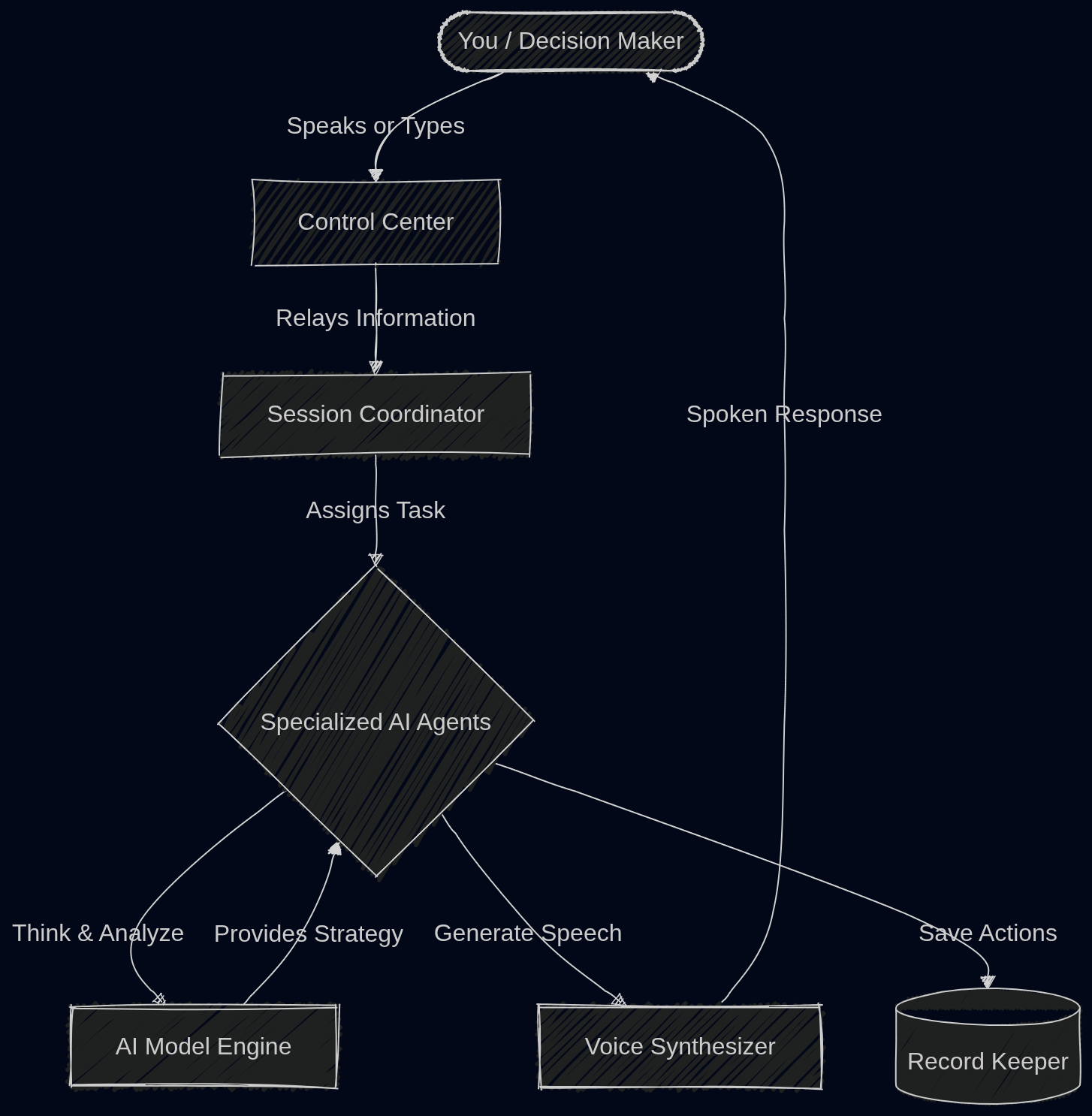
WAR ROOM is an immersive, real-time multi-agent AI crisis simulation platform. Users take on the role of the "Chairman," navigating high-stakes, dynamically generated scenarios by orchestrating a team of specialized AI advisors through live voice and real-time dashboards.
💡 Inspiration
Real-world crises aren't solved by typing prompts into a single chat window; they are solved in war rooms filled with experts debating conflicting priorities. We wanted to move beyond basic chatbot wrappers and build a true "Event-Driven" simulation where AI agents act independently, the environment escalates dynamically, and the user must lead via voice command under pressure.
⚙️ What it does
WAR ROOM drops the Chairman into a live crisis dashboard with several core features:
1. The Scenario Analyst (The Architect)
When you start a new session, the Scenario Analyst goes to work first. It acts like a casting director for the crisis. Based on the scenario, it decides exactly which experts need to be in the room.
For example, if there is a massive data breach, it might decide: "We need a Legal Expert to handle lawsuits, a Chief Marketing Officer (CMO) for public relations, and an Engineering Lead to fix the servers." It then automatically creates these specific "sub-agents," giving each one a unique name, a specific role, and special skills to help you navigate the crisis.
2. The Specialist Advisors (Your War Council)
These are the sub-agents created by the Scenario Analyst (like the Legal, PR, or Military agents). Each specialist acts independently:
- They listen to what you (the Chairman) say and what the other agents are discussing.
- They think about the crisis entirely from their professional point of view. For instance, the Legal agent will always worry about liability, while the PR agent will obsess over the company's public image.
- They take action by speaking up, debating with each other, suggesting solutions, or updating the shared "Crisis Board" to assist you.
3. The World Agent (The Game Master)
While you and your advisors are trying to solve the initial problem, the World Agent acts as the unpredictable outside world. It watches the clock and periodically injects new twists—like "Breaking News: The company's stock price just crashed" or "A new whistleblower has come forward." This keeps the pressure on and forces your team to constantly adapt.
4. The Observer Agent (The Scorekeeper)
The Observer Agent quietly watches the entire conversation from the background. It evaluates how well you and your team are handling the crisis. It scores metrics like "public trust" or "company stability" based on your decisions, making sure there are real consequences for how you manage the situation.
5. Chairman Controls (Your Command Authority)
The Chairman Controls give you direct authority over the advisor team. You can call for votes when the group is split on a decision, and you can mute or dismiss advisors who are underperforming or no longer useful. This keeps the discussion focused and lets you steer the crisis response effectively.
🛠️ How we built it
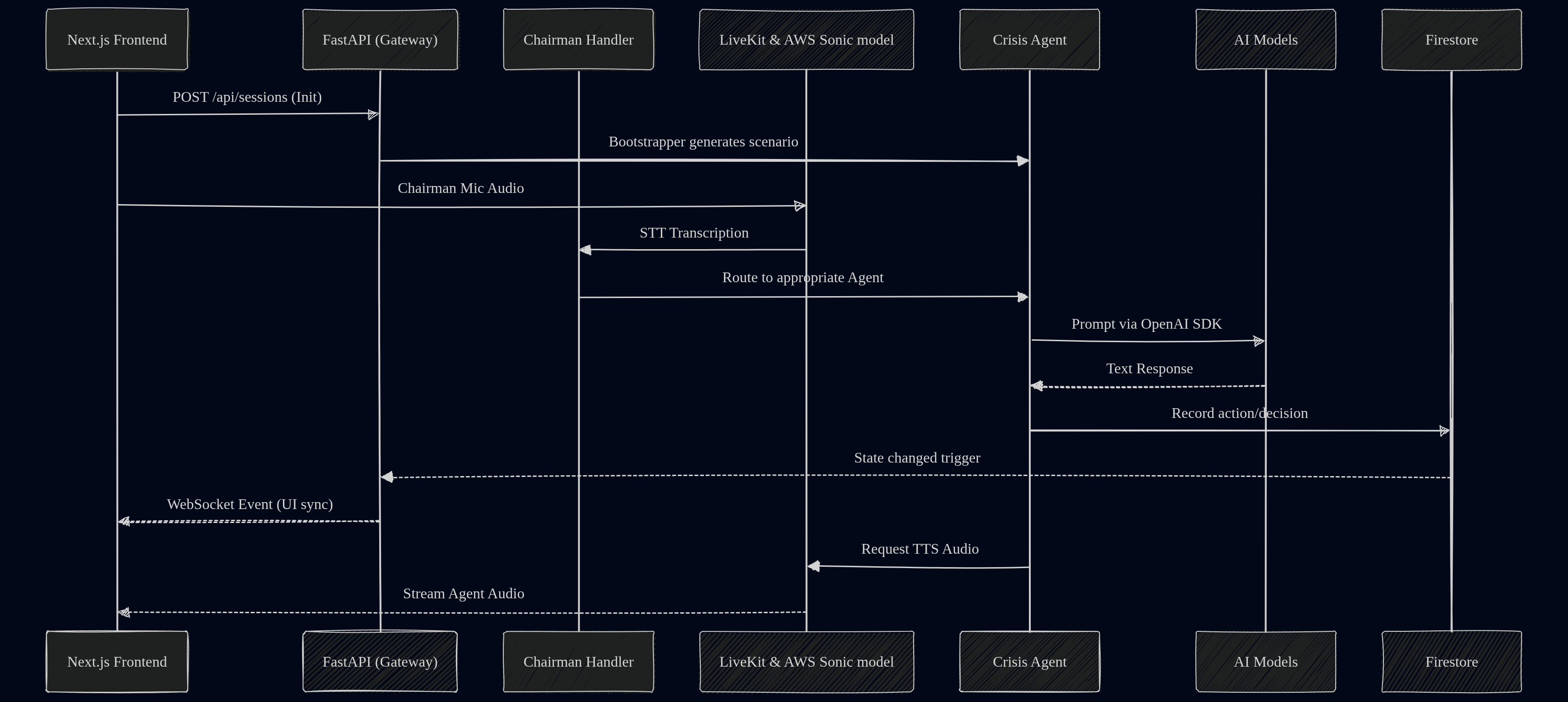
The platform is built on a decoupled, event-driven architecture designed for high-bandwidth synchronization:
- Frontend: A Next.js (App Router) Single Page Application that handles complex state hydration via REST and reacts to live updates via WebSockets.
- Backend Gateway: A Python FastAPI server orchestrating the simulation, managing full-duplex WebSockets, and routing raw audio streams.
- State Management: Google Cloud Firestore acts as the single source of truth. We strictly isolate memory by giving each agent its own private Firestore collection, preventing cross-agent hallucinations.
- Audio Pipeline: We integrated LiveKit (WebRTC) and ElevenLabs for ultra-low latency Speech-to-Text and Text-to-Speech capabilities, allowing seamless bidirectional voice streams.
Based on the logic in your
model_provider.pyand agent files, here is the technical breakdown for your AI Model Engine section: - AI Model Engine: We engineered a custom, provider-aware
model_provider.pywrapper that routes all simulation intelligence through the Z.AI stack via Bedrock's OpenAI-compatible endpoints: - Reasoning & Intent Detection: We utilize GLM 4.7 to power the high-frequency reasoning loops for our specialist advisors and the
Scenario Analyst. This provides the low-latency response times required for a live "war room" environment. - Scenario Generation: The
Scenario Analystuses GLM 5 to parse raw crisis inputs and output a strictly validatedScenarioSpecJSON, which orchestrates the entire agent team and escalation schedule. - Conversational Voice: For real-time, bidirectional audio, we integrated eleven_turbo_v2_5 via the LiveKit Elevenlabs plugin. This allows agents to speak naturally and respond to the Chairman's voice commands with minimal delay.
🚧 Challenges we ran into
- Voice Leakage: Having multiple AI agents in one room led to chaotic overlaps where they would try to speak over the user or each other. We solved this by implementing strict "Active Speaker Gating" on the backend—emitting turn-based speaker tokens so the frontend drops overlapping audio chunks and mutes inactive UI components.
- Memory Isolation vs. Shared Context: If agents shared the same LLM context window, they lost their distinct personalities and agreed with each other too easily. We had to architect a system where agents run completely isolated Python reasoning loops and can only interact by calling specific tools to read/write to the shared Firestore "Crisis Board".
🏆 Accomplishments that we're proud of
- Successfully building an incredibly robust WebSocket Event Bus that pushes live UI updates (like new board decisions, trust score changes, and agent dismissals) without requiring constant client-side polling.
- Creating the After-Action Report feature that triggers when the simulation ends, providing a comprehensive review of final decisions, key moments, and a resolution score.
🎓 What we learned
Building a multi-agent system is less about the prompt engineering and more about the data infrastructure. By treating the AI agents as discrete microservices that communicate via a shared database and tool calls—rather than one giant LLM chain—we achieved much higher reliability and realism.
⏭️ What's next for WAR ROOM
We plan to implement full multi-player capabilities so multiple human users can sit in the War Room together, taking on different director roles (e.g., CEO vs. Board Member) and debating the AI advisors cooperatively.
Built With
- ai
- cloud
- python
- typescript

Log in or sign up for Devpost to join the conversation.