-
-

logo
-
overview

Inspiration
As a student, I have seen how conventional social media can quietly pull people away from their goals. You open an app to talk to a classmate or take a short break, then suddenly spend hours watching reels, comparing yourself with others, causing narcissism or getting caught in a loop that was never meant to matter.
I have experienced some of this personally: unhealthy connections, bullying, rumours, and the pressure to always be visible online. Many students face the same things, often while also trying to study, build confidence, and figure out their future.
That is why I started Waqi. I wanted to imagine social media differently: a place built around campus life, real friendships, study support, and safer conversations; not endless distraction. The idea is simple: social media should help students move closer to their goals, not further away from them. So I worked to build a student-friendly social platform.
What it does
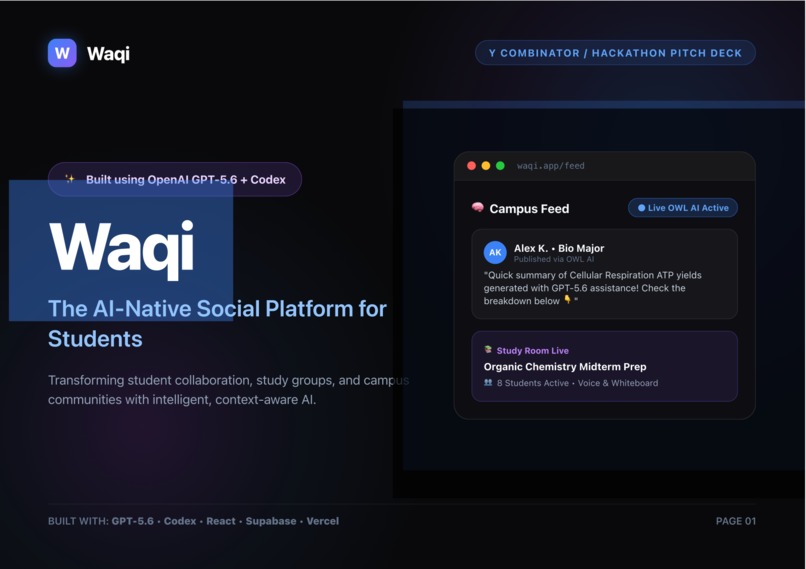
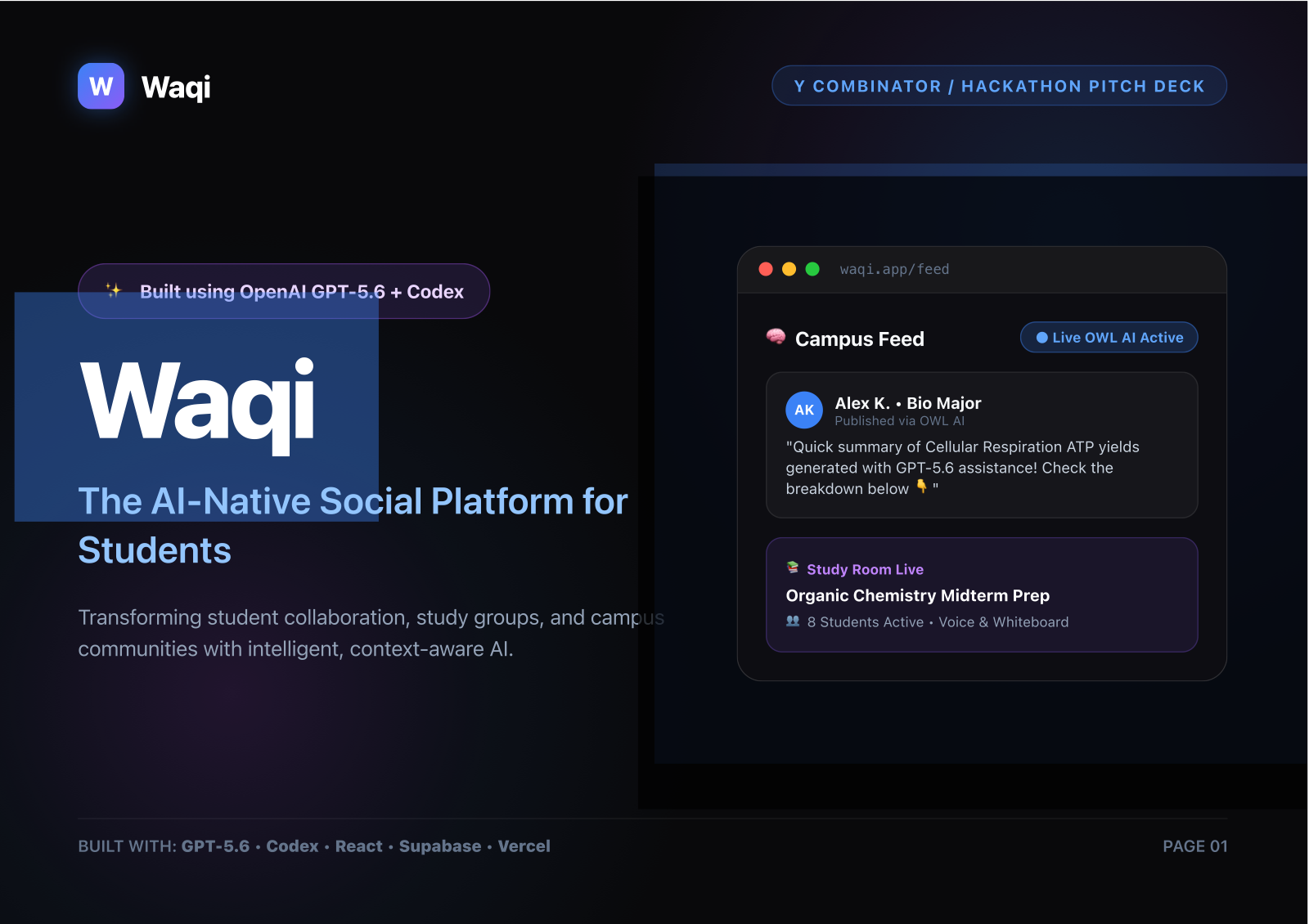
Waqi is a campus-focused social platform for students. It gives students a place to connect with classmates, share posts and stories, chat, discover campus communities, and find study support. The most important part is that every posts is being fact-checked by the campus admins, which reduces rumors at a notable quantity.
Key features include:
- Campus-based feed and student profiles
- Posts, photos, videos, and stories with privacy controls
- Anonymous posting through aliases for sensitive conversations
- Reporting and admin fact-checking tools to help reduce harmful rumours
- Direct messaging, organized notifications, and voice/call foundations
- A Study Corner for tasks, focus sessions, study groups, and study-room support
- OWL, an in-app assistant designed to help students organize study-related activities, which can do agentic works too
- No boring advertising of commercial business
- No endless reels as well as no dedicated page for reels
- Instant searching with highlighting the word The goal is to make the value of the platform greater than the distraction it creates:
[ \text{Healthy student connection} > \text{endless scrolling} ]
How we built it
I built Waqi as a web application using Next.js, React, TypeScript, and Tailwind CSS. Supabase handles the database, storage, and row-level security so that student data and campus content can be protected more carefully.
The project also includes real-time social features such as posts, stories, reactions, chat, notifications, reporting, and study tools. I used Capacitor to prepare the project for Android as well.
This was a very new kind of project for me. I began with raw ideas, sketches, personal experiences, and many questions. With Codex and GPT 5.6 as the development partners, I was able to turn those thoughts into working features step by step. I built most of the foundation with Codex. After getting GPT 5.6, the work smartly accelerated. I did not want to build “just another social app”; I wanted each part of Waqi to answer a real student problem.
Challenges we ran into
The hardest challenge was balancing openness with safety. Students need a space where they can speak honestly, but anonymity can also be misused. That is why I worked on reporting, privacy settings, moderation paths, aliases, and fact-checking instead of treating safety as an afterthought.
Another challenge was deciding what not to copy from mainstream and conventional social media. Reels, public like counts, and engagement-driven feeds can keep people online, but they can also create pressure and addiction. Designing a platform around student wellbeing meant making different choices.
As a student and a beginner builder, I also had to learn a lot quickly: databases, authentication, security policies, responsive UI, UX, media uploads, deployment, and connecting many features into one product. There were many moments where an idea sounded easy but became difficult when I tried to make it work in real life. Implementing the features with stability was tough as a beginner.
Accomplishments that we're proud of
I am proud that Waqi started from a personal problem and became a real, working project.
I am especially proud of:
- Building a campus-first alternative to general social media
- Including anonymous sharing while still considering accountability and safety
- Combining social connection with practical study tools
- Building an AI, which can help with studies and work around the website
- Building privacy, reporting, and moderation foundations early in the project
- Learning to turn an emotional idea into a technical product
For me, the biggest accomplishment is not only that the project is perfect, but also I did not leave the idea as only a complaint about social media; I started building the alternative I wished existed.
What we learned
I learned that good technology is not only about adding more features. It is about asking: how will this make someone feel?
I learned how reels can destroy an immature soul. I learned how important privacy, moderation, and trust are for a student. I also learned that building software is an iterative process: first ideas are rarely complete, and feedback matters more than pretending to have every answer from the beginning.
Most importantly, I learned that being a student or beginner does not mean you have to wait to solve problems. If a problem affects you and people around you, you can start small, learn while building, and make something meaningful.
What's next for Waqi: Your Campus Social
Waqi is still at the beginning. The current version is a foundation, and there is much more to improve.
Next, I want to test Waqi with real students, collect honest feedback, strengthen moderation, improve campus verification, and make the Study Corner more useful for daily student life. The admin fact checking is merely a raw idea, with a little implementation, which I want to make comprehensive. I also want to develop better wellbeing features that encourage students to take breaks, focus on their work, and form healthier connections.
My long-term vision is for Waqi to become a trusted digital campus space for every students.
Built With
- livekit
- openai-api
- postgresql
- react
- supabase
- tailwind-css
- typescript
- vercel
- vite
- webrtc


Log in or sign up for Devpost to join the conversation.