-
-
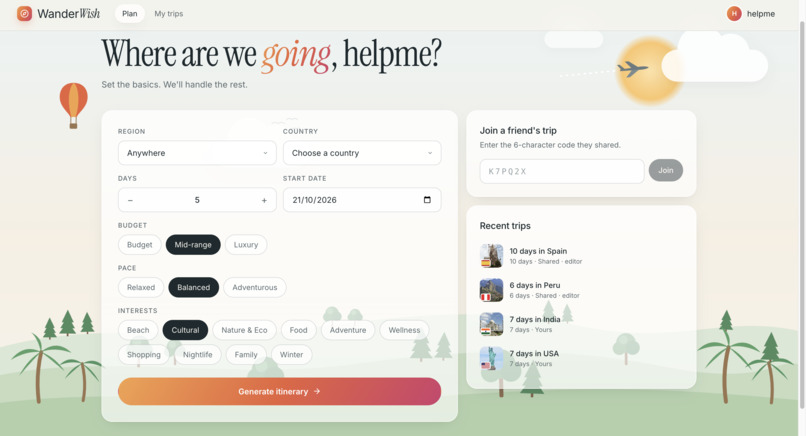
Dashboard
-
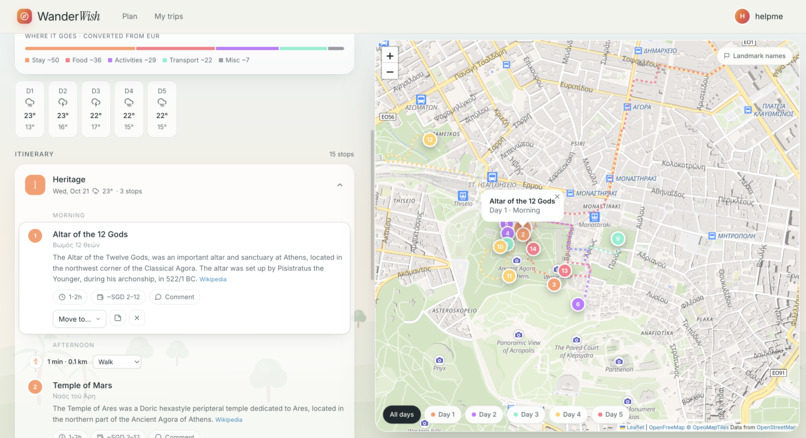
Map in Action (Map taken from OpenStreet)
# WanderWish: Making Travel Planning Feel Like Part of the Adventure
Inspiration
My inspiration for WanderWish came from two things: my love for building things and my family.
This was my first full-stack development hackathon project, so I wanted to build something I would genuinely enjoy using myself. My family and I LOVE travelling, and we were excited about visiting Spain. However, when it came to actually planning the trip, comparing destinations, researching activities, figuring out routes, and coordinating everyone's preferences quickly became overwhelming. At some point, planning the holiday felt almost as exhausting as the holiday itself!
I wanted to create something that made this process easier, especially for groups of people who want to travel together without spending hours figuring out the logistics. What if planning a trip could be just as exciting as going on one?
And so, WanderWish was born!
What It Does
WanderWish is a travel planning web application that takes the stress out of organising a trip while giving users complete control over their itinerary.
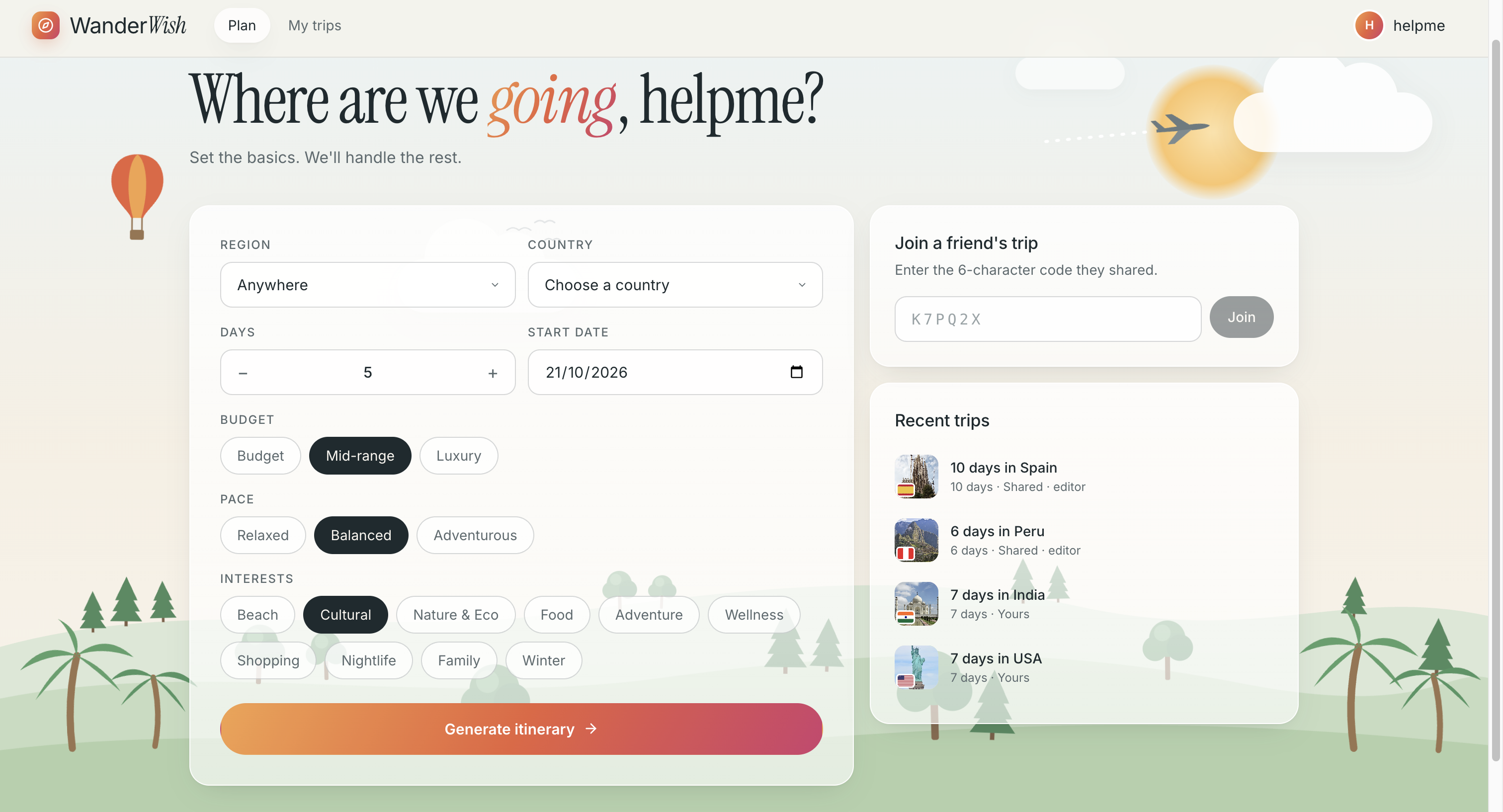
Simply choose your destination and the kind of holiday you're envisioning, and WanderWish generates a starting itinerary for you. From there, the possibilities are yours!
Key features include:
- Customisable itineraries: Generate an itinerary and make it your own. Rearrange activities, add new destinations, and adapt the plan to suit your travel style.
- Collaborative trip planning: Invite friends and family using a unique code or invitation link. Assign viewer or editor permissions so everyone can participate at their preferred level.
- Trip comments: Leave comments for other travellers to discuss plans, share thoughts, and coordinate decisions in one place.
- Cost splitting: Keep track of shared expenses and split costs, with support for local and destination currencies.
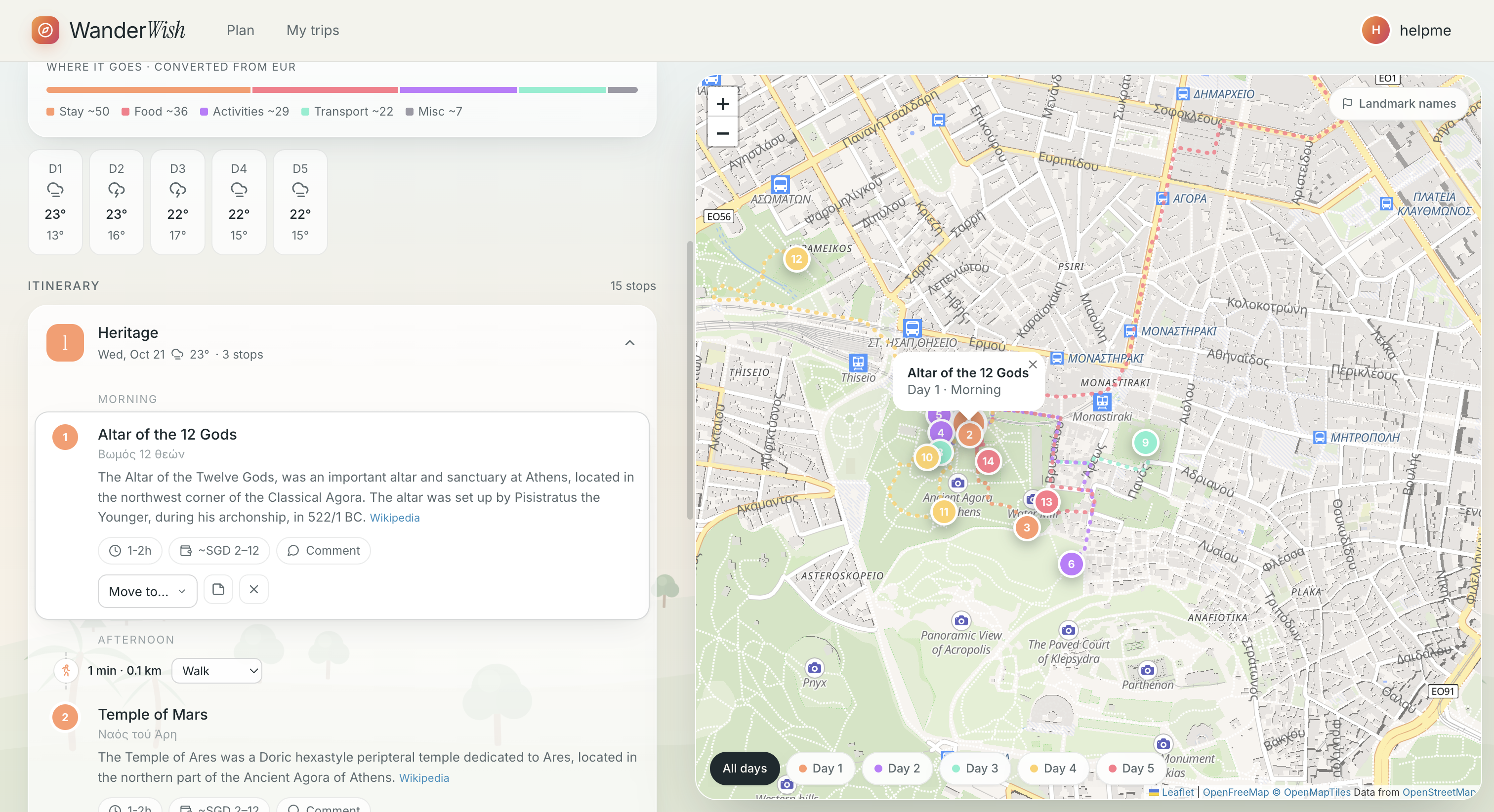
- Interactive maps and routes: Visualise your itinerary on a map and explore routes based on your preferred mode of transport.
- Trip history: Access both current and past trips, keeping your travel plans and memories organised in one place.
Rather than forcing users to follow a rigid, pre-generated itinerary, WanderWish gives them a flexible starting point that they can shape around their own preferences.
Because the best trips aren't necessarily the ones with the perfect itinerary. They're the ones that feel like your trip.
How I Built It
I built WanderWish using HTML5, CSS, JavaScript, and Vue 3, bringing together frontend development, API integrations, and interactive user experiences.
I used free APIs to retrieve information for the application and Wikipedia as a source for destination imagery. Vue 3 helped me build the interactive interface, while HTML and CSS allowed me to bring the overall design together.
One of my main priorities was making the application feel intuitive. I wanted users to be able to move between planning, customising, collaborating, and managing expenses without the experience feeling fragmented.
I also wanted the application to go beyond simply displaying information. Features such as itinerary editing, invitations, comments, route visualisation, and cost splitting were designed to make WanderWish a practical tool for planning an actual trip with other people.
Challenges I Ran Into
One of my biggest challenges was working with APIs. Each API came with its own documentation, response structure, and requirements, so understanding how to retrieve the information I needed and integrate it into my application took time. I had to learn how to navigate unfamiliar documentation, handle returned data, and make different pieces of information work together consistently.
Another challenge was managing the interactions between different features. WanderWish wasn't just about generating an itinerary; users needed to be able to modify it, collaborate with others, and manage trip-related information. Making these features work together while keeping the interface intuitive required me to think carefully about how the application was structured.
I also had to balance ambition with the time and resources available during a hackathon. There were many features I wanted to implement, but I had to prioritise building a functional experience instead of trying to add everything at once.
These challenges taught me that building a full-stack application involves much more than getting individual features to work. The real challenge is making all those features work together as one coherent product.
Accomplishments That I'm Proud Of
My biggest accomplishment was taking an idea inspired by a real problem in my life and turning it into an interactive web application.
As my first full-stack development hackathon project, WanderWish pushed me to move beyond isolated coding exercises and think about how different features could come together to create a complete user experience.
I'm particularly proud of the interactive interface and the level of customisation I aimed to give users. Instead of treating a generated itinerary as a finished product, I wanted users to feel that they could change, rearrange, and personalise their plans.
I'm also proud of bringing together features that address different parts of the same problem, from coordinating with travel companions to visualising routes and splitting expenses.
Most importantly, seeing the different parts of WanderWish come together into a working application was incredibly rewarding. It made the process of learning full-stack development feel tangible, and it gave me the confidence to take on more ambitious projects in the future.
What I Learned
Building WanderWish taught me that developing a useful application requires a combination of technical problem-solving and user-centred thinking.
On the technical side, I gained experience working with APIs, interpreting documentation, handling data, and developing interactive features with Vue 3. I also learned how important it is to break a large project into smaller, manageable components and test how those components interact.
Beyond the technical aspects, I learned to think more carefully about the problem I was trying to solve. A travel planner could simply generate a list of places to visit, but that wouldn't necessarily solve the frustration of organising a trip with multiple people. The collaboration and customisation features came from thinking about what happens after an itinerary is generated.
I also learned that constraints can be useful. Working with free resources meant I had to be deliberate about the features I could realistically implement, rather than relying on paid services to do the heavy lifting.
Ultimately, this project reminded me why I enjoy building things: I get to take an everyday frustration, experiment with possible solutions, and turn an idea into something people can actually use.
What's Next for WanderWish?
I want to continue developing WanderWish around its biggest strength: giving travellers the freedom to plan a trip their own way.
Some features I'd love to explore include:
- A personalised AI travel assistant: An assistant that answers destination-related questions, suggests activities, and helps users refine their itinerary based on their interests. I'd like to explore free-tier or locally run models so that this can be developed without relying on expensive subscriptions.
- Collaborative decision-making: Allow travellers to vote on destinations and activities, maintain a shared wishlist, and see which options suit the group best. This would make planning more democratic instead of leaving one person responsible for every decision.
- Preference-based itinerary generation: Let users specify their budget, preferred pace, interests, dietary requirements, and transportation preferences so that generated itineraries better reflect what they actually want.
- Smarter itinerary adjustments: Let users change one activity and adapt the rest of the itinerary around it, taking travel time, opening hours, and scheduling constraints into account where data is available.
A more personal travel experience: Allow users to save favourite activities, reuse preferences from previous trips, and learn from their past itineraries to make future planning easier.
A tiered membership system: I'd also like to explore introducing a free-premium model to make WanderWish financially sustainable in the long run. The core features would remain free for everyone, while Gold members could unlock premium features such as AI-powered itinerary recommendations, more advanced budget planning, and personalised travel insights. This would allow WanderWish to remain accessible while creating opportunities to support the platform's ongoing development and maintenance.
I also want to explore how WanderWish can make customisation more meaningful. Rather than simply allowing users to move activities around, the app could help them understand the trade-offs behind their choices. For example, users could compare a relaxed itinerary with a packed one, or see how choosing a different destination affects their budget and travel time.
My long-term vision is for WanderWish to become more than an itinerary generator. I want it to be a space where people can dream up trips together, turn their different preferences into a shared plan, and spend less time worrying about logistics and more time looking forward to the adventure.
After all, the wish is only the beginning. WanderWish helps you make it happen.
Built With
- apis
- css
- html5
- javascript
- vue

Log in or sign up for Devpost to join the conversation.