Inspiration
Travel planning usually starts with inspiration — a TikTok reel, an Instagram post, or a photo a friend shares. But the process of turning that moment into a bookable trip is clunky: open tabs, guess locations, compare prices, and risk overpaying because of hidden surcharges. We wanted to close the gap between inspiration and booking in one seamless step.
What it does
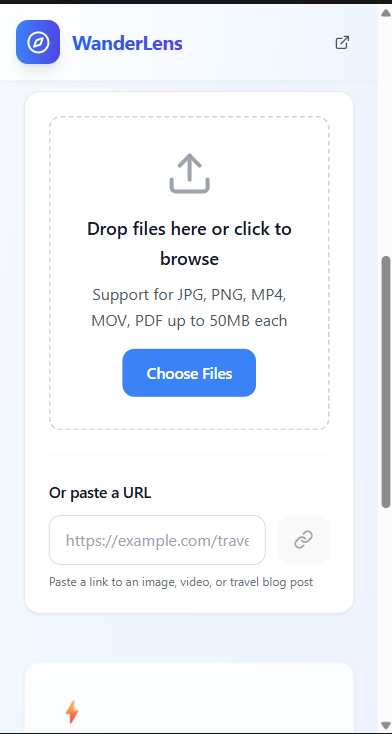
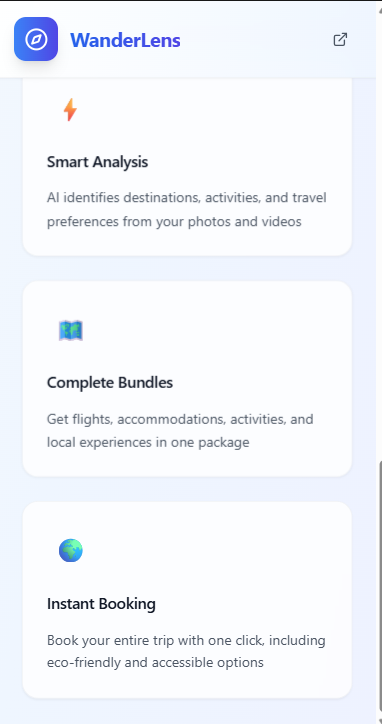
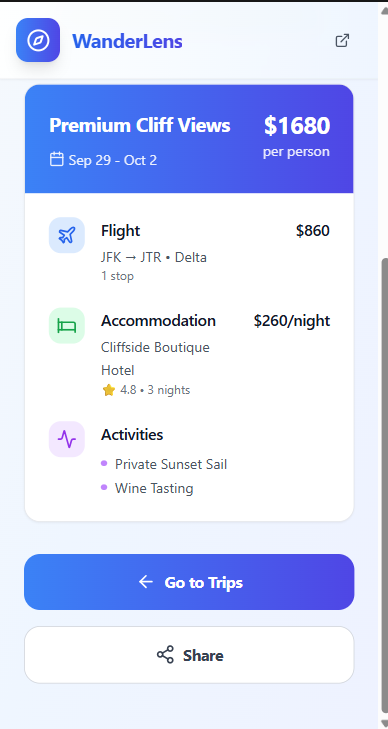
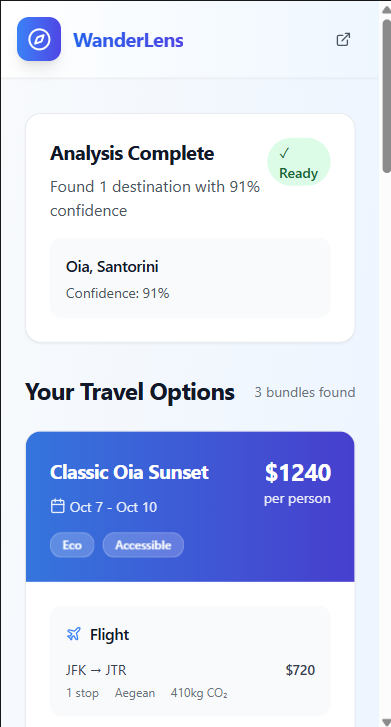
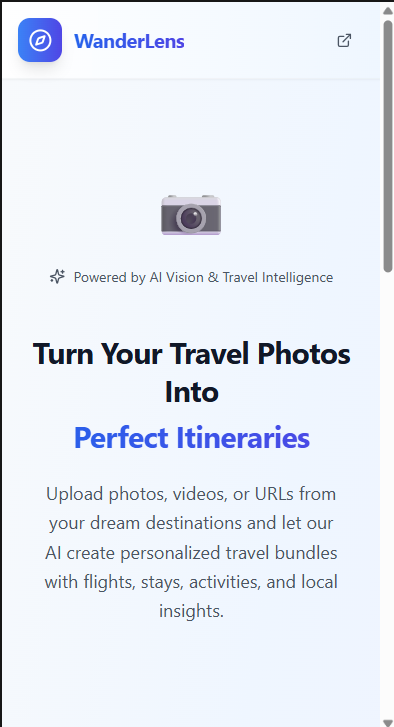
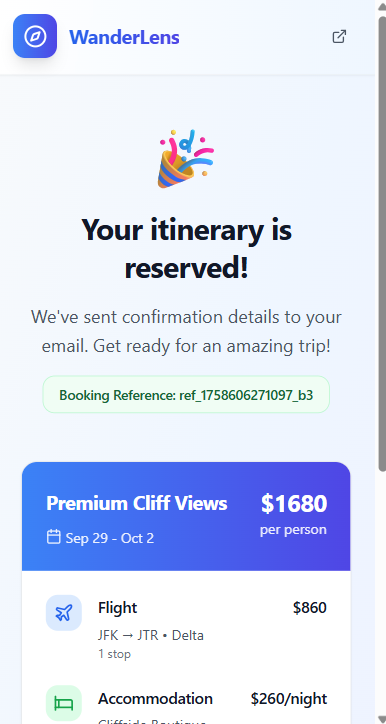
WanderLens lets you upload a photo or video and instantly get curated, bookable itineraries. Our AI recognizes the destination and activities, enriches them with context (weather, holidays, visas, accessibility, emissions), and generates 2–3 smart trip bundles with one-click booking or share-and-vote for groups.
At its core:
Image/Video → Destination Detection
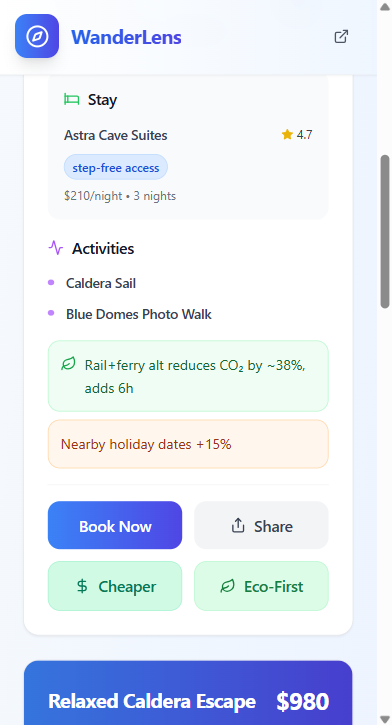
Contextual Intelligence (weather, surcharges, CO₂, visas)
Bookable Bundles (flights, stays, activities)
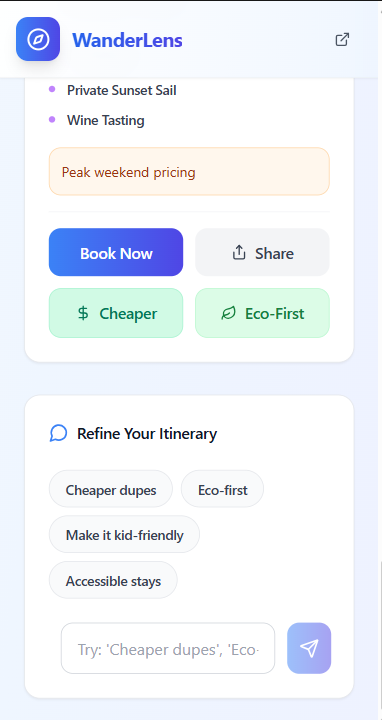
Smart Alternates (cheaper dates, eco routes, accessible options)
How we built it
Frontend: Next.js + Tailwind + Vercel AI SDK for a conversational, card-based UI.
Backend: Node/TypeScript with mocked APIs during the hackathon.
Vision Layer: Used pre-trained landmark detection models to identify POIs.
Context Layer: Weather, holiday, visa, and carbon footprint APIs (stubbed for demo).
Orchestration: A GPT-class LLM to assemble bundles from detected inputs and tool calls.
Equation for time saved vs. baseline planning:
𝑇 baseline ≈ 2 hours of research , 𝑇 WanderLens ≈ 2 minutes , Δ
𝑇
𝑇 baseline − 𝑇 WanderLens ≈ 118 minutes saved T baseline
≈2 hours of research,T WanderLens
≈2 minutes,ΔT=T baseline
−T WanderLens
≈118 minutes saved
Equation for eco route benefit:
CO₂ reduction
𝐸 flight − 𝐸 rail+ferry 𝐸 flight × 100 % ≈ 38 % CO₂ reduction= E flight
E flight
−E rail+ferry
×100%≈38%
Challenges we ran into
Vision accuracy: Landmarks aren’t always clear; we built a fallback “top-3 candidates” UI.
API limits: Travel APIs are rate-limited; we mocked responses for demo speed.
UX balance: Making cards both informative and lightweight required several iterations.
Data gaps: Accessibility and eco data aren’t standardized, so we relied on enrichment + user feedback loops.
Accomplishments that we're proud of
Proved the concept of “upload → trip plan” in under 48 hours.
Designed a clean conversational UI with shareable itineraries.
Integrated contextual intelligence (eco, accessibility, visa) into the booking flow.
Created a viral growth hook: trips generated from social media reels.
What we learned
Multimodal AI (vision + LLM) is extremely powerful when combined with structured APIs.
Simple UX touches (like showing CO₂ badges or holiday surges) add huge perceived value.
Hackathon scope requires ruthless prioritization — mocks are your friend.
The gap between inspiration and booking is a product moat in travel tech.
What's next for WanderLens
Phase 1: Harden vision model; real travel APIs; eco & accessibility filters.
Phase 2: Group share & voting; taste memory (store preferences across trips).
Phase 3: Voice-first trip planning, AR “scan the view → book trip,” and creator partnerships (IG/TikTok revenue share).
Built With
- ai
- gpt
- javascript
- json
- next.js-(app-router)
- tailwind-css
- typescript
- vercel

Log in or sign up for Devpost to join the conversation.