-
-
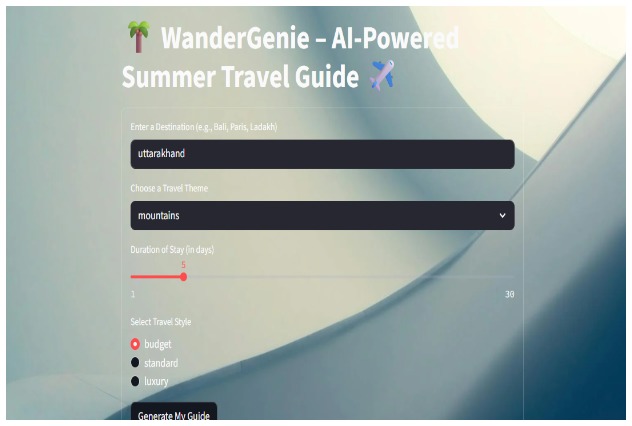
"Smart summer travel starts here – Wander Genie homepage"
-

"Get personalized summer destination suggestions with one click"
-
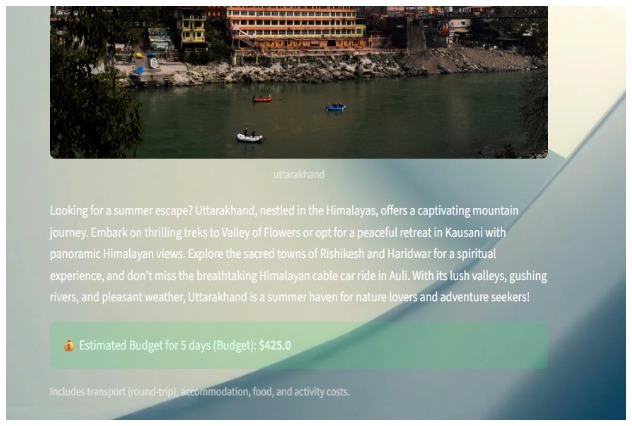
"Estimate travel costs and make smarter choices"

Inspiration
I’ve always been fascinated by the intersection of AI and travel. Planning a summer vacation can be overwhelming – deciding where to go, estimating the cost, and visualizing the destination. I wanted to build a tool that could make this process fun, smart, and simple. That’s how Wander Genie was born – your pocket travel planner powered by AI.
What it does
Wander Genie is an AI-powered summer travel guide that helps users: 1.Discover summer destinations based on their preferences using natural language prompts. 2.Generate personalized travel suggestions using the Cohere language model. 3.Estimate travel budgets based on destination-specific cost data and duration of stay. 4.Visualize destinations with real-time images fetched from the Unsplash API. 5.Interact through a friendly web interface built with Streamlit – no technical skills required.
In short, Wander Genie simplifies trip planning by combining generative AI, real-time visuals, and budget estimation in a single, easy-to-use tool.
How we built it
I built Wander Genie using the following tools and technologies: 1.Cohere API – to generate personalized travel suggestions based on natural language inputs. 2.Streamlit – for building an interactive and responsive web application interface. 3.Unsplash API – to fetch real-time destination images based on AI-generated suggestions. 4.Custom Budget Estimator – developed in Python to calculate estimated travel costs based on destination, trip length, and category (budget, mid-range, luxury). 5.Modular Code Structure – I structured the project with utility modules: cohere_logic.py – handles text generation using Cohere. budget_utils.py – contains the logic for estimating travel budgets. image_utils.py – handles Unsplash image fetching. 6.Environment Variables – .env file used to securely manage API keys. 7.Iterative Development & Testing – Used Sublime Text and local testing with streamlit run app.py before final deployment.
The project is fully deployed using Streamlit Community Cloud, making it accessible to anyone with an internet connection.
Challenges we ran into
Building WanderGenie as a solo developer came with its fair share of hurdles: 1.API Integration Issues: Initially, integrating multiple APIs (Cohere and Unsplash) was tricky due to authentication errors and rate limits. 2.Generating Relevant Responses: Fine-tuning prompts to get specific, high-quality travel suggestions from Cohere took multiple rounds of experimentation. 3.Budget Calculation Logic: Designing a flexible and realistic budget estimator that adjusts across countries and travel types was challenging. 4.Staying Modular: Ensuring the codebase remained clean, readable, and modular required careful planning and file structuring. 5.Deployment Hiccups: Deploying on Streamlit Community Cloud required adjustments in handling secrets (.env variables had to be moved to the cloud secrets section). Despite these challenges, I was able to learn a lot and complete the project with all planned features.
Accomplishments that we're proud of
1.Successfully built WanderGenie as a solo developer within the hackathon time frame. 2.Integrated AI (Cohere) to generate personalized destination plans with natural language understanding. 3.Created a working travel budget estimator that factors in country, accommodation, and trip duration. 4.Automatically fetched real-time destination images and icons using the Unsplash API and organized them by folder. 5.Maintained a clean and modular folder structure with reusable utilities (utils/), making the project scalable and understandable. 6.Deployed the app on Streamlit Cloud, enabling easy sharing and live interaction. 7.Learned how to combine multiple APIs, prompt engineering, and UI integration in one cohesive project.
What we learned
1.Gained hands-on experience with Cohere’s Generate API for building creative AI-powered applications. 2.Learned how to use Streamlit to quickly develop and deploy interactive web apps. 3.Understood how to fetch and display dynamic images using the Unsplash API, improving visual appeal. 4.Improved my modular coding skills by organizing logic into utils/ for reusability and clarity. 5.Practiced prompt engineering to fine-tune AI responses for better travel recommendations. 6.Learned to manage API keys securely using environment variables and .gitignore. 7.Understood how to integrate budget logic and UI components together for a better user experience. 8.Strengthened my ability to work independently on full-stack AI projects from idea to deployment.
What's next for Wander Genie: AI powered summer travel companion
1.Add Real-Time Flight & Hotel Integration using APIs like Skyscanner or Booking.com for instant planning. 2.Multi-Destination Itineraries with route optimization and daily activity plans. Voice Assistant Support using tools like Whisper or Google Speech-to-Text for hands-free use. 3.Personalized Travel Goals – allow users to select travel moods like "adventure," "relaxation," or "culture" for better AI recommendations. 4.Weather-Based Suggestions – dynamic suggestions based on the forecast at the travel destination. 5.Memory Mode – save past trips and preferences for improved future recommendations. 6.Mobile App Version using React Native or Flutter for on-the-go planning. 7.User Login & Saved Trips – users can create accounts to save, edit, and revisit itineraries anytime. 8.AI Image Generation of custom postcards from the suggested locations using models like DALL·E.


Log in or sign up for Devpost to join the conversation.