-
-

Home page for WanderAI
-
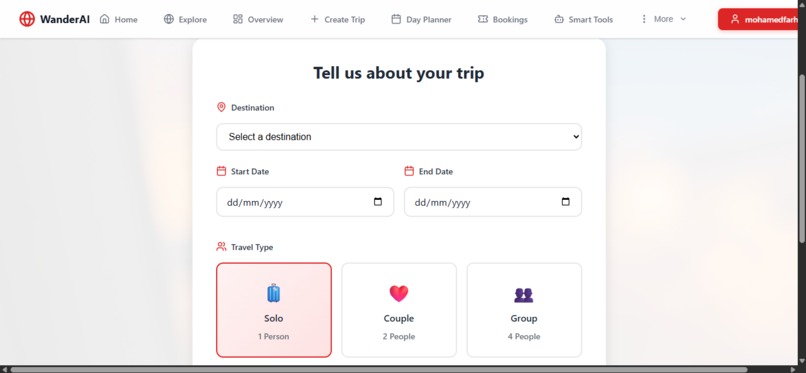
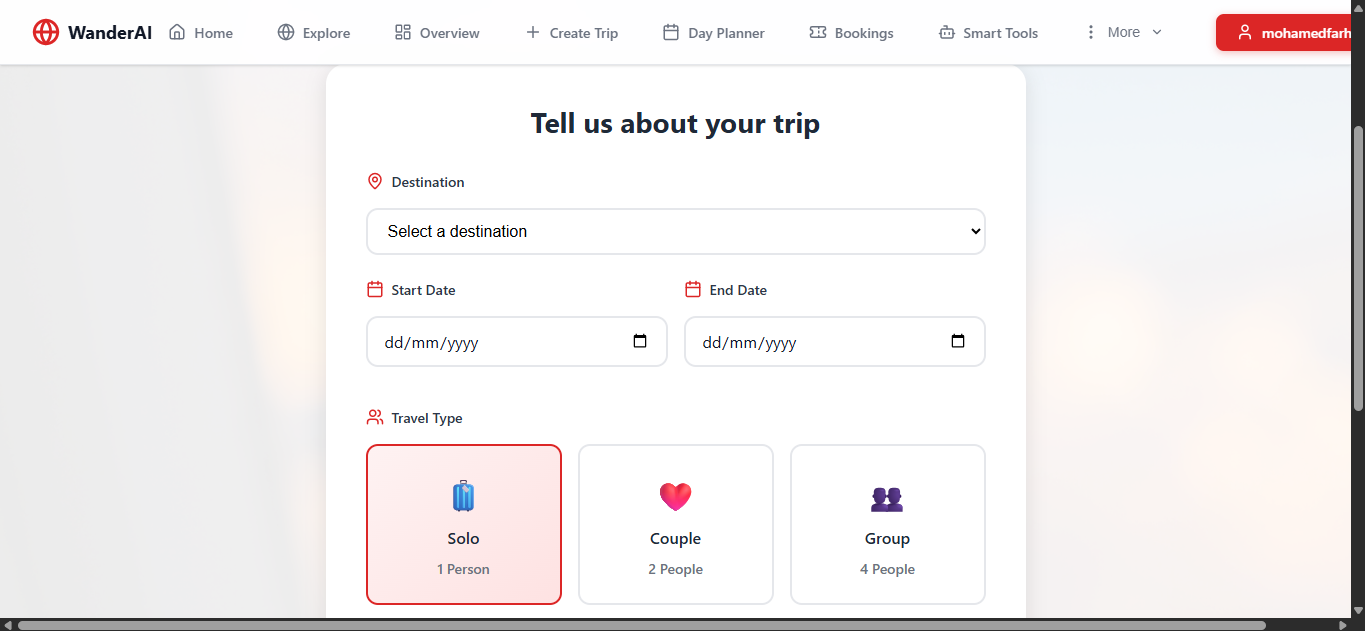
AI Trip Creation
-
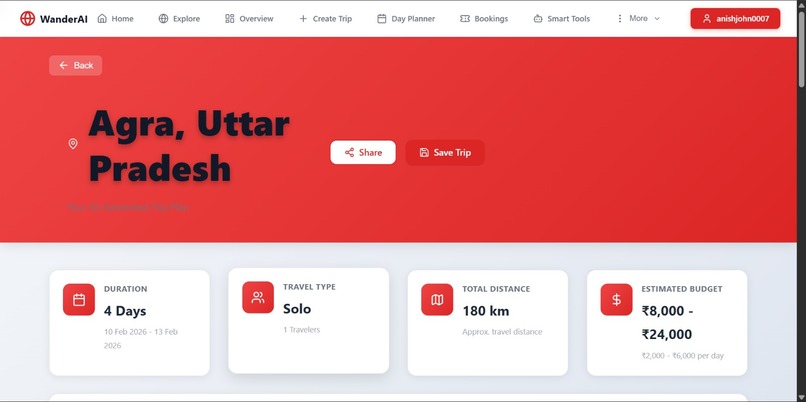
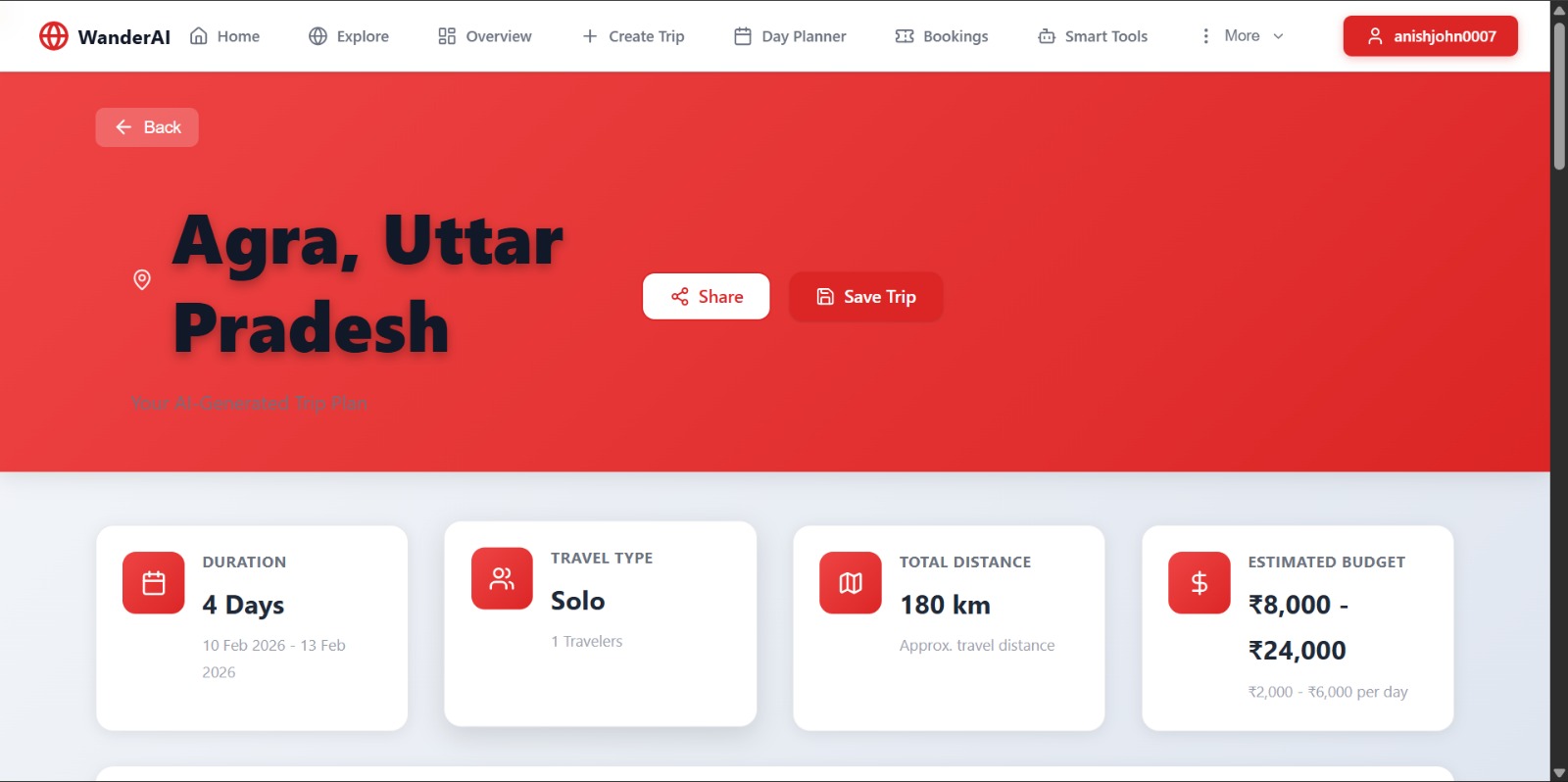
Result of AI Trip Generator

Inspiration
Planning a trip often starts with excitement and quickly turns into dozens of browser tabs — maps in one place, hotels in another, weather somewhere else, and notes scattered everywhere. We wanted to remove this chaos. The idea behind WanderAI came from a simple thought: what if a single smart assistant could understand where you want to go and plan the journey for you in seconds? That vision of stress-free planning is what inspired us to build WanderAI.
What it does
WanderAI is an AI-powered trip planner that creates personalized, day-by-day travel itineraries based on user preferences. Users enter their destination, dates, and interests, and the app generates a structured plan they can edit, save, and export.
It also brings together practical travel tools in one place — maps for locations, weather updates, booking references, budget utilities, packing lists, and trip sharing. Instead of switching between apps, everything needed to plan a trip lives inside a single dashboard.
How we built it
We built WanderAI as a full-stack web application using a modern toolset:
React with Vite for a fast, responsive frontend
React Router and component-based architecture for smooth navigation
Supabase for authentication, database, and storage
Google Gemini AI API to generate intelligent itineraries
Leaflet maps and weather APIs to add real-world travel context
jsPDF to export trip plans as downloadable documents
The core workflow of the app can be summarized as:
User Input → AI Itinerary Generation → Interactive Editing → Save and Export User Input→AI Itinerary Generation→Interactive Editing→Save and Export
AI generates the structure, and the user refines it.
Challenges we ran into
One of the biggest challenges was getting AI to return well-structured, day-wise plans instead of long descriptive text. We had to carefully design prompts and post-process responses.
Managing multiple APIs together without affecting performance was another hurdle. We also had to handle complex state management so users could create, edit, and revisit multiple trips smoothly.
Keeping the interface simple while packing in many features required constant design decisions. Deployment was also tricky due to handling several environment variables and API keys.
Accomplishments that we're proud of
We’re proud that WanderAI is not just an idea but a working product that genuinely reduces the effort of trip planning. The seamless integration of AI with maps, weather, storage, and exports makes it feel like a complete travel assistant rather than a demo project.
We’re especially proud of how the AI output feels practical and usable, and how users can take that plan and immediately act on it.
What we learned
We learned that AI becomes truly powerful when guided with the right structure. We gained hands-on experience in full-stack integration, API coordination, authentication flows, and real-world UX design.
We also learned how important it is to think from the user’s perspective — every feature had to answer the question: does this make planning easier?
What's next for Wander AI
The next step for WanderAI is to make it even smarter and more connected. We plan to add real-time booking integrations, smarter budget predictions, collaborative trip planning with friends, and mobile optimization.
We also aim to improve personalization so the AI understands user travel history and preferences better over time, making each trip plan more tailored than the last.
Built With
- css
- database
- git
- google-gemini-ai-api
- google-maps-/-places-api
- javascript
- jspdf
- leaflet-maps
- lucide-react-icons
- openweathermap-api
- react-(vite)
- react-router
- storage)
- supabase-(auth
- vercel-(deployment)

Log in or sign up for Devpost to join the conversation.