-
-
Page 1
-
-
-
-
Inspiration
Teenagers are growing up in a world that constantly shows them how far everyone else seems to have gone. Social media, school, expectations, and other people's achievements can make it feel like you should already know what you want to do, what you're good at, and where you're going.
We wanted to create something that gives students permission to not have everything figured out yet.
Wander was inspired by the idea that discovering yourself doesn't have to start with a big decision. Sometimes it can start with taking a breath, trying something small, and noticing what you enjoy.
What it does
Wander is a low-pressure exploration space for students who feel overwhelmed, uncertain, or stuck comparing themselves to others.
Instead of telling users who they are or what career they should choose, Wander helps them explore through small adventures.
The core journey is:
Overwhelmed → Breathe → Choose → Adventure → Reflect → Discover → Wander again
Users can pause and breathe, choose something that sounds interesting, try a short activity, and reflect on what they discovered about themselves.
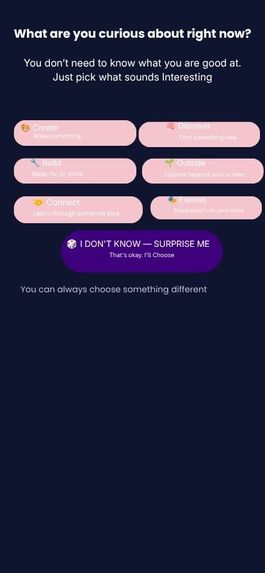
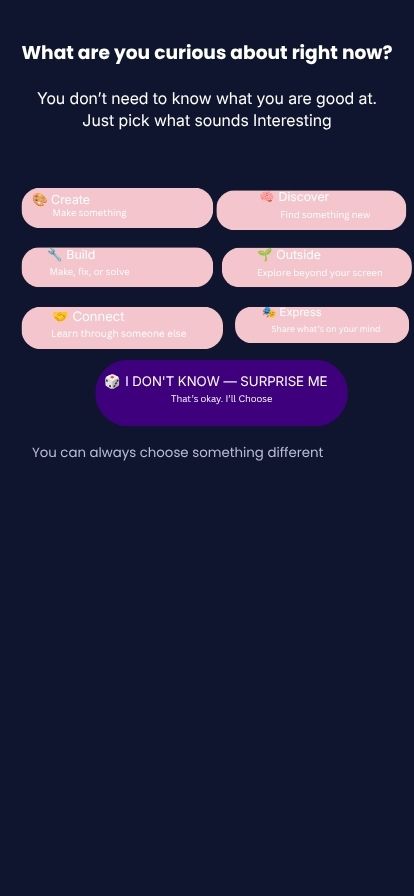
Wander has six exploration worlds: Create, Discover, Build, Outside, Connect, and Express, plus a Surprise Me option for users who don't know where to start.
There are no rankings, leaderboards, streaks, or pressure to be perfect. Not enjoying something is also useful information.
How we built it
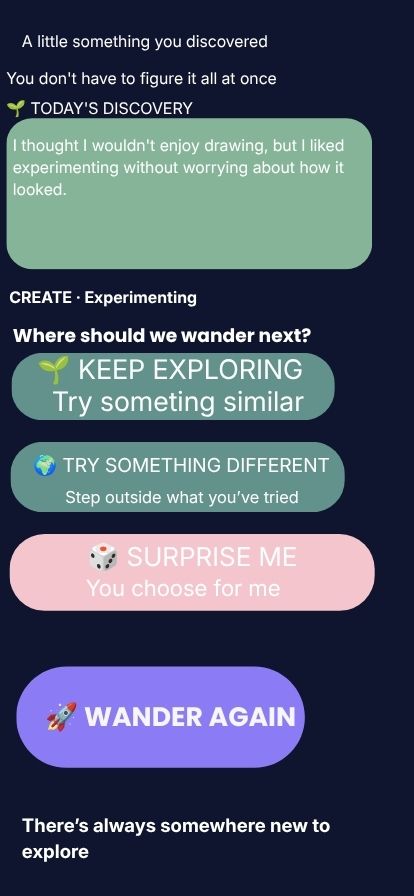
We designed Wander as a mobile prototype in Canva, using a calm but adventurous visual identity built around a midnight sky, stars, paths, and exploration.
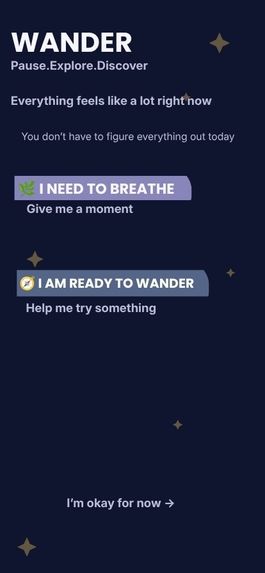
The prototype contains six connected screens:
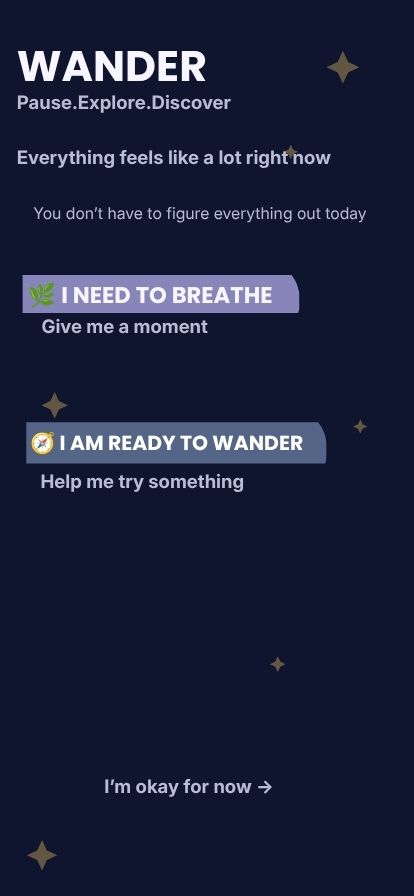
- Overwhelmed — gives the user a choice to breathe or start wandering.
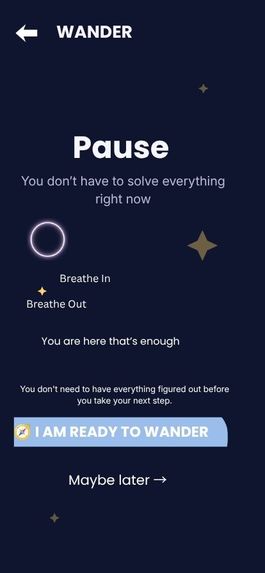
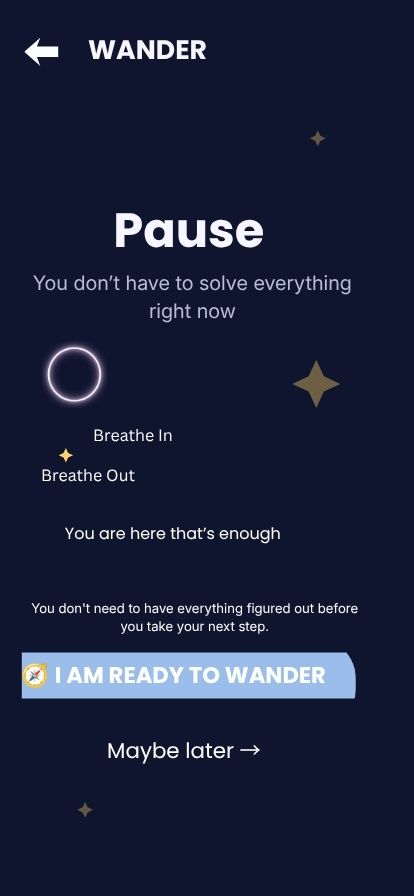
- Breathe — provides a short pause before exploring.
- Choose — lets the user select what they are curious about.
- Adventure — gives them a small, low-pressure activity.
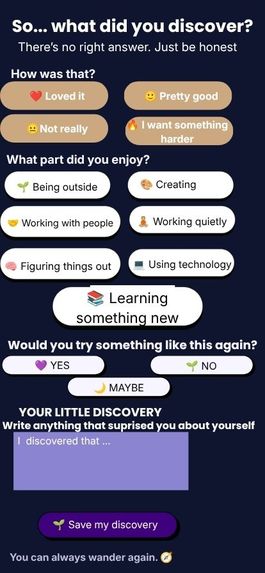
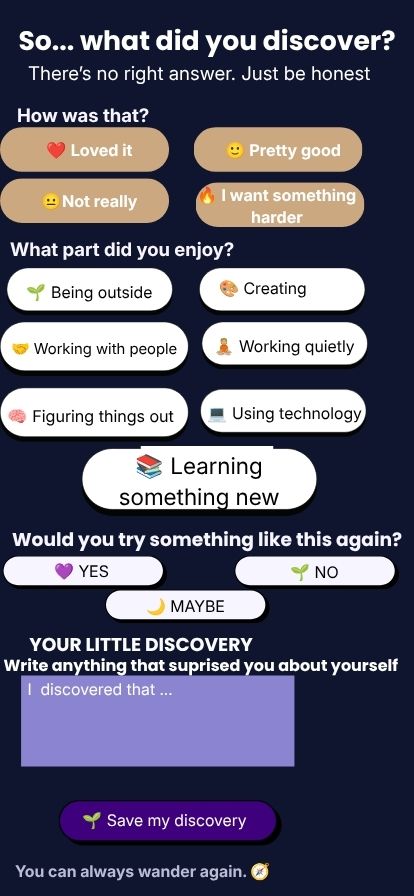
- Reflect — helps them think about what they experienced.
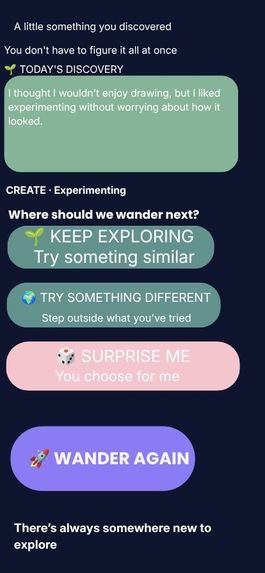
- Discovery — turns that reflection into a small personal discovery and invites them to wander again.
We focused on creating the experience and interaction flow first rather than building a full coded application.
Challenges we ran into
One of our biggest challenges was deciding what to include without turning Wander into another productivity or self-improvement app.
We also had to work within the limits of a Canva prototype. Some interactions, such as selecting reflection options or entering text, are represented visually rather than functioning like they would in a fully developed application.
Another challenge was making the experience feel adventurous while still keeping it calm and low-pressure. We solved this by using small activities, simple choices, and visual elements such as stars, paths, and a compass.
Accomplishments that we're proud of
We are proud that we turned an emotional and difficult-to-define problem into a simple experience that can be understood in a few steps.
We created a complete clickable MVP rather than only describing the idea. The main journey can be tested from beginning to end:
Choose → Try → Reflect → Discover → Wander again.
We are also proud that Wander does not treat uncertainty as something that needs to be fixed. It makes room for users to say, "I don't know yet," and still take a first step.
What we learned
We learned that solving a problem doesn't always mean adding more features. In Wander, removing pressure was part of the solution.
We also learned how important it is to test the flow of a prototype, not just how individual screens look. Building Wander helped us think more carefully about what a user should feel and understand at each step.
Most importantly, we learned that discovering yourself can be an experience rather than a label.
What's next for Wander
The next version of Wander could include a larger library of adventures, personalized suggestions based on previous reflections, and more ways to explore offline.
We would also like to make the reflection experience fully interactive and eventually turn the prototype into a working app.
The long-term goal is to help students build a broader understanding of themselves through curiosity and experience, without turning self-discovery into another competition.
You don't have to know where you're going yet. You can start by wandering.
Built With
- canva
- chatgpt
- openai

Log in or sign up for Devpost to join the conversation.