-
-
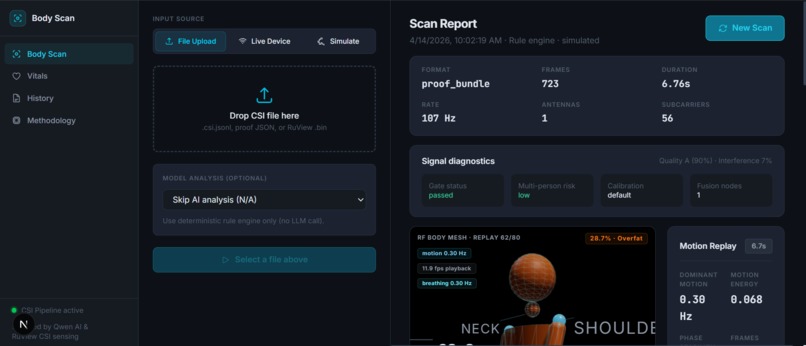
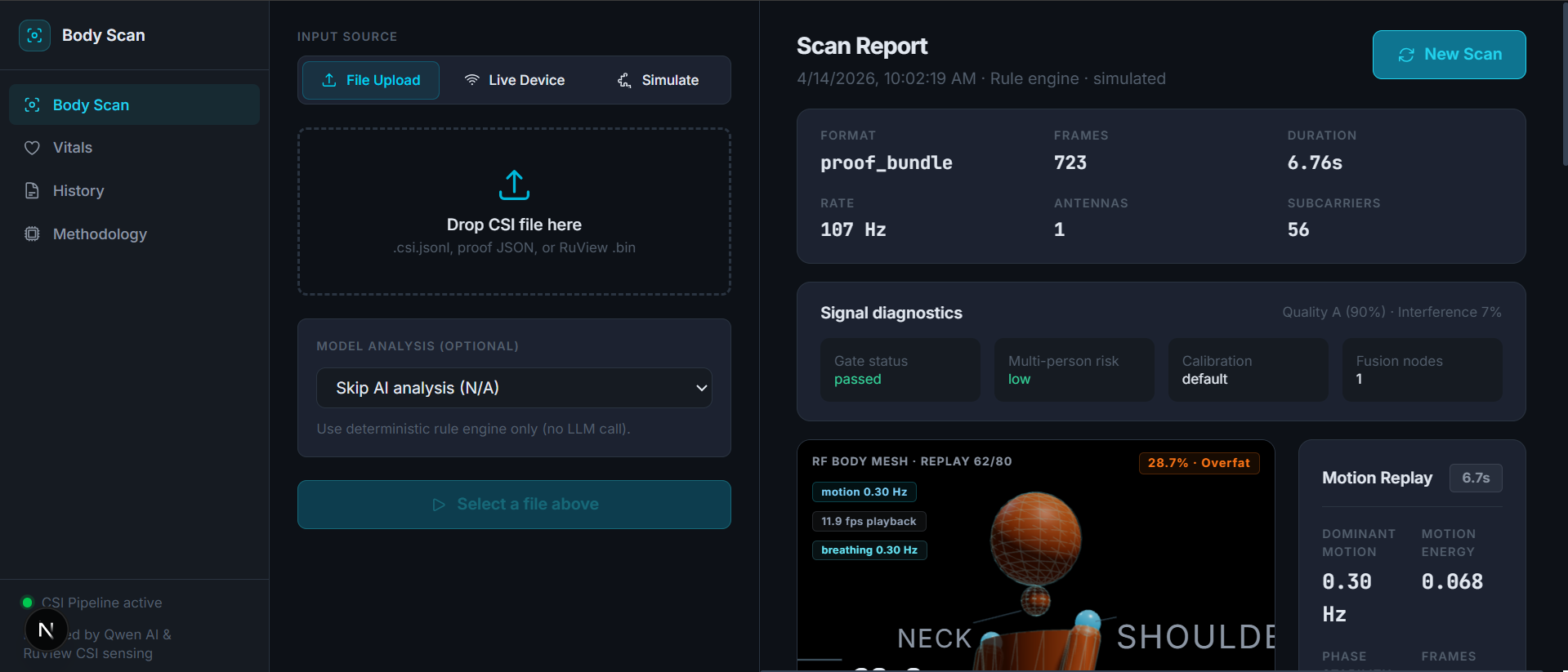
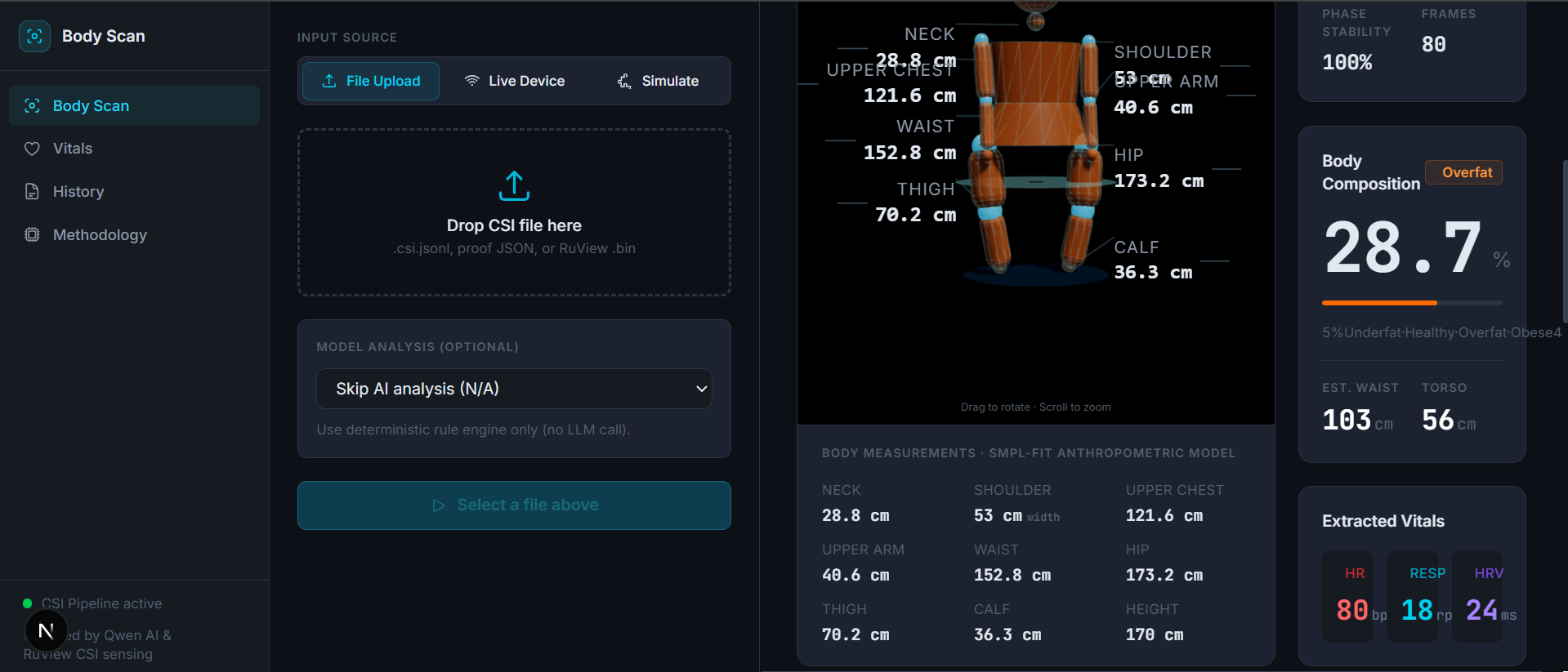
Scan Report Example
-
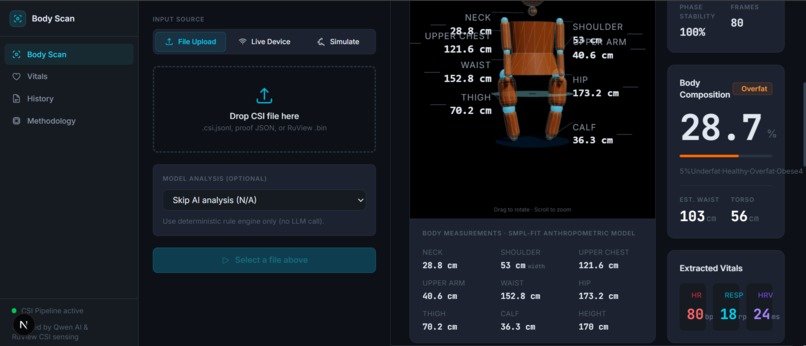
Scan Report Example
-
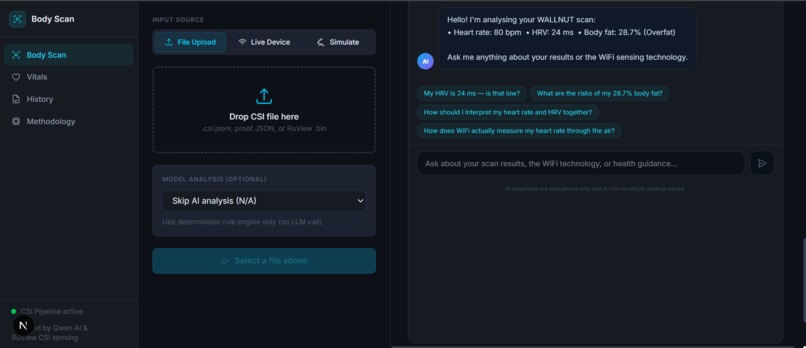
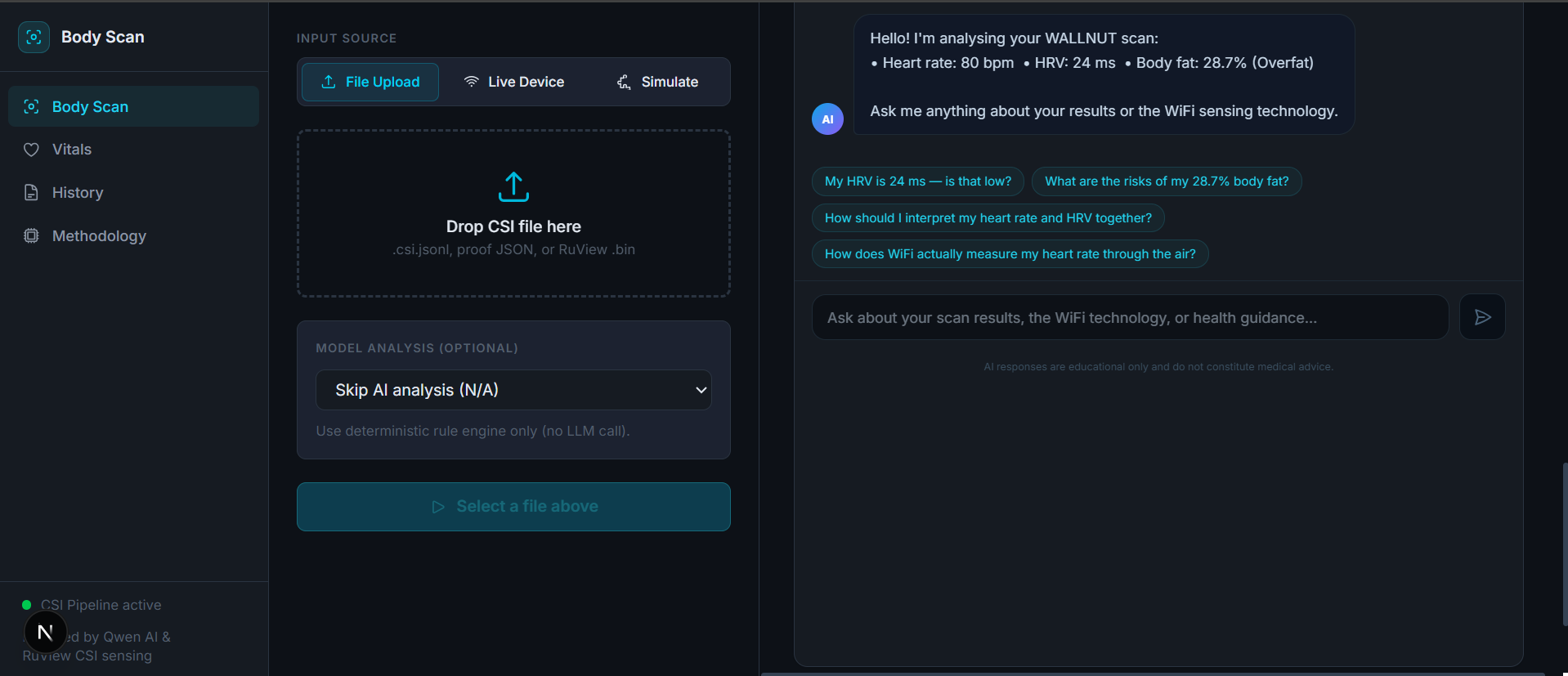
Qwen Chatbot supported analysizing
Inspiration
The inspiration for WALLNUT stems from the gap between health tracking and personal privacy. While wearable devices are intrusive and camera-based monitoring raises significant privacy concerns, ambient WiFi signals offer a unique opportunity to "see" health without visual sensors. We wanted to build a platform that acts as a silent, camera-free observer, capable of tracking vitals and body composition through walls, ensuring that a patient's most sensitive health data never leaves their local environment.
What it does
WALLNUT is a privacy-first body scan platform that utilizes WiFi Channel State Information (CSI) to provide comprehensive health monitoring. It features:
- Support for live hardware streams (ESP32-S3), file uploads, or deterministic simulations.
- Non-invasive tracking of heart rate, breathing rate, and Heart Rate Variability (HRV) using signal processing.
- Estimation of body fat percentage, BMI proxies, and eight clinical circumferences (waist, hip, chest, etc.) using Ramanujan's ellipse approximation.
- A 17-keypoint COCO-aligned skeletal model that reflects real-time movement and breathing patterns without using a camera.
- A Qwen-powered assistant that uses Retrieval-Augmented Generation (RAG) to help patients analyze their results and understand the underlying WiFi sensing technology.
How we built it
We engineered a robust 5-stage pipeline to process ambient radio signals:
- Capturing IQ-decoded CSI matrices from 56 OFDM subcarriers.
- Implementing 2nd-order IIR bandpass filters for vitals extraction and DC removal to isolate mechanical oscillations.
- Using wavelength-dependent diffraction to map subcarrier energy to anatomical zones.
- Synthesizing motion dynamics through sliding-window DFT and phase stability scoring.
- Integrating Qwen-Plus for clinical summaries and a MemPalace-backed RAG server for interactive patient guidance.
Challenges we ran into
- At 5 GHz, the WiFi wavelength is ~6 cm, creating a Rayleigh resolution limit of ~3 cm. This made resolving fine-grained features like finger joints impossible, requiring us to rely on statistical priors for certain metrics.
- Dealing with "DC offset" from static reflections in a room required sophisticated temporal mean subtraction to isolate purely dynamic body modulations.
- Fusing data from multiple WiFi nodes required a weighted time-aligned strategy to handle varying signal strengths and packet arrival times.
Accomplishments that we're proud of
- Successfully synthesizing a 3D-aware skeletal pose purely from the diffraction and reflection of WiFi subcarriers.
- Implementing a mathematical regression model based on the ANSUR-II and CAESAR databases that allows for circumference estimates with a narrow error margin.
- Building a chatbot that provides deep health insights while keeping raw CSI signals local.
What we learned
We gained deep insights into RF signal processing, specifically how human tissue modulates signal phase and amplitude. We learned how to apply complex mathematical formulas, like Ramanujan's ellipse, to anthropometric data and how to manage asynchronous "upload jobs" in a Next.js environment using SQLite for state tracking.
What's next for WALLNUT Body Scan App
- Expanding the "weighted_time_aligned" strategy to support more complex mesh environments for 360-degree body reconstruction.
- Enhancing the local database to provide deeper "trend summary" reports that track vitals and body composition over months.
- Developing a lightweight client for monitoring while on the move, utilizing mobile hotspot CSI data.

Log in or sign up for Devpost to join the conversation.