-
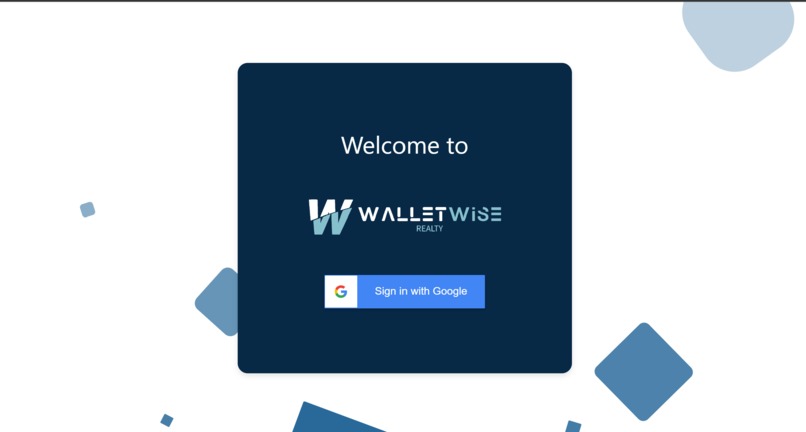
This is the login page where the user will log in using Google OAuth on Firebase. Their email, name, and image url are saved
-
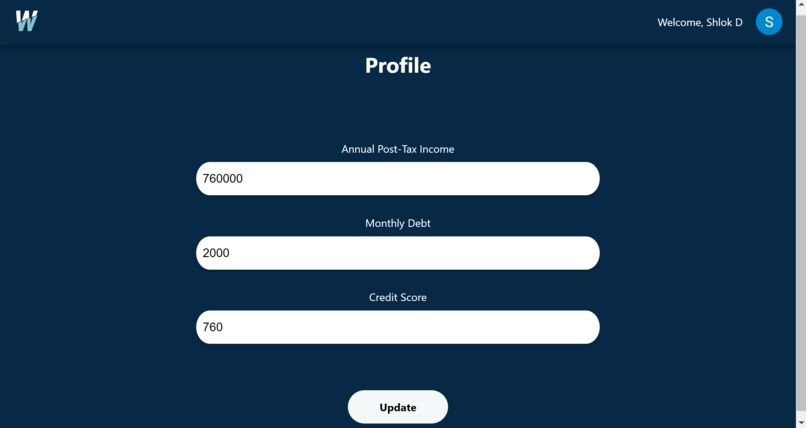
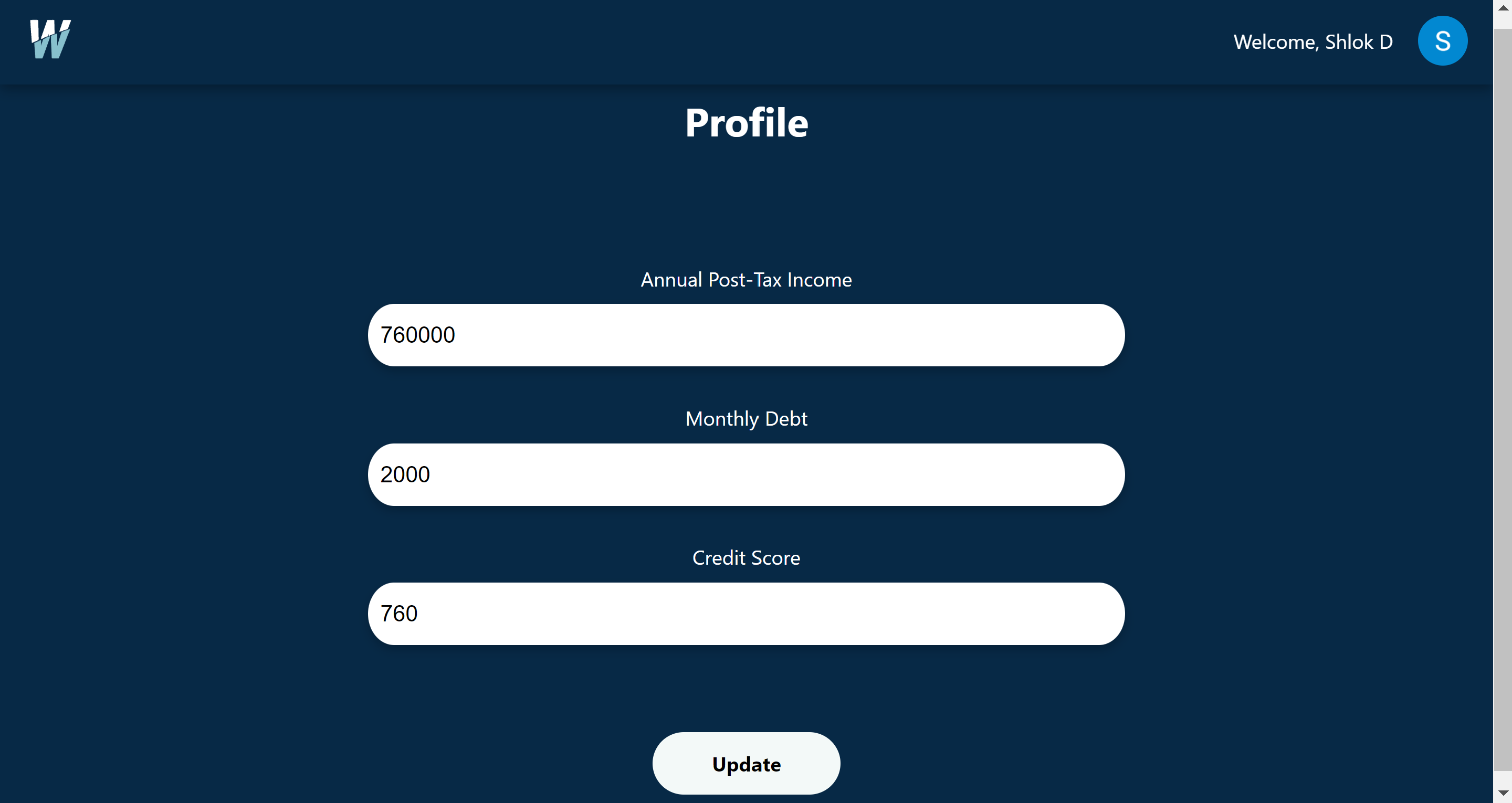
After signing in, users can update their financial details to get a more accurate estimate. This is also saved in Firebase.
-
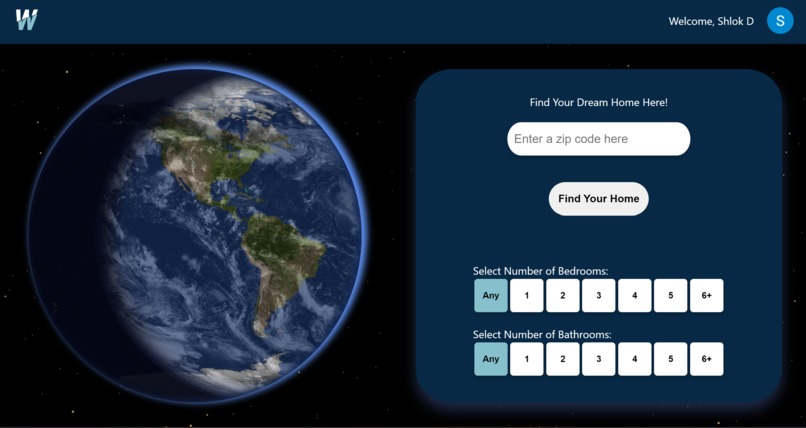
On the search page, users can search for a certain zip code and list preferences which is used to fetch data from the API.
-
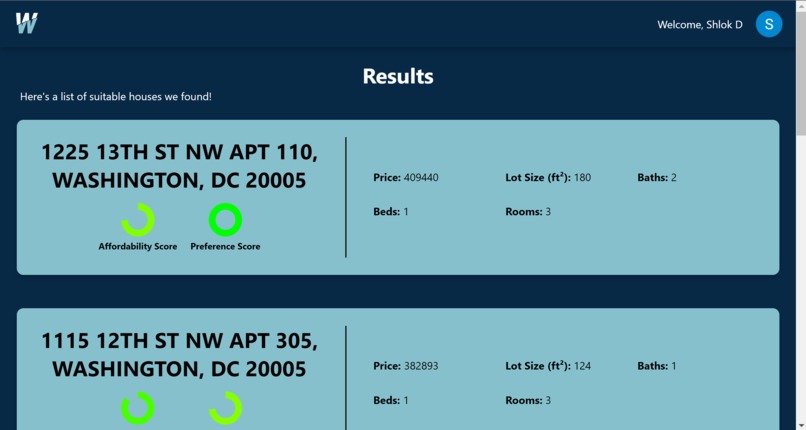
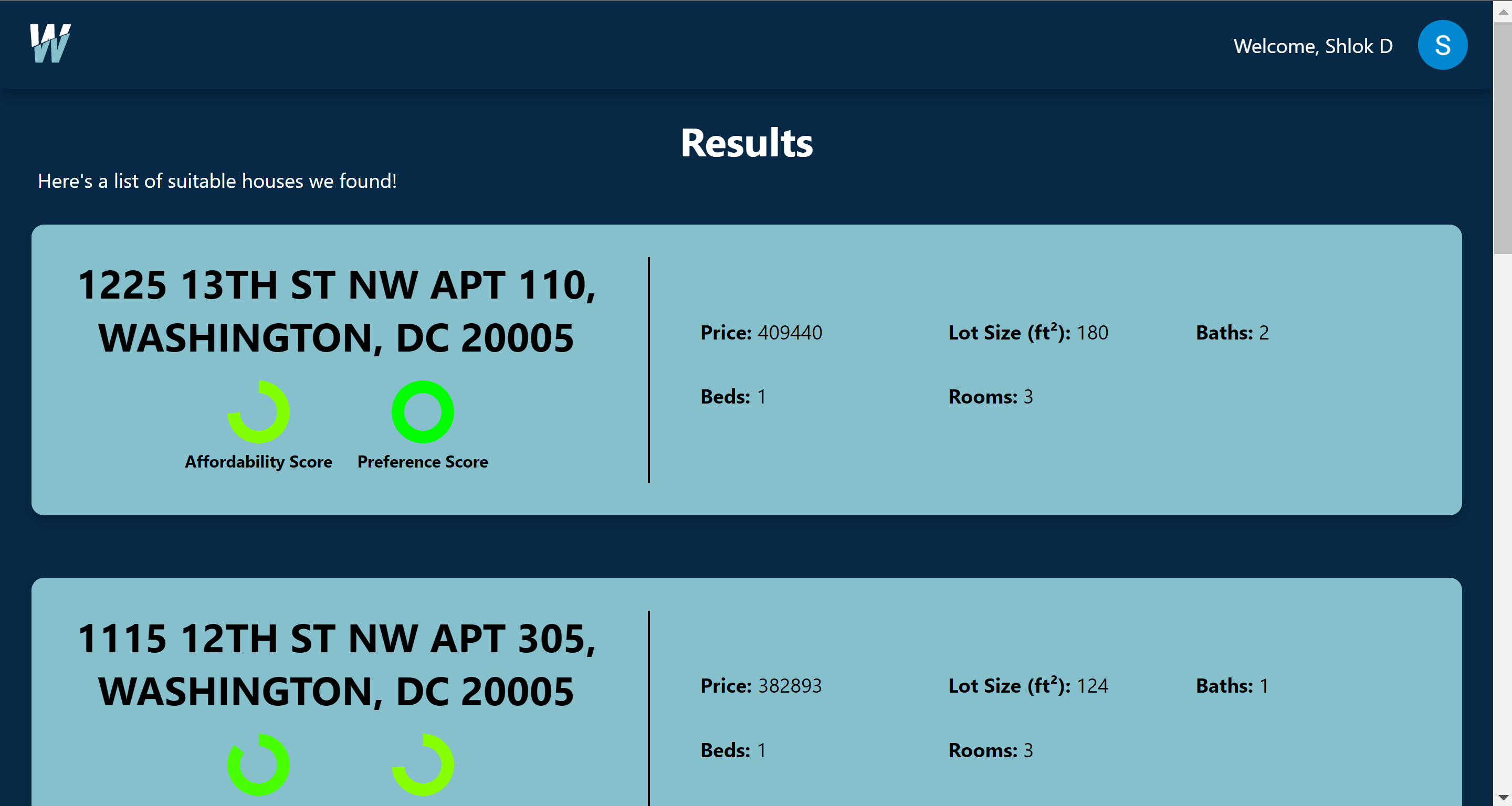
The data received from the API (address, sq ft, schools, etc.) are displayed and used to calculate our Affordability and Preference score
-
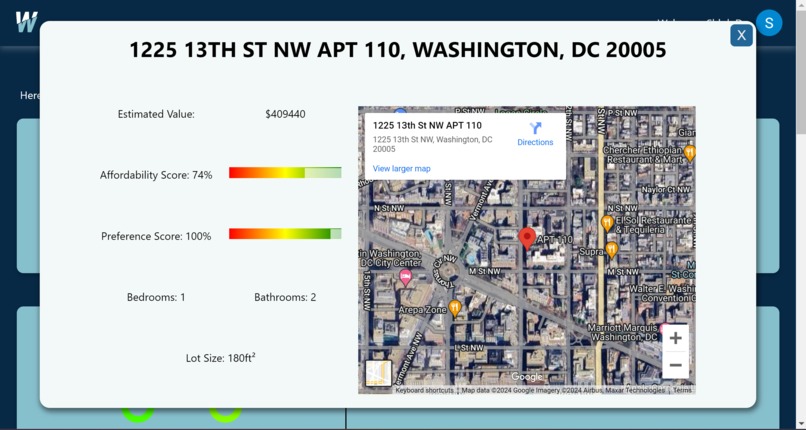
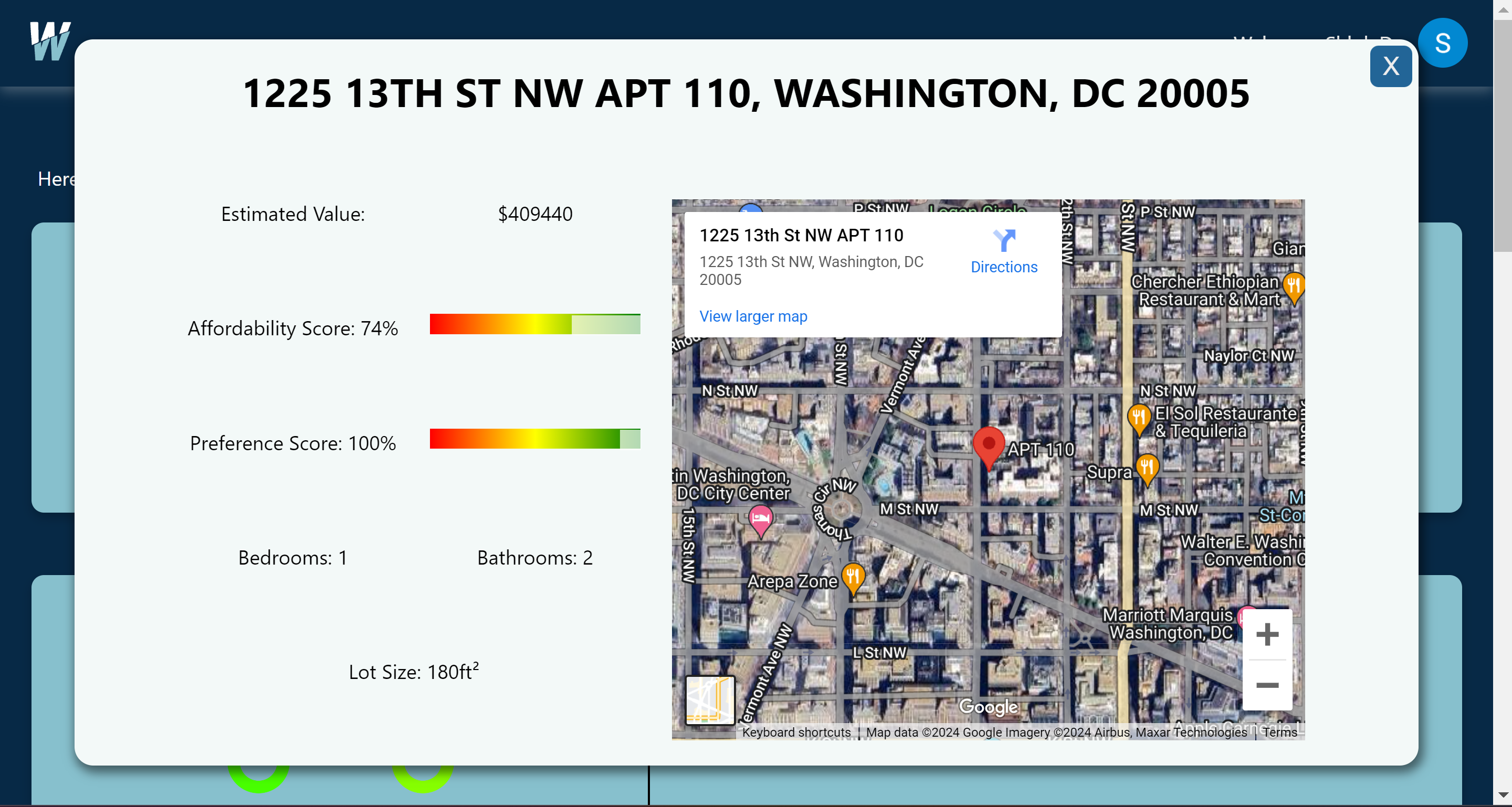
This popup shows the data more efficiently and also gives the user the ability to see the surrounding area.


Inspiration
Our inspiration for this project was that we wanted to remedy housing shortages and homelessness. In 2023 the Department of Housing and Urban Development found that the amount of homeless Americans starkly increased from 2022 by about 12%. This is extremely worrisome because of the exponential nature of this data. Additionally, many of our group members come from larger cities where homelessness is more apparent. Seeing people sleeping in the freezing cold makes us feel for them and want to do something to fix it.
What it does
Half of buying a house is first searching for one. So, to tackle this issue, we have decided to take advantage of available data in the housing market and a consumer's spending and income data to sophisticatedly compute which properties they should look into purchasing. We incorporate data points such as the the square footage per dollar, the number of rooms, the number of baths, etc. We are able to display this information neatly to the user with lists and popups to give more insight into the property. We also save the user's spending and income data for better ease of use the next time.
How we built it
We built the application using ReactJS, Firebase, Python Flask, REST API calls, and mathematical computation. On the first day of the hackathon, we started by organizing our thoughts fully using diagrams and flow charts. We spent a couple hours doing this before writing a single line of code because of how important this step is to the software development cycle. Without a fully formed plan, the pace of work will tend to be much slower since confusion comes into the mix. Next, we started implementing our application by splitting up into teams before ultimately convening back together finish the frontend. We managed to work at an exceptional pace and were able to debug our errors rather quickly to keep us on track to finish.
Challenges we ran into
Some challenges we ran into were along the line of being too ambitious for our given time frame. We hoped to be able to analyze spending data Capital One's API, and also implement many more visualization components. Unfortunately due to a lack of time, we were unable to fully accomplish our goals. Delving deeper into our issues with the Capital One API, we were very excited to use it because of how it gave us the ability to a specific user's spending data with tools such as machine learning (utilizing random forest regression) however, we quickly found that the API did not give us access to individual consumer data and so, we had to scrap a portion of our idea.
Accomplishments that we're proud of
First and foremost, we are proud that we were able to even finish our application. Given that this was a first time hackathon for our group members, we still managed to learn extremely quickly. Our abilities to learn and then make consequential contributions was a huge accomplishment and we hope to take this same momentum into future projects. Additionally, we worked with technologies many of us were initially unfamiliar with such as Firebase and Google SSO login. Despite coming in blind on how to implement them, we were still able to seamlessly integrate them into our application.
As a collective, our favorite features were the spinning globe on the search page (using only HTML and CSS) and the calculations and mathematical formula used for the Affordability and Preference Scores, as it took a lot of planning and consideration.
What we learned
On the technical side we picked up things from each other. Some of us were good at frontend and CSS while others were better at designing a backend and doing API requests. Additionally, from attending multiple workshops we deepened our knowledge on things like Flutter & Firebase, SQL, and Content Creation.
However, we also learned how to not only budget our time effectively, but also know when a project is just ambitious enough such that everyone in the group is able to significantly grow in their computer science knowledge. We also learned the value of planning and how it can dramatically speed everything up by putting everyone on the same page. Furthermore, we learned how to work together well despite lacking quality sleep and long hours. We know that these skills will translate extremely well into the actual work force and makes us excited to continue learning.
What's next for Wallet-Wise Realty
The next steps for Wallet-Wise Realty would to implement the functionality from the Capital One API as mentioned before. This way, our algorithm would be able to be a lot more sophisticated. With the emergence of big data and data processing as a large field in computer science, we would be excited to use this to dip our toes into the field. We also want to partner with a large firm such as Capital One who does not have this functionality already built in. Doing so, we would have the ability to bring our application to the people who it would benefit the most. We would also like to make this web app responsive for mobile users, or use Flutter to develop it into a mobile app, as Flutter is a lot faster and easier to use than React for mobile app development. Additionally, we already use Firebase so integrating Flutter with Firebase would be seamless.
*(THE DEMO LINK ONLY SHOWCASES THE FRONT END AS BACK END HOSTING IS LOCAL)* ** go to /dashboard endpoint to see mock data displayed

Log in or sign up for Devpost to join the conversation.