Inspiration
Every street has a "For Lease" sign, and behind it someone about to bet their savings on a guess. Commercial real estate has a tool for this question, void analysis: it finds the businesses an area is missing. But it is sold to landlords and brokers, and it is built on which chains are already present or on foot traffic counted from phones. It counts chains and phones rather than taste, and it is made for the landlord, not for the person opening the business. Asked about 15 storefronts in 15 cities, a plain chatbot's top pick was a coffee shop, café or bakery at 10.
Qloo's own client story shows that taste answers this question: Clarion Partners, a real estate investor, used Qloo's audience insights "down to a city block" to win an athleisure brand as a tenant on Chicago's Magnificent Mile. We wanted to make that self-serve, for the owner.
What it does
Walk-in is taste-based void analysis for the owner of an empty storefront. Drop a pin, and it answers two questions: what should open here, and how do I launch it?
1. Pick the storefront and the question
- Search an address or drop a pin: the pin shows its street address and links to Google Maps. Or open a finished example first; it's free and needs no sign-in.
- Set where customers come from: a walk or a drive of 5 to 60 minutes, or a road distance of 1 to 100 km, traced over the real streets, so a river or a highway cuts it.
- Choose who you want to serve (everyone, under 25, 25–34, 35–54 or 55+), describe the unit (size, food prep, outdoor space) and set your rules (no alcohol, halal, vegetarian, family friendly, budget).
- Ask one of three questions: Find what's missing, Test my idea ("a taco shop", "boba", "a Starbucks"), or Improve my place.
2. Watch the survey work (1 to 3 minutes, live)
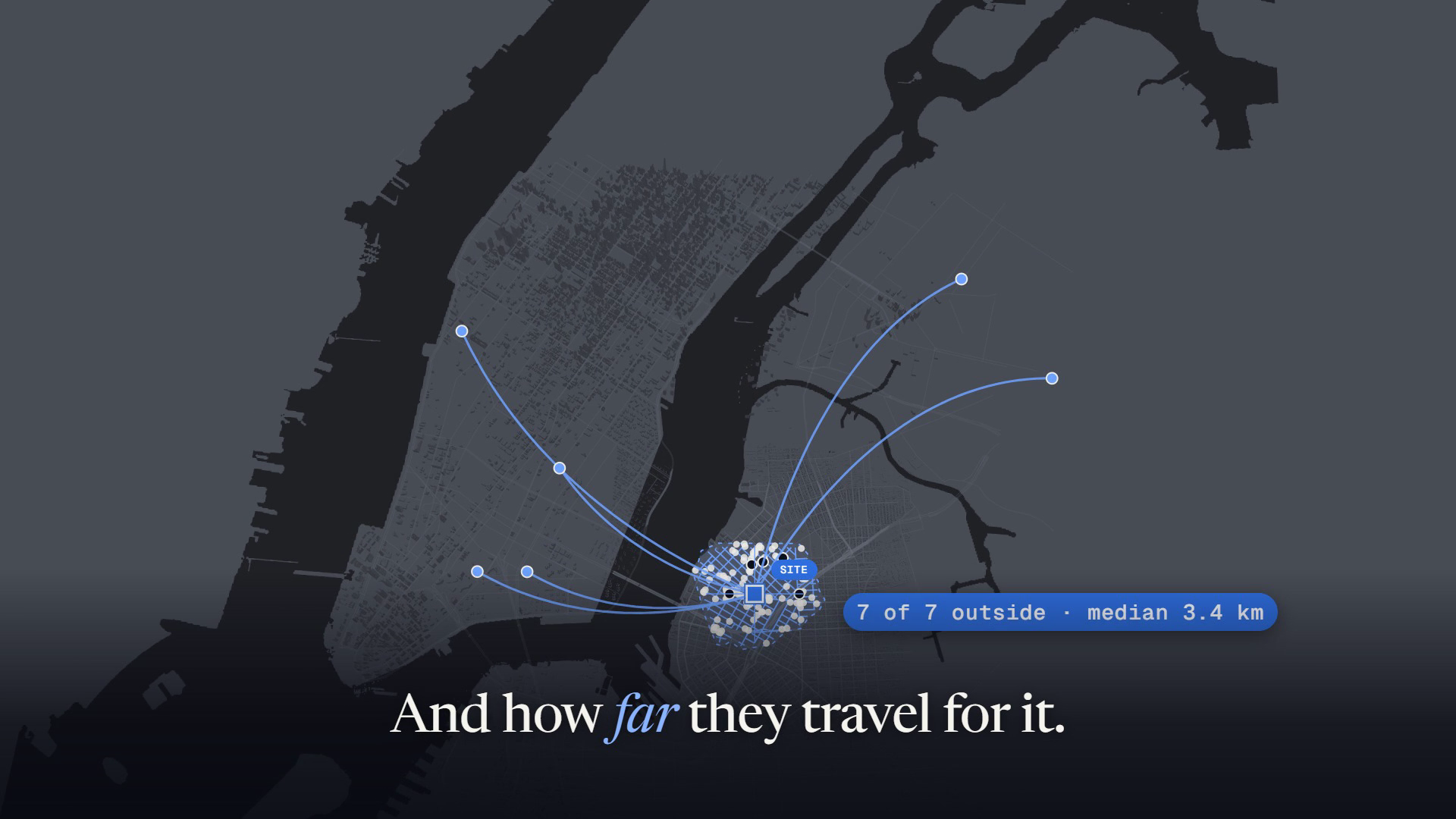
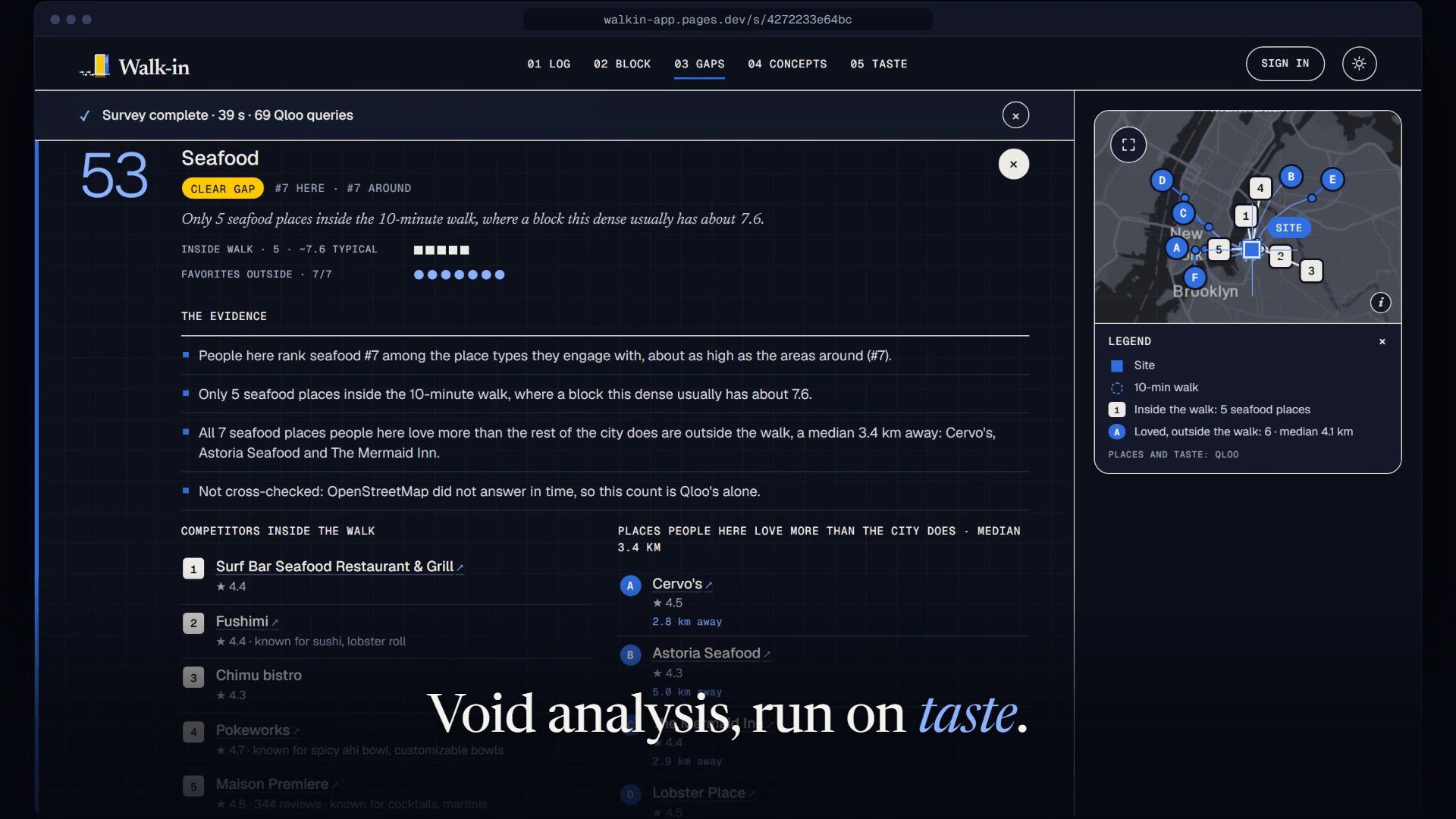
- Every place inside the area; the kinds of place people here love, compared with same-size areas around; the places they love more than the rest of the city does, and how far they travel to reach them. All of it comes from Qloo.
- An agent tests its own hunches live on Qloo, and every step shows in the log and on the map.
3. Get the answer, with its evidence
- What's missing, ranked: demand, supply and pull on every row; the real competitors inside the area and the loved places outside it, pinned on the map; each gap double-checked against OpenStreetMap.
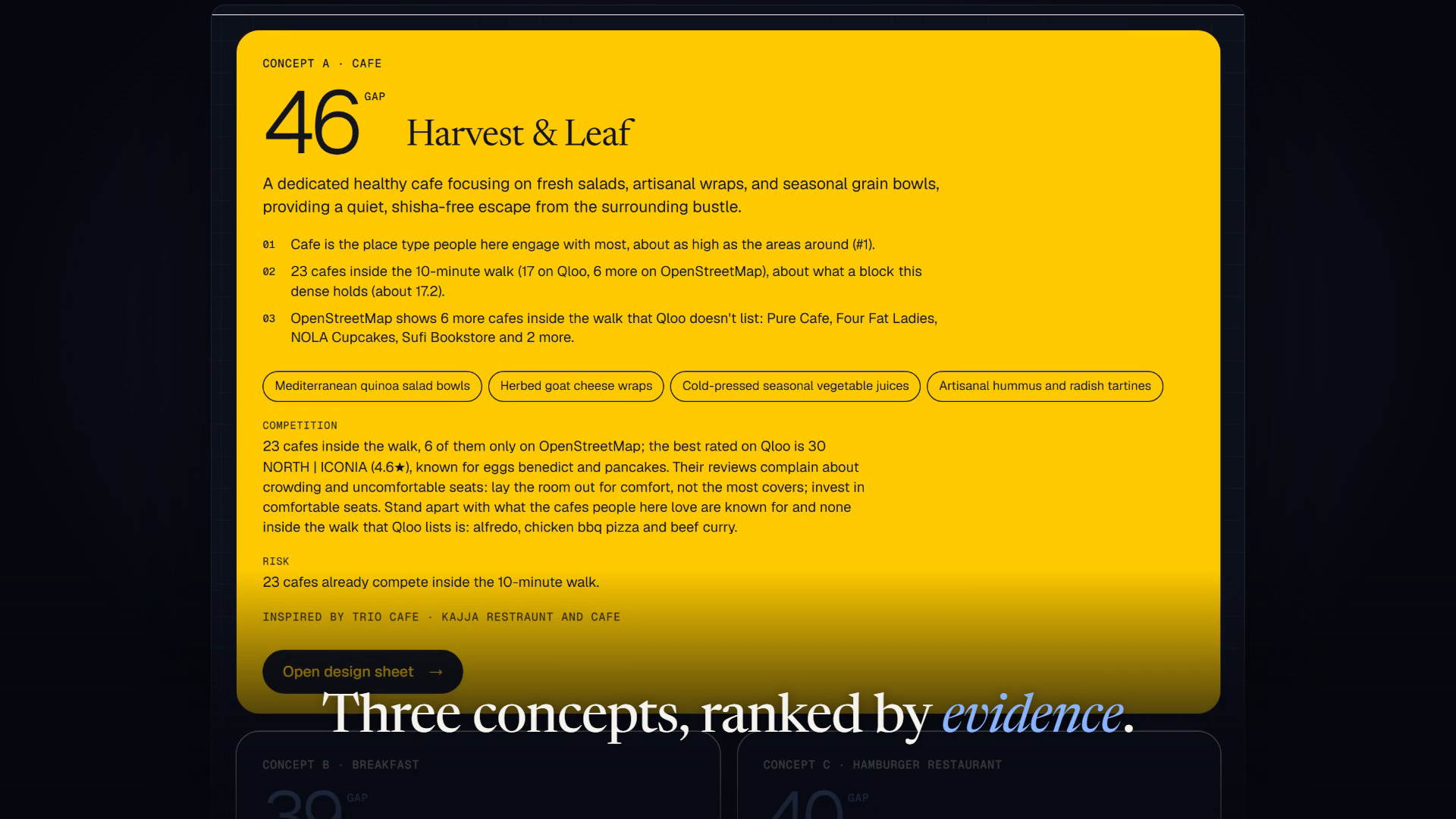
- Three concepts, ranked by evidence, plus at most one marked, untested wild card. Each keeps your rules and fits your unit, and sits beside what a chatbot with no data suggests, struck through.
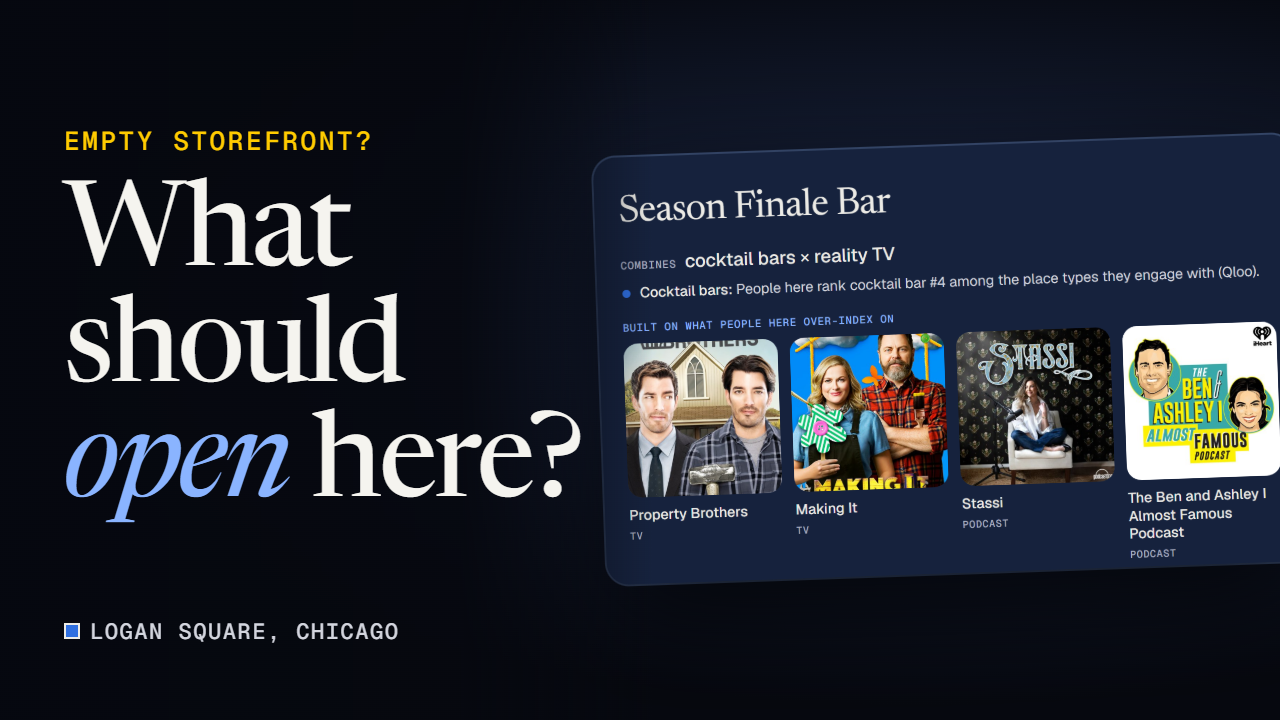
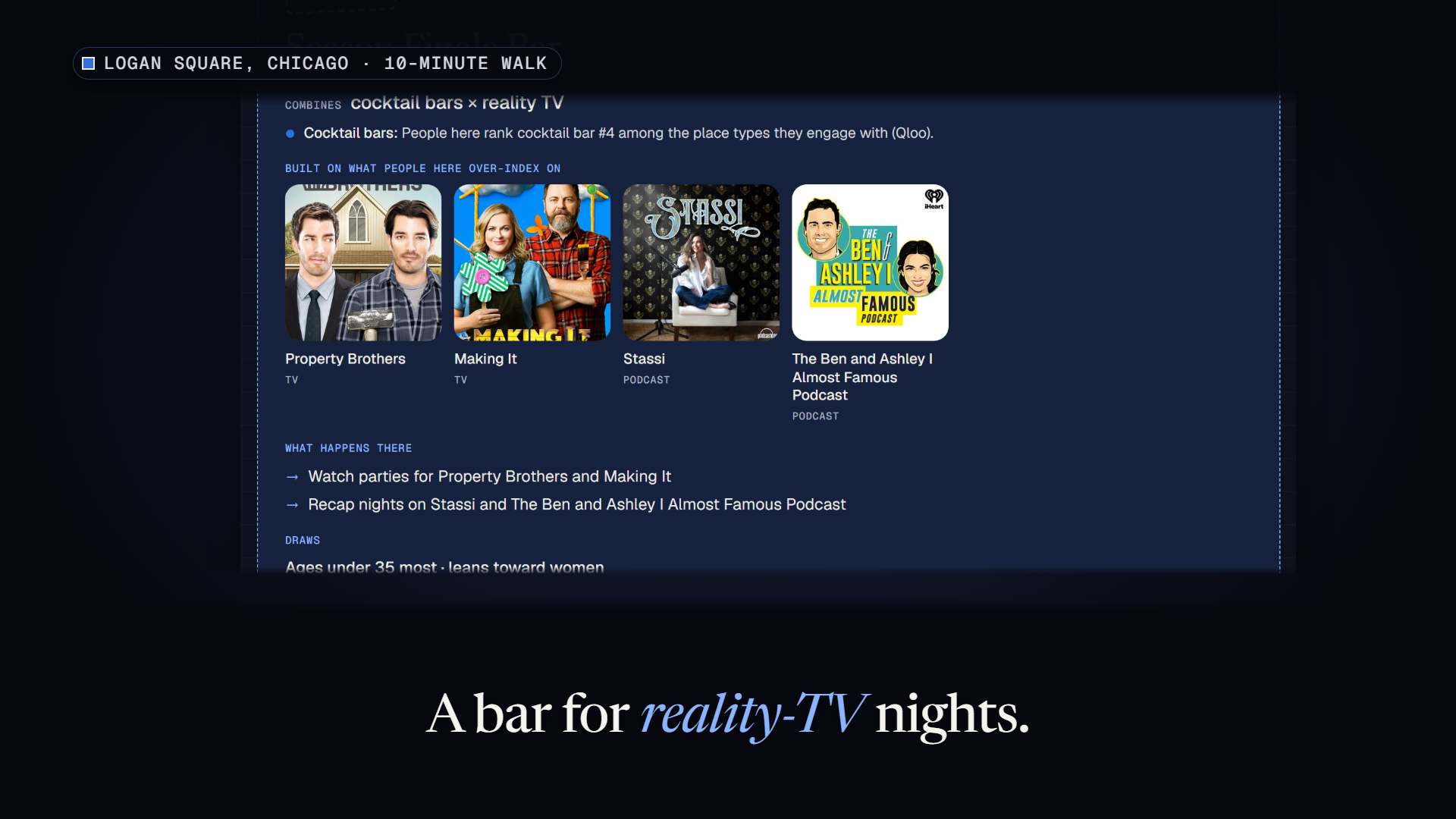
- A wild card built on the area's passions. When what people here watch, hear and follow points to a theme, the wild card is a place built around it: it shows the shows, podcasts or artists it stands on, what happens there, and who they draw. In Logan Square, Chicago, it is a cocktail bar with reality-TV watch parties; for 25–34-year-olds at the same storefront, a brewery with hip-hop listening nights, built on rappers such as Chicago's Dreezy and 600Breezy.
- A straight verdict on your idea (strong, possible, weak, thin data, or doesn't fit) with its main reason, and the chain stores already there: "6 Starbucks locations are already inside the 10-minute walk."
- How your place compares with the ones people nearby love, with the changes to make.
4. Shape the business: the design sheet
- What to sell, from what the loved places are known for; the hours they keep; how many guests the unit can hold.
- Who you'd win: the age groups and gender the loved places draw, and the ad settings that follow.
- What to play, screen and host: a soundtrack of artists, films and shows to screen, and podcasts to host talks around. They come from what people here over-index on compared with the areas around (Qloo's cross-domain taste), with a reminder about music and screening licenses.
- A launch plan: ad audiences ready to paste. Spotify fans of the area's artists and podcasts, Nextdoor's neighborhoods, Google Ads custom segments, Meta or Google local ads.
5. Launch it with a free kit
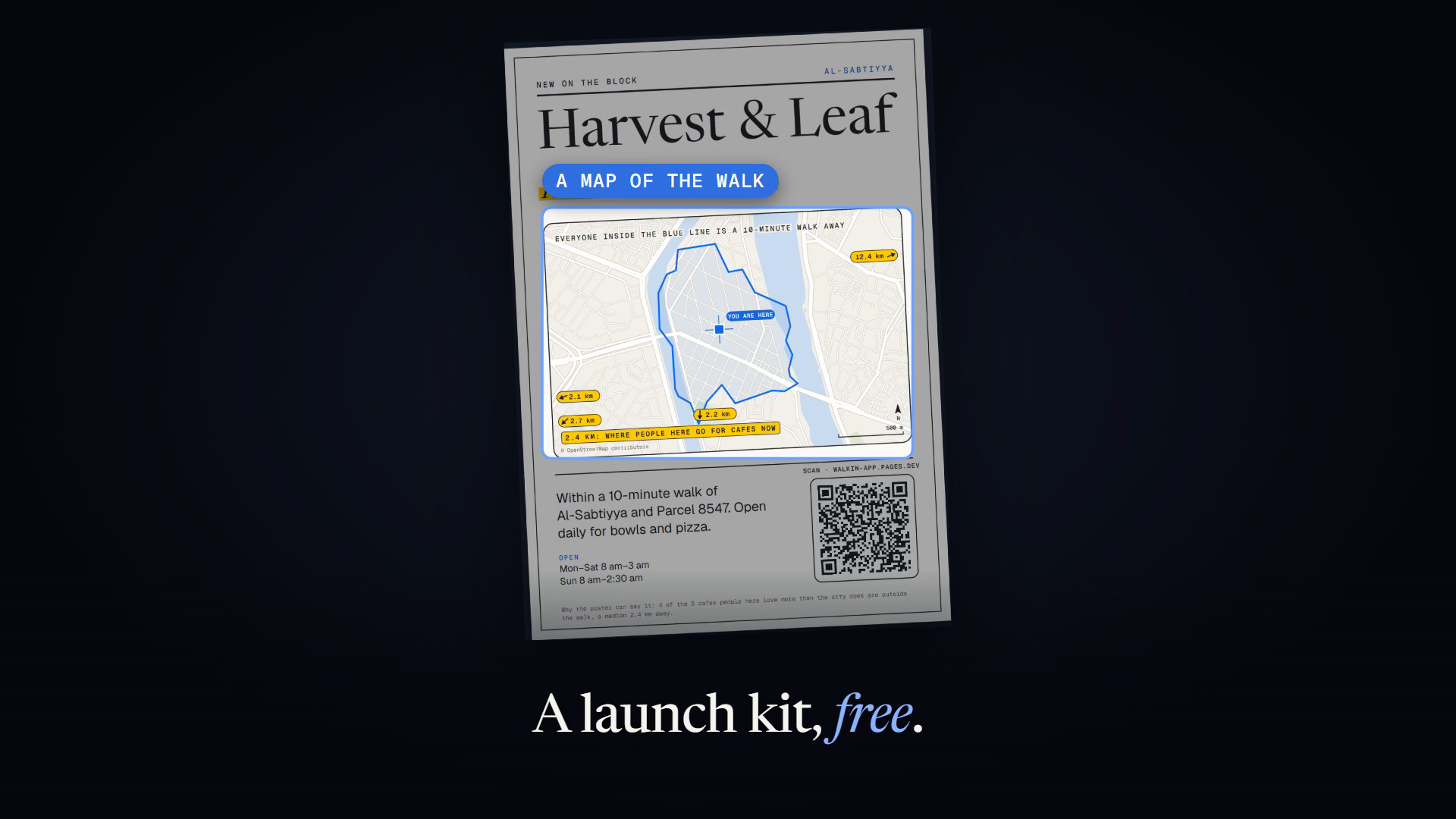
- A window poster with a real street map of the walk and a QR code to your own page.
- Ad copy for Spotify, Nextdoor, Google and Meta, every line checked against the evidence.
- Tracked links, and a report of up to 12 sections for a landlord or a lender, saved as a PDF.
6. Let the neighbors back it, before the lease is signed
- Start a campaign from any launch kit: you set the money terms, AI drafts the page from the survey's evidence, and the server checks every word you keep.
- Neighbors pledge with PayPal, no account needed. PayPal only holds each pledge: if enough of them join by the deadline, everyone is charged and the money goes to you; if not, every hold is released and nobody pays.
- The campaign's page shows why this, why here, how many neighbors have joined and how much PayPal holds so far. Test mode: PayPal's sandbox, no real money.
Also
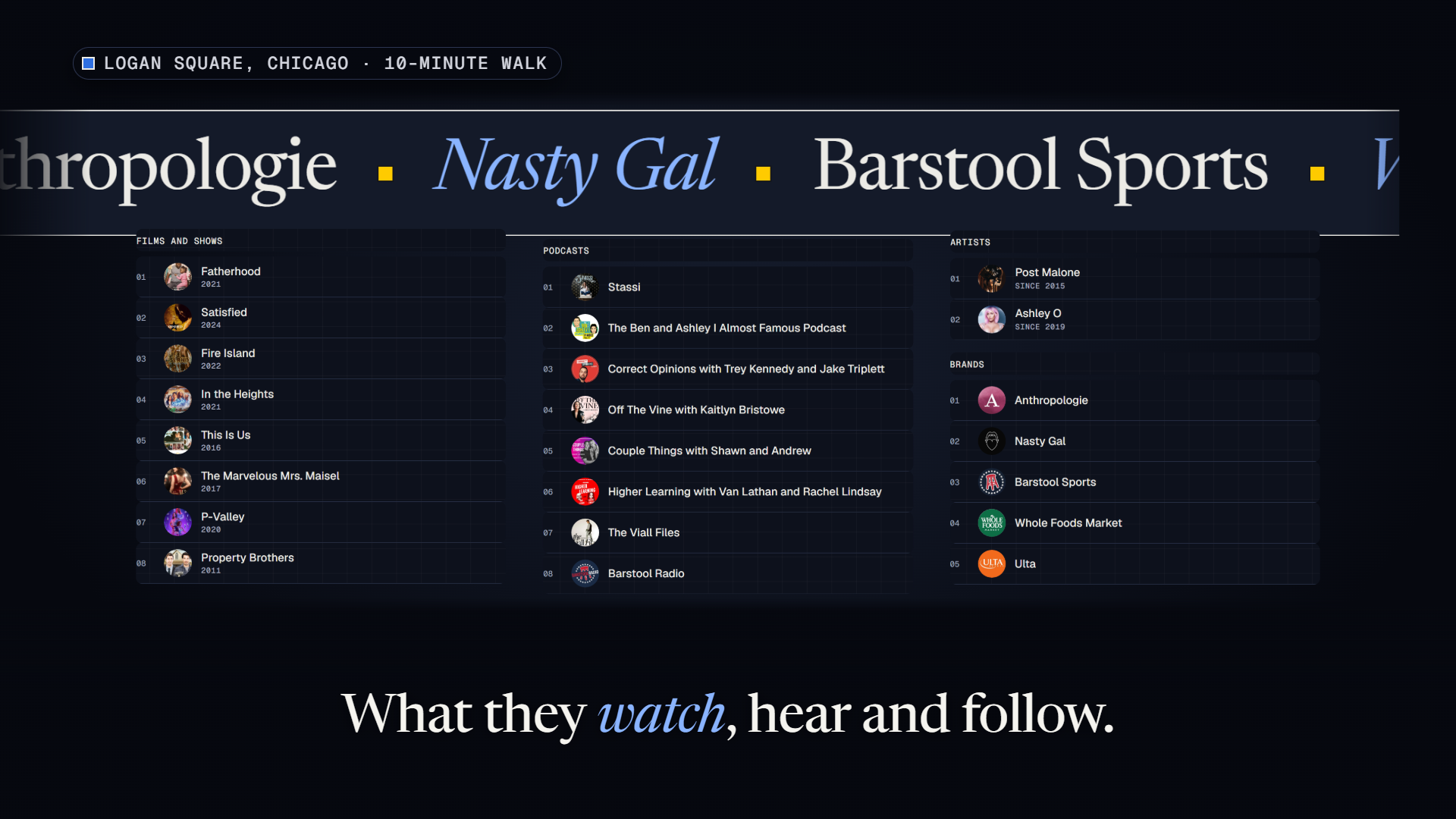
- The area's wider taste: the brands, artists, films, shows and podcasts it over-indexes on.
- Results in clear tabs, answer first, and each tab ends by saying what the next one shows. Surveys are saved and shareable; sign in with Google to keep them in My places.
- It works wherever Qloo has data, from Brooklyn to Cairo.
- From your AI assistant: Walk-in runs as an MCP server with six tools:
survey_storefront,list_examplesandget_survey, andfind_campaigns,get_campaignandback_campaign, which prepares a pledge for a person to approve in PayPal (setup).
How we built it
A Python and FastAPI backend streams each survey to the browser as server-sent events, and a React and TypeScript frontend draws it live on a Leaflet map. Walks and drives come from Valhalla on OpenStreetMap data; the cross-check and the kit's street maps come from OpenStreetMap's Overpass API, with OpenFreeMap's vector tiles, read by a small pure-Python decoder, as the street maps' second source. Nominatim finds addresses and names a dropped pin's.
How the ranking works. Demand compares the place types people inside the area engage with against six same-size areas around it, not the whole city, so a neighborhood's own taste shows. Supply is compared with what a trip twice as long reaches over the streets, so the far bank of a river counts only where a bridge crosses it. Pull is the share of the places people here love more than the rest of the city that lie outside the area, and the median trip to them. Every "missing" is cross-checked against OpenStreetMap.
The agent is a tool-using model with three tools: test a category live against Qloo, check live what a category's fans also love, and inspect a gap's competitors and favorites. It runs on a chain of free models (Gemini, then Groq) that rests rate-limited models and keeps the conversation going on the next one. The model only chooses, names and positions; the server writes every factual line from the measurements. A model-written line that breaks a rule, leans on filler ("cozy", "vibe") or states a figure the evidence doesn't give is repaired once or replaced by the evidence's own line, and a concept that still breaks a rule is dropped, with the reason shown. The design sheet calls no model, and no number in the report comes from one. Without any model, evidence rules do the whole job.
Founders. Each pledge is a PayPal Orders v2 order with intent AUTHORIZE, so PayPal only holds the money. At the deadline every hold is captured (renewed first past PayPal's 3-day honor period) or voided, and PayPal Payouts sends the owner the total after PayPal's fees. Settlement can resume after a crash and never captures or pays twice, and each PayPal webhook is verified with PayPal before it counts. It was run end to end against PayPal's sandbox.
Surveys, design sheets, kits and campaigns are saved in Postgres on Neon. The API runs on Render's free tier behind a Cloudflare Pages front door that never sleeps, and the engine keeps itself awake. 965 server tests drive the real HTTP app and survey pipeline against a synthetic Qloo world and a fake PayPal, 515 more cover the front end, and GitHub Actions runs them, the type checks, the linters and the Docker build on every push.
How Qloo makes it work
A map search lists what is there. A chatbot knows nothing about the block. Qloo gives Walk-in five things neither can:
- The taste of the people inside the area, against same-size areas around. Qloo ranks place types, brands, artists, films, shows and podcasts for a location signal: here, the area's own outline. Comparing it with same-size areas nearby, rather than the whole city, shows what this area cares about more than its surroundings. Qloo's demographic signal does the same for one age group.
- The places they love more than the rest of the city does, and the trips they make to reach them. Qloo ranks places, independents included, for the area and for the wider city; once the city's shared favorites are set aside, what remains is the neighborhood's own. Where those places lie outside the area, people here make a trip that a business on the block could save them.
- Who those places draw. Qloo's audience data on the loved places gives the age groups and gender they lean toward, and with them the ad settings an owner can use.
- Cross-domain audiences for ads. What people here over-index on in music, podcasts, TV, films and brands becomes targeting that ad platforms accept: Spotify takes fans of named artists and podcasts, Google's custom segments take websites.
- A theme for a place. Read by their Qloo genres, the shows, podcasts, artists and brands people here over-index on can point to a theme (reality TV, comedy, hip-hop, karaoke and more), and the wild card becomes a place built around it. Qloo's audience data on those titles says who it would draw.
Qloo also supplies the block itself (places, ratings, hours, review keywords, Michelin and TripAdvisor references), the brand graph for the chain check, the heatmap of where a category's taste is strongest, tag search to turn "bakery" into a category, and search to find an owner's place. The README maps every question to its Qloo call. Without Qloo there is no demand, no pull, no taste and no audience: the product cannot exist. Each survey shows how many Qloo queries it read and the date of the oldest answer.
AI tools we used
In the product. Walk-in's agent runs on free models through OpenAI-compatible endpoints: Google Gemini first (gemini-3.6-flash, then gemini-3.5-flash, gemini-2.5-flash and gemini-3.1-flash-lite), then Groq (gpt-oss-120b, qwen3.8-27b and gpt-oss-20b). It reads the survey's evidence, tests hunches live against Qloo, and chooses, names and positions the concepts. The same chain writes the launch kit's ad copy and the "no data" answer shown struck through beside the concepts. Deterministic checks review every line the agent and the ad writer produce; the measurements and the design sheet come from no model, no number in the report does, and without a model the evidence rules run everything.
To build it. We built Walk-in with GitHub Copilot. Working as a coding agent under our direction, Copilot wrote much of the code and the tests, ran the checks, reviewed changes and screenshots of the interface, built and ran the head-to-head, and drafted documentation, including this text. We set the direction, decided what to keep and what to cut, and reviewed every change. The head-to-head's plain chatbot was Gemini on the app's own settings (gemini-3.6-flash, and gemini-3.5-flash or gemini-2.5-flash when it was overloaded), with no system prompt and no data.
The film. The launch film was built in code with Remotion; its narration is an AI voice (Gemini TTS, voice Sulafat) and its music is generated in code.
Challenges we ran into
- Scale bias. Comparing a neighborhood with the whole city made "New American" look like a local passion everywhere. Comparing with same-size areas around the site fixed it.
- "Fans of a category" are often everyone. For some categories Qloo returns the area's general ranking. Walk-in detects that and uses the neighborhood's own signature taste instead.
- Models ignore constraints. Our own test runs caught Walk-in proposing dishes that need a fryer or a pizza oven for a unit with no hood, and ignoring an owner's request for budget prices. Rules are now enforced after the model answers.
- Water. The walks followed the streets, but the area supply was compared with was a circle that crossed the East River into Manhattan and covered the Nile around Zamalek. It is now a longer trip over the streets, and comparison areas that fall in open water are moved ashore or left out.
- Big areas. The free routing server answers trips of up to 60 minutes and 100 km, so areas stop there. OpenStreetMap's free servers time out on a big drive, so areas over 30 km² skip the cross-check and say so; when they don't answer for the kit's street map, OpenFreeMap's vector tiles do. A big drive's outline has thousands of points, and every Qloo request simplified it again on the server's event loop, until the host's health check restarted the server mid-survey; it is now simplified once, on a worker thread, so drives up to 60 minutes no longer slow the server (East Austin's 15-minute drive: 38 s with a 15-second stall before, 3.8 s now). And in a dense city a big area holds almost everything, so few gaps show; the brief says so before you run it.
- Age groups and chains. Qloo ranked 25–29 like 30–34, and 35–44 like 45–54, so the age focus offers the groups that rank differently. Qloo's brand search is fuzzy ("bakery" finds a chain with Bakery in its name), so a chain counts only when the request names it, and the verdict judges the category its stores are filed under.
- Features that said nothing. AI renders, a mood board, design tags, an interior description and partner suggestions looked good in a demo, but on real surveys they came out much the same everywhere or were invented. We cut them, so everything on the design sheet comes from the evidence.
- Coverage gaps. Qloo's place data missed a couple of real bakeries in East Austin; the OpenStreetMap cross-check catches them.
- Free tiers. Rate-limited models and a host that sleeps: a chain of models, answers replayed while the evidence is unchanged, and a front door that stays up while the engine wakes.
Accomplishments that we're proud of
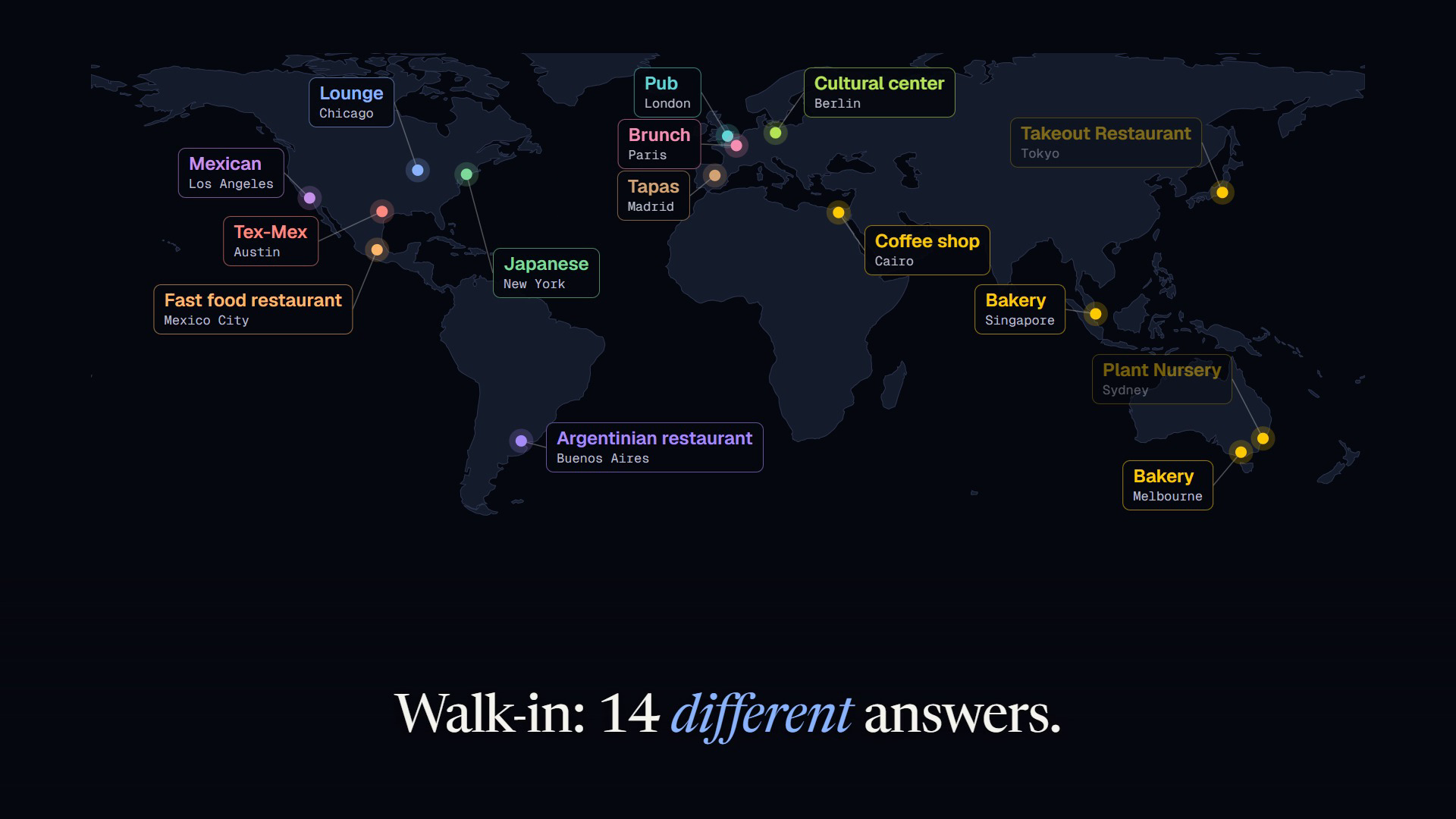
- A head-to-head against a plain chatbot, on 15 storefront addresses chosen before any answer was seen: across 15 storefronts in 15 cities on 6 continents, a plain chatbot's top pick was a coffee shop, café or bakery at 10 of them (coffee shop 5, bakery 3, café 2); Walk-in's 15 top picks were 14 different kinds of place, each a place type people around that storefront rank highly. The method, every site's picks and the script are in the repo (eval/head-to-head), with what it does not show (see What we learned).
- Broad, checked use of Qloo: insights over places, place tags, brands, artists, films, shows, podcasts, heatmaps and audience data; the demographic signal; the brand graph; tag search; search; and entities.
- Every recommendation shows its reasoning: demand, supply, pull and the real places behind it.
- Every model-written line in a concept or an ad is checked before an owner sees it, and the page says what was repaired or dropped.
- A product, not a demo: saved and shareable surveys, a free launch kit, accounts with a privacy page and account deletion, and it works from Brooklyn to Cairo, on a city block or across a town.
What we learned
Taste data is most useful when it is compared, not just retrieved: a neighborhood against the areas around it, a category's fans against everyone, a place against the ones people already travel for. A model is most useful when it chooses and names, while the facts come from the data. And an honest "no clear lean" or "not cross-checked" is part of the answer: cutting what looked good but said nothing made the product more trustworthy.
What Walk-in does not claim
- Taste is not foot traffic, rent or sales. A gap is evidence for a decision, not a forecast.
- "Who you'd win" gives leans, not head counts, and Qloo has no audience data for some kinds of place (night clubs, for one); the section then hides.
- Areas over 30 km² skip the OpenStreetMap check and say so.
- Trips to favorites are straight-line distances, and "only" claims are true of the places Qloo and OpenStreetMap know on the survey date.
- The head-to-head does not show that the chatbot picks crowded categories: by Qloo's count both sides' picks faced the same median of 8 competitors. Walk-in's picks come from the same Qloo data the comparison reads, and 15 sites, with one chatbot answer each, is a small sample.
What's next for Walk-in
- Foot-traffic and rent data next to taste, so a gap comes with what the unit would cost and who walks past.
- Founders with real money: PayPal's marketplace onboarding, so pledges go straight to the owner instead of a payout.
Business model
Free for owners. Brokers and landlords pay a subscription to survey their vacant listings and hand prospective tenants the kit.
- Price: $49 per broker per month, unlimited storefronts; always free for owners.
- Why it holds: in New York City about 11% of storefronts are vacant, and in many neighborhoods 80–90% of the vacant ones had already been empty for at least nine months (NYC Comptroller, June 2026). Landlords lose rent every empty month.
- Today: nothing is charged in the app. This is the plan.
Built With
- alembic
- cloudflare-pages
- docker
- fastapi
- github-actions
- google-identity
- groq
- mcp
- neon
- openfreemap
- overpass
- playwright
- postgresql
- pytest
- python
- qloo
- react
- render
- sqlalchemy
- sqlite
