Inspiration
As people age, physical activity significantly decreases, accelerating muscle loss and often leading to bodily imbalances. Among these, the first and most crucial function to be impacted is walking. An unbalanced walking posture can lead to the weakening of muscles on one side, resulting in joint inflammation and further reducing overall activity.
The question is: What if seniors could practice correct walking form for just 5 to 10 minutes a day in the comfort of their homes?
While many AI-powered training apps exist for younger people, there is a lack of accessible, personalized solutions for seniors.
What it does
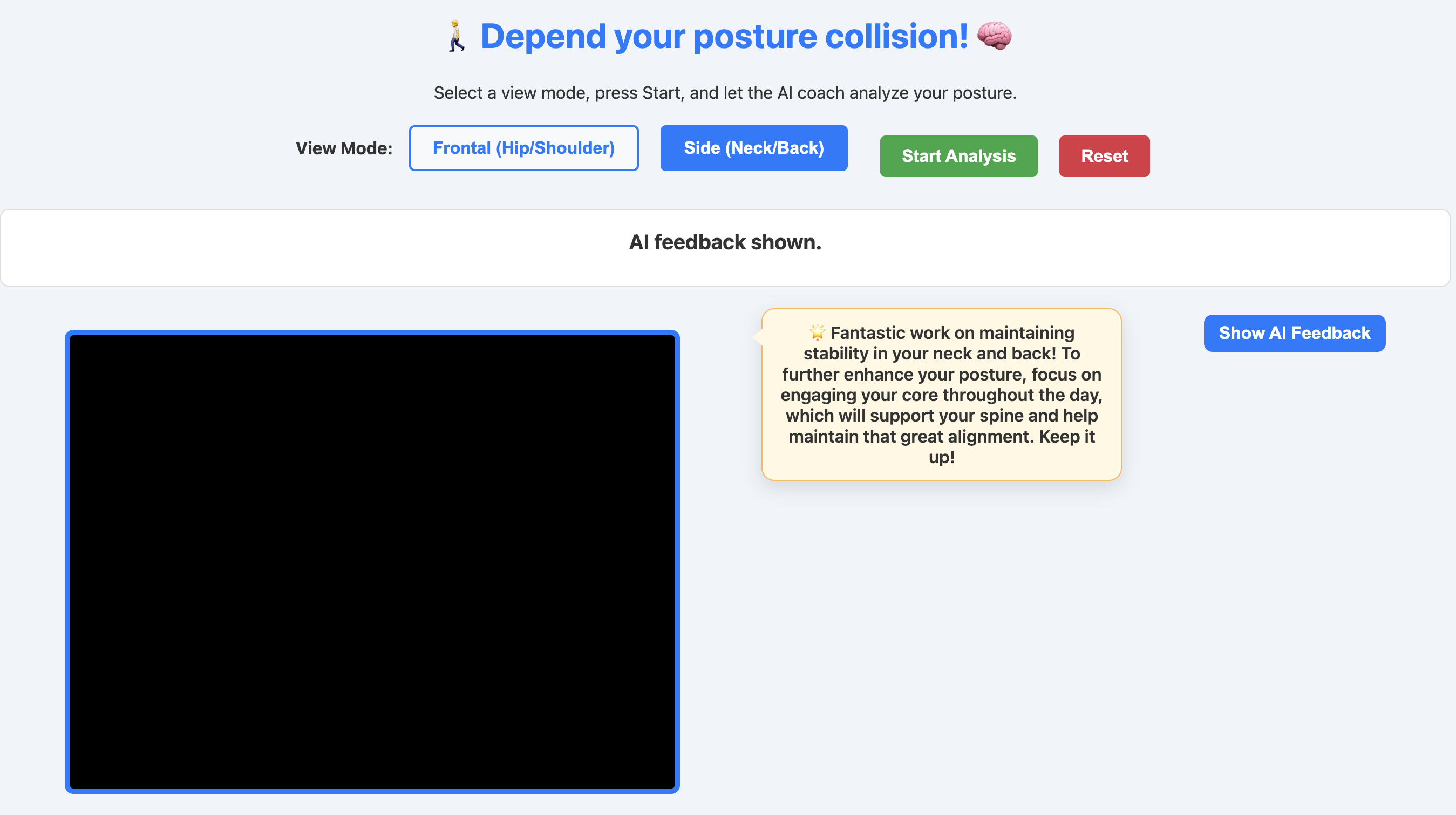
Captures live video and detects pose landmarks with MediaPipe. Provides frontal and side posture analysis (hip tilt, shoulder balance, forward neck, rounded shoulders). Collects short angle samples, produces a stability/imbalance diagnosis, and requests contextual coaching from an AI agent. Streams annotated video and real-time textual feedback via a web UI.
How we built it
FastAPI serves the web UI and streaming endpoints, and manages control actions (start/stop, mode switching). MediaPipe Pose extracts landmarks; custom detector modules compute angles and normalized offsets. A background task collects time-series samples, performs batch analysis, and triggers an asynchronous AI coaching request. Results and AI feedback are delivered non-blocking so the UI remains responsive.
Challenges we ran into
Balancing real-time processing with reliable batch collection required careful async task coordination. Handling noisy landmark visibility and mixed units (degrees vs. normalized distances) needed unified thresholds and robust filtering. Delivering non-blocking AI coaching while keeping the interface informative and responsive.
Accomplishments that we're proud of
A mode-aware pipeline supporting both frontal and side posture checks. Non-blocking AI feedback integration that enriches analytic summaries without stalling the UI. Clear separation of detectors and analytics that makes the system extensible.
What we learned
Consistent data collection windows and visibility gating greatly improve diagnostic reliability. Async tasks and cancellation semantics are crucial for user-driven control flows (start/stop). Normalizing measures (angles vs. relative shifts) simplifies cross-mode analysis and messaging.
What's next for DPC
- Gamification: Add a simple scoring system or "Postural Streak" counter to encourage daily engagement.
- Accessibility: Integrate Text-to-Speech (TTS) functionality for verbal coaching, making the agent fully accessible to users who may struggle to read the screen.
- Progression Tracking: Store the daily imbalance scores in a simple database (e.g., Snowflake, if scaling up) to visualize the user's postural improvement over time.
Built With
- css
- html
- javascript
- openai
- python


Log in or sign up for Devpost to join the conversation.