-
-
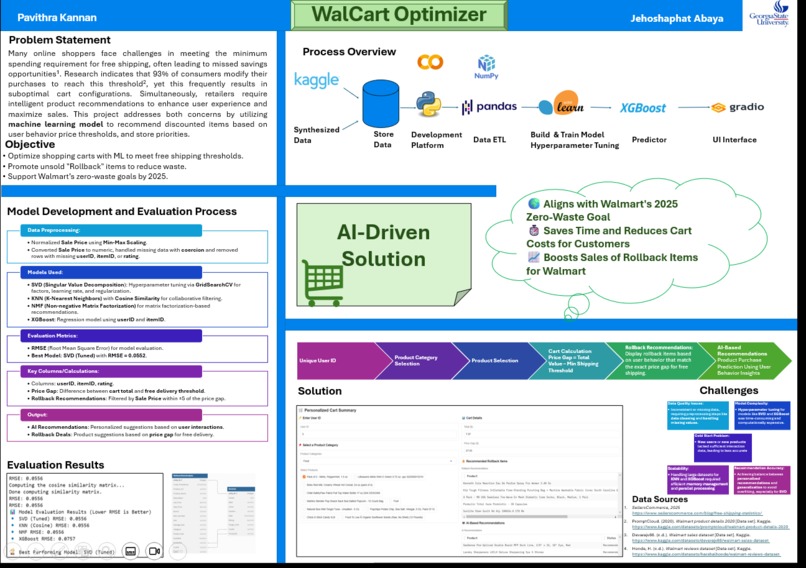
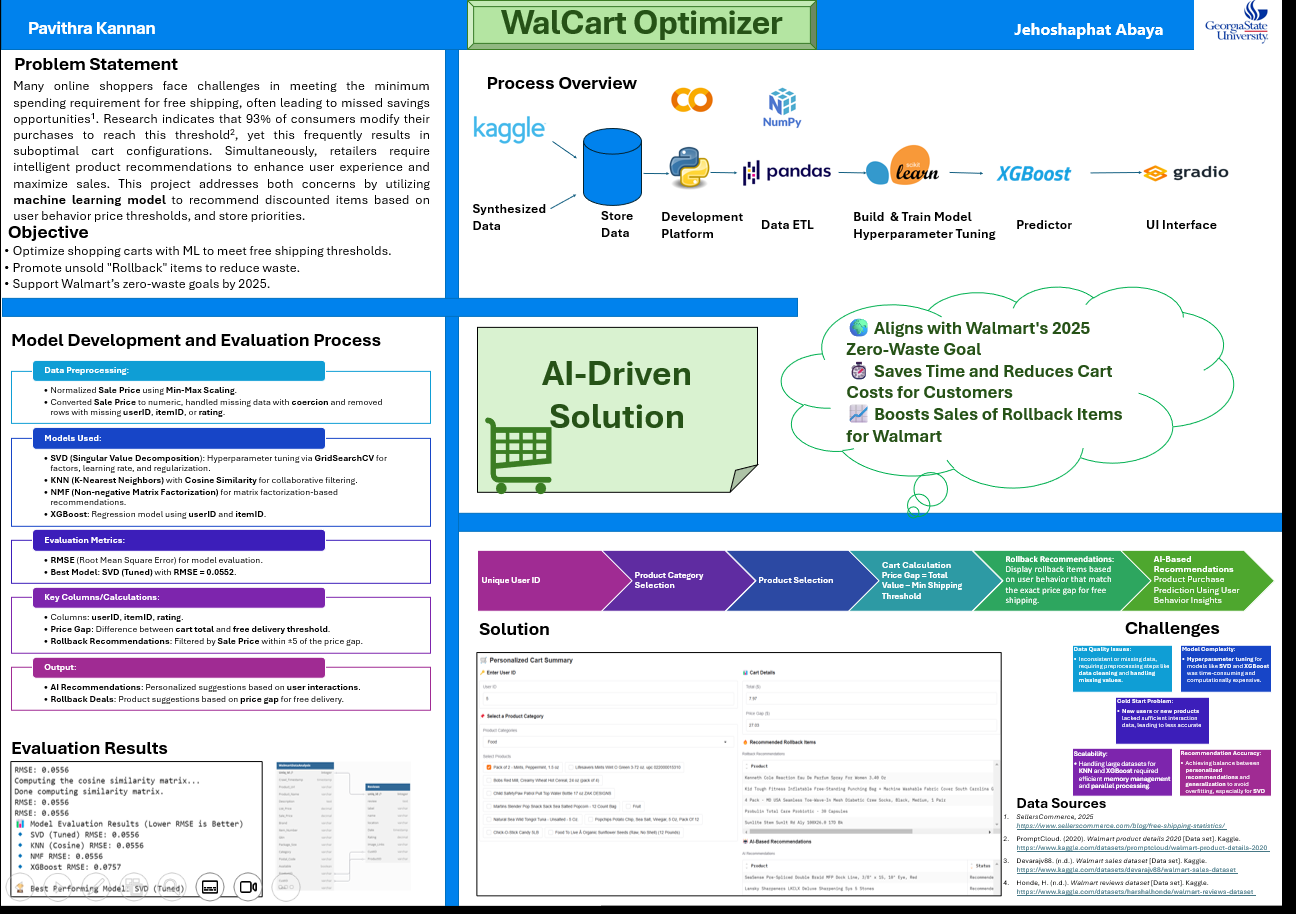
Poster Presentation of Solution
Hackalytics 2025 , 23 Feb 2025
Hack Title: AI Driven Cart Optimizer
Subtitle: Personalized Walmart-Style Shopping with ML-Driven Recommendations
Submitted by: Pavithra Kannan ([email protected]), Jehoshaphat T. Abaya
Project Overview
Many online shoppers face challenges in meeting the minimum spending requirement for free shipping, often leading to missed savings opportunities (SellersCommerce, 2025). Research indicates that 93% of consumers modify their purchases to reach this threshold (CapitalOne Shopping Research, 2024), yet this frequently results in suboptimal cart configurations. Simultaneously, retailers require intelligent product recommendations to enhance user experience and maximize sales. This project addresses both concerns by utilizing machine learning to recommend discounted items based on user behavior, sentiment analysis, price thresholds, and store priorities.
Objectives
This project aims to:
Optimize shopping carts using machine learning to help users meet free shipping thresholds.
Promote "Rollback" items and slow-moving inventory to minimize waste.
Support Walmart’s 2025 zero-waste initiative.
Data Sources
We utilized publicly available datasets from Kaggle, along with synthesized data to supplement missing information:
PromptCloud (2020): Walmart Product Details 2020 – Dataset Link
Devarajv88 (n.d.): Walmart Sales Dataset – Dataset Link
Honde, H. (n.d.): Walmart Reviews Dataset – Dataset Link
Solution overview
Our system integrates machine learning and a user-friendly interface to deliver an intelligent shopping assistant. Key features include:
Personalized Product Recommendations – Uses collaborative filtering to suggest relevant products based on purchase history, products that are in demand and store priorities to ensure you stay within budget but meet the free shipping threshold.
Smart Cart Summary – Displays total price, price gap, and free delivery thresholds to guide users in optimizing their purchases.
User-Friendly Interface – Built with Gradio for an intuitive shopping experience.
How We Built It
Our approach combined data processing, machine learning, and a user-friendly dashboard:
Data Processing: Cleaned and synthesized 30,000 customer reviews, ensuring accurate and consistent product ID mapping.
Machine Learning Model: Implemented Singular Value Decomposition (SVD) for personalized recommendations.
Sentiment Analysis: Extracted customer sentiments from reviews to refine rollback suggestions.
Gradio UI: Developed an interactive shopping dashboard for seamless user interaction.
Tech Stack: Python, Scikit-Learn, Pandas, NumPy, Gradio, Google Colab.
Challenges
While building the AI-driven cart optimizer, we faced and overcame several challenges:
Data Structuring: Ensuring consistent product ID mapping across different datasets.
Model Training: Handling missing values and optimizing SVD for more accurate predictions.
Performance Optimization: Efficiently filtering rollback items for real-time recommendations without slowing down user experience.
Conclusion
This project demonstrates the power of AI-driven recommendations in e-commerce by helping customers optimize their purchases while supporting retailers’ business meet their objectives. By incorporating purchase history, reviews and the shop priorities e.g. how to manage rollback goods, our solution provides a dynamic and intelligent shopping experience that benefits both shoppers and businesses.

Log in or sign up for Devpost to join the conversation.