
WakeUp
Inspiration
We built WakeUp for everyone who goes to bed with a dream and wakes up with an excuse.
The whole thing started with a small, embarrassing observation. There is a person who exists at 11pm, planning tomorrow with total conviction, certain of who they are about to become. And there is a different person who exists at 7am, hitting snooze for the fourth time, already negotiating. Most goals do not die in a dramatic failure. They die in that soft, silent argument you lose before you are even fully awake.
We are two people building companies, and we had tried everything. Alarm apps you kill with your thumb before your eyes open. Habit trackers you abandon on day nine. Planners with seventeen categories and color coded tags that turn organizing your life into a substitute for living it. They all failed the same way: they assumed the problem was information. It is not. You already know what to do. The problem is that nobody is there at 6:45am to make sure the version of you that made the promise wins the argument against the version of you that wants five more minutes.
So we stopped asking "how do we help people be productive" and started asking something much narrower. How do we make sure that tomorrow, you actually get up and do the two things you swore you would do.
What it does
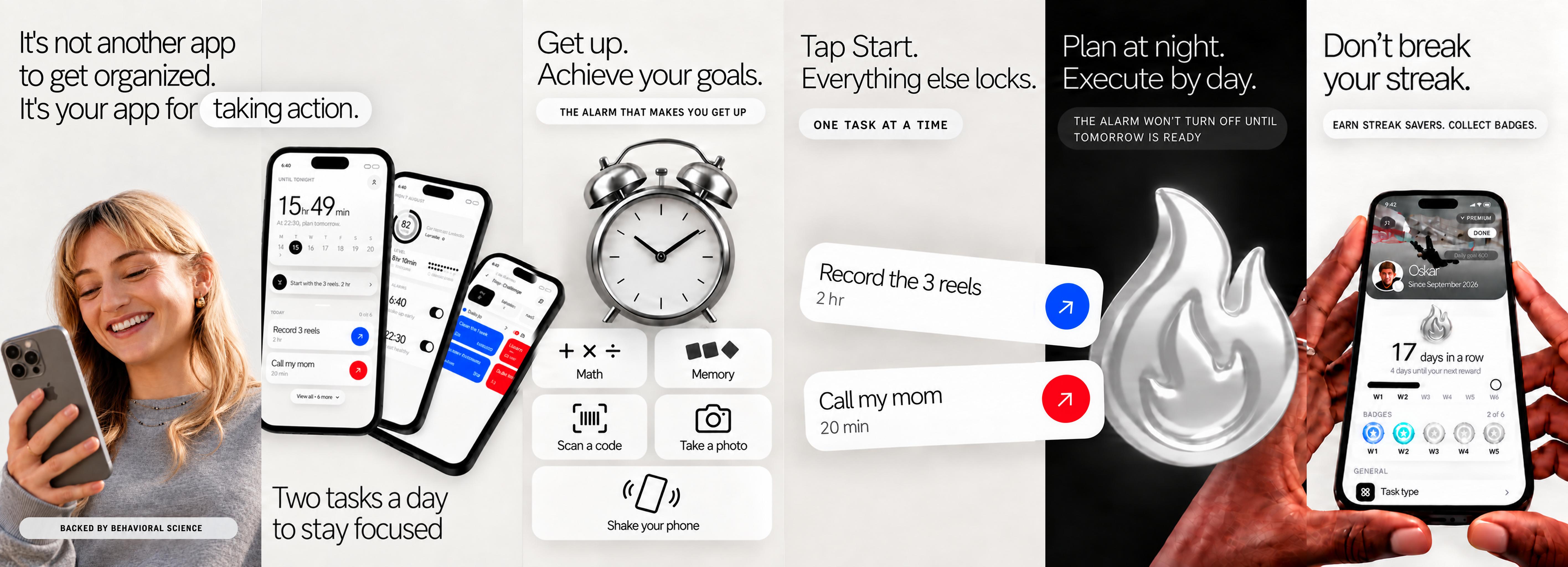
WakeUp is the app that helps you hit your goals. Waking up is just the first step.
You give it one goal, in your own words. "Launch my agency." "Get my first ten clients." "Buy the car." The app breaks it into milestones, and every milestone into tasks. Only one milestone is ever active. The rest stay locked. You are never staring at the whole mountain, only at the next ridge.
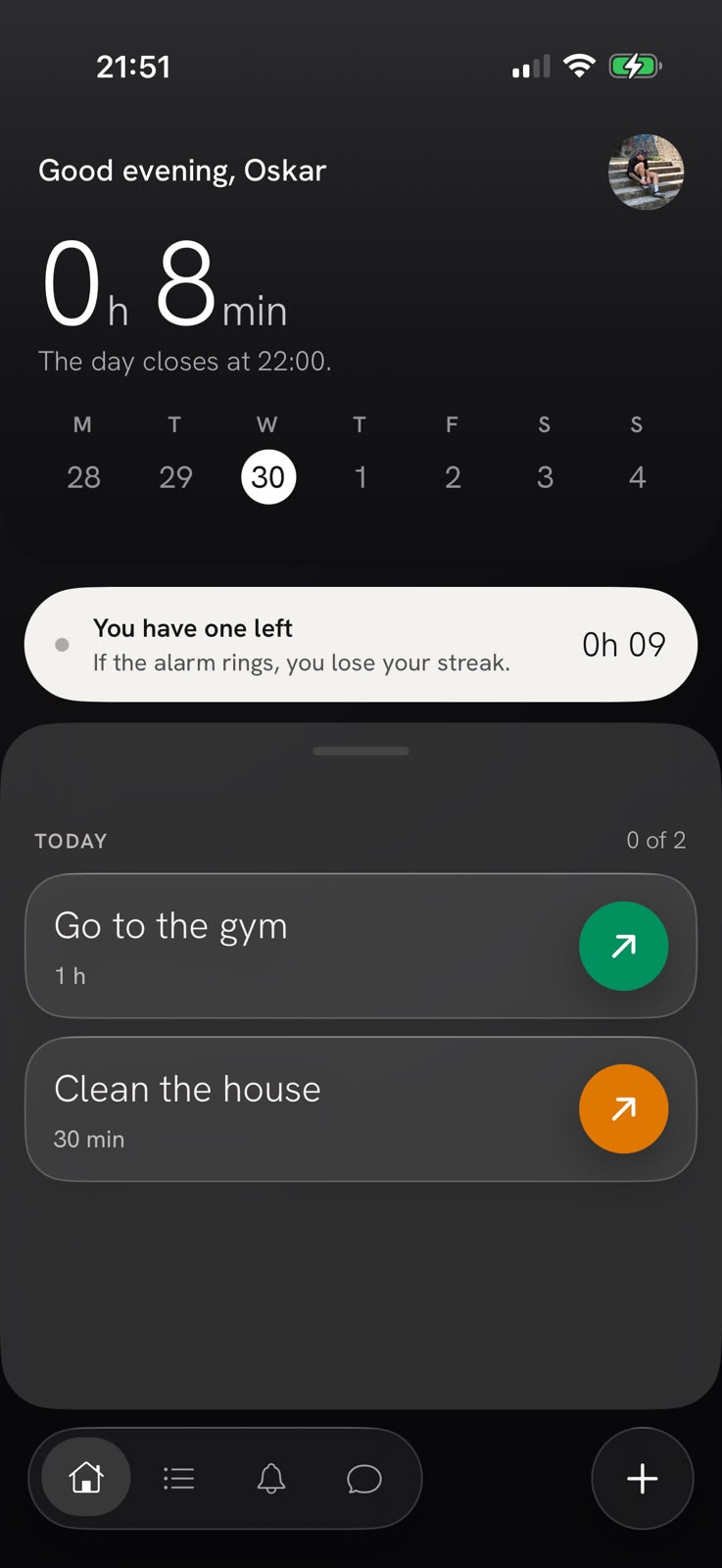
Every night, the app makes you pick the two things that matter tomorrow. Only two. Then the rest of the plan hides itself, because a plan you can see all of is a plan you will spend the day reorganizing instead of executing.
Every morning, an alarm goes off that you cannot kill by reflex. You have to solve a puzzle to stop it. By the time it goes quiet, you are awake, and the first thing you see is not a feed. It is the two tasks you chose for yourself last night. Not a list someone handed you. A promise you made.
Through the day, priority notifications keep pulling you back to the plan. And your progress lives in two shapes: the path, a curved line with one node per milestone, and **the streak, a grid with one square for every single day left until your deadline.
That grid is the honest part. If your goal is days away and you close the two you chose each morning, the total work between you and it is:
$$T = 2d$$
No heroics. No motivation spike. Just a number that gets embarrassingly large when you stop negotiating with yourself. And inside each milestone, the bar moves by the only metric that is real:
$$P = \frac{\text{tasks completed}}{\text{tasks in the milestone}} \times 100$$
How we built it
The app is native iOS, built by Marcos while I handled product, onboarding, brand and copy. The two of us, no team, no funding.
We made one decision early that shaped everything: no AI API at launch. Partly to keep costs near zero, but mostly because it forced a harder discipline. If the app cannot ask a model to figure out what the user meant, then the onboarding itself has to do all the work. Every question has to earn its place. So the goal is free text, just a label the user writes, and the structure underneath is a templated entrepreneur ladder. Validate the idea, launch, first clients. The onboarding figures out where you are standing on that ladder and turns the steps above you into your milestones.
The system is not invented. It sits on work that has been tested for decades: Locke and Latham on specific and difficult goals beating "do your best", Bandura and Schunk on proximal goals building self efficacy, which is exactly why we show you the next ridge and hide the mountain, and Gollwitzer on implementation intentions, which is the entire reason you choose tomorrow's two tasks the night before instead of deciding in the morning when you have no willpower left. On top of that we used Brian Tracy's Goals and Eat That Frog thinking as the practical scaffolding, because theory that does not survive contact with a Tuesday is useless.
The interface is almost violently restrained. Near black background, #08080A. Hanken Grotesk. Frosted glass surfaces. White as the only accent. No status colors, no green checkmarks, no emoji, no confetti. We tested warmer versions and they all felt like a productivity app congratulating you for existing. The final look is closer to a watch than a dashboard. Quiet, expensive, serious about what you told it you wanted.
Challenges we ran into
The onboarding was rebuilt from scratch. In the first version, the app generated your milestones for you. It was smoother, faster, and completely wrong. People read the milestones, nodded, and felt nothing, because they were not theirs. Now the app teaches you what a milestone is, teaches you what a task is, and then makes you write your own first milestone and your own first two tasks. It is slower. Friction in exactly the right place. Ownership beats optimization, and that cost us weeks to learn.
The alarm had to be hard without being cruel. We shipped puzzle difficulty as a user setting at first. Then we removed it entirely. Any difficulty a user can lower at 6:45am is a difficulty they will lower at 6:45am. The app is not there to be agreeable. It is there to be the one thing in your life that does not accept your excuses.
Knowing what to leave out. Community, streak rewards, social feeds, AI coaching, stats dashboards. Every one of them was designed and then cut. The app only earns its place if opening it takes you toward the goal, and almost every feature we cut was really just a nicer way to avoid the two tasks.
Distribution turned out to be harder than the build. We are on iOS only. Everyone who has used it loves it, but "everyone" is still mostly people who know us, so we do not yet have honest proof that a stranger finishes the onboarding. That is the scariest open question we have, and we would rather say it out loud than pretend otherwise.
What we learned
That motivation is not a feature, it is a byproduct, and you get it by making the next step small enough that starting is easier than avoiding.
That the most valuable thing an app can do for someone is remove decisions, not add options.
That building the product was the easy part. Getting it into the hands of people who do not already love you is the actual work.
And that the honest measure of whether this thing works is not downloads or retention curves. It is whether someone who has been putting off the same goal for three years finally moves. That is the only number we care about.
What's next
Android. Real testing with people who owe us nothing. And a simple price that makes the decision easy, around €0.10 a day, because the thing standing between you and what you said you wanted should never be the price of the app.
Wake up. Take the day. Become the person you promised you would be.
Built With
- claude
- onesignal
- posthog
- revenuecat
- supabase
- swift
- swiftui


Log in or sign up for Devpost to join the conversation.