-
-

Logo
-
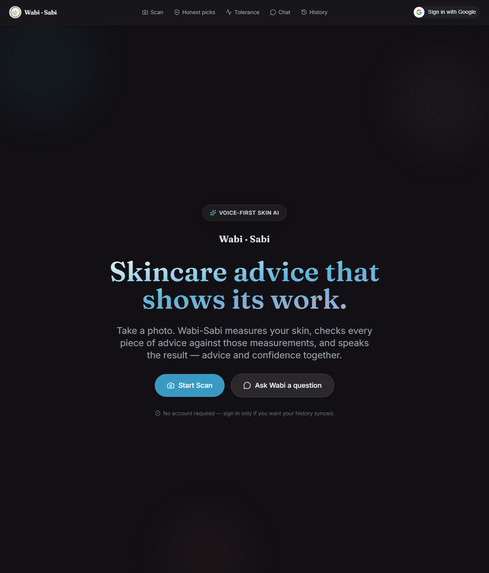
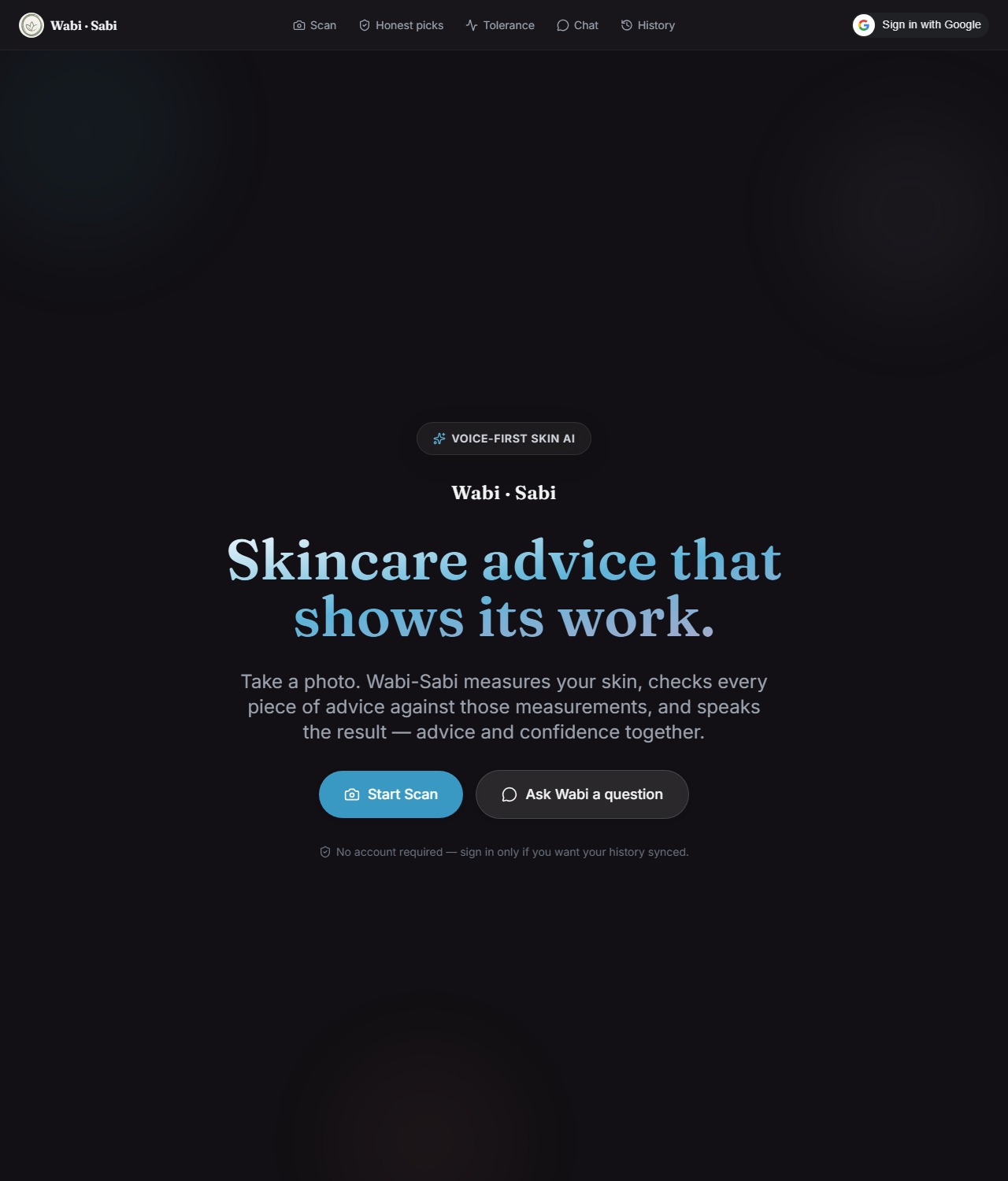
Landing Page
-

Onboarding
-

Honest picks
-

Hype check
-
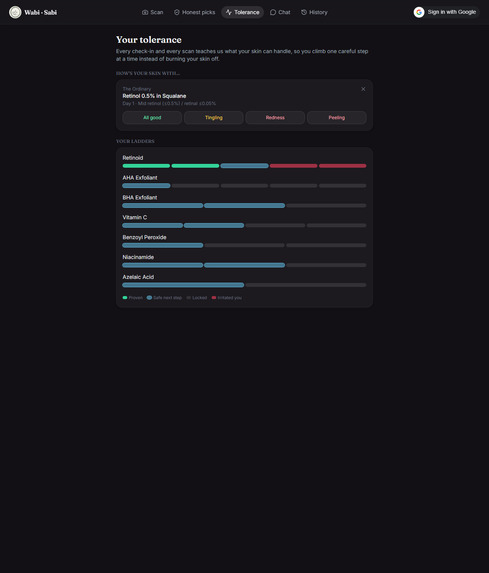
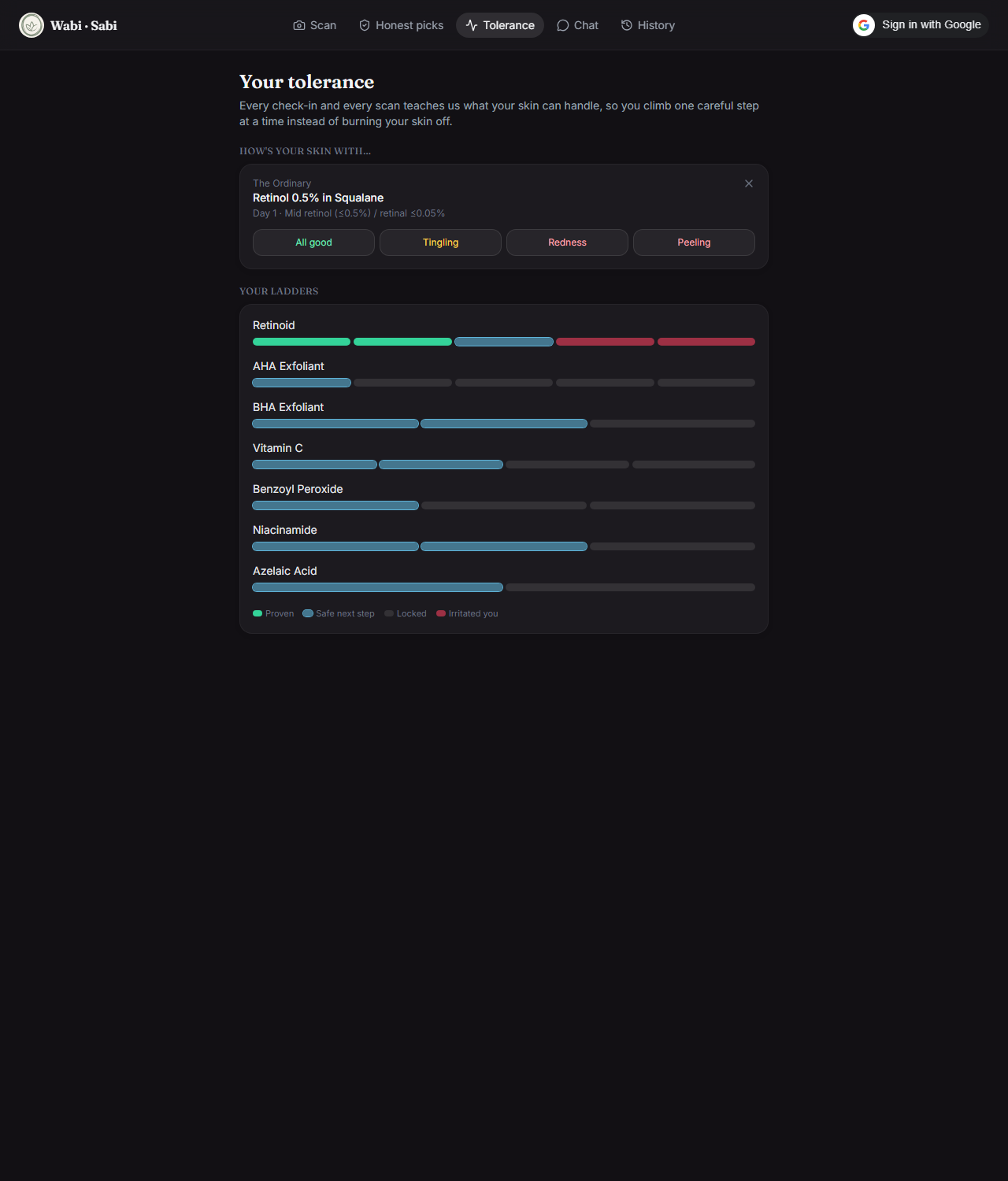
Tolerance




Inspiration
Growing up, dealing with persistent acne from a very young age wasn't just a physical struggle it was an emotional one. Desperate for a solution, I spent years navigating a maze of skincare products. But without a deep understanding of active ingredients or chemical concentrations, I easily fell into the classic trap: believing every viral trend, buying into paid influencer hype, and assuming that if a product worked miracles for someone online, it would work for me. The result? A damaged skin barrier, constant breakouts, and a closet full of half-used bottles. That’s when I realized the double-edged sword of this industry: over-consumption is destroying both our skin barriers and our planet. The constant pressure to buy the "next big thing" leads to excessive waste, single-use plastic pollution, and ruined skin. We built Wabi-Sabi to stop this cycle. I wanted to create an honest, hype-free space that protects your skin from active-ingredient burns and protects the environment from unnecessary consumer waste.
What Wabi-Sabi does
Wabi-Sabi is a skincare shopping assistant that tells you the truth. It uses the YouCam AI Skin Analysis API to measure your actual skin, remembers what your skin can handle, and tells you whether a product is worth buying for you, not for an influencer. It is a data-driven skincare matching platform built on radical transparency and personalized tolerance mapping , Instead of basic "dry" or "oily" tags, the app profiles your skin’s specific tolerance to active chemical concentrations to prevent barrier damage before it happens.
The problem Skincare buying runs on hype. A serum goes viral and thousands of people buy it based on someone else’s skin. Retinol shows the damage best. There are many forms and strengths, people with sensitive skin burn their faces by jumping straight to a 1% product, and the same active at the same strength can cost 2x to 20x more depending on the logo. Most skincare apps make this worse by selling you a flawless “after” photo.
How it works, in four steps
Scan. Take a selfie. YouCam Skin Analysis measures 11 concerns: moisture, wrinkles, redness, dark spots, acne, pores, oiliness, radiance, texture, firmness and eye bags. It also returns a skin score and skin age. Wabi-Sabi turns these numbers into your skin type and what your skin needs right now.
Learn your tolerance. Every active ingredient (retinoids, AHAs, BHAs, vitamin C, benzoyl peroxide, niacinamide, azelaic acid) has a strength ladder.
You can only climb one careful step above what you’ve already proven.
A strength that burned you is blocked.
The ladder learns from a short quiz (“this burned me,” “this worked for a month”), quick check-ins (fine, tingling, redness, peeling), and repeat scans.
If redness, texture or moisture measurably gets worse after you start a new product, the app asks whether that product caused it.
Honest picks. Every product gets a score with plain-language reasons:
Need: does it address what your scan found?
Tolerance: is it within your ladder and free of ingredients you react to? This is a hard gate that nothing can override.
Value: price per ml compared with products doing the same job at the same strength. Overpriced products are flagged, and the cheaper equivalent is named.
Hype gap: how much of a brand’s buzz is backed by what’s in the bottle.
Try this instead: if something is too strong for you, you get the strongest version you can handle. If it’s overpriced, you get an honest dupe.
People like you: what other users with your skin type and experience actually reported. It stays quiet until enough similar users have logged reactions, and it tells you so.
Hype check. Saw something on your feed? Search it and get a verdict for your skin. For example, a $74 retinol cream you’ve reacted to before comes back as “off your list, 2.5x the typical price, try this 0.5% version at $0.26/ml.”
Built to be heard, not just read Scan results are spoken aloud, and every spoken claim is checked against your measured YouCam scores first. Anything the measurements don’t support is removed, not softened with a caveat. Each answer ends with a spoken confidence line, so you know how sure the app is. This makes it usable without sight, with the screen off.
Everything else included -Scan history, with progress counted only when a change is bigger than normal measurement noise -A text chat assistant for open-ended skincare questions, which can start from a finished scan -No account required, with optional Google sign-in to sync history across devices
Conscious Consumption: By matching you only with what actually works for your skin chemistry, Wabi-Sabi saves your money, cuts out trial-and-error purchasing, and reduces skincare waste for a healthier planet.
How we use YouCam
We call the AI Skin Analysis API server-side: upload the image, start the task, poll until it finishes, then download the results. YouCam’s scores drive the whole product. They set your needs, detect your skin type, power the safety filters (for example, moderate redness rules out fragrance), verify tolerance when you rescan, track progress, and ground the spoken advice.
Why it matters
For shoppers: fewer wasted purchases, fewer burns, and an honest answer to “is this worth it for me?”
For retailers and brands: shoppers matched to products their skin tolerates are more likely to keep using them and less likely to return them or complain about irritation. Brands with real formulas and fair prices come out ahead, while hype alone does not.
How we built it
Wabi-Sabi is a web app with a React front end and a Python (FastAPI) back end. YouCam AI Skin Analysis provides the skin measurements, and a deterministic trust engine turns them into honest product recommendations. Gemini voices the advice, but no product claim ever comes from an LLM. YouCam AI Skin Analysis, S2S API v2, is called server-side so the API key never reaches the browser:
POST /s2s/v2.0/filereturns a file id and a pre-signed upload URL; the photo is uploaded exactly as instructed.POST /s2s/v2.0/task/skin-analysisruns with 11 concerns: moisture, wrinkle, redness, age spot, acne, pore, oiliness, radiance, texture, firmness, eye bag.GET /s2s/v2.0/task/skin-analysis/{task_id}is polled asynchronously until the task succeeds.- The result zip is downloaded and parsed.
score_info.jsongives a 0–100 score per concern plus skin age and the overall skin score, and each concern's annotated mask image is shown over the user's own photo. 5.Trust engine: scores each product on need, tolerance (a hard gate), price per ml against same-job same-strength products, hype gap, and dupes. It produces the reasons you see on each card. Products that don’t disclose their concentration are flagged as potentially strong and kept off beginner ladders, not guessed at.
What the scores drive:
- Needs: each score becomes a severity band (clear / mild / moderate / significant), and each band maps to ingredient categories to recommend and avoid.
- Skin type detection: oily, dry, combination, normal or sensitive, inferred from oiliness, moisture and redness.
- Safety filters: for example, moderate redness rules out fragrance, and significant dryness blocks any retinoid step-up.
- Reaction detection: a measurable rise in redness, texture or dryness after starting a new product triggers an alert for the user to confirm.
- Progress tracking between scans, with a noise threshold so tiny changes aren't reported as improvement.
- Grounding: every spoken claim is checked against these measurements.
Back end
| Technology | What we use it for |
|---|---|
| Python 3.13 + FastAPI | API server: scan orchestration, profile, matches, check-ins, chat, voice |
| httpx (async) | YouCam client with retry on network errors and non-blocking polling |
| Pillow | Validating and resizing images to YouCam's size limits |
| Honest Match trust engine (plain Python) | Scores every product: scan need × tolerance gate × value per ml × hype gap, plus honest dupes and safer alternatives. Deterministic: no AI, no network calls |
| Tolerance model (plain Python) | Per-ingredient strength ladders (retinoids, AHAs, BHAs, vitamin C, benzoyl peroxide, niacinamide, azelaic acid) that learn from a quiz, check-ins and rescans |
| Curated catalog (JSON) | About real products with actives, concentrations (undisclosed ones flagged), prices and sizes, plus editorial brand buzz tiers |
| SQLAlchemy | Scans, users, skin profiles, product usage and reactions; SQLite by default, Postgres when DATABASE_URL is set |
| google-auth | Server-side verification of Google Sign-In tokens (optional accounts) |
AI
| Technology | What we use it for | What it's not used for |
|---|---|---|
Gemini 2.5 Flash (google-genai) |
Writing the spoken scan advice, limited to ingredient categories allowed for the measured bands; the chat assistant | Recommending or describing specific products |
| Gemini 2.5 Flash as a grounding judge | Checking each advice claim against the measured YouCam scores before it's spoken (retries once on a dropped connection) | Scoring products |
| Gemini TTS | Reading the result aloud, with the browser's own speech as a fallback |
All product scoring, tolerance rules, price comparisons and dupes are ordinary, testable code.
Front end
| Technology | What we use it for |
|---|---|
| React 19 + TypeScript 5.9 | Screens: Scan, Honest picks, Hype check, Tolerance, Chat, History |
| Vite 7 | Dev server and production build |
| Tailwind CSS 3 | Dark theme and design tokens; responsive down to phone width |
| Framer Motion | Screen transitions |
| lucide-react | Icons; every icon-only control has a screen-reader label |
| axios | API client |
| Google Identity Services | Optional sign-in |
Infrastructure and quality
| Technology | What we use it for |
|---|---|
| Vercel | Hosting: the FastAPI backend as a Python serverless function and the React front end as a static build |
| Docker Compose + nginx | Local and self-hosted setup (API, built front end, reverse proxy) |
| pytest | 61 tests for tolerance rules, the trust engine, YouCam parsing (including a mock built from a real captured result), grounding and HTTP endpoints; they run without any real keys |
Datadog (datadog, ddtrace, browser RUM) |
Metrics and tracing: scan volume, grounding scores, trust bands, YouCam latency and failures |
| GitHub | Source control |
Challenges we ran into
1. Turning scores into advice that never contradicts the measurement. YouCam returns 0 to 100 scores, but people need advice in plain words. We mapped scores into severity bands and bands into ingredient categories, but a reading just under a band boundary is genuinely ambiguous. An LLM will give confident advice on either side of it. We took product decisions away from the model entirely and used deterministic rules. We then added a grounding check that removes any spoken claim the numbers don’t support, and readings near a band edge lower the stated confidence.
2. Safe, but not stuck. Tolerance rules that are too loose let people burn their skin, and rules that are too strict never let them progress. We settled on a one-step climb above what you’ve proven, a permanent block on strengths that irritated you, and a step back down after redness or peeling. Making this feel fair, not nagging, took the most tuning.
** 3. Products that don’t say how strong they are.** -Many retinoids don’t disclose their concentration. Guessing would be dishonest, and ignoring them would hide real risk. We flag undisclosed strengths as potentially strong and keep them off beginner ladders.
- When a brand hides an ingredient's strength, there's no number to score. We decided to treat undisclosed strengths as strong, so hiding a number never helps a product.
4. Bugs that only real scans exposed. Unit tests didn't catch these, but walking the full flow with live YouCam scans did:
- A price comparison named a cheaper product that had burned that same user. Now we only name products the user can actually use.
- A luxury cream appeared in honest picks as "earned." Products without a key active ingredient were only being compared against themselves on price. We now group products by the job they do, and nothing we flag as overpriced or overhyped can become a pick.
- YouCam's analysis masks showed up on a black background, so they meant nothing. We now lay them over the user's own photo.
- Keeping the AI honest. One dropped connection to the grounding judge was enough to mark a good scan as "uncertain." We added a single retry, and a claim that fails grounding is still removed, never softened.
7. Keeping an LLM from breaking a trust product. The model writes the voice, but a malformed judge response can’t be allowed to slip an unchecked claim through. If the grounding judge returns bad output, the system treats the claim as ungrounded and removes it. It never silently lets it pass.
Accomplishments that we're proud of
🏆 Accomplishments That We're Proud Of Translating a deeply personal lifelong struggle with acne into a functional solution that empowers consumers. Building an engine that prioritizes user safety and price transparency over marketing hype. Creating a feature set designed to curb consumer over-purchasing and lower plastic waste in the beauty industry. Telling real change from noise. Skin measurements wobble between photos because of lighting and angle. If we reported every difference, normal variation would look like improvement or irritation. We only report changes above a noise threshold, and the irritation alert only fires when redness, texture or moisture gets measurably worse after starting a new product.
What's next for Wabi Sabi
Dynamic Barrier Recovery Tracking: A feedback loop that learns from your real-time skin reactions over time to continuously refine sensitivity thresholds. Conflict Detector: Scanning an entire routine to flag dangerous active combinations (e.g., mixing strong BHAs with high-potency Retinols). Eco-Impact Score: Showing users the carbon and plastic footprint saved by avoiding unnecessary product purchases.
