-
-
Urban Noir Parsa
-

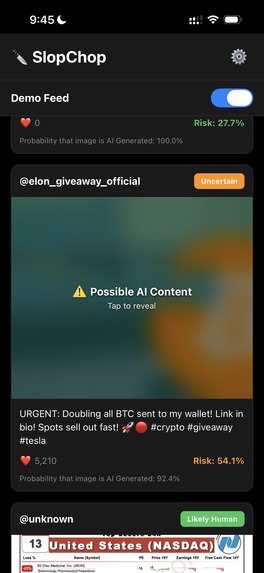
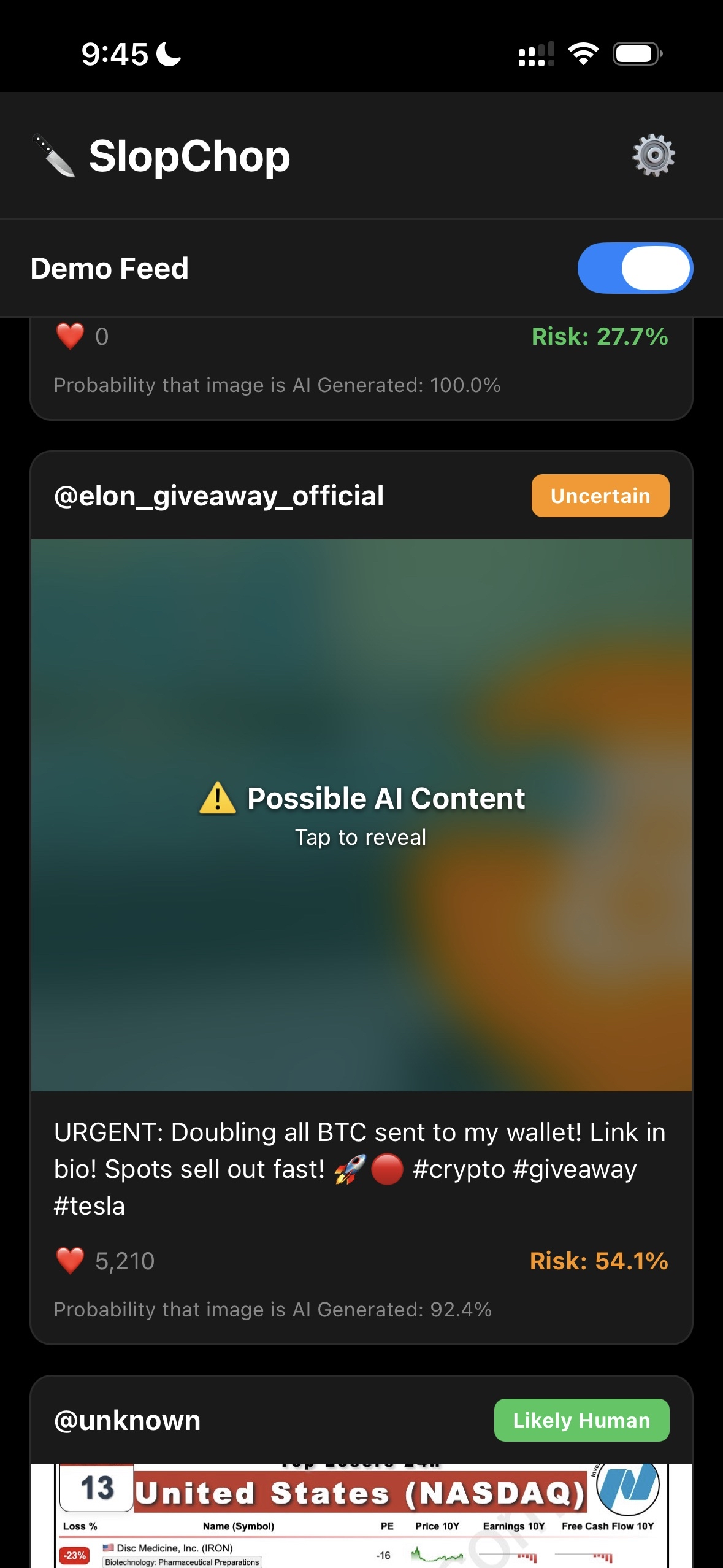
Post detected as likely AI/scam
-
Post blurred by user in settings
-
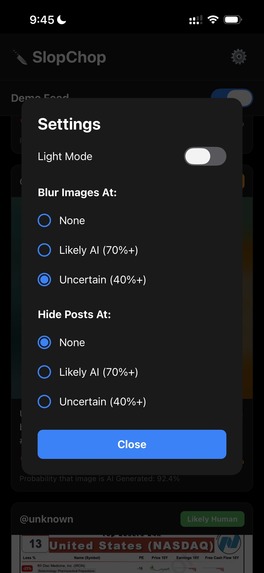
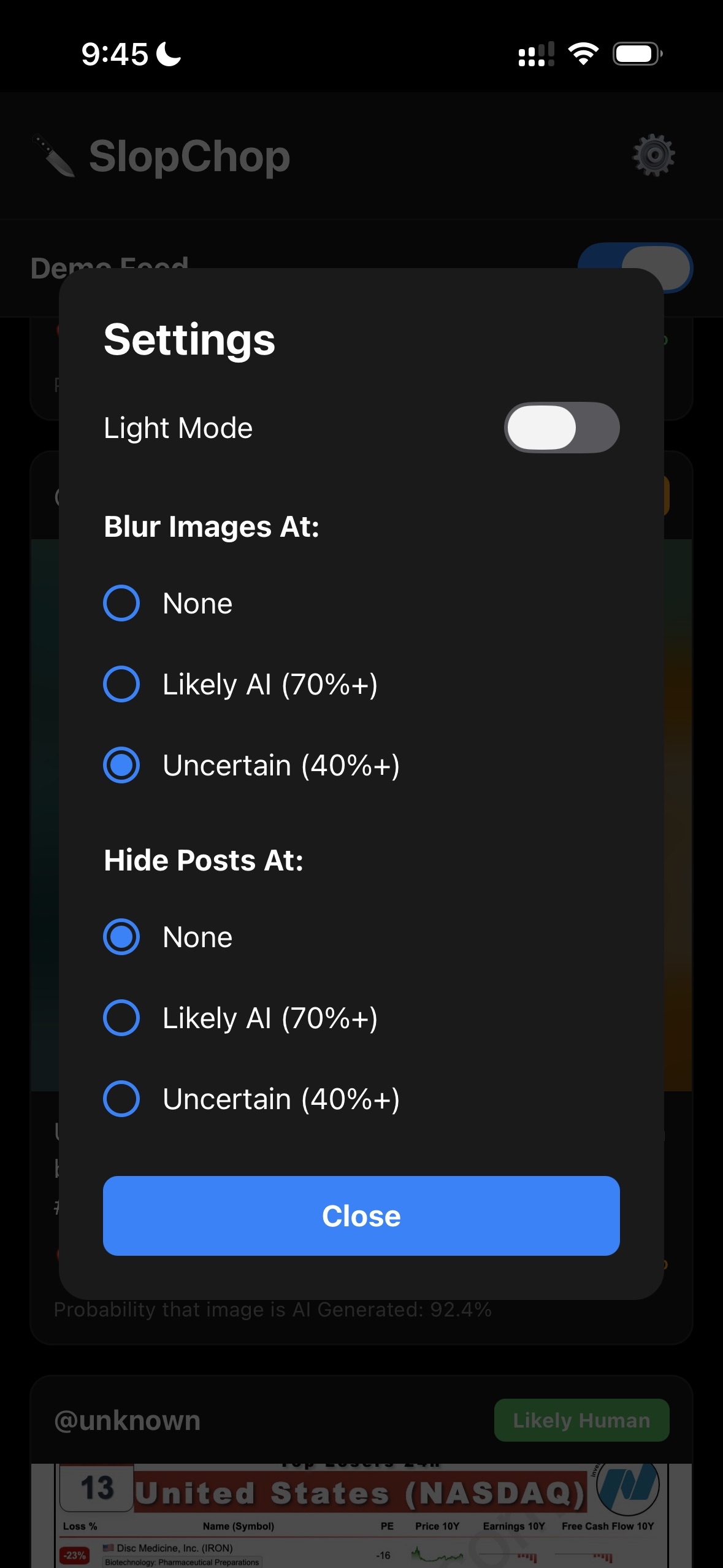
Options Menu
-
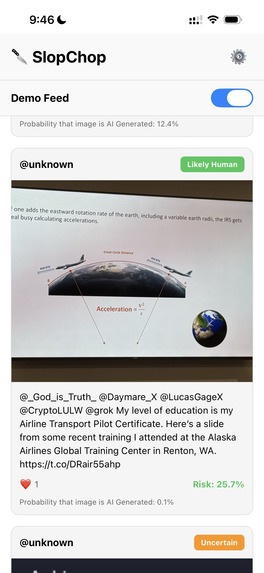
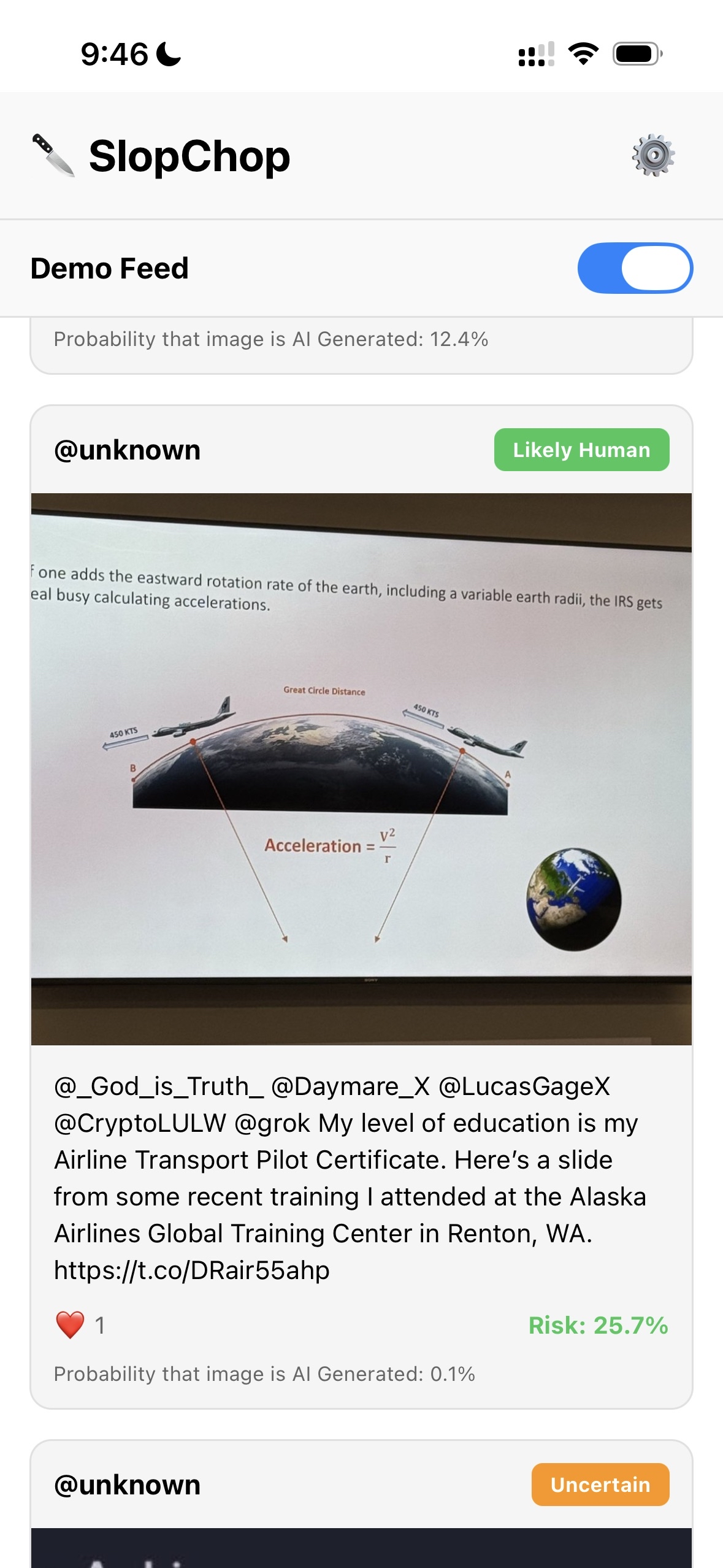
Light mode

Inspiration
After hearing about the Siren's Call, we looked into it. We found that AI-generated misinformation is spreading faster than ever on social media. Recent research by Drolsbach and Pröllochs [2025] analyzing over 91,000 misleading posts revealed that AI-generated misinformation receives 34% more likes and 11% more retweets than traditional misinformation on X (formerly Twitter). With AI tools becoming more accessible and sophisticated, users need reliable, real-time detection tools. SlopChop addresses this growing threat by providing instant, multi-modal AI content detection directly within social media feeds.
What it does
SlopChop provides assessments on each social media post by running its text through 2 AI text detection models and processing its image through an AI image detection model. The results from these assessments are then used to classify the post as 'likely human,' 'uncertain,' and 'likely AI/scam.'
This approach recognizes that AI-generated misinformation often combines both text and visual elements, with research showing 93% of AI-generated misleading posts contain media.
How we built it
We built the app in Expo (React Native) so one codebase runs on both iOS and Android. The app pulls live posts from X through the X API and sends each one to our FastAPI backend, which uses Pydantic to validate requests.
On the backend, each post’s text runs through two Hugging Face text detectors: OpenAI’s RoBERTa detector (openai-community/roberta-base-openai-detector) and a RoBERTa model trained to detect ChatGPT output (Hello-SimpleAI/chatgpt-detector-roberta). We combine their scores as a weighted average, giving the OpenAI detector full weight (1.0) and the ChatGPT detector 0.7. Any images go through an SDXL image detector (Organika/sdxl-detector), processed with Pillow. The text and image scores are then combined into one verdict, likely human, uncertain, or likely AI/scam, which the app shows on the post.
We split the work three ways: frontend, the FastAPI and model pipeline, and the live X feed.
Challenges we ran into
Choosing and actually implementing a live social media feed into our app. Among the many social media platforms available, we decided to implement X. X specifically has a large influx of posts every minute, along with having an integrated AI system, Grok, which makes X a hotspot for AI-generated content. Additionally, research validates X as a significant source of AI-generated misinformation (5.06% of flagged misleading posts)
Accomplishments that we're proud of
Completing this project without having to rush down to the last minute was a big accomplishment. Cross-platform deployment on both iOS and Android using a single codebase was also important to us, since our team had both iOS and Android users.
What we learned
Taking the time to flesh out an idea and develop the architecture of a project saves time and effort in the long run.
What's next for SlopChop
In the future, we would like to implement and streamline running multiple social media feeds into a single app, such as including Instagram's Explore page and TikTok's FYP in the live section of the app. Expanding core functionality such as messaging, sharing, and other modern social media tools will also be essential. These additions will make it easier and more appealing for users to adopt SlopChop as their primary platform for filtering out AI-generated content.
References
Chiara Drolsbach and Nicolas Pröllochs. 2025. Characterizing AI-Generated Misinformation on Social Media. arXiv:2505.10266 cs.SI. https://doi.org/10.48550/arXiv.2505.10266
Built With
- census
- expo.io
- google-trends-api
- huggingface
- javascript
- pillow
- pydantic
- python
- pytorch
- react-native
- x-api

Log in or sign up for Devpost to join the conversation.