Inspiration
Small businesses have to manage a lot every day—inventory, customers, suppliers, billing, payments, reports, and business decisions. In many cases, these tasks are still handled using spreadsheets, notebooks, or different tools that do not work together.
We wanted to build something more practical: an AI business companion that not only stores business information, but also helps business owners understand what is happening in their business.
That idea became VyaparAI — AI Business Copilot.
Our goal was to bring everyday business operations into one platform and use AI to turn business data into simple answers, insights, and recommendations. Instead of spending time going through multiple reports, a business owner should be able to ask a question naturally and get useful information quickly.
What it does
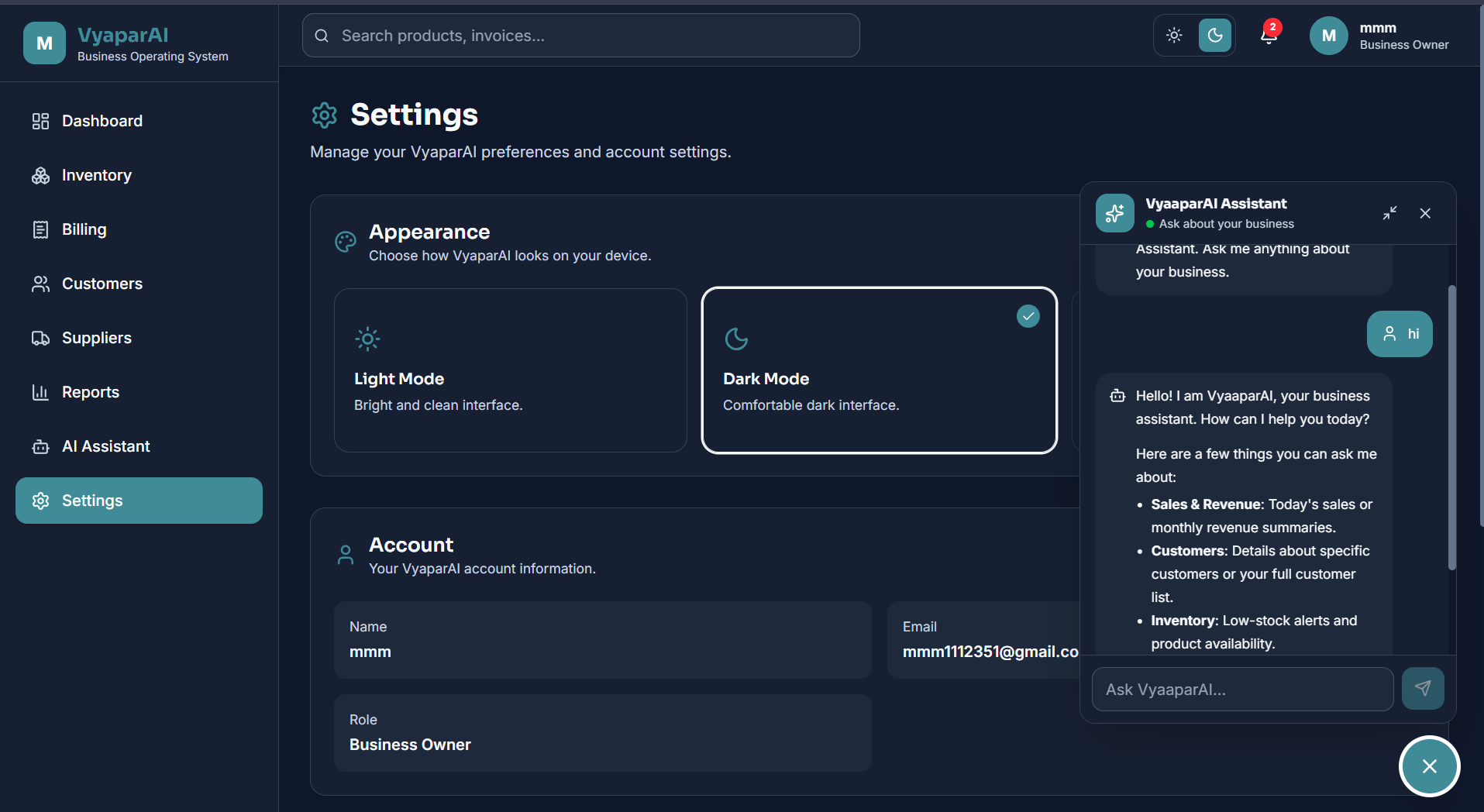
VyaparAI is an AI-powered business management platform that combines essential business tools with an AI assistant.
It provides:
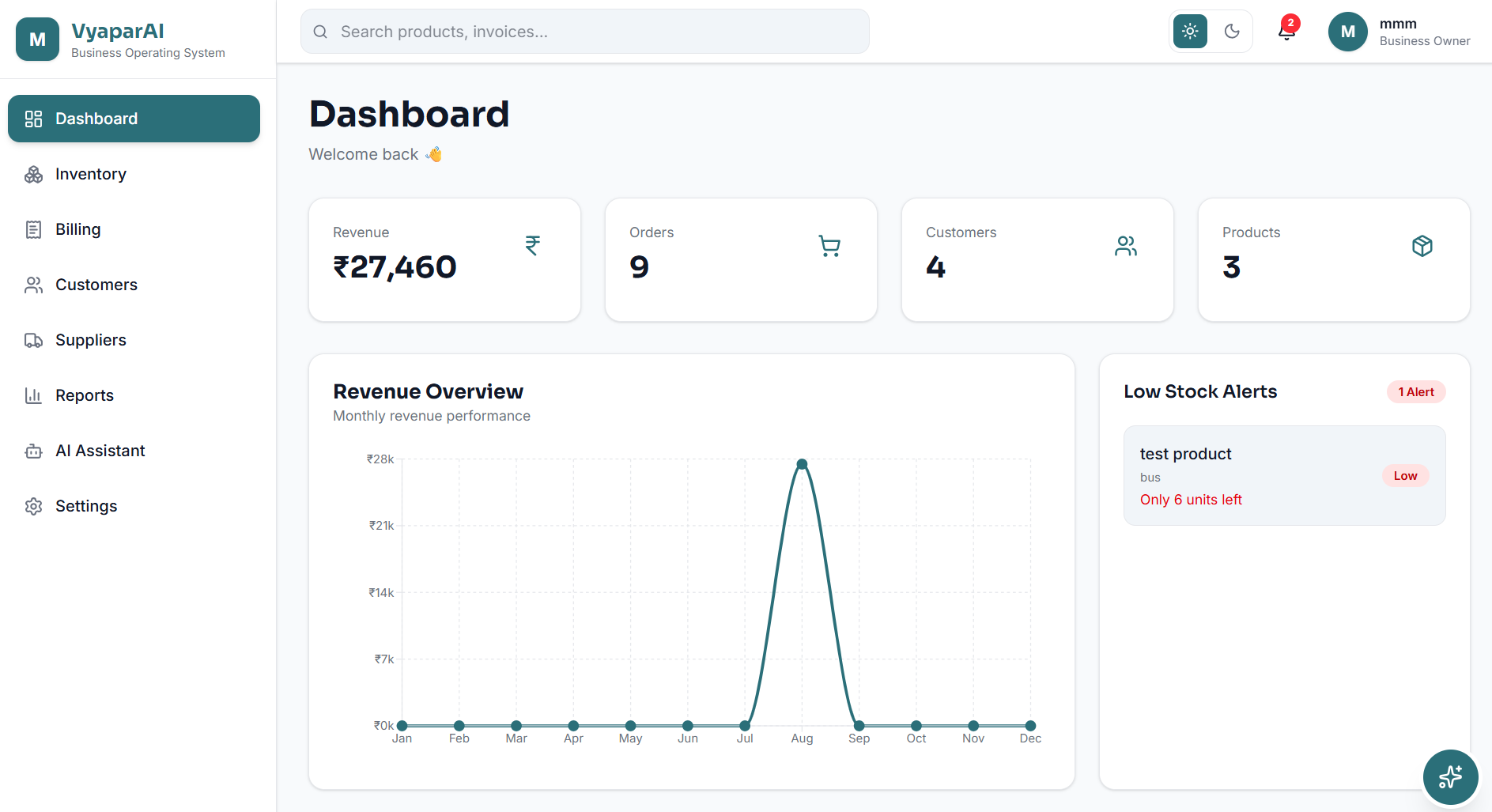
Business Dashboard — view important business metrics and analytics in one place.
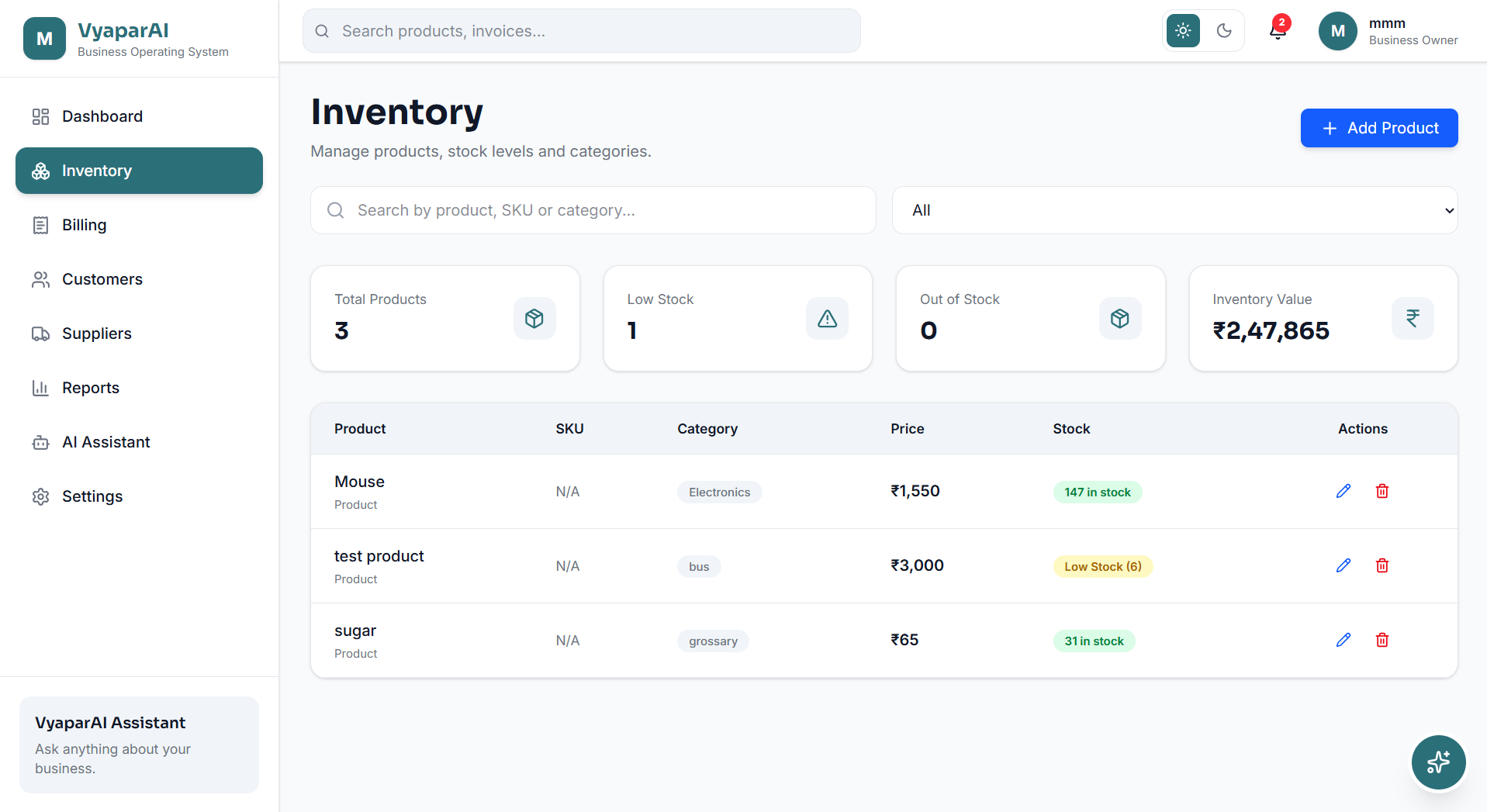
Inventory Management — add, edit, search, and monitor products and stock levels.
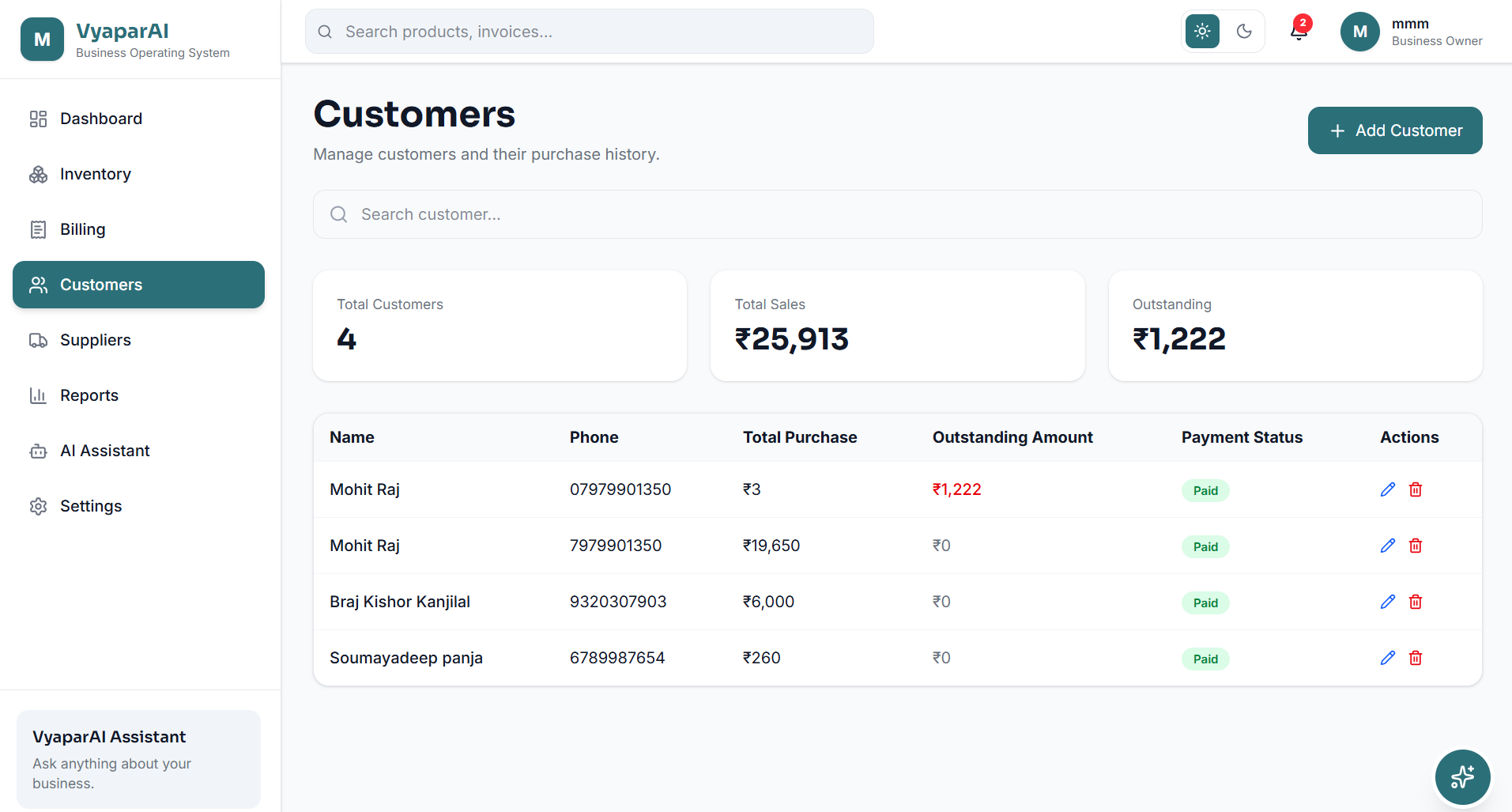
Customer Management — manage customer information and records.
Supplier Management — maintain supplier details and relationships.
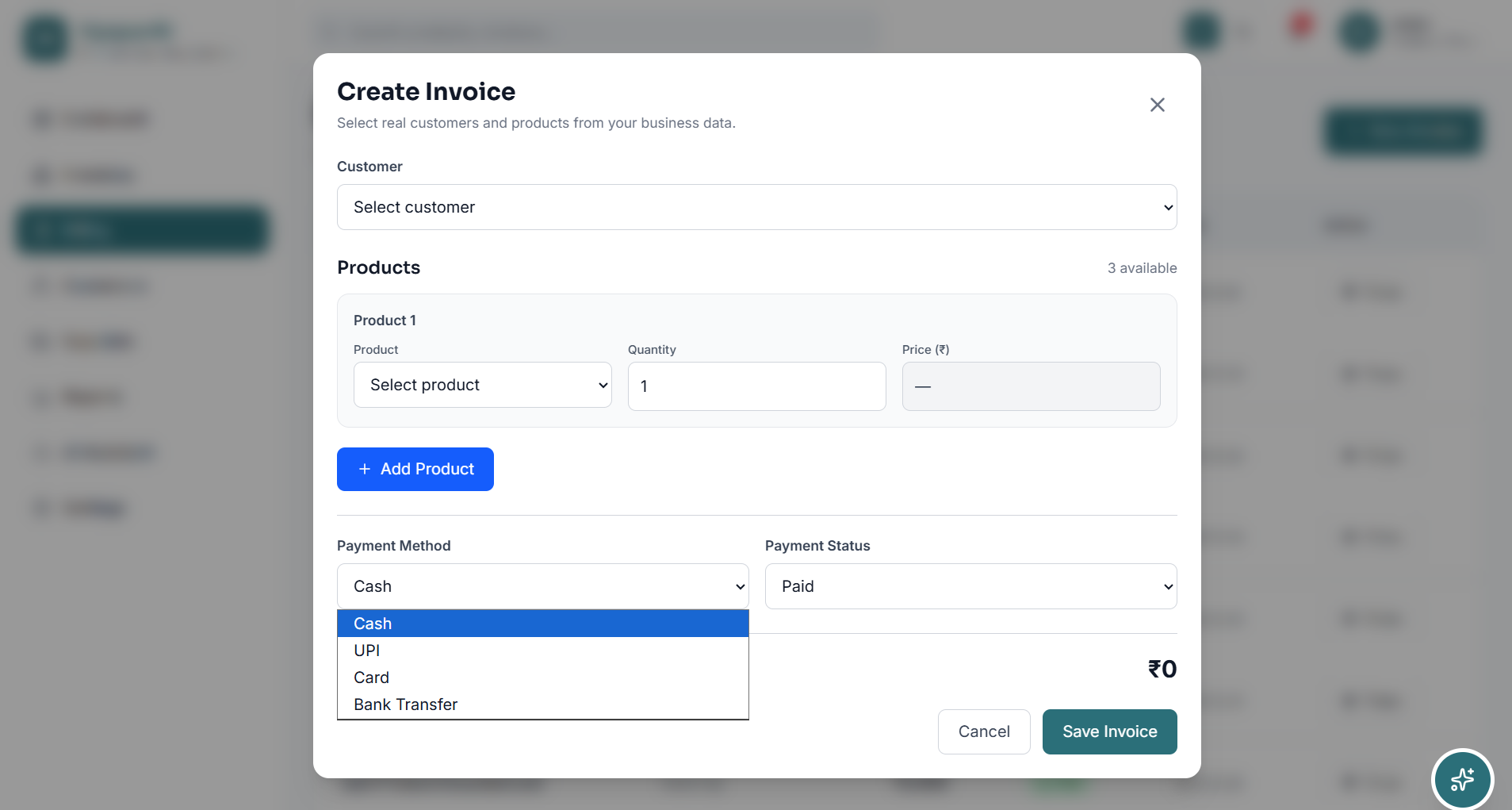
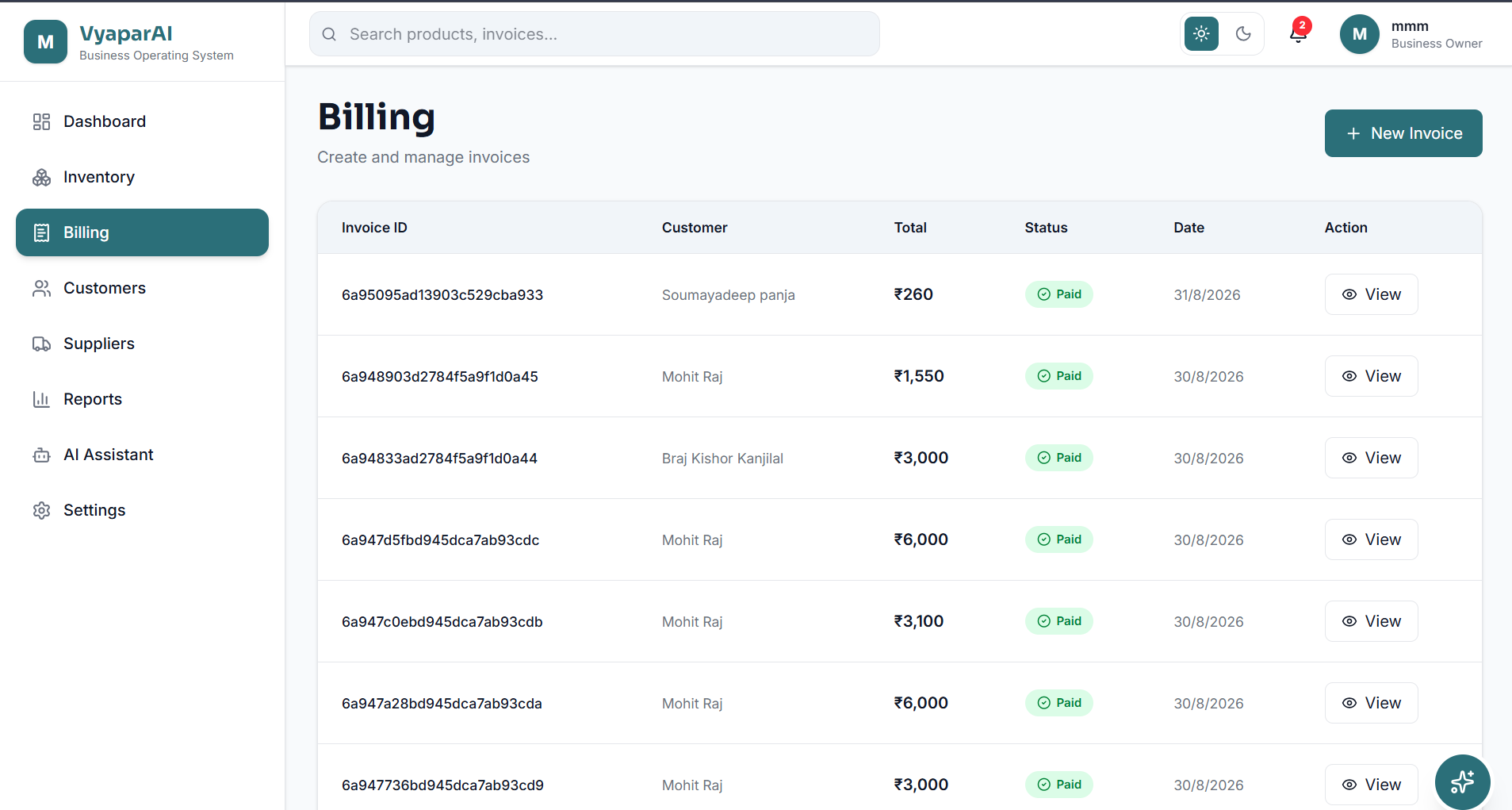
Billing & Invoicing — create invoices, record payments, track outstanding amounts, and support online payments.
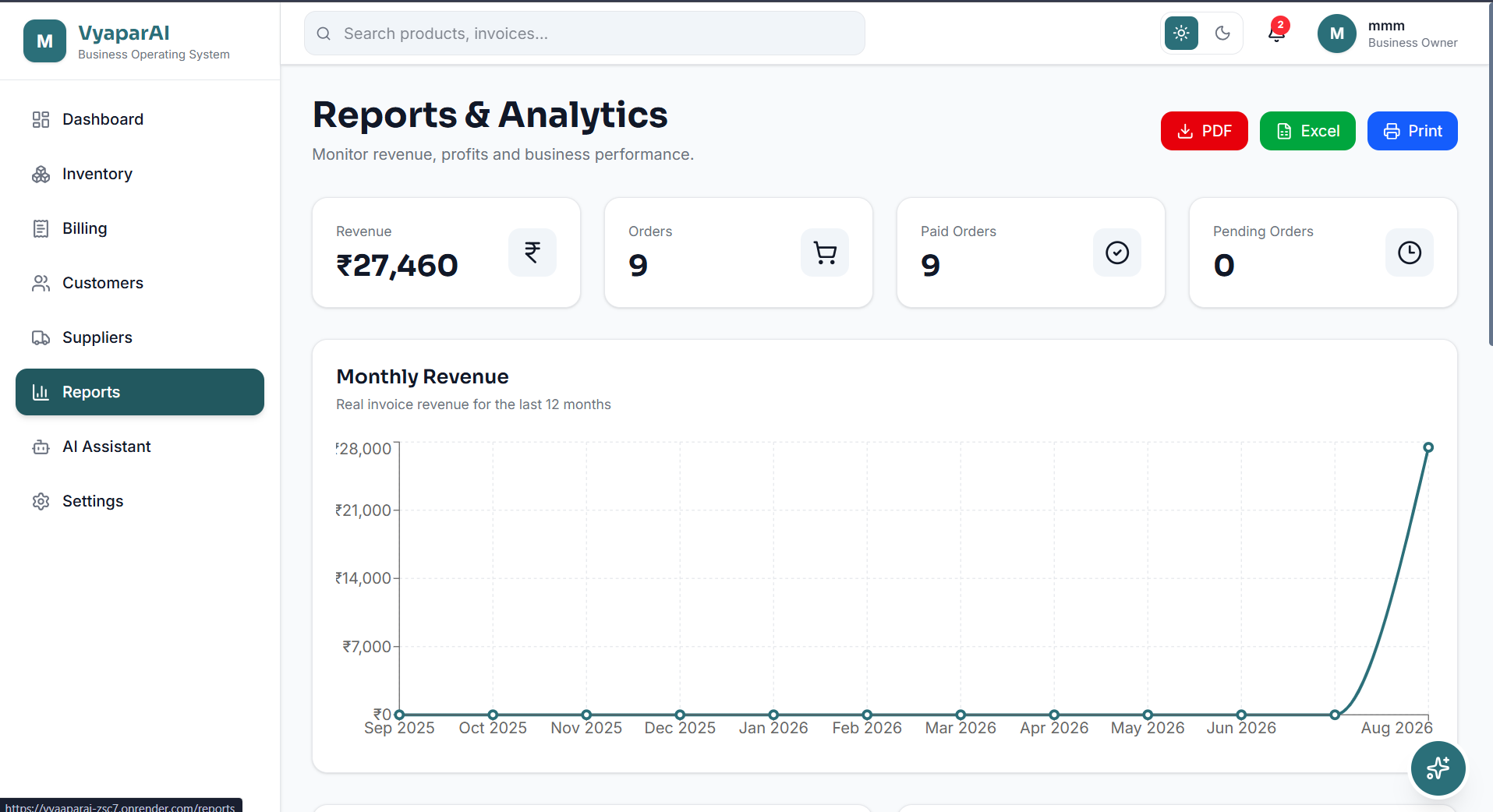
Reports & Analytics — view sales, revenue, products, categories, and transaction information.
AI Business Assistant — ask business-related questions in natural language and get AI-powered insights.
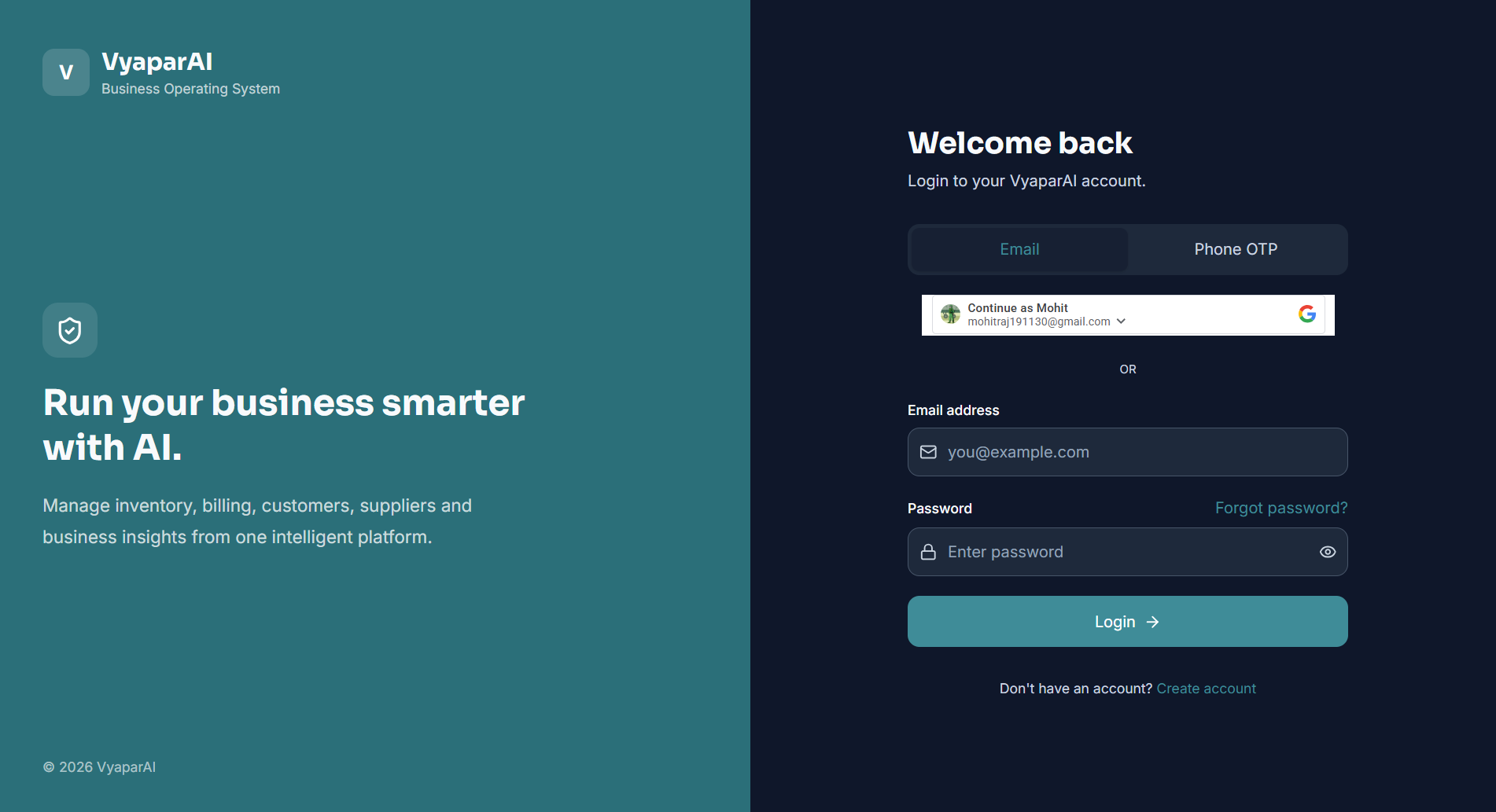
Authentication — email/password and Google Sign-In.
Password Recovery — forgot-password and reset-password functionality.
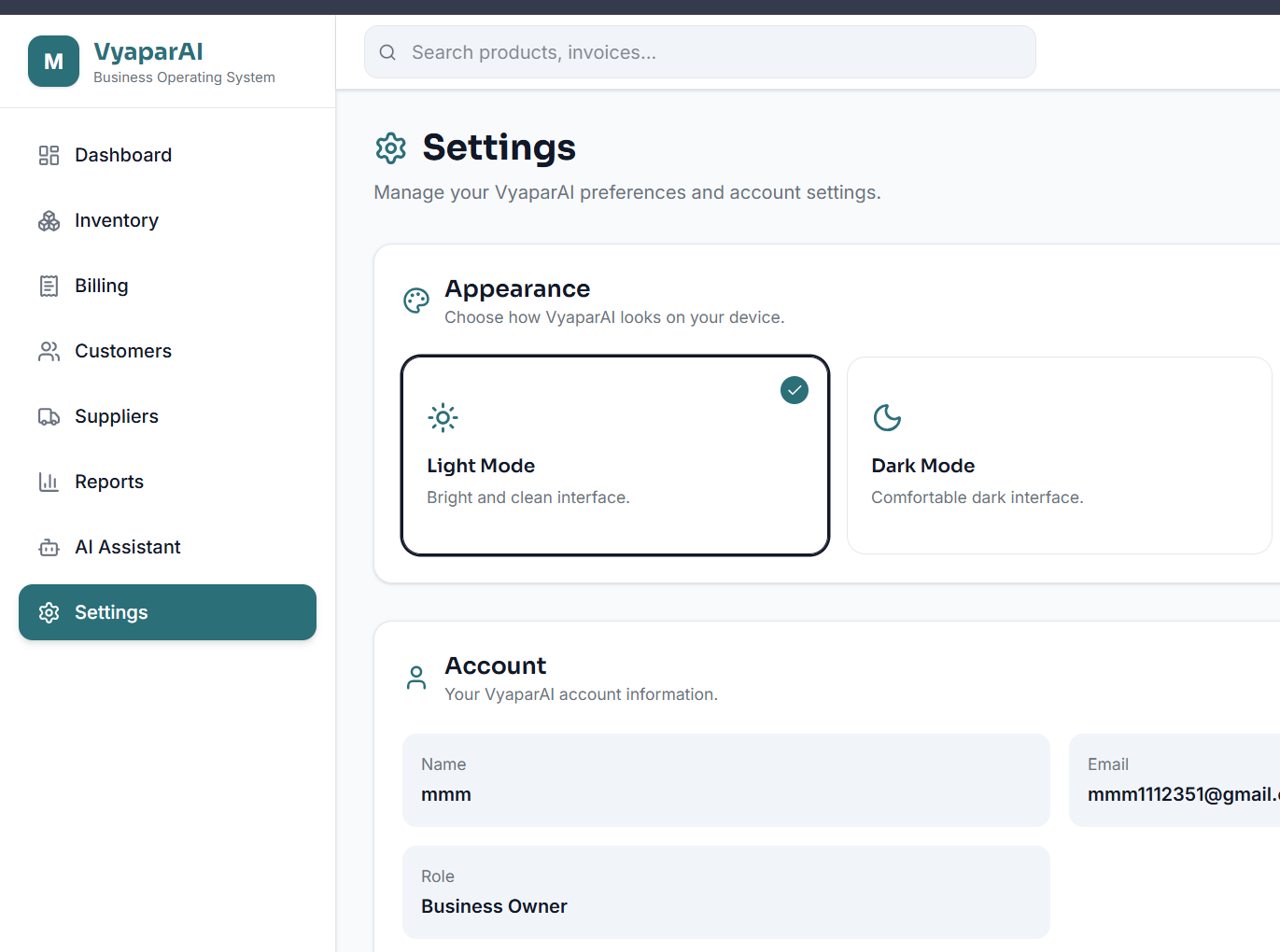
Responsive UI — a modern interface designed for practical day-to-day use.
The core idea is simple:
VyaparAI turns business data into business understanding.
How we built it
We built VyaparAI as a full-stack application.
The frontend was developed using React, TypeScript, Tailwind CSS, and Vite.
The backend was developed using Python, FastAPI, REST APIs, JWT authentication, and bcrypt password hashing.
We used MongoDB to store users, customers, suppliers, inventory, invoices, and other business data.
For the AI capabilities, we integrated the Google Gemini API to power the AI Business Assistant and provide business-focused responses and insights.
We also implemented Google OAuth, protected API routes, dashboard analytics, inventory validation, billing and payment workflows, and frontend-backend API integration.
The application follows a component-based frontend structure with a dedicated backend API layer, allowing the different business modules to work together instead of functioning as isolated features.
Challenges we ran into
One of our biggest challenges was authentication.
We wanted to support multiple ways of accessing the application while keeping user information and protected pages consistent. This involved normal login, account creation, Google Sign-In, JWT authentication, password recovery, and protected API routes.
We also faced several frontend-backend integration issues, especially around API paths, CORS, environment variables, authentication state, and cloud deployment.
Another challenge was making changes without breaking existing features. Because modules such as the dashboard, inventory, billing, and authentication depend on each other, even a small backend or frontend change could affect another part of the application.
Deployment was another learning experience. We had to deal with Git branches, environment configuration, production APIs, Google OAuth settings, and differences between local development and cloud environments.
These challenges taught us that building a real application is not just about implementing features. Making all the parts work together reliably is just as important.
Accomplishments that we're proud of
We are proud that we built a working full-stack business platform rather than stopping at a UI prototype.
We are especially proud of building a complete React and FastAPI application, connecting inventory, customers, suppliers, billing, dashboard, and reports, integrating Gemini as an AI Business Assistant, implementing JWT-based authentication and bcrypt password security, adding Google Sign-In alongside normal authentication, connecting the application to MongoDB for persistent data, building invoice and payment workflows, creating a reusable component-based frontend, setting up Git and GitHub-based development and deployment, and solving real integration and deployment problems during the hackathon.
Most importantly, we are proud that AI is being used to solve a practical business problem instead of being added just because it is an AI project.
What we learned
This project taught us how different parts of a software product depend on one another.
We learned that the frontend, backend, database, authentication, AI services, and deployment cannot be treated as completely separate pieces. They need to be designed and tested as one system.
We also learned that adding AI to a product is more useful when the AI is connected to meaningful business context instead of simply acting as a generic chatbot.
Debugging was another major lesson. Many of the problems we faced were not caused by a single line of code, but by interactions between different parts of the application. Learning to trace a request from the frontend to the backend, database, and external services became one of the most valuable skills we gained.
Most importantly, we learned that a good product is not about having the most features. It is about making the features work together to solve a real problem.
What's next for VyaparAI — AI Business Copilot
VyaparAI is a starting point. Our next goal is to make the AI assistant much more deeply connected to business operations.
We want to build proactive business alerts for low stock, overdue payments, and unusual business activity.
We want to add AI-powered forecasting for sales, demand, revenue, and inventory.
We want users to be able to ask natural-language questions such as “Which products generated the most revenue this month?” and receive instant answers.
We also want to add automated recommendations for restocking, pricing, and payment follow-ups, smarter billing assistance, personalized AI assistance based on each business's data, improved scalability, and better mobile access.
Our long-term vision is for VyaparAI to become more than business management software.
We want it to feel like a digital business partner—one that understands the numbers, watches what is happening, answers questions, and helps business owners decide what to do next.
VyaparAI — Manage your business. Understand your data. Decide smarter.


Log in or sign up for Devpost to join the conversation.