Here is a draft for your Devpost/submission form. It is structured exactly as requested in the image, written to maximize your scores across Impact, Technical Execution, and Ethical Alignment.
Inspiration India's informal economy is the backbone of the nation, but formalizing a small business is a terrifying prospect for everyday entrepreneurs. Imagine Sunita, a home-based pickle maker in Varanasi. She likely doesn't know that under recent rules, her turnover limit for a simple FSSAI Basic Registration—which costs just ₹100—has been expanded up to ₹1.5 crores. The sheer labyrinth of central statutes, state laws, and municipal bye-laws creates a massive barrier to entry. The fear of heavy fines, "inspector raj," and complex English legalese keeps businesses in the shadows. We built Vyapar Sathi ("From Kirana to Kanoon: Compliance made easy") to democratize legal knowledge and empower the smallest of businesses to operate with dignity and confidence.
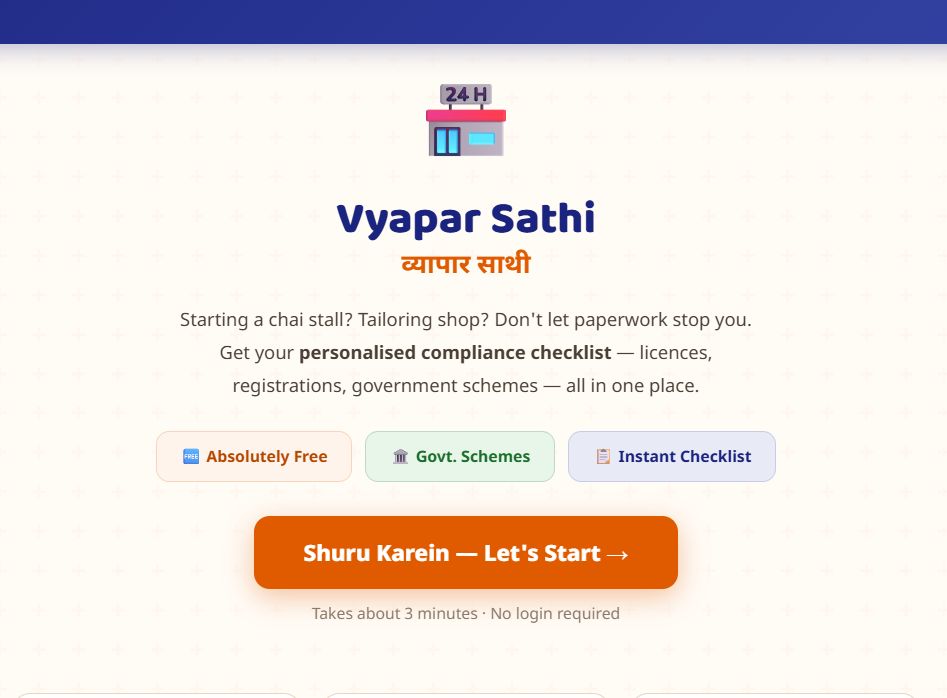
What it does Vyapar Sathi takes three simple inputs from the user: business type, state (currently starting with Uttar Pradesh), and scale of operations. Using Claude's advanced reasoning, it generates a highly personalized, jargon-free compliance checklist. Instead of generic advice, it tells a 10-square-meter medical shop owner that they specifically need a Drug License and a registered pharmacist , or informs a street vendor about municipal vending certificates.
Crucially, it prioritizes ethical alignment and user safety. It provides estimated costs, flags whether a requirement is mandatory or optional, and assigns a "Confidence Level" to each output. Every requirement is linked directly to official government portals, like UP's Nivesh Mitra , putting the user in control of verifying the information. To ensure we don't exclude our target demographic, the app includes a Hindi language toggle.
How we built it We kept the architecture intentionally lean and effective for a 3-hour build: a single-page React frontend that calls the Anthropic API directly. The true technical execution lies in our prompt engineering and the curated knowledge base we built. We fed Claude a highly structured prompt containing the intersecting rules of Central laws (like GST and MSME Udyam ) and UP-specific state laws (like the UP Shops & Commercial Establishment Act ). By structuring the output format, we forced Claude to return clean JSON that our frontend renders into an intuitive, prioritized timeline.
Challenges we ran into Our biggest challenge was navigating the fragmented nature of Indian regulations and translating that into deterministic AI logic. For instance, we had to program the AI to understand exclusionary state principles—such as the fact that while the Labour Welfare Fund is mandatory in many states, it is not currently applicable in Uttar Pradesh.
Our most significant ethical challenge was mitigating the risk of the AI hallucinating and providing dangerous legal advice, which could result in a vulnerable business owner facing crippling fines.
Accomplishments that we're proud of We are incredibly proud of the ethical safeguards we built into the core functionality. We successfully constrained the AI to act as an educational guide rather than a lawyer. By implementing strict non-legal-advice disclaimers, confidence scoring, and zero data retention (to protect users from fears of government surveillance), we built a tool that empowers rather than endangers. We are also proud of successfully mapping hyper-local edge cases, such as exempting purely home-based digital freelancers from certain municipal trade licenses.
What we learned We learned that prompt engineering for legal compliance requires a delicate balance of negative constraints and conditional logic. More importantly, we learned that true technological impact means designing for the user's lived reality. A highly accurate AI model is useless if the output is in dense English legalese that the target user cannot read, which reinforced our decision to enforce simple language and multilingual support.
What's next for Vyapar Sathi Our immediate next step is to scale our regulatory database beyond Uttar Pradesh to include Maharashtra, Delhi, Karnataka, and Tamil Nadu. Technically, we plan to implement a calendar-based "Timeline View" that alerts users to recurring compliance deadlines, like the annual MSME return. Ultimately, we want to deploy Vyapar Sathi as a WhatsApp chatbot, bringing this vital legal guidance directly to the platform where Indian MSMEs already live and conduct their daily business.

Log in or sign up for Devpost to join the conversation.