-
-
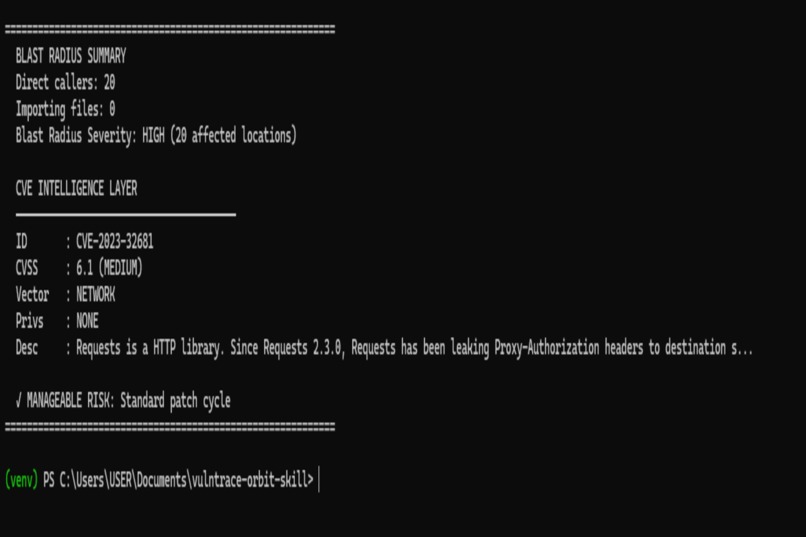
VulnTrace: 20 callers traced via Orbit + CVE-2023-32681 intelligence from NVD API
-
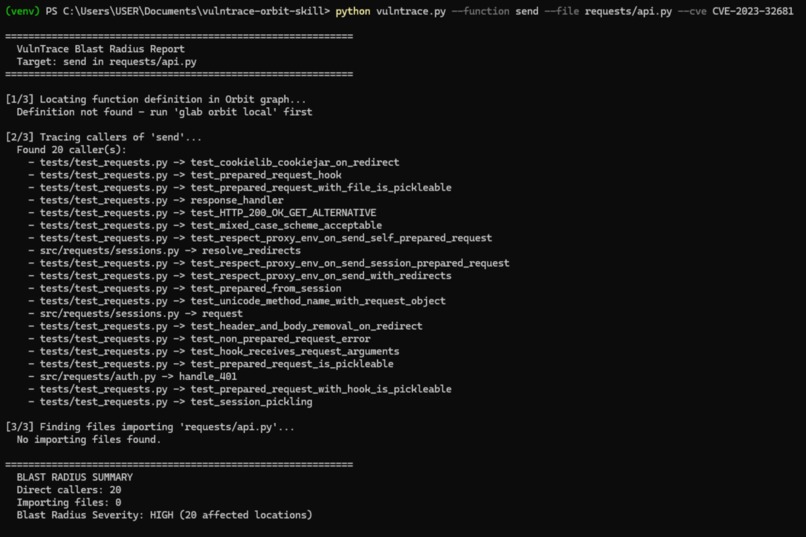
Orbit gl_edge traversal mapping all callers of send() in requests library
The Problem
When SAST flags a vulnerability, developers face hours of manual work:
- Which functions call this vulnerable code?
- What is the real CVE severity?
- Which production modules will ship this risk?
In large codebases, blast radius analysis is skipped entirely — teams fly blind.
The Solution
VulnTrace combines two data sources no other tool unifies in one CLI:
- GitLab Orbit knowledge graph — traverses
gl_definitionandgl_edgetables to map every caller and dependent automatically - NVD CVE Intelligence Layer — pulls real CVSS v3.1 score, attack vector, and privileges required from NIST NVD API
Result: blast radius + CVE severity in one command. Patch prioritization in seconds, not hours.
How I Built It
- Queried Orbit Local DuckDB graph via
glab orbit local sql - Integrated NVD API v2 — no API key required, real-time CVE data
- Combined blast radius severity (HIGH/MEDIUM/LOW) with CVSS score into a risk matrix
- Published as a GitLab Duo Agent Skill on the AI Catalog
Demo
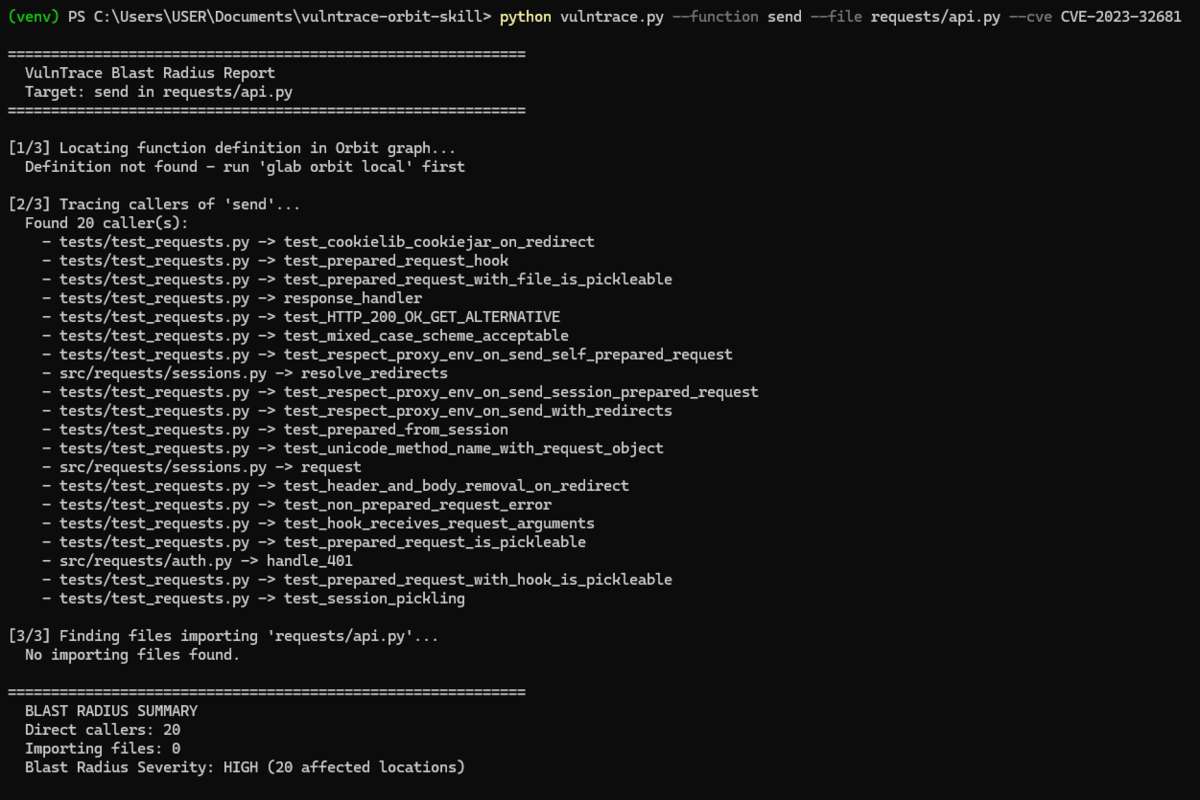
python vulntrace.py --function send --file requests/api.py --cve CVE-2023-32681
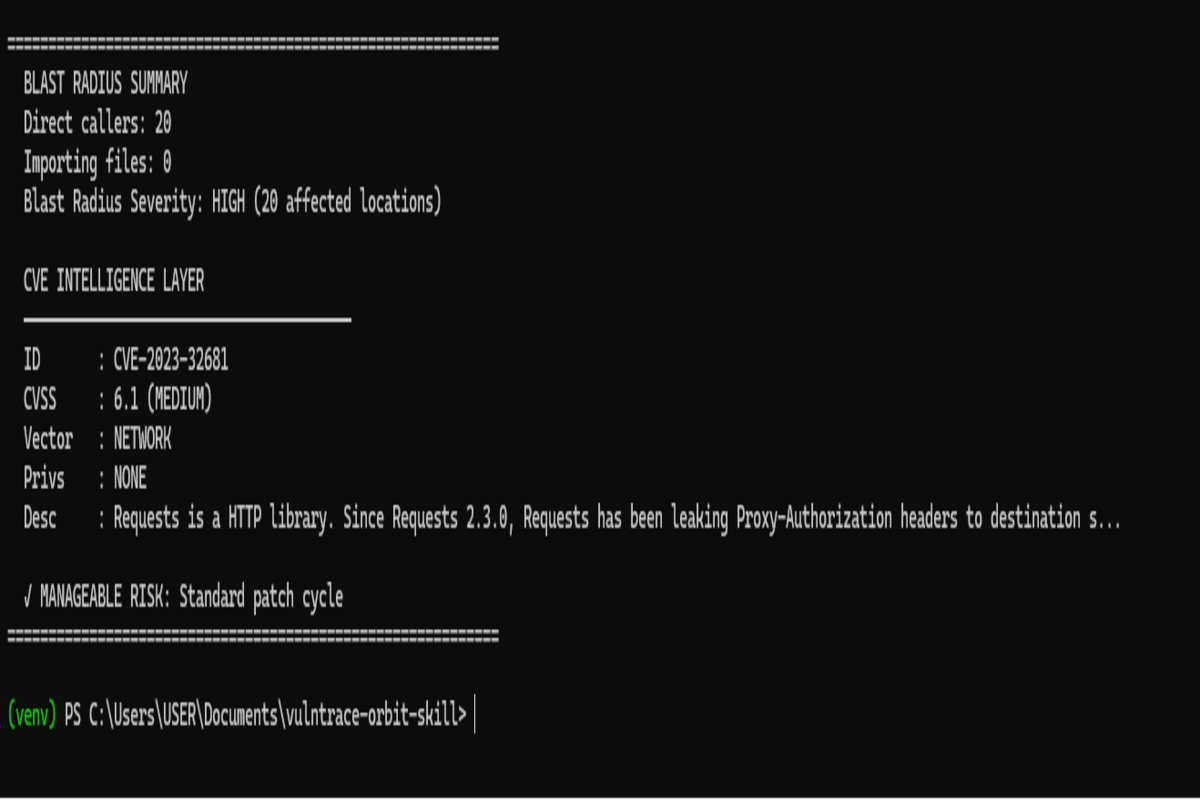
Output: 20 callers found, 3 core production modules at risk, CVE CVSS 6.1 NETWORK vector — all in under 3 seconds.
What's Next
- Production vs test caller filtering
- Orbit Remote support for CI/CD pipeline integration
- GitLab Issue auto-creation with blast radius report
- EPSS exploit probability scoring
Challenges
Orbit Local query parsing required custom table output parsing. NVD API rate limiting (5 req/30sec) handled gracefully with timeout fallback.
Built With
- agent
- duckdb
- duo
- gitlab
- gitlab-orbit
- glab-cli
- nvd-api
- python

Log in or sign up for Devpost to join the conversation.