Inspiration
I'm a second-year student, and almost every student project I've seen, including mine, has the
same bugs: SQL queries built with f-strings, os.system(f"...") on user input, API keys pasted
straight into the code. Linters flag them, but they don't tell a beginner why it's dangerous or
how to fix it. And when you ask an AI to "fix my code", it often returns a patch that doesn't
compile or quietly breaks something else. I wanted an AI tool that doesn't just suggest a fix
but checks its own work, and shows you the attack actually failing.
What it does
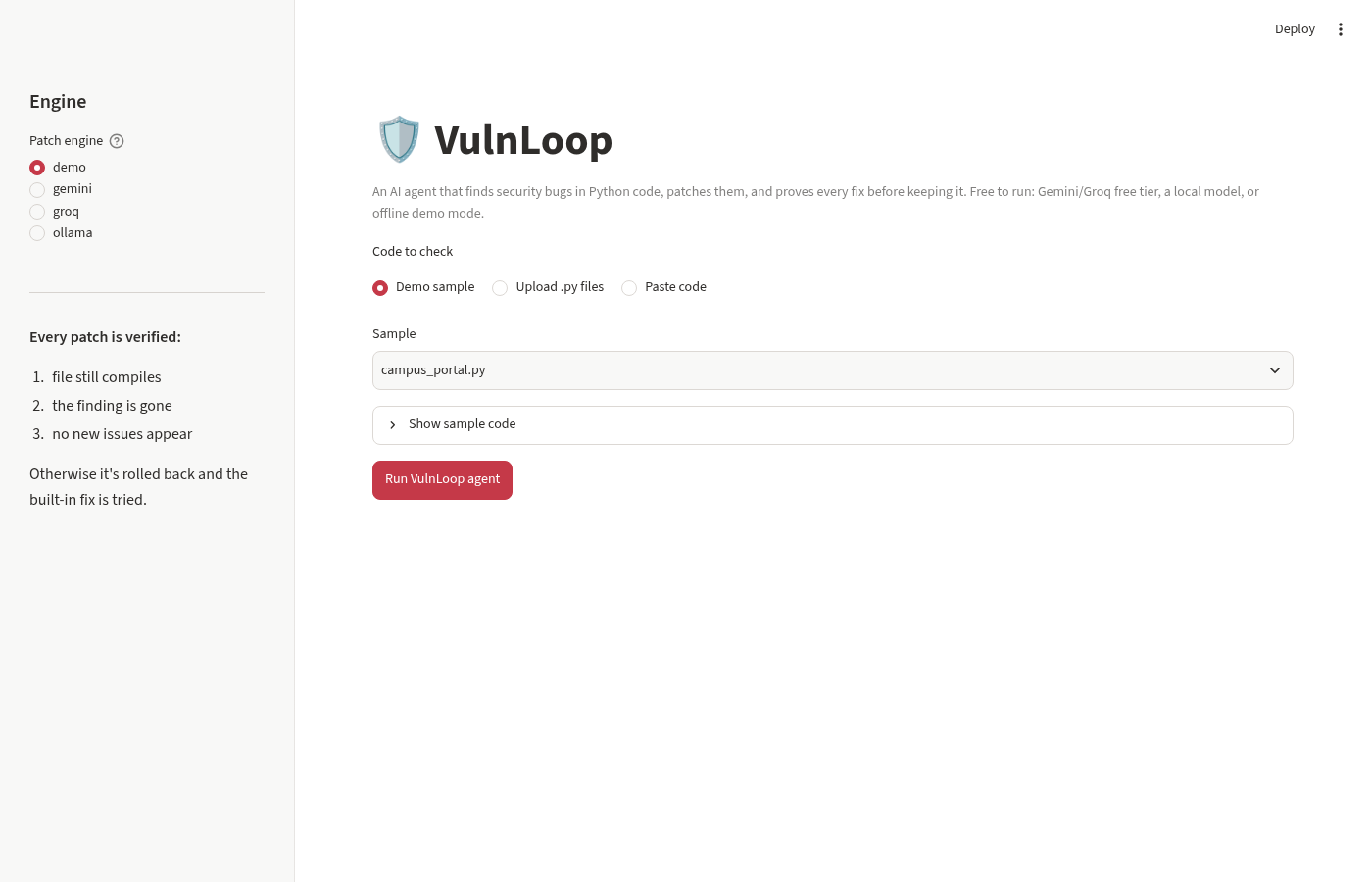
VulnLoop is an agent that runs a full loop on your Python code:
- Scan. Finds 11 classes of vulnerabilities (SQL injection, command injection,
eval, unsafepickle/YAML, hard-coded secrets,verify=False, MD5/SHA-1, debug mode, insecure temp files), each tagged with its CWE id and OWASP Top 10 category. - Plan. Orders the work by severity.
- Patch. For each bug, an LLM writes the smallest safe fix and a concrete attacker story
("the input
' OR '1'='1dumps every user"). - Verify. Every patch must pass three checks: the file still compiles, the bug is gone, and no
new issue appeared. If not, it's rolled back and a deterministic built-in fix is tried.
Bugs it can't fix safely (like
exec()of plugin code) go to a human with guidance instead of a fake fix. - Prove. Exploit replay runs the same harmless attack against the original and the patched
function: SQL injection leaks 3 rows before, 0 after;
; echo PWNEDruns before and is blocked after. - Report. Diff, patched file download, and a Markdown security report.
On the demo app it fixes 10 of 11 issues, all verified, and raises the security score from 0 to 75/100.
It's also a dev tool: python -m vulnloop . --check fails a CI build or pre-commit hook when
issues exist.
How we built it
- Python 3 with the standard-library
astmodule for the scanner. Rules resolve import aliases (from os import system) and track SQL strings assigned to variables beforeexecute(). - Patches as minimal source edits using AST node positions, so comments and formatting outside
the changed expression survive. SQL fixes convert f-strings,
%,+and.format()queries into parameterized queries with the right placeholder (?for sqlite3,%sotherwise). - Agent loop in
agent.py: scan → plan → patch → verify → rollback/fallback → report, with a live trace streamed to the UI. - Free LLM backends only: Google Gemini (free tier), Groq (free tier, Llama 3.3 70B), or a local open-weight model through Ollama. With no key, an offline demo mode uses the built-in fixes, so anyone can try it.
- Streamlit web UI, pytest suite (29 tests including a Streamlit AppTest that clicks through the whole demo), GitHub Actions CI, Dockerfile for free Hugging Face Spaces hosting.
- AI coding assistants helped during development; all libraries and APIs are listed here per the rules.
Challenges we ran into
- Trusting LLM patches. Models sometimes return code that doesn't compile or fixes one bug by adding another. The verify-then-rollback step was the answer: nothing is kept unless it passes.
- Editing code without destroying it. Re-printing the whole file from the AST loses comments, so patches are applied as byte-accurate edits at AST node positions (UTF-8 columns included).
- SQL injection has many shapes: f-strings,
%, concatenation,.format(), and queries built on one line and executed on another. Each needed its own rewrite into a parameterized query, with quote stripping around the placeholders. - Proving fixes safely. Exploit replay runs only on the bundled sample, with fixed harmless payloads, in a separate process inside a temp folder, never on uploaded code.
Accomplishments that we're proud of
- Every fix shown to the user is verified, and the demo shows the actual attack failing after the patch.
- It runs completely free, even with no internet and no API key.
- Honest about limits: it hands
exec()to a human instead of pretending.
What we learned
How real injection attacks work end to end, how to map bugs to CWE/OWASP, how much an agent
improves when it can check its own output, and how to make Python's ast do precise source edits.
What's next for VulnLoop
- A GitHub App that comments verified fix suggestions on pull requests.
- Cross-file taint tracking (user input from a Flask route reaching
execute()in another module). - More languages (JavaScript first) and auto-generated exploit tests for any function, not just the demo.
