Inspiration
9 in the evening in Patna. The school shut hours ago, but one light is still on. A girl is stuck on a sum and there is nobody left to ask. Tomorrow, in a class of 60, she will be too shy to raise her hand. I am 15, from India — I see this around me every day: coaching classes that cost more than families earn, classrooms too crowded for one question, and exam papers that leak for money. UNESCO counts 250 million children out of school; the World Bank says 70% of 10-year-olds in low and middle-income countries are in learning poverty. Different countries, different classrooms, one shape: the help a student needs is not there at the moment they need it. That is the problem I was born inside of — and the one Vroqn Nexus answers.
What it does
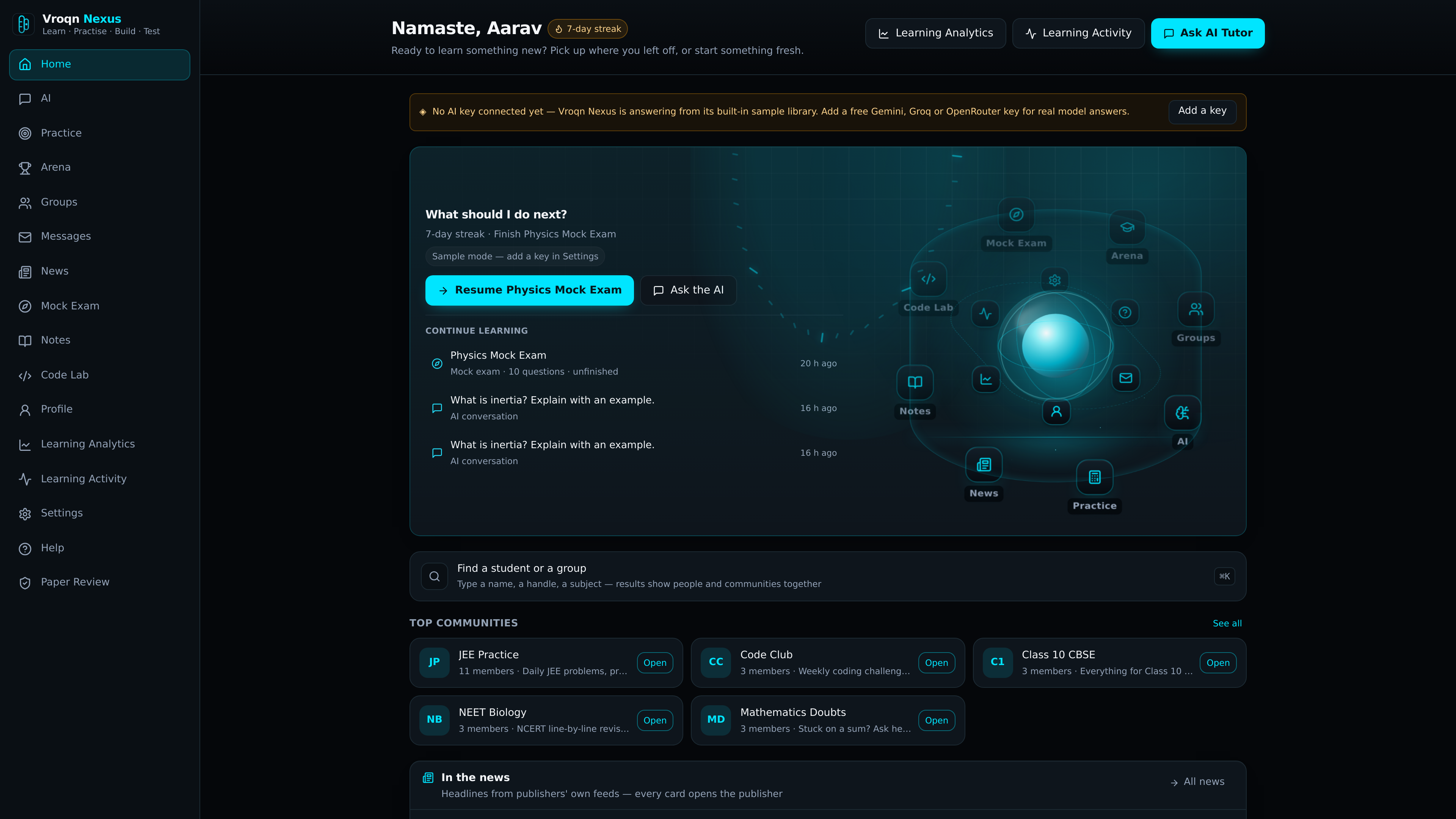
Vroqn Nexus is an AI learning workspace that runs in any browser, on the phone a family already owns:
- AI tutor with mentor mode — explains step-by-step in the student's own language, never just the final answer
- Practice sets generated from the student's own mistakes, with an explanation after every attempt
- Secure mock exams that live on the server — answer keys never reach a student's browser, so there is nothing to leak
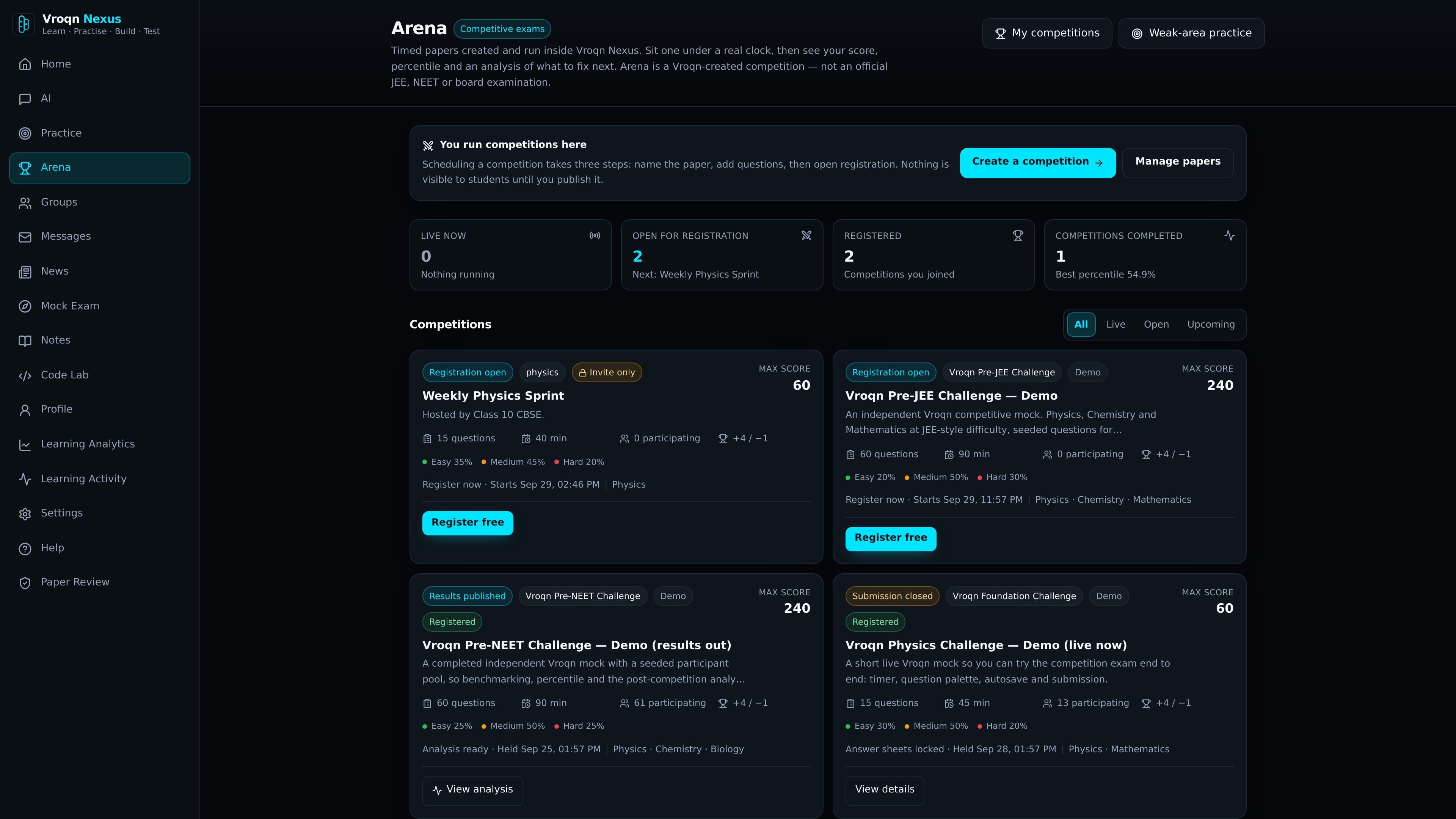
- Arena — timed, server-graded competitive papers with percentile benchmarks and a full analysis of what to fix next
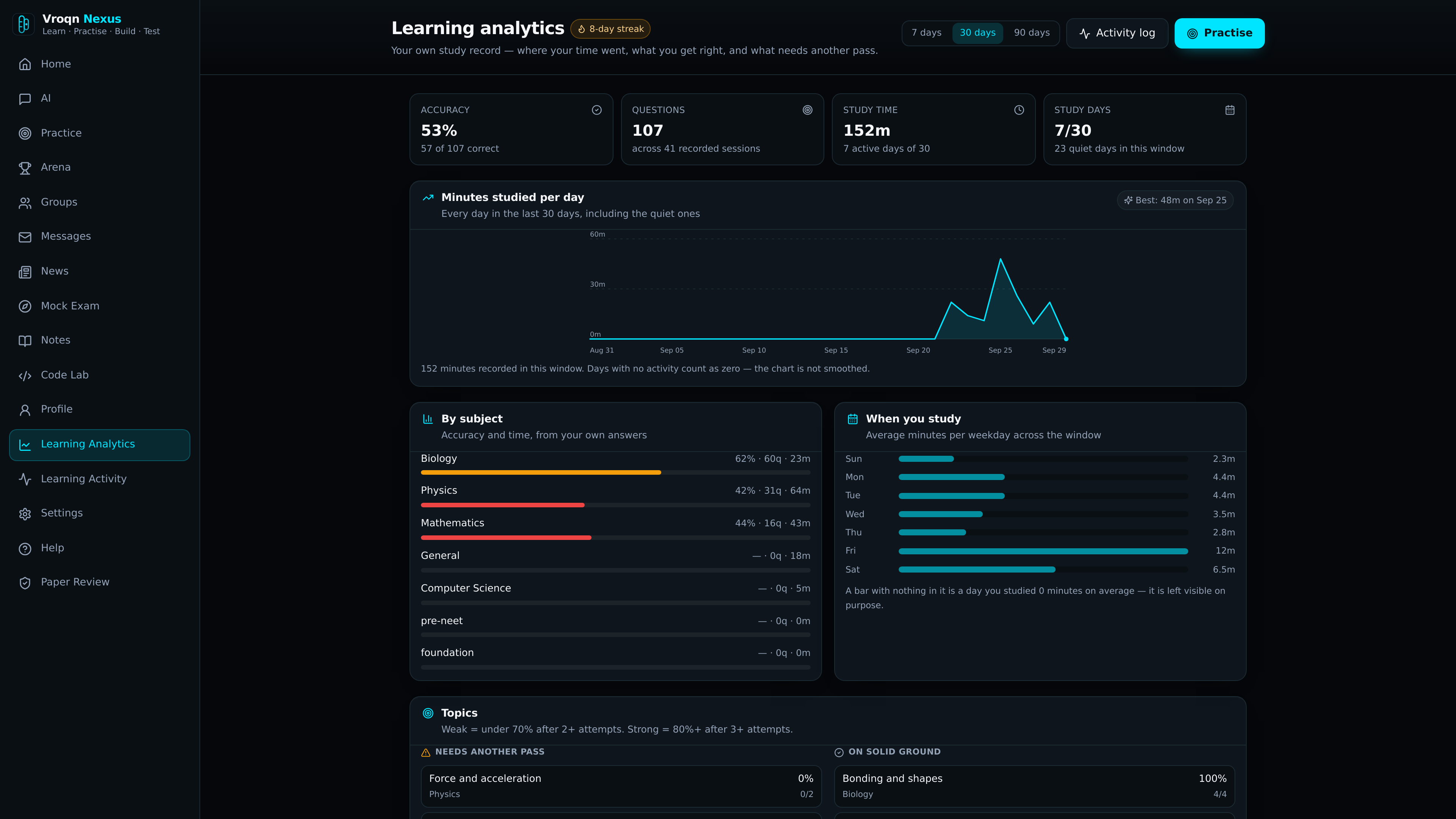
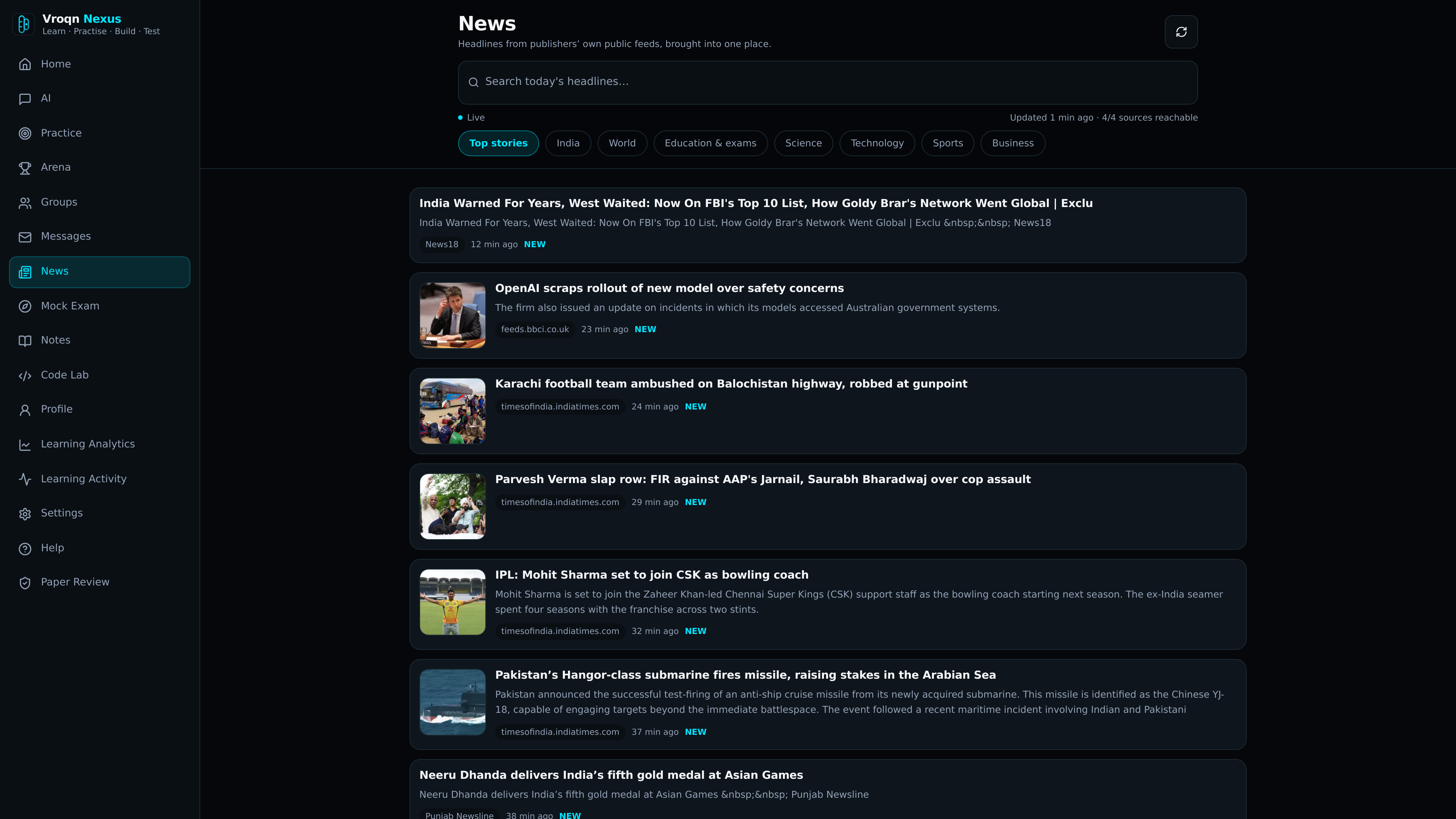
- Communities, notes, code lab, news, messages and learning analytics — the rest of the school day in the same app
One login. Nothing to install. No license fee.
How we built it
I am an AI-native builder: I don't hand-write code — I direct AI tools, and I verify everything with checks the server enforces. The product's rules are engineering facts, not promises: answer keys are joined to a question only after submission; an uploaded paper is rewritten (new numbers, wording, option order) before it runs; every AI question is validated against structure and consistency checks; AI keys are encrypted per user; three AI providers run with failover so one outage never stops a lesson. The build is covered by 182 passing server tests, 339 product checks and 21 live competition checks, all rerunnable.
Challenges we ran into
- Making AI teach instead of answer — mentor mode had to explain step-by-step, not dump a solution
- Keeping exams leak-proof — moving papers and keys fully server-side without breaking the exam experience
- Making it work on low-end phones — so everything runs in the browser, nothing to install
- The temptation to dress up numbers — I chose honesty: no adoption figures are claimed because the platform is young
- Building without traditional coding skills — I learned to verify AI output with automated tests instead of trusting it blindly
Accomplishments that we're proud of
- A working product, not a slide — every screenshot in the deck is captured from the running site
- Server-enforced honesty: 182 server tests, 339 product checks, 21 live competition checks, all green
- A 2:24 pitch that tells the problem in the world's own numbers (UNESCO, World Bank, ASER)
- Learning to separate "I'm still learning" from "I'm not professional yet"
What we learned
- AI-native building is not prompting — it is judgment: directing, verifying, and testing what AI produces
- Real problems deserve real evidence: the world's reports measure the problem, our own checks measure the fix
- "A tutor for every student who can't afford one" is not a slogan, it is a design constraint: free, browser-based, low-data
- Talking to other builders (like this community) sharpens the product faster than building alone
What's next for Vroqn Nexus
- Hindi and regional language support
- More subjects and chapters
- A real pilot with students in my own school
- Free AI key onboarding (Gemini, Groq, OpenRouter) so every student gets real model answers
- And staying connected with the builders I meet here — this community is part of the roadmap now
Built With
- ai
- edtech
- education
- llm
- machine-learning
- node.js
- pwa
- testing
- typescript
- web

Log in or sign up for Devpost to join the conversation.