Inspiration
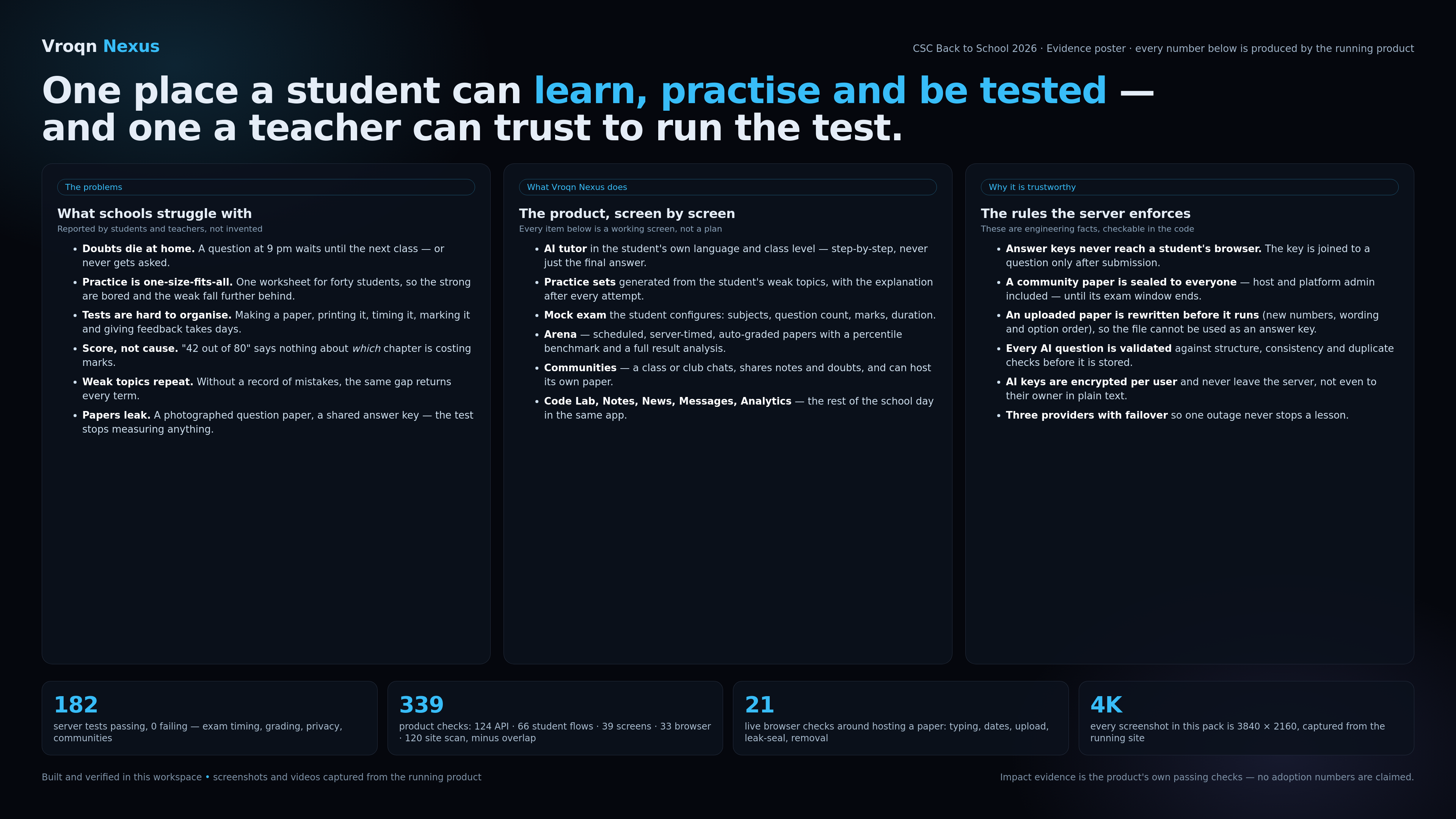
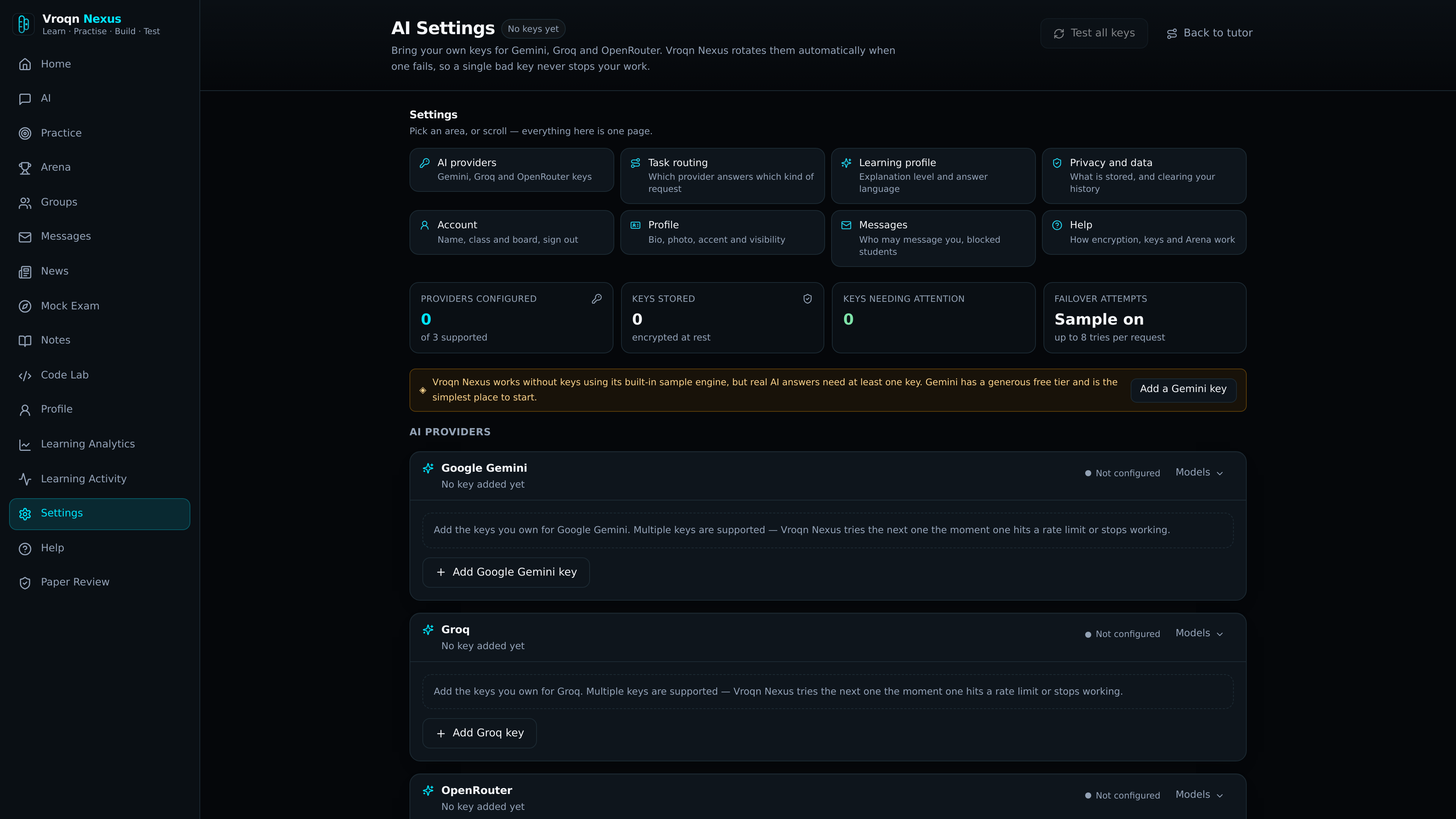
Vroqn Nexus was inspired by a simple problem: students often have to use many different tools to manage different parts of their learning. One platform may be used for asking questions, another for practice, another for notes, another for coding, and separate platforms for communities and competitions.
I wanted to explore whether these different parts of student life could be brought together into one focused learning workspace.
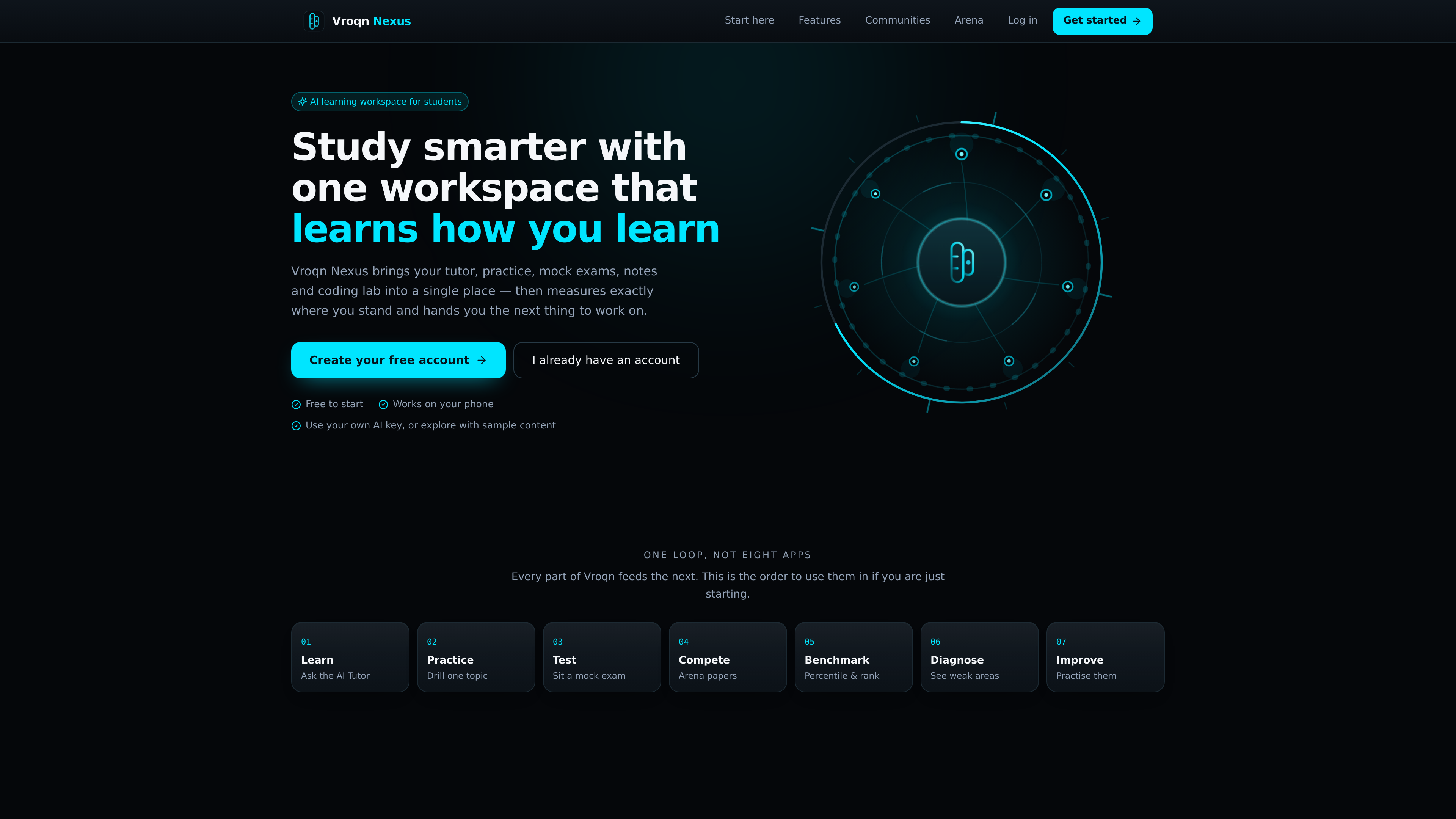
The goal was not to build just another AI chatbot. The idea behind Vroqn Nexus was to create a student-focused learning ecosystem where AI assistance, practice, notes, coding, collaboration, and competitive learning could work together in one place.
What it does
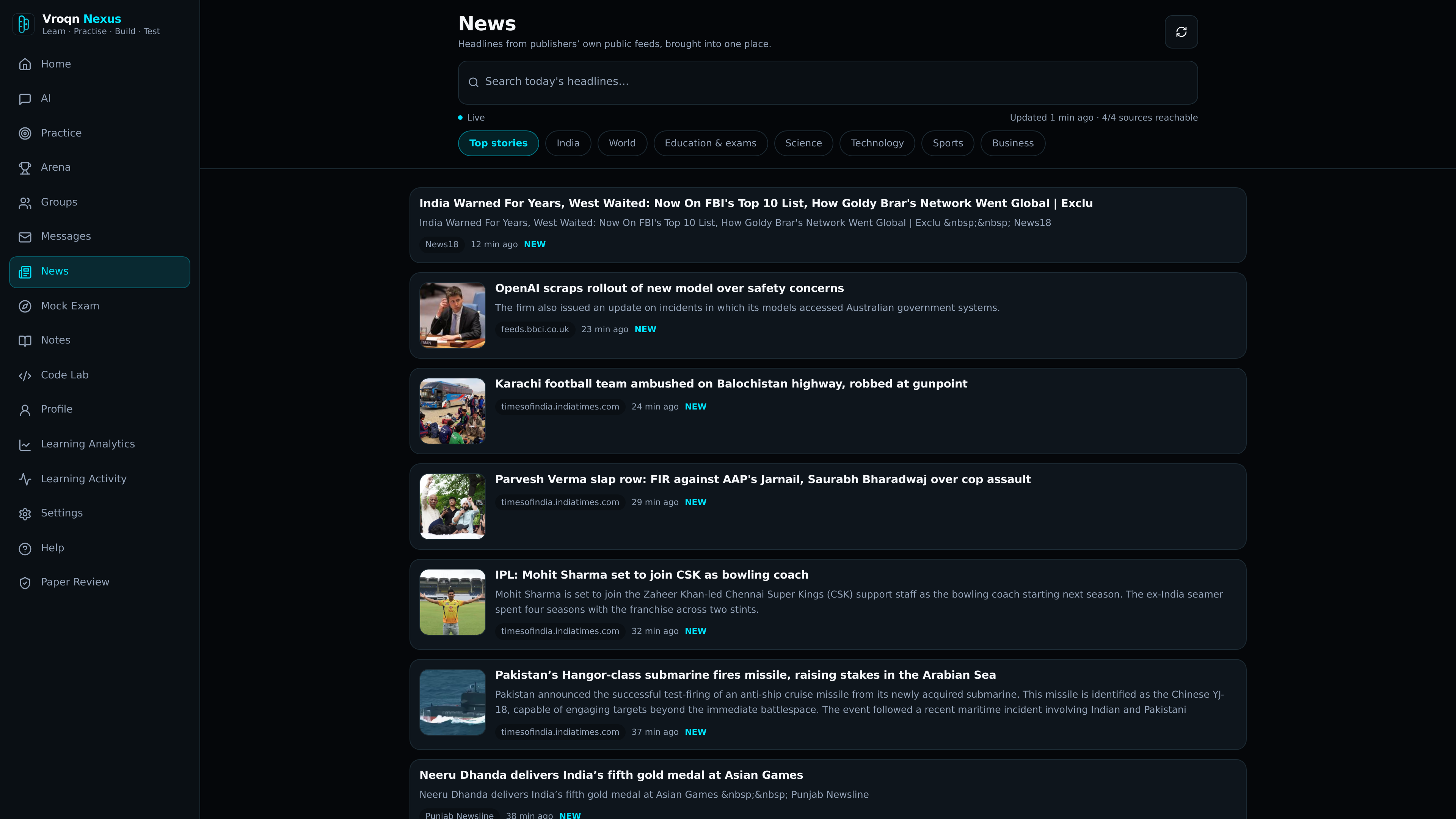
Vroqn Nexus is an AI-powered learning workspace designed to bring multiple student learning workflows together.
It includes:
- AI Tutor for asking questions, understanding concepts, and getting learning assistance
- Practice for generating questions based on subject, chapter, difficulty, question type, and question count
- Mock Exams for structured self-assessment
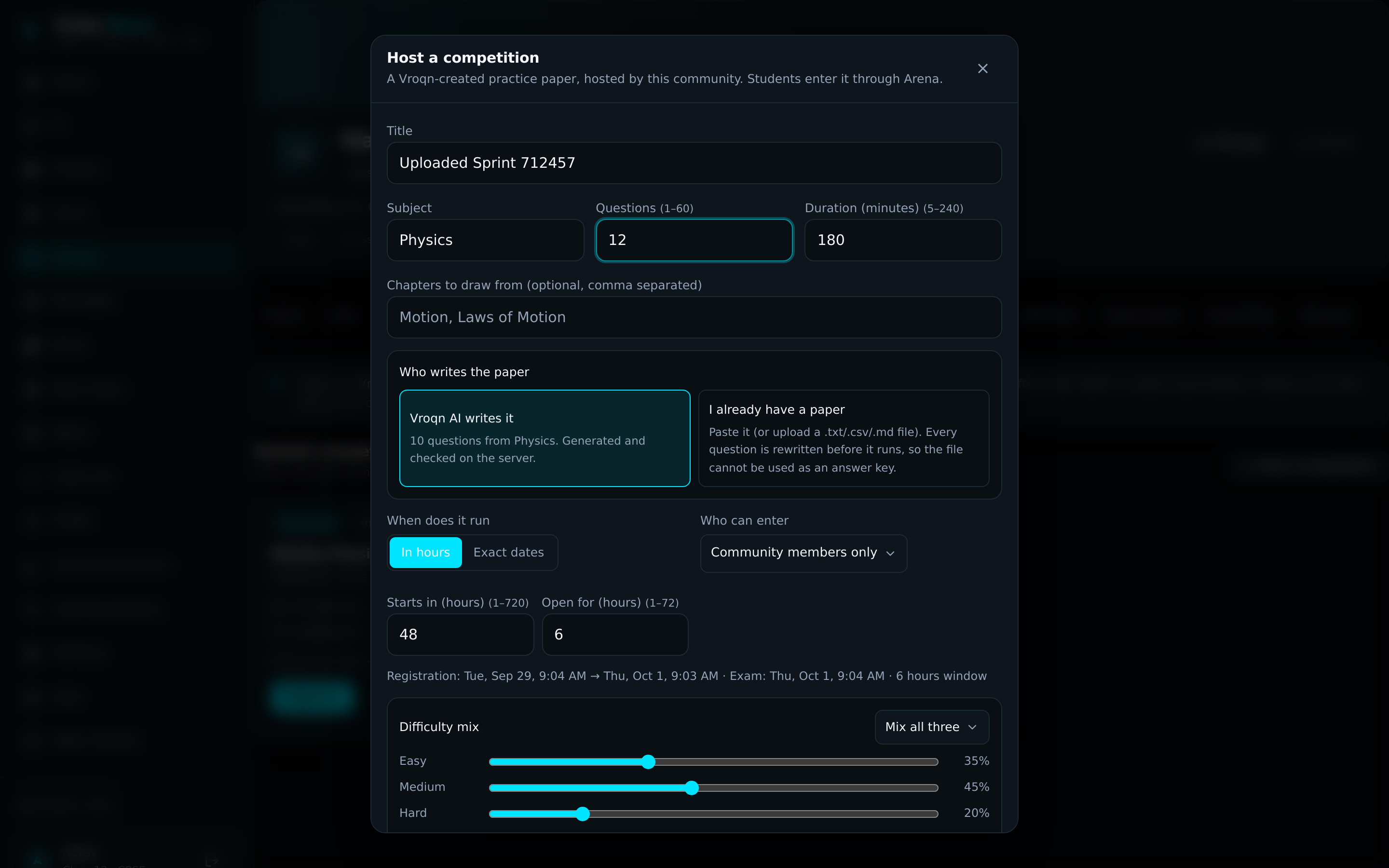
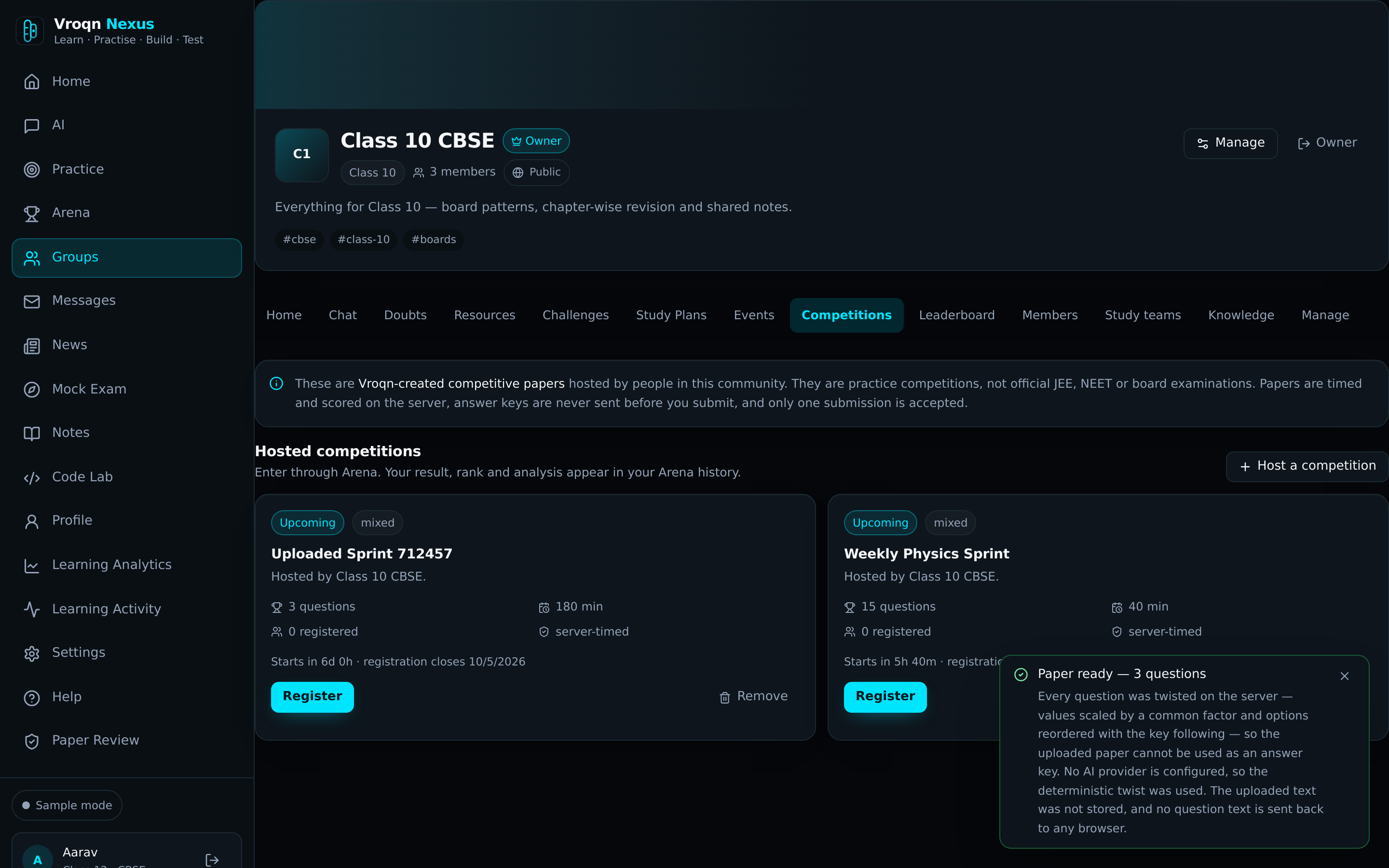
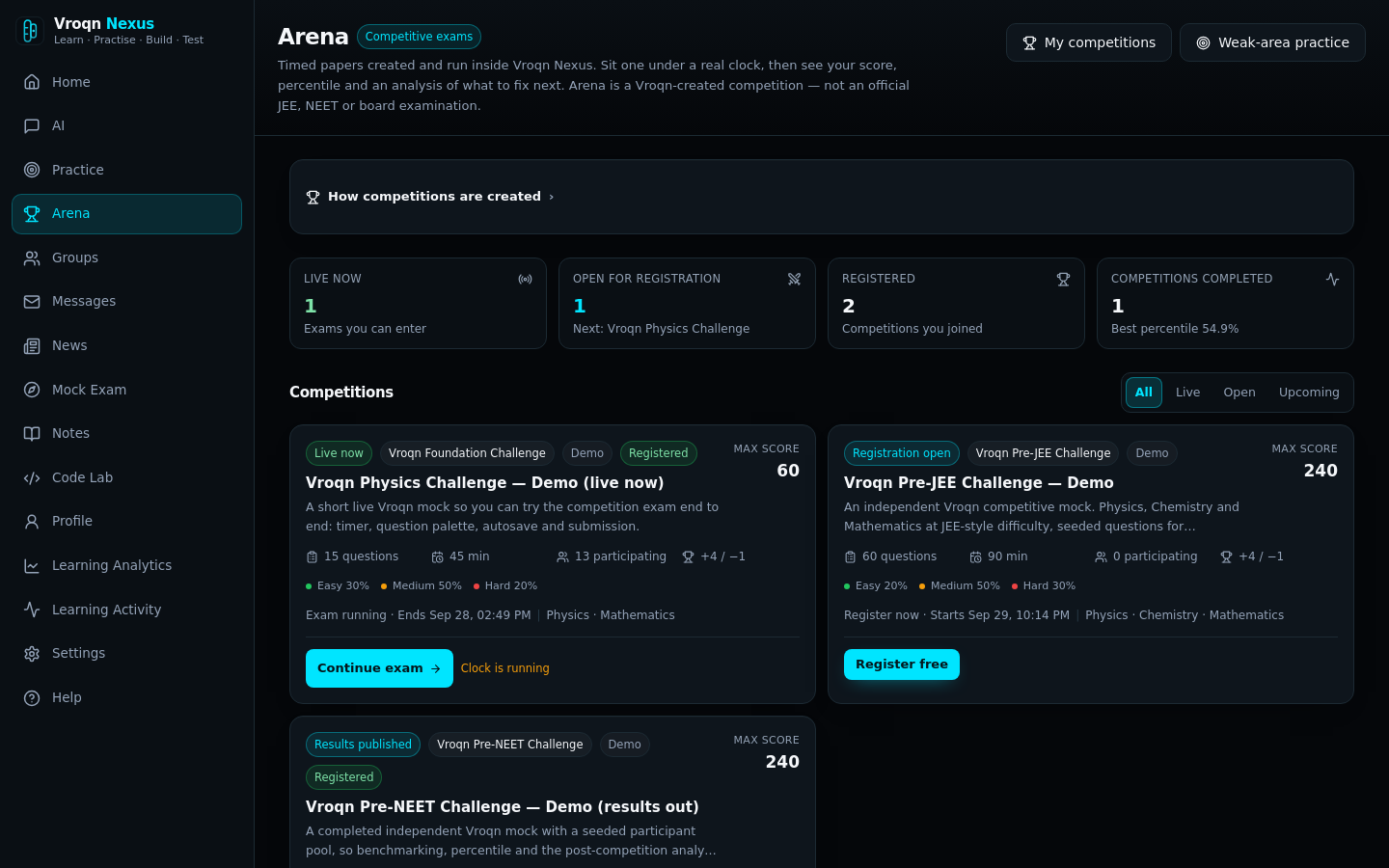
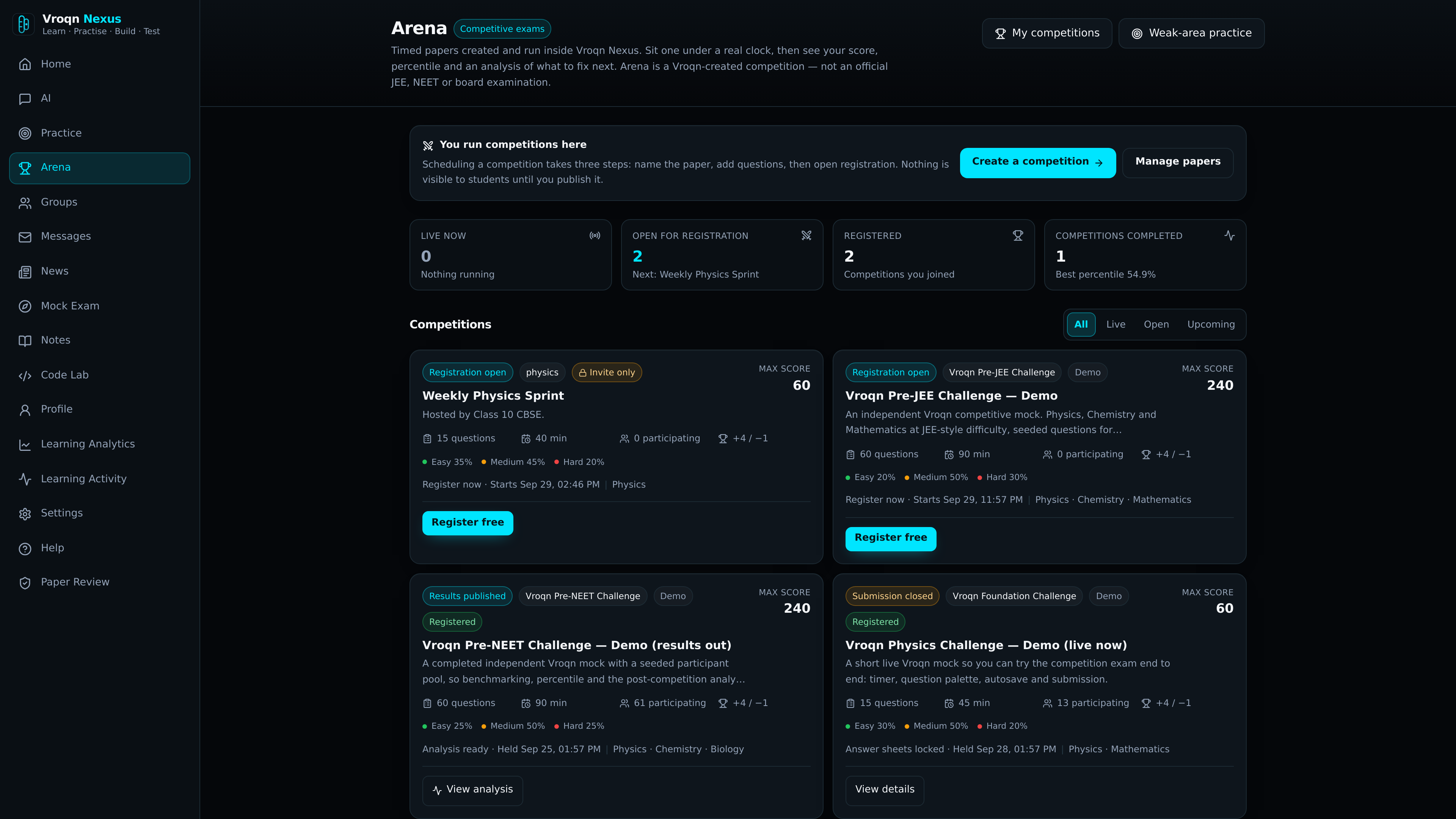
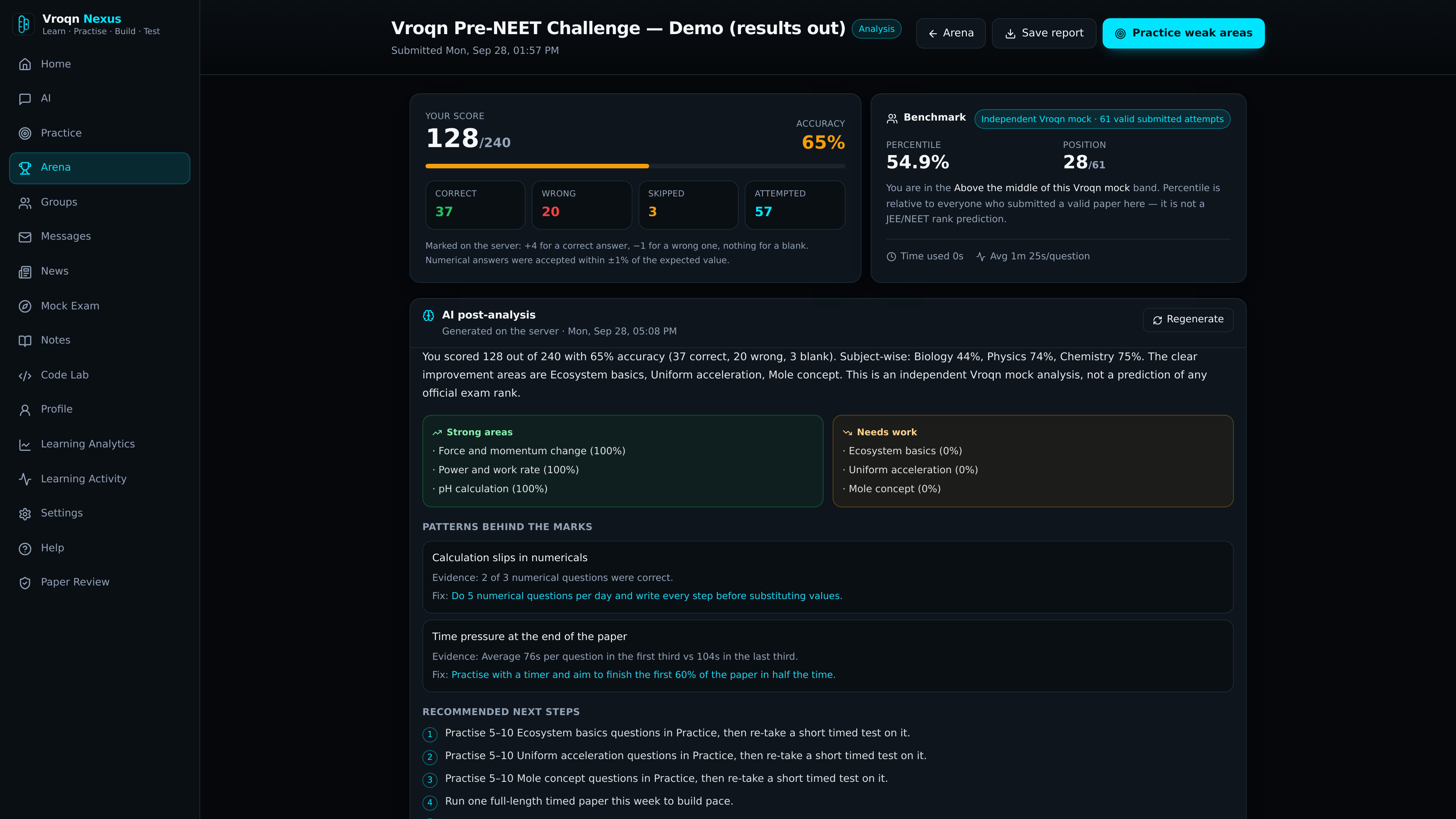
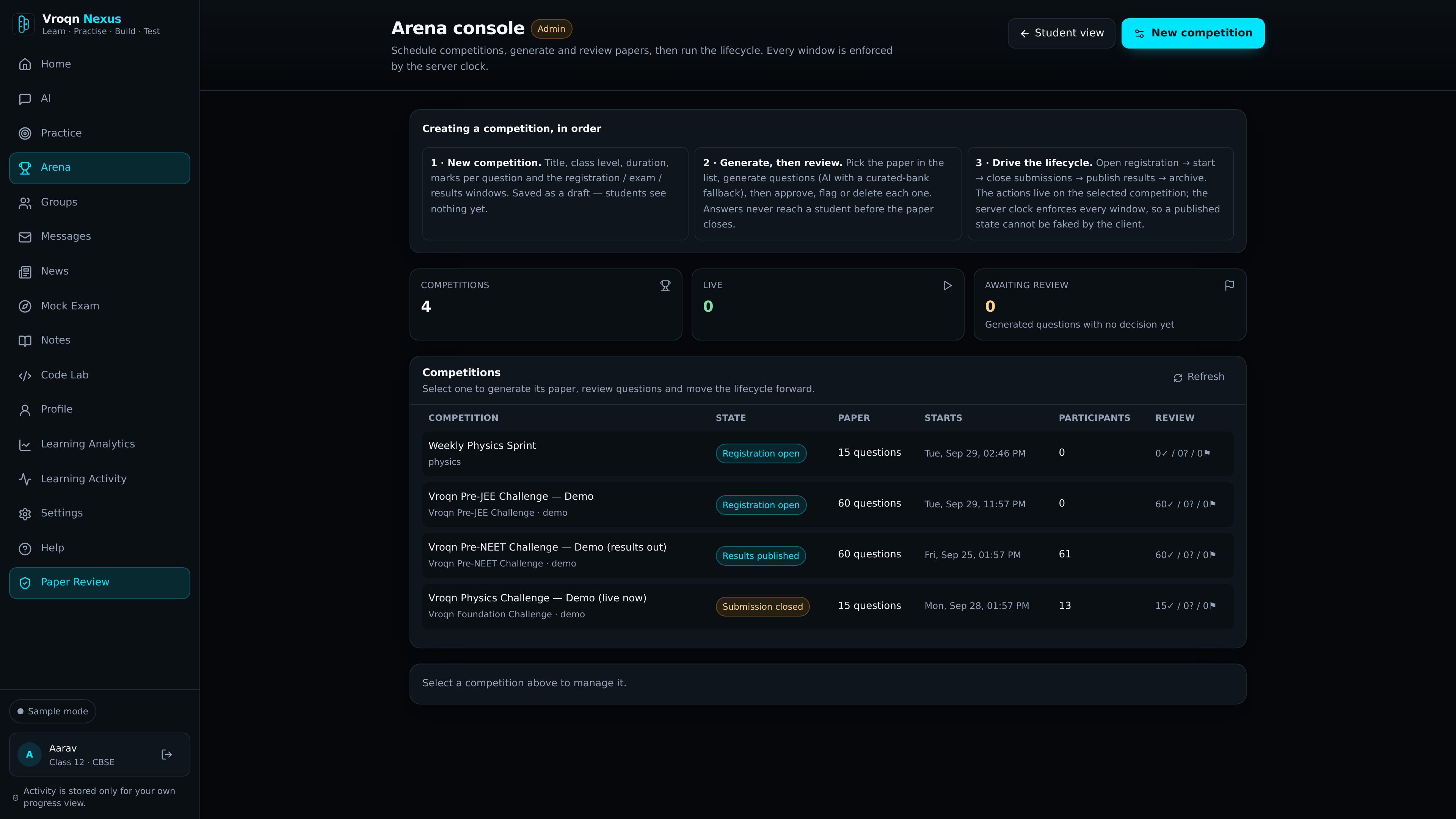
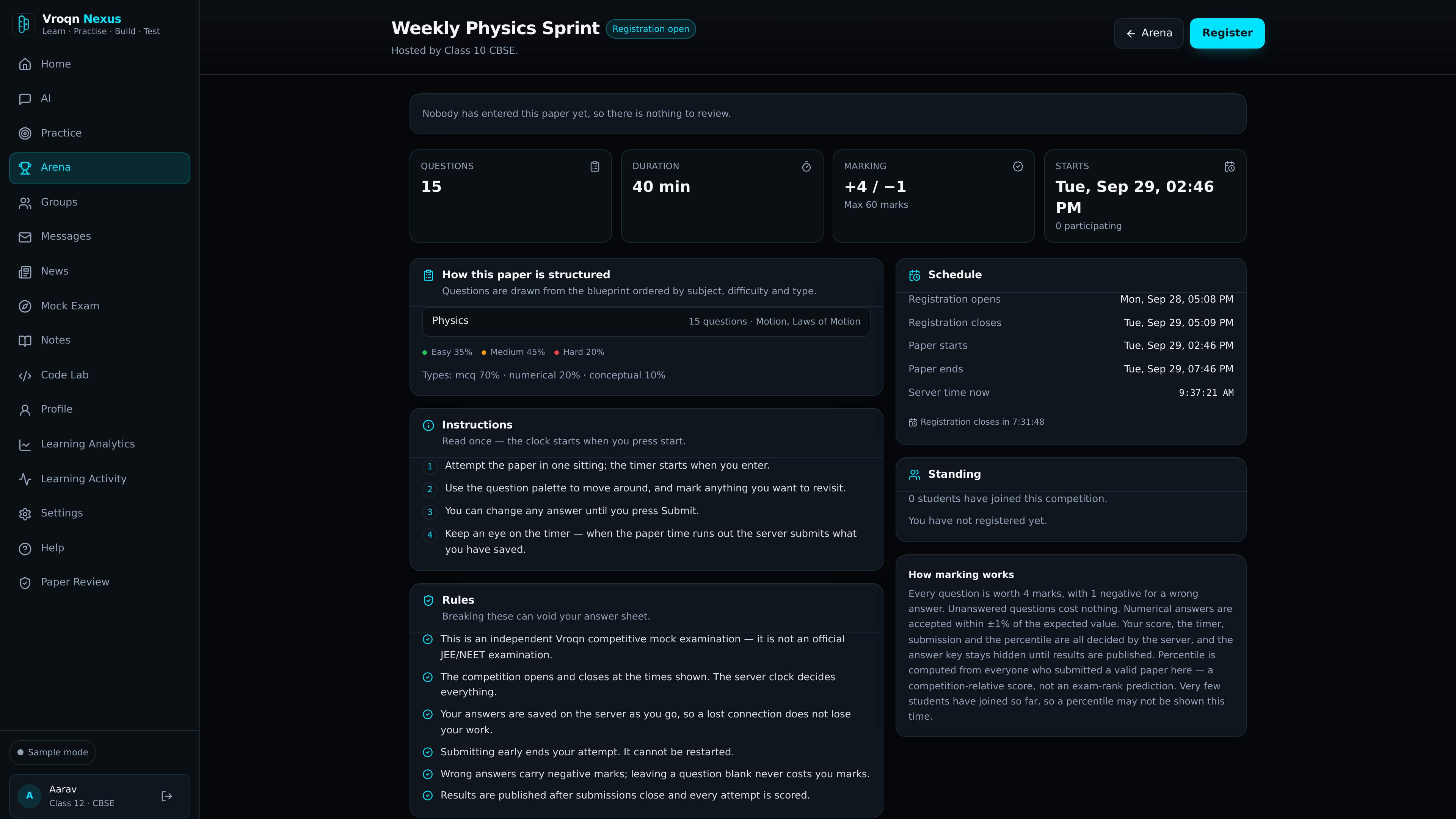
- Vroqn Arena for independent competitive mock exams with timing, scoring, accuracy, and rankings
- Notes and note-cleanup workflows for organizing learning material
- Code Lab for writing, running, and reviewing code with AI assistance
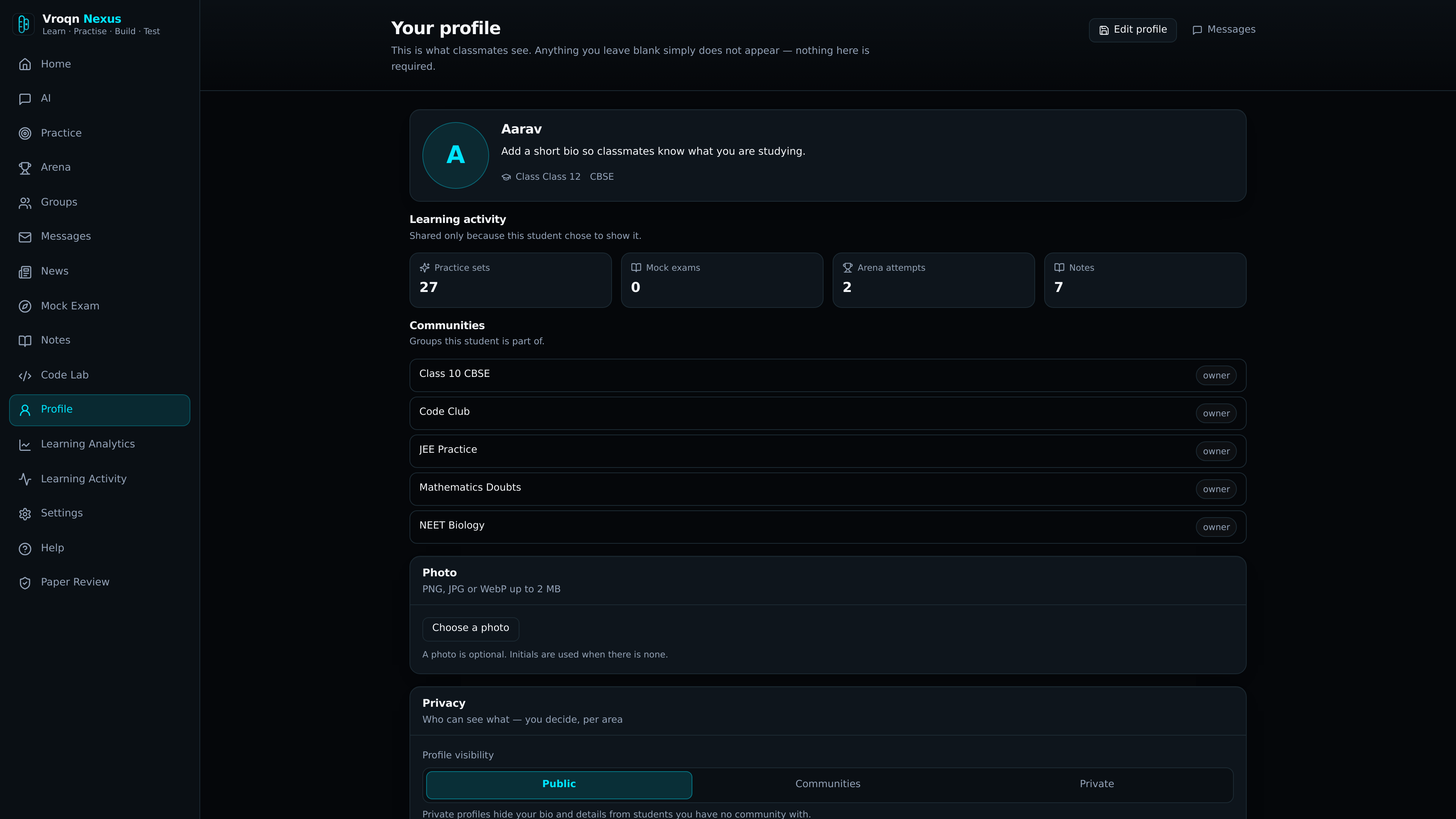
- Vroqn Communities for students to learn and collaborate around subjects and exams
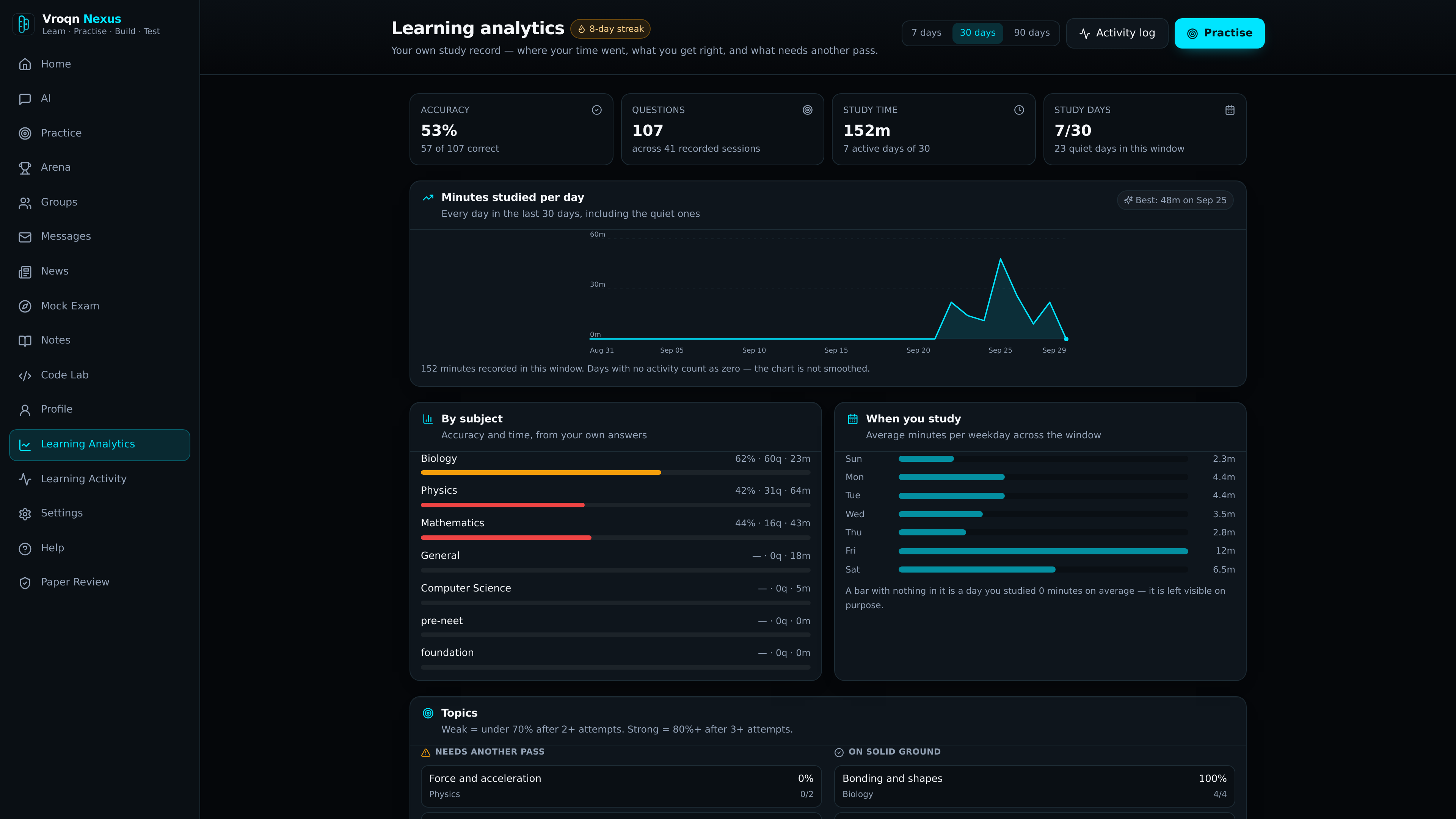
- Learning activity and progress features to help students track their learning
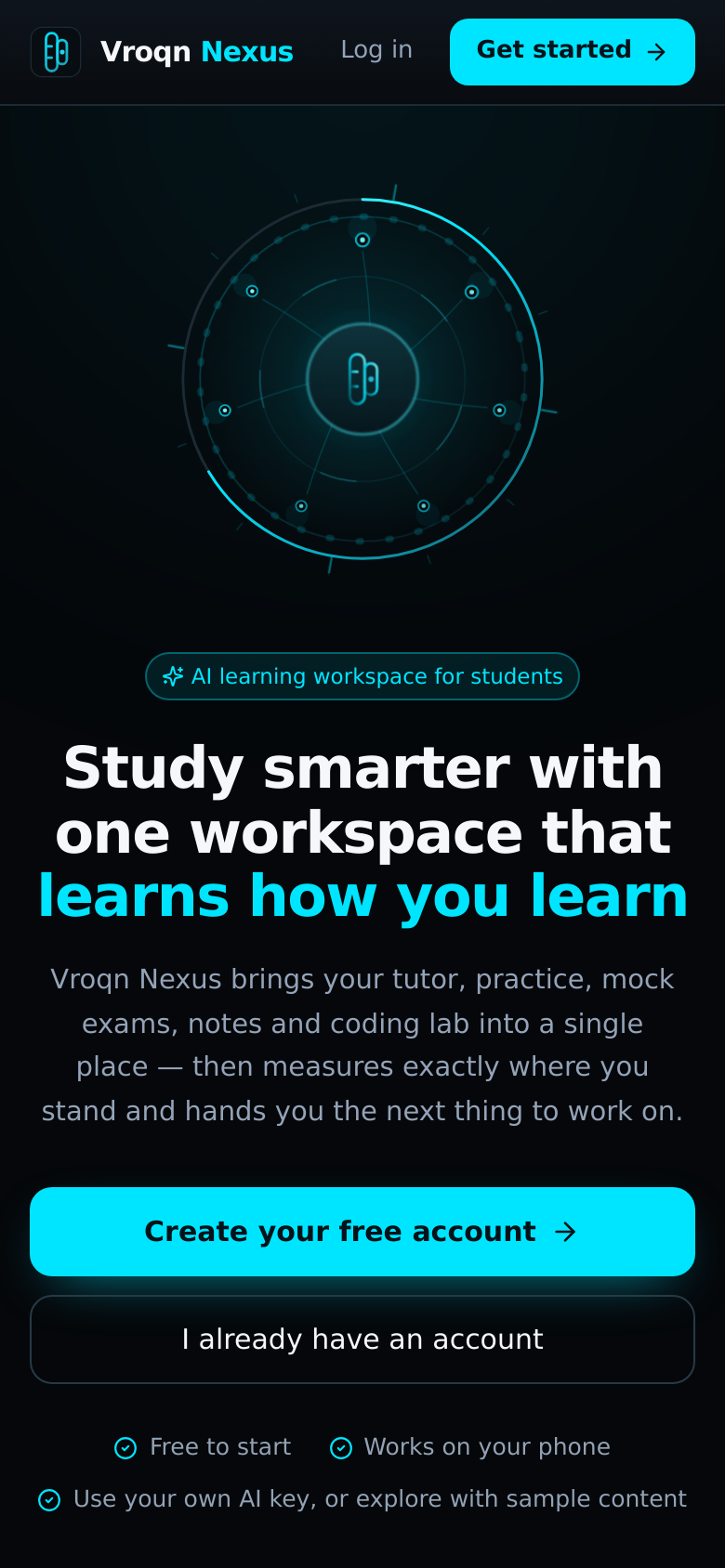
- Responsive student-focused design that works across mobile and desktop layouts
Vroqn Arena is an independent Vroqn competitive mock-exam system. It is not an official JEE, NEET, or government examination.
How we built it
Vroqn Nexus was built as a full-stack web application with separate frontend and backend architecture.
The platform uses a modern web frontend, a Node.js backend, PostgreSQL for persistent data, REST-based application communication, and AI services for educational assistance.
A major focus during development was making important operations reliable and server-controlled. Authentication, competition timing, scoring, answer validation, and rankings are handled with server-side logic rather than relying only on the browser.
The interface was designed with a student-first approach and tested across mobile and desktop layouts. We also focused on responsive design, error handling, security considerations, database structure, and reliable interaction between the different parts of the platform.
AI tools were also used during the development process. ChatGPT, Claude, and Gemini were used as development and problem-solving assistants for brainstorming, architecture discussions, coding assistance, debugging, technical explanations, reviewing approaches, implementation support, and iteration.
These AI tools supported the development process, but the final product decisions, implementation, integration, testing, debugging, and deployment were carried out by the project creator.
Challenges we ran into
One of the biggest challenges was connecting many different learning features while keeping the overall experience simple for students.
Vroqn Nexus combines AI interactions, practice generation, exams, competitions, communities, notes, coding, authentication, databases, and deployment. Making these systems work together reliably required continuous debugging, testing, and iteration.
Competition functionality created another significant technical challenge. Timing, scoring, answer validation, and rankings need to remain consistent and trustworthy, so important competition logic had to be handled on the server.
We also had to deal with mobile responsiveness, database design, authentication, security considerations, error handling, deployment issues, and unexpected edge cases.
Balancing a growing number of features with a clear and usable student experience was an ongoing part of the development process.
Accomplishments that we're proud of
We are proud that Vroqn Nexus evolved from an initial AI learning idea into a working student-focused platform with multiple connected learning workflows.
We built and connected AI learning assistance, practice generation, mock exams, competitive learning, coding, notes, and communities within one platform.
We are especially proud of Vroqn Arena because it adds a competitive learning layer where students can test their knowledge through independent mock competitions with structured timing, scoring, accuracy, and rankings.
We are also proud of turning the idea into a usable full-stack product rather than stopping at a prototype or presentation concept.
Another important accomplishment was learning how to connect different technical systems—frontend, backend, database, authentication, AI services, and deployment—into one working application.
What we learned
Building Vroqn Nexus taught us that creating a useful product is not simply about adding more features.
We learned about full-stack development, APIs, databases, authentication, AI integration, deployment, responsive design, security, server-side logic, and product architecture.
We also learned that every feature needs to be considered from the student's perspective. A technically impressive feature is only valuable when it makes the learning experience clearer, easier, or more useful.
Most importantly, we learned the importance of iteration. Building, testing, finding problems, fixing them, and repeating the process became a major part of developing Vroqn Nexus.
The project also taught us how important it is to think about reliability and edge cases early, especially when building systems involving authentication, competitions, databases, and user-generated content.
What's next for Vroqn Nexus
Vroqn Nexus is intended to continue growing beyond this hackathon.
Our next areas of focus include better personalization, deeper learning analytics, stronger communities, improved competitive learning, accessibility, reliability, and student safety.
We also want to improve how the different parts of Vroqn work together so that the platform can better understand a student's learning journey and provide more useful support over time.
Future development may also explore improved collaboration, richer learning resources, better progress insights, and more personalized study experiences.
The long-term vision is to build Vroqn Nexus into a student learning ecosystem where AI assistance, practice, collaboration, notes, coding, and competition can come together in one focused platform.
Built With
- ai
- api
- css
- design
- express.js
- full
- generative
- github
- html
- javascript
- node.js
- postgresql
- react
- render
- responsive
- rest
- vite
- web


Log in or sign up for Devpost to join the conversation.