-
-
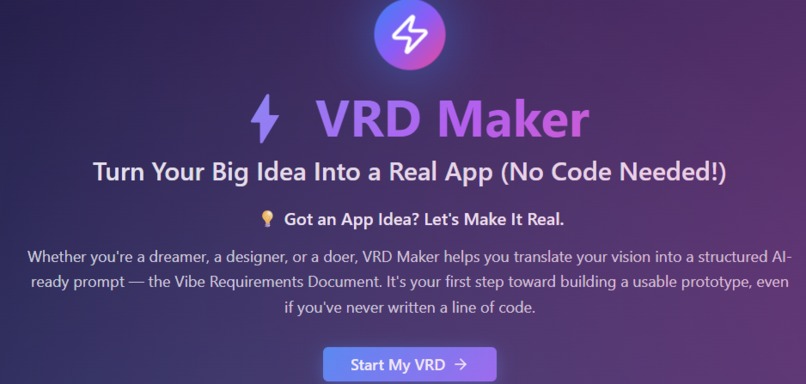
VRD Maker helps you generate Vibe Requirements Documents
Inspiration
In my senior year of high school, way back in the mid-80s, I took a programming class. We learned BASIC, a bit of Pascal, and even some COBOL. It was a blast. The course was brand new, and our teacher had no prior experience with programming. But he did an amazing job. He supported us, gave us freedom, and encouraged exploration.
My friend and I created a game I still remember fondly: Top of the 7th. It was a baseball simulation that began, yes, you guessed it, in the top of the seventh inning, where much of baseball’s real strategy begins. It took us most of the school year to build, and I was proud of it then and still am today.
That experience stuck with me. Over the years, I often wondered why I never kept up with coding. But life, as it often does, pulled me in other directions. Then came AI and low/no-code platforms.
When I saw the announcement for the Bolt.new Hackathon, I thought: Why not? True to form, I dove in, learning everything I could about Vibe Coding and the Bolt platform. I discovered that building something was surprisingly easy. Building something meaningful, though, that was a different story. It wasn’t discouraging, but it made me realize I needed a better plan.
While exploring Vibe Coding, I kept running into the idea of a Product Requirements Document (PRD). Having spent a career in sales and marketing, PRDs were familiar to me, they’re essentially blueprints for products. But something felt off.
See, I’m one of those annoying people with a million "million-dollar ideas." (To anyone I’ve shared one with: my sincerest apologies.) Most of those ideas were bad. Some were incredibly bad. But platforms like Bolt give you a space to test those ideas. And sometimes? They turn out not so stupid after all.
That led me to one idea that might not be stupid: the VRD: Vibe Requirements Document.
A VRD isn’t about technical specs or stakeholder approval. It’s about the feel, the tone, and the look of an idea. That’s it. But in practice? It changes everything.
Bolt has done two remarkable things for me:
It made my ideas visible. As a visual learner, seeing and using a working prototype without knowing how to code is nothing short of magic.
It let me build tools for building bigger things. One of those tools is VRD Maker.
What it does
VRD Maker helps users quickly plan, organize and build digital apps and prototypes by guiding them through a simple series of questions and choices. It produces a Vibe Requirements Document (VRD) that can be used as a starter prompt in platforms like Bolt.new.
How we built it
Slow and steady through countless prompts and iterations.
Challenges we ran into
As a non-coders there were many! Every bug and fix needed was a learning experience. Staying away from feature creep wasn't easy either.
Accomplishments that we're proud of
It's usable and helpful. I've used it dozens of times now. It's fun and I think others will find it useful too.
What we learned
Oh so much! Mostly that it takes careful planning and patience to work my way through my developed app.
What's next for VRD Maker
Saving and re-using VRDs. The ability to share as well. AI assisted help in making VRDs. AI assisted evaluations of VRDs.

Log in or sign up for Devpost to join the conversation.