-
-
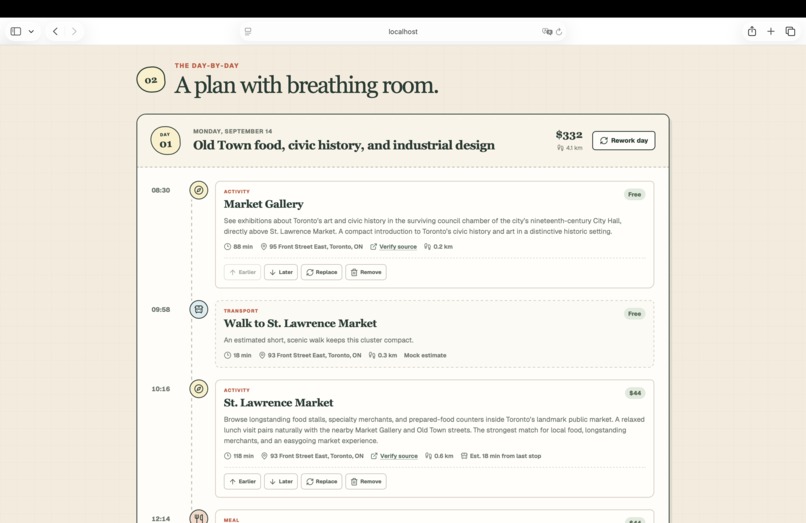
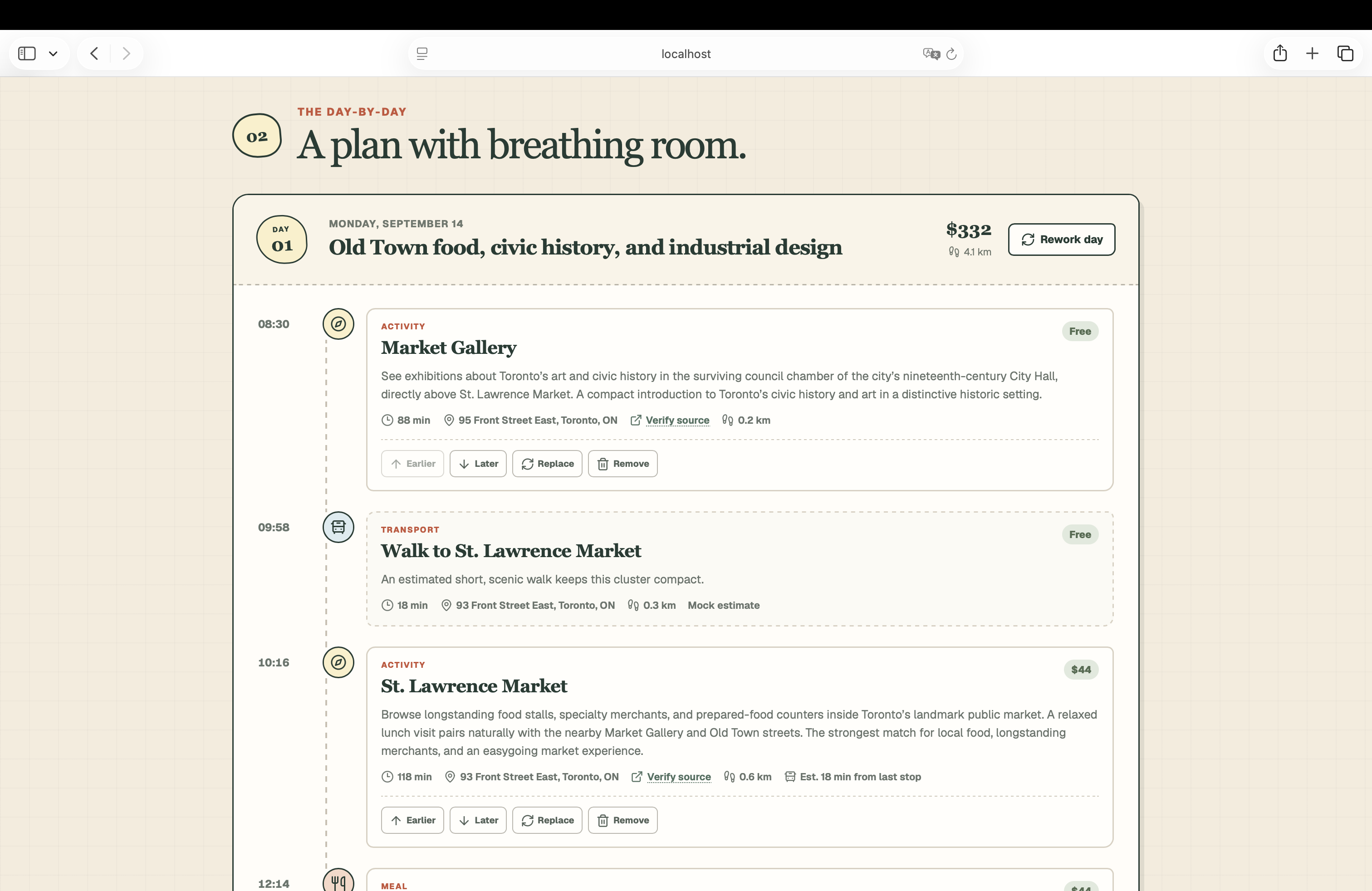
VoyaPace - Toronto plan day 1 page
-
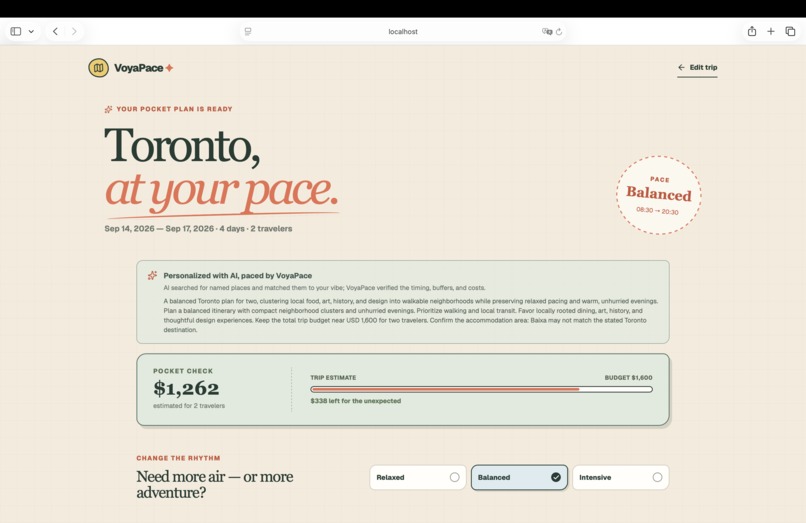
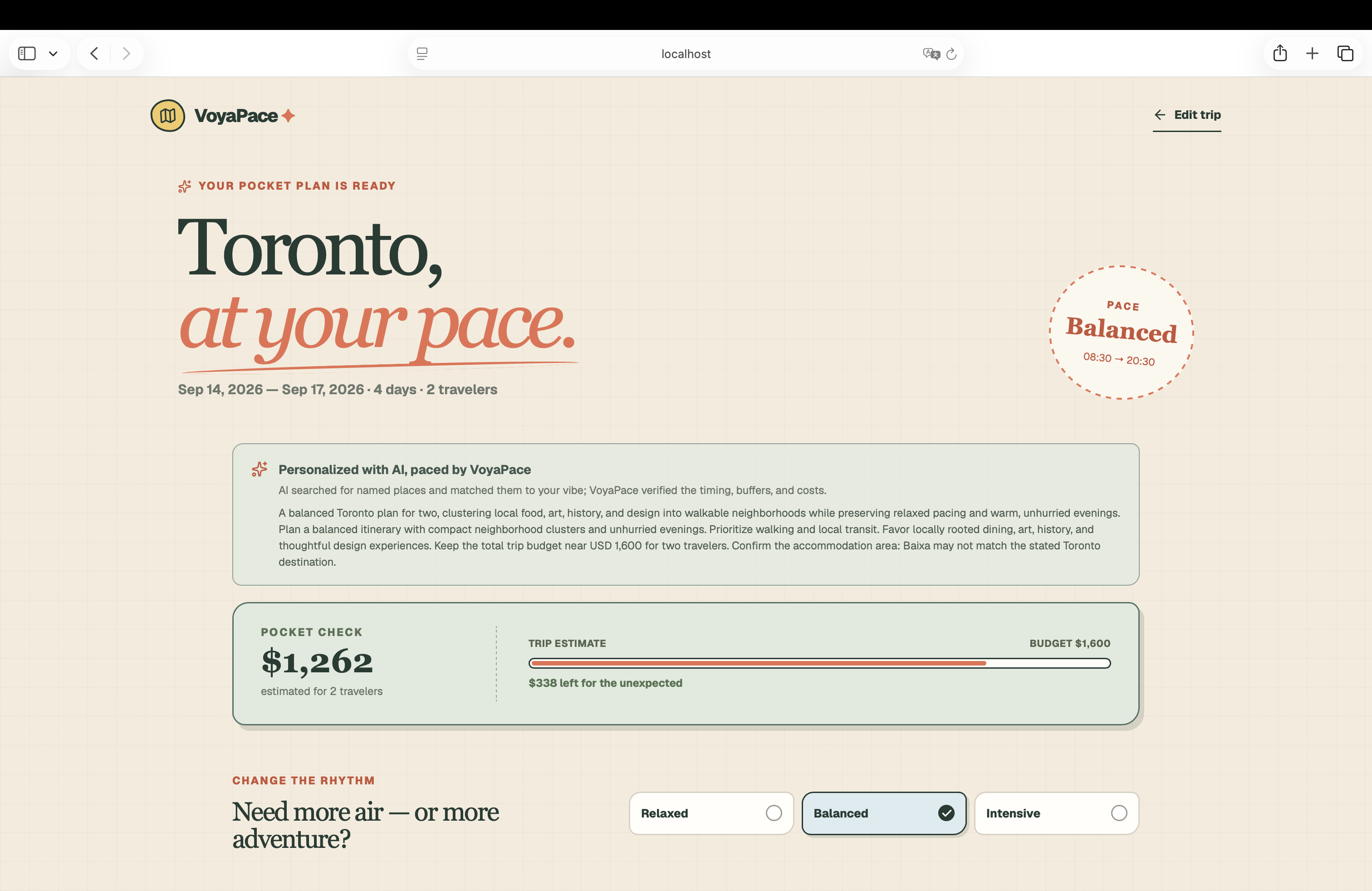
VoyaPace - Toronto plan page
-
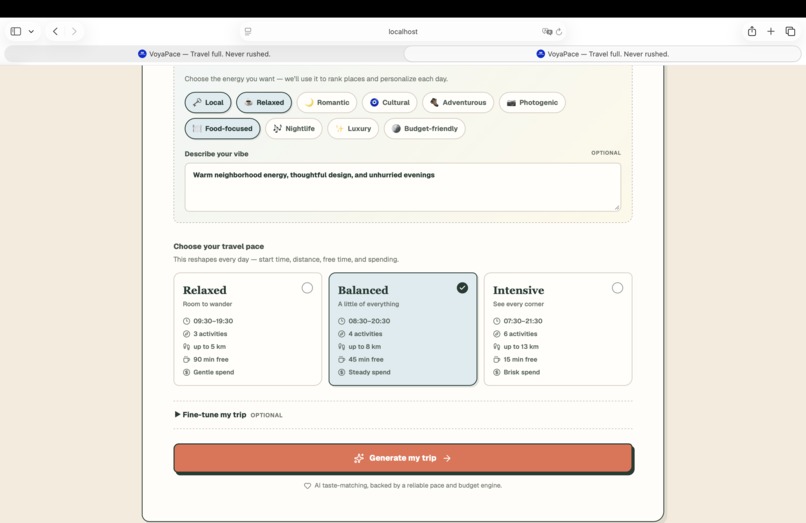
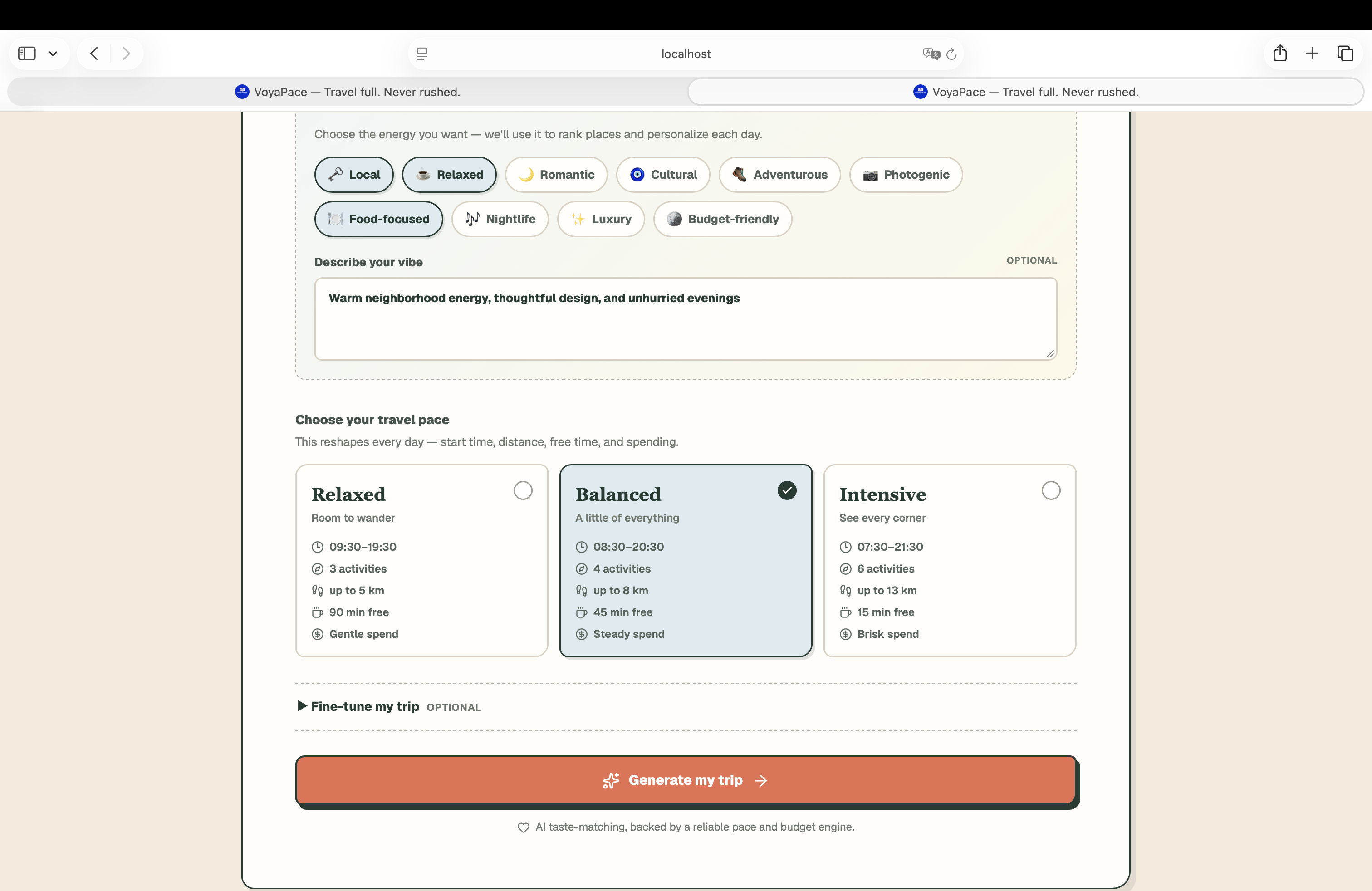
VoyaPace - plan customized page 2
-
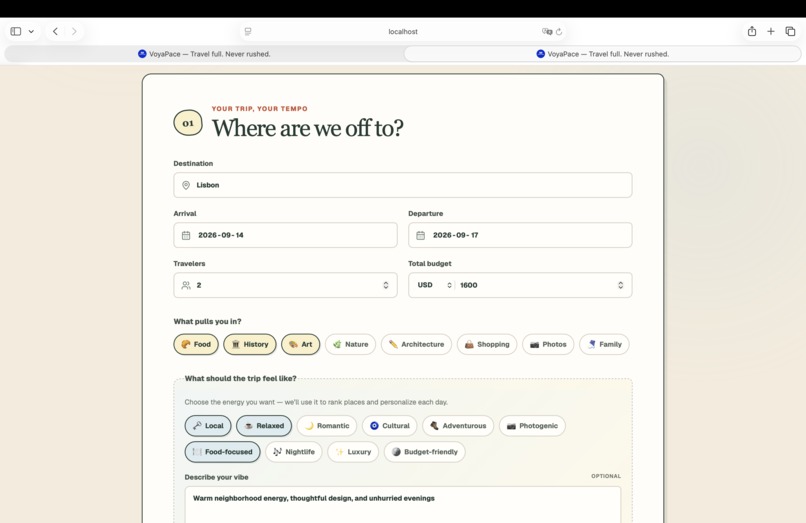
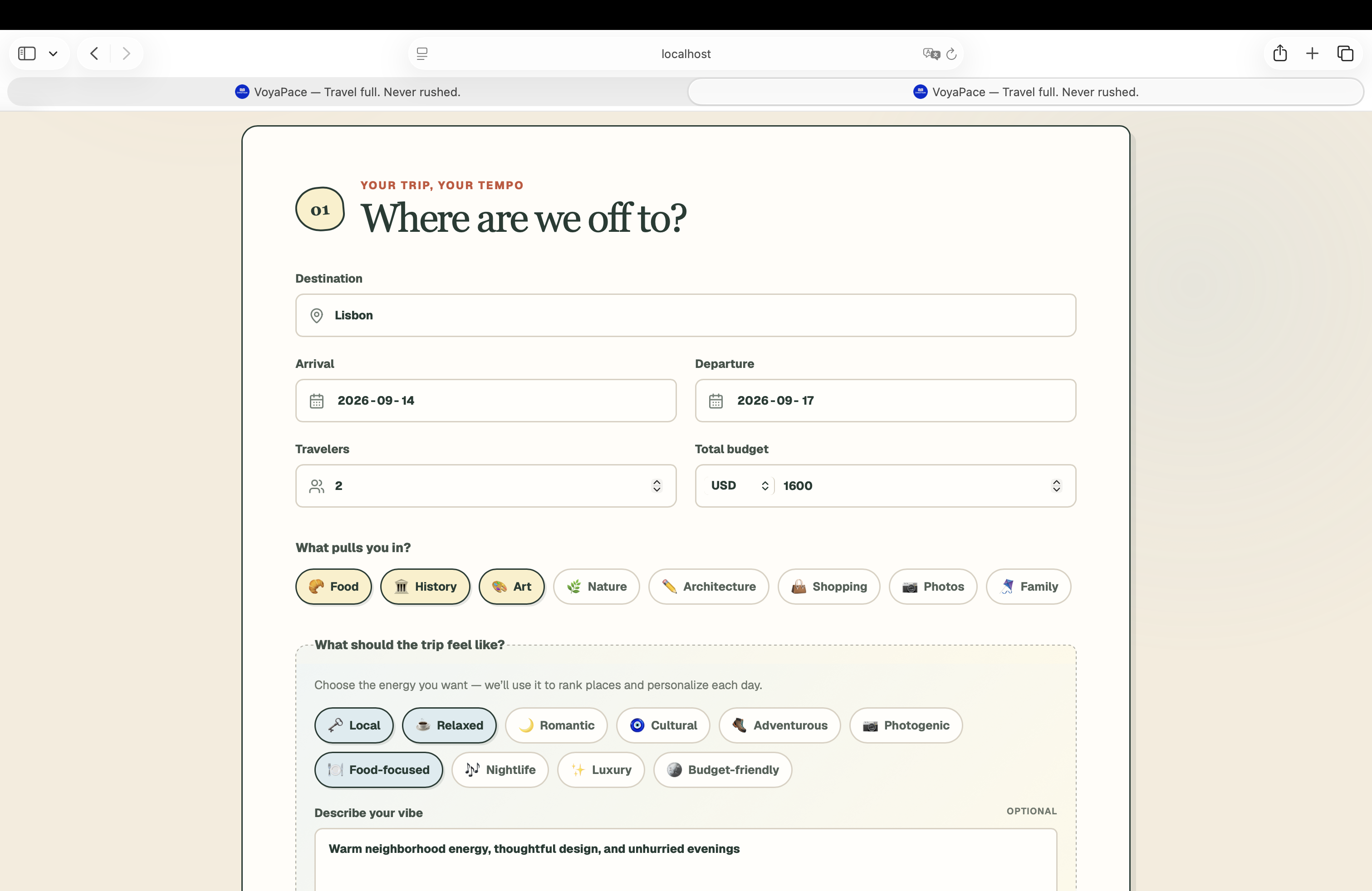
VoyaPace - plan customized page 1
VoyaPace
Inspiration
Planning a trip often starts with excitement but quickly turns into a complicated optimization problem. Travelers need to balance fixed dates, limited budgets, transportation time, meal breaks, must-see attractions, and their preferred travel pace.
Most itinerary tools treat travel style as a simple preference label. However, a “relaxed” traveler and an “intensive” traveler should receive fundamentally different schedules—not just different descriptions of the same itinerary.
VoyaPace was inspired by the idea that a travel vibe should act as a real planning control. The product turns a few user preferences into a structured, realistic itinerary while presenting the result through a simple, hand-drawn interface that feels more like a personal travel notebook than a spreadsheet or chatbot.
What it does
VoyaPace creates a detailed travel plan within a user’s fixed travel dates and budget.
Users provide:
- Destination
- Travel dates
- Number of travelers
- Total budget
- Interests and must-see locations
- Preferred travel vibe
The three primary travel vibes are:
- Relaxed
- Sightseeing-focused
- Intensive
These are not merely prompt labels. Each vibe directly controls planning variables such as:
- Daily start and end times
- Number of attractions per day
- Meal duration
- Maximum walking distance
- Transportation radius
- Amount of free time
- Daily budget consumption
For example, a relaxed itinerary may begin later, group activities within one neighborhood, include longer meals, and reserve several hours of free time. An intensive itinerary may begin earlier, cover more locations, allow shorter meal breaks, and use a wider transportation radius.
The generated result includes:
- A trip-level budget breakdown
- A day-by-day itinerary
- Activity start and end times
- Estimated transportation time
- Meal suggestions
- Expected costs
- Daily walking and activity intensity
- Remaining budget
Users can also adjust a single destination or activity without regenerating the entire trip. VoyaPace updates only the affected portion of the day, recalculates the schedule and budget, and keeps the rest of the itinerary stable.
How I built it
I built VoyaPace as a structured planning workflow rather than a traditional chat-based itinerary generator.
The user interface collects the traveler’s dates, budget, interests, constraints, and preferred travel vibe. The selected vibe is translated into explicit planning parameters, including activity density, time limits, walking distance, meal duration, free-time targets, and spending pace.
GPT-5.6 then generates the itinerary as structured data instead of unformatted text. The itinerary schema contains trip-level budget information, daily plans, activities, meals, transportation segments, timing, and estimated costs.
After generation, a validation layer checks whether the itinerary satisfies the user’s constraints. It verifies that:
- Activities do not overlap
- Transportation time is included
- Daily and total budgets remain within the requested limit
- Meals and breaks are scheduled
- Must-see locations are included
- Activity density matches the selected vibe
- Daily costs add up correctly
When a user replaces or removes one destination, the application sends only the affected day and its remaining constraints back to the planning workflow. This allows VoyaPace to perform a localized update instead of rebuilding the entire trip.
The interface uses a lightweight, hand-drawn visual style with timeline cards, travel doodles, budget summaries, and clearly separated daily plans. The goal was to make a complex itinerary feel approachable and easy to edit.
Codex helped accelerate the implementation by assisting with component development, structured data models, validation logic, debugging, and iteration across the planning and editing flows. GPT-5.6 powers the itinerary generation, explanation, and localized replanning experience.
Challenges
Turning a subjective vibe into measurable constraints
The largest design challenge was converting concepts such as “relaxed” or “intensive” into values that a planning system could consistently apply.
Instead of relying only on descriptive prompts, I mapped each vibe to concrete limits for start time, activity count, walking distance, meal duration, free time, transportation radius, and spending speed. This made the resulting differences visible and testable.
Keeping generated plans realistic
A language model can produce an itinerary that sounds reasonable while still containing overlapping activities, impossible transportation windows, or inconsistent costs.
To address this, I separated generation from validation. GPT-5.6 proposes the plan, while deterministic checks verify its timing, totals, density, and constraints before the itinerary is displayed.
Updating one activity without breaking everything else
Regenerating an entire trip after every small edit can unexpectedly remove activities the user already approved.
I designed the adjustment flow to preserve unaffected days and locked activities. Only the relevant section is replanned, after which the day is validated again.
Balancing detail with a simple interface
Travel planning contains a large amount of information, but displaying all of it at once can make the product overwhelming.
The hand-drawn interface uses progressive detail: users first see the total budget and daily overview, then open a specific day to inspect its timeline, transportation, meals, and costs.
What I learned
This project reinforced that an effective AI product needs more than a strong prompt. Reliable planning requires structured outputs, explicit constraints, validation, and clear boundaries between generative reasoning and deterministic application logic.
I also learned that personalization becomes more useful when users can see how their preferences affect the result. By showing changes in activity count, walking distance, free time, and spending pace, VoyaPace makes the meaning of a travel vibe transparent.
Most importantly, I learned to treat the AI-generated itinerary as an editable plan rather than a final answer. Giving users control over individual destinations makes the experience more practical, predictable, and collaborative.
What’s next
Future versions of VoyaPace could include:
- Real-time opening hours and travel times
- Weather-aware itinerary adjustments
- Hotel and flight budget integration
- Collaborative planning for groups
- Accessibility and mobility preferences
- Saved traveler profiles
- Automatic replanning when delays or closures occur
The long-term vision is to create a travel planner that does not simply generate an itinerary once, but continues adapting as the traveler’s priorities and real-world circumstances change.

Log in or sign up for Devpost to join the conversation.