-
-
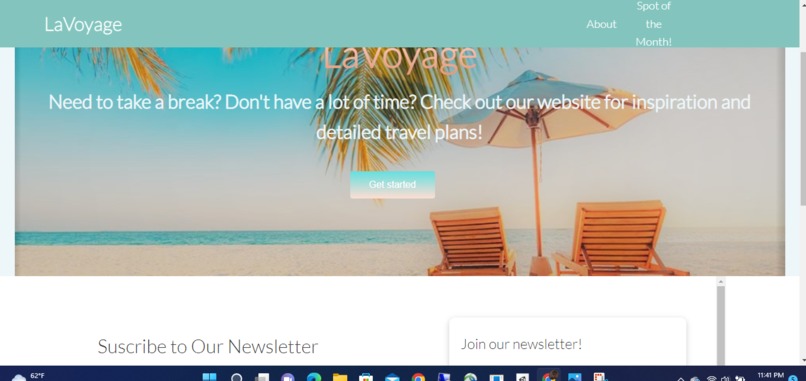
About page + newsletter signup
-
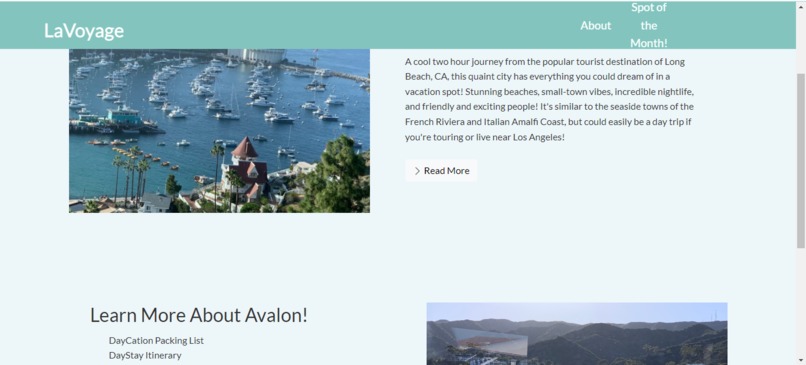
Spot of the month
-
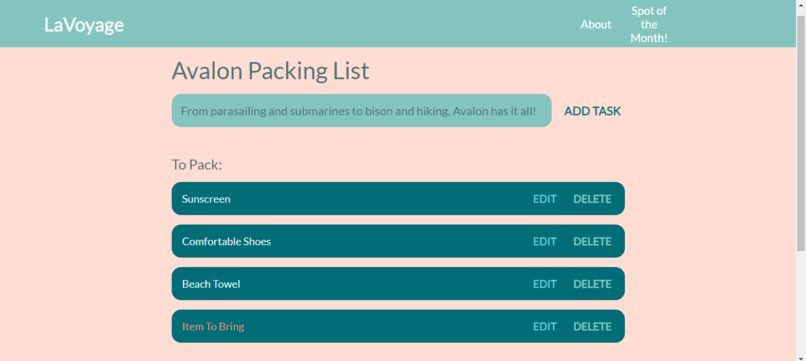
Packing List
-
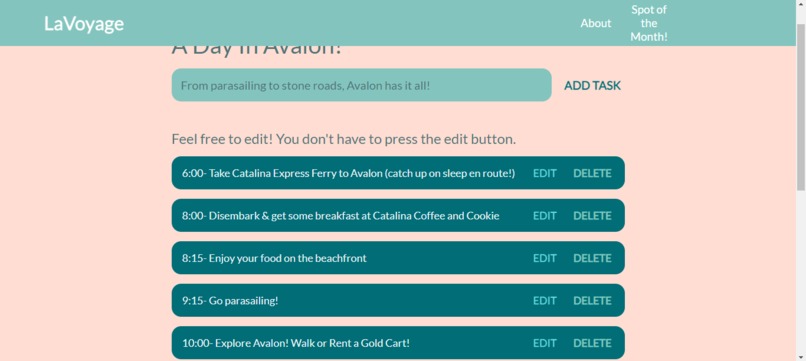
Itinerary
Inspiration
The world we live in today is extremely faced-paced, creating a competitive and stressful environment for many people. A vacation would be a great option to destress from these environments, however, that also requires a large amount of planning. Our main inspiration came from people's experiences about how vacations themselves can be stressful rather than relaxing. We thought this would be a great project considering that summer is starting and more people are starting to go on trips: going to unfamiliar locations, having travel anxiety, wasting time trying to figure things out during their vacation, etc. This can have the opposite effect where the entire experience can become a nightmare instead of a dream. Thus came the idea for Voyager, a website that would plan out the itineraries for local daycation spots - packed with ample rest, exploration, and meditation to ensure the best for the user.
What it does
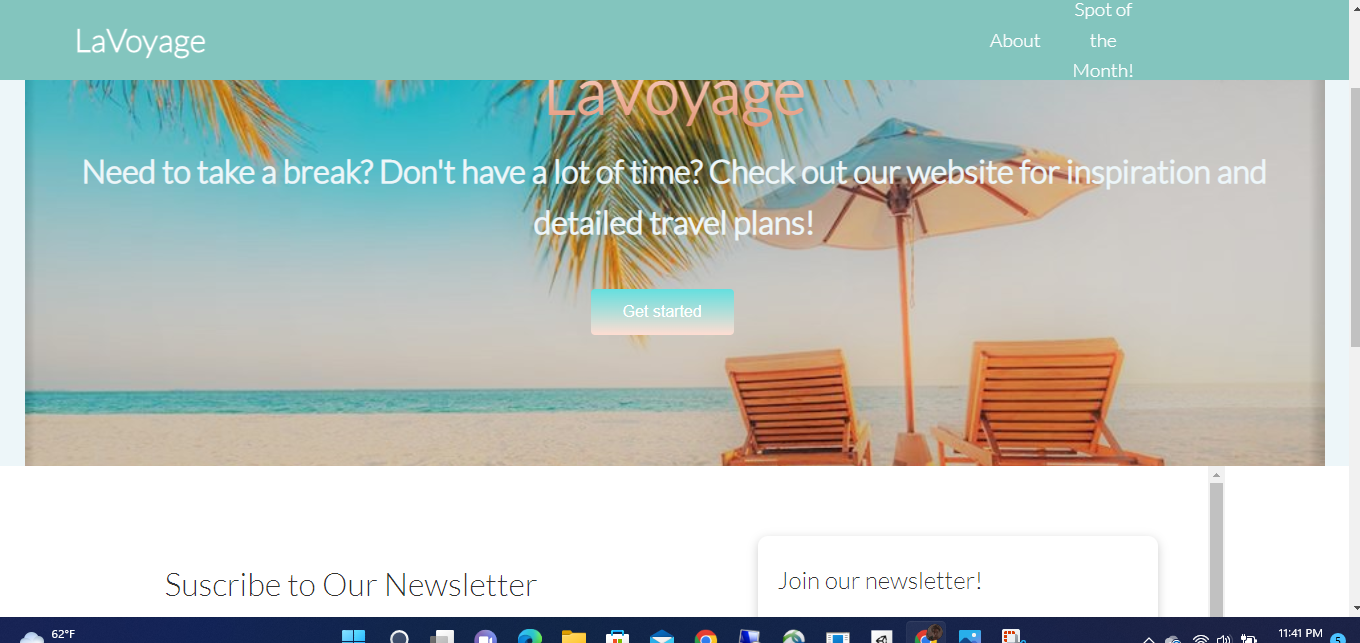
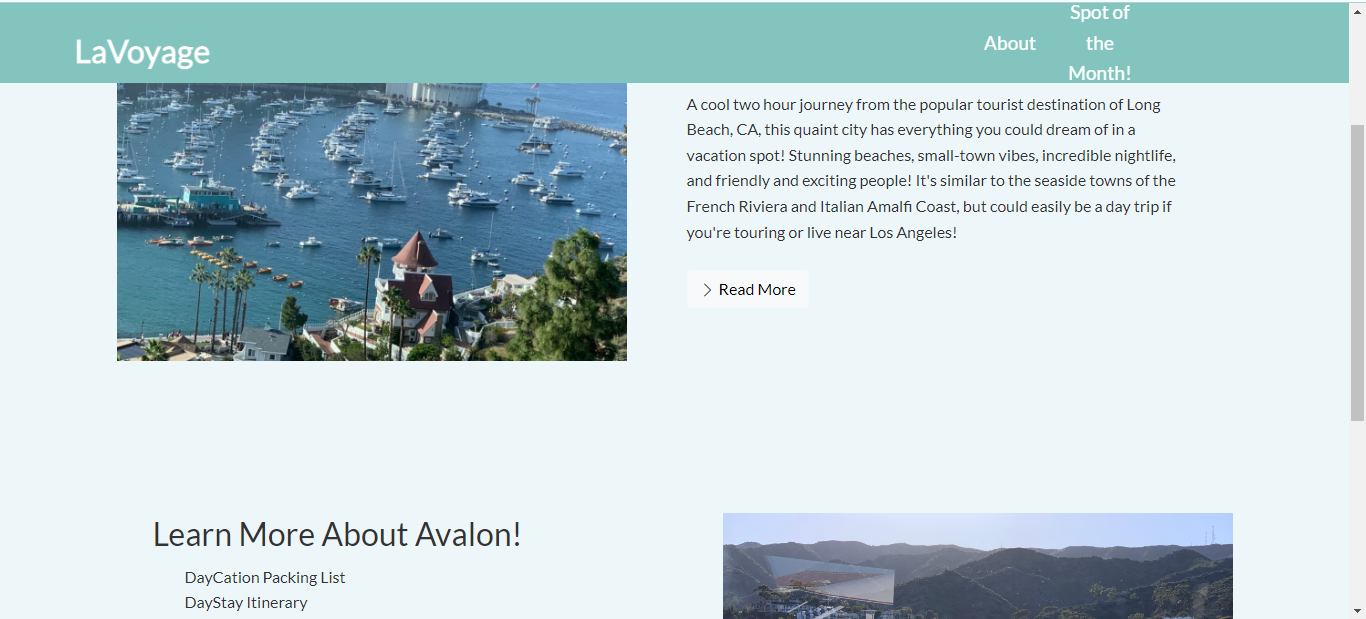
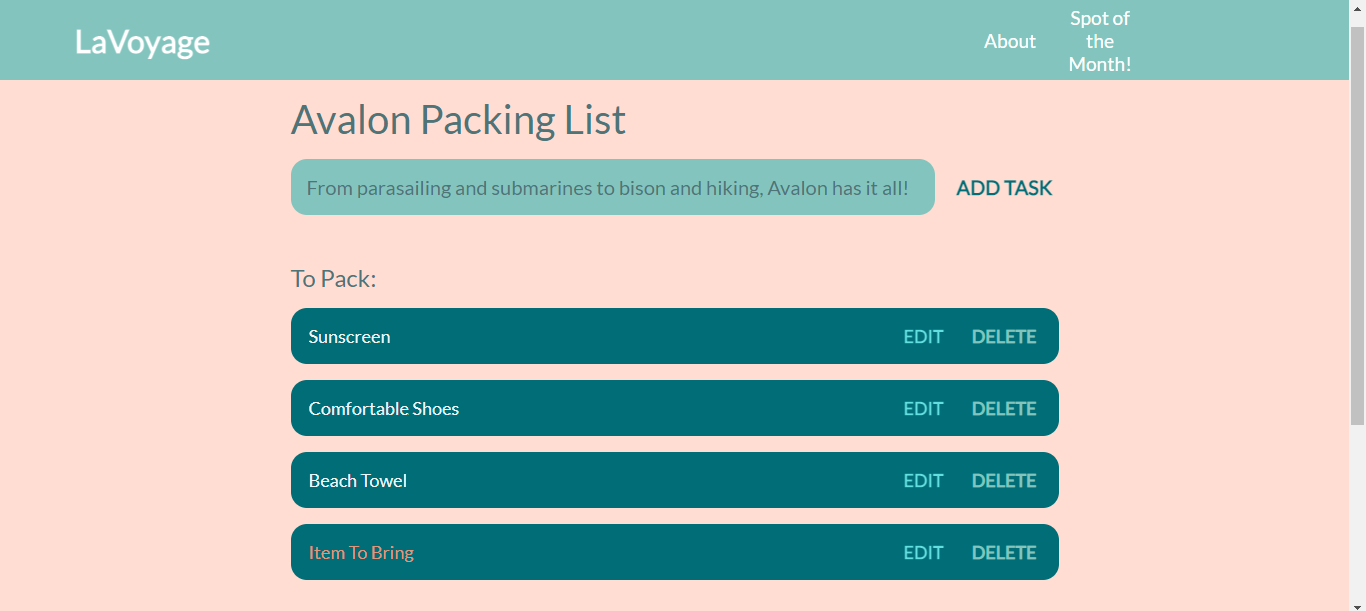
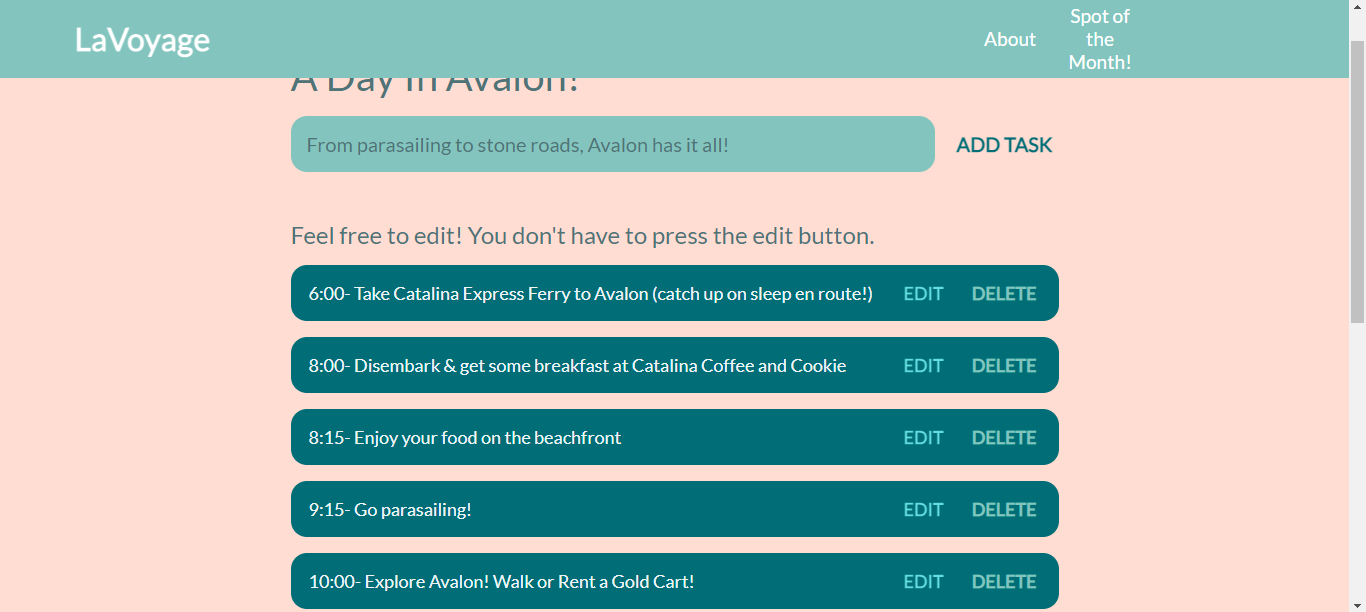
As you first land on the website, you can see a get start button that is linked to the “Spot of the Month'' page which the users can use to gain inspiration for their next trip. Below that we created a newsletter form where the idea was to let the user fill it out in order to receive a weekly Message with the spot of the Month, a guided meditation video, and the link to our website via Twilio. On our “Spot of the Month” page we go in-depth about one location every single month- customized blurbs, packing lists, and itineraries galore! When the user clicks on either the packing list or the itinerary, they will be able to customize it to their liking- adding and subtracting anything they want from the list. We give them a few things to start their list with, and they simply add to or edit it to their liking on their own. Since we take care of all of the planning, all the users have to do is pick a date and have the time of their lives! We also wanted to add in a personal guided meditation video provided to them that would be tailored to the destination of the month (ie- Since Avalon is a beachy place, "Feel the waves crashing down on the sand") that would be delivered via Twilio call, but could not actually implement it due to time and experience constraints.
How we built it
After tinkering with Twilio for a while, we prototyped the website using Figma. built the website up using HTML, CSS, Vanilla JS, and Bootstrap. We added the index homepage with the newsletter signup section (we thought we would be able to implement Twilio by then but could not). The JS was mostly for the two list sections of the website, but we did use some JS to build up the navigation bar.
Challenges we ran into
One of our biggest issues was not having enough time to get the results we wanted. We wanted to make something grander, with a phone number you could call in order to get a guided meditation video tailored to the place of the month using Twilio, but weren't able to. It was something we were truly devastated by, but we kept charging through. We also had quite a problem because one of our team members was based in EST while the other was based in PST and we worked on the demo video rather late at night. This meant that the EST teammate had to stay awake until 2 a.m their time to get everything figured out before the early morning deadline. The project was also due at 5 a.m PST, so the PST teammate couldn't have waited to submit the project until morning. We also had an audio problem while recording the demo video, because whenever we tried to record through Zoom, the presentation was always muted and we didn't know how to change that, so we had to get creative and use Google Meets and Vimeo recorder instead. We also ran into many problems with the code itself- from not being able to figure out why the HTML elements were updating with the CSS traits to not being able to update the div element correctly, but we are proud to say that we have pulled through and made a good program that we think has the capability to help many people.
Accomplishments that we're proud of
We were both pretty proud of the fact that we experimented with Twilio and that we both really liked how it opened up many paths that were previously closed. Twilio is definitely going to be something both of us carry with us throughout our entire hackathon careers because of how useful it is in so many different manners. We are also proud of the fact that we built the entire website in a single day- something we didn't think we would be able to do before, so we're pretty proud of ourselves for breaking up all our doubts and submitting a project we thought was pretty good for someone of our age and experience. We also are proud of the fact that we branched out and tried venturing into some unknown territory.
What we learned
We definitely had our eyes opened to all of the great computer science technologies that once seemed too intimidating for us to use. We spent a lot of time using the same old languages and frameworks, but this time, we branched out and ventured through new waters. Even though Twilo may not have been a part of our final project, we still loved it dearly and are certain we will use it in the future. We also learned how to solve problems with a clear mind and how to compromise to ensure we get our work done. We also learned how to create a functional checklist using JavaScript, a language we don't use too much in our other works. This really built up our knowledge of it and it gave us a good grasp on what to do in situations like those and how to treat learning new languages/concepts.
What's next for Voyager
We definitely want to go deeper with the itineraries. Instead of having our current model, which is catered to how we would spend a day in our location, we would like to have the user customize their actions. Adding cost brackets, scales for how adventurous you want it to be, and filtering previous spots by location are all features we would love to add onto Voyager to make it more inclusive of everyone. The mindfulness/meditation calling feature with Twilio is also something we are actively trying to incorporate into the website and hope that we will be able to figure it out. We would also like to make the itinerary design more interactive so that people would be able to drag their schedule together if they would like to arrange it in a different way than is already pre-arranged, and maybe add a feature to transfer the itinerary to the user’s calendar app of choice. All of these features would greatly improve user experience and make the process of going on a DayCation and taking a break a whole lot easier and stress-free.

Log in or sign up for Devpost to join the conversation.