-
-

Home Screen
-
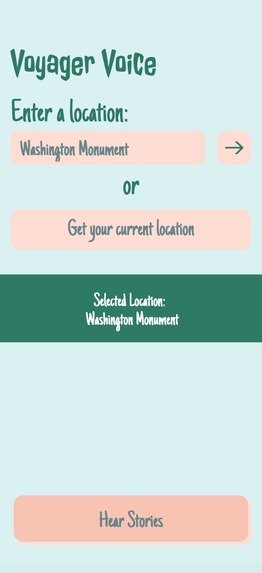
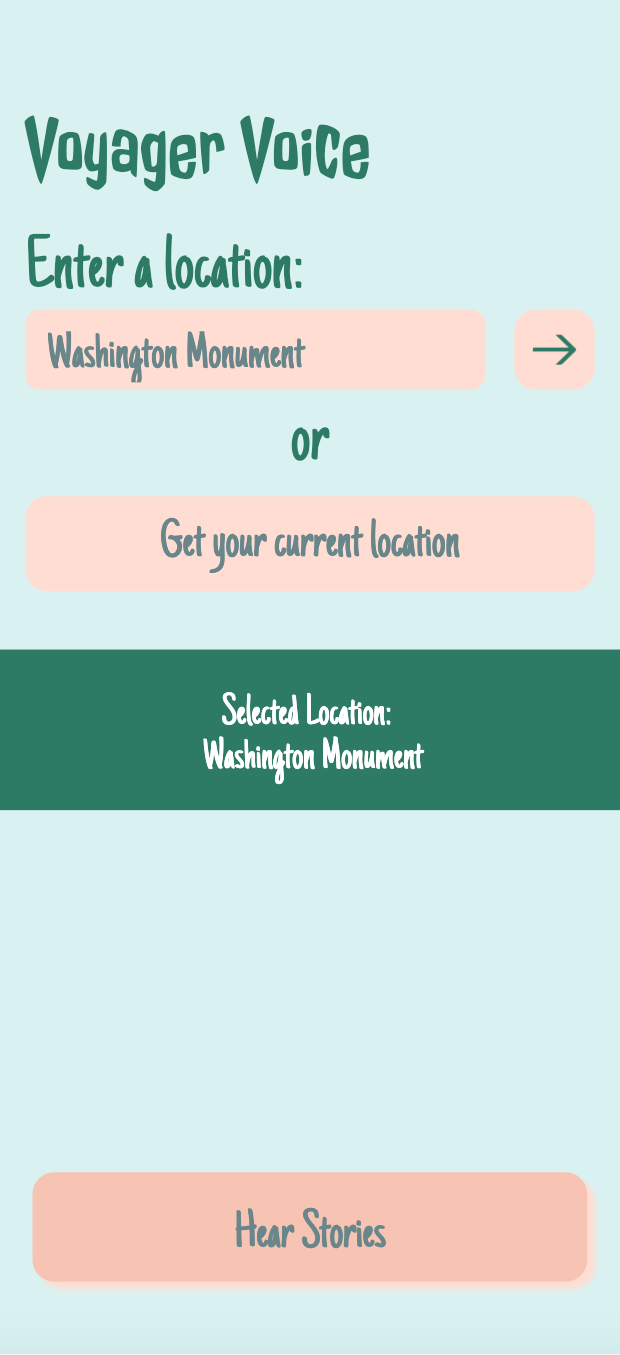
Location Screen
-
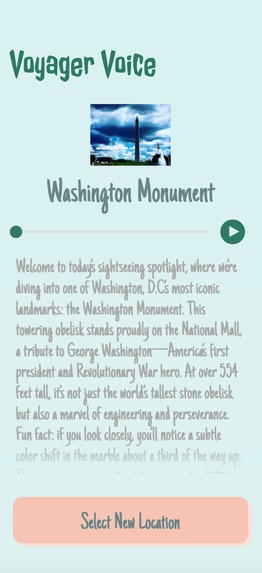
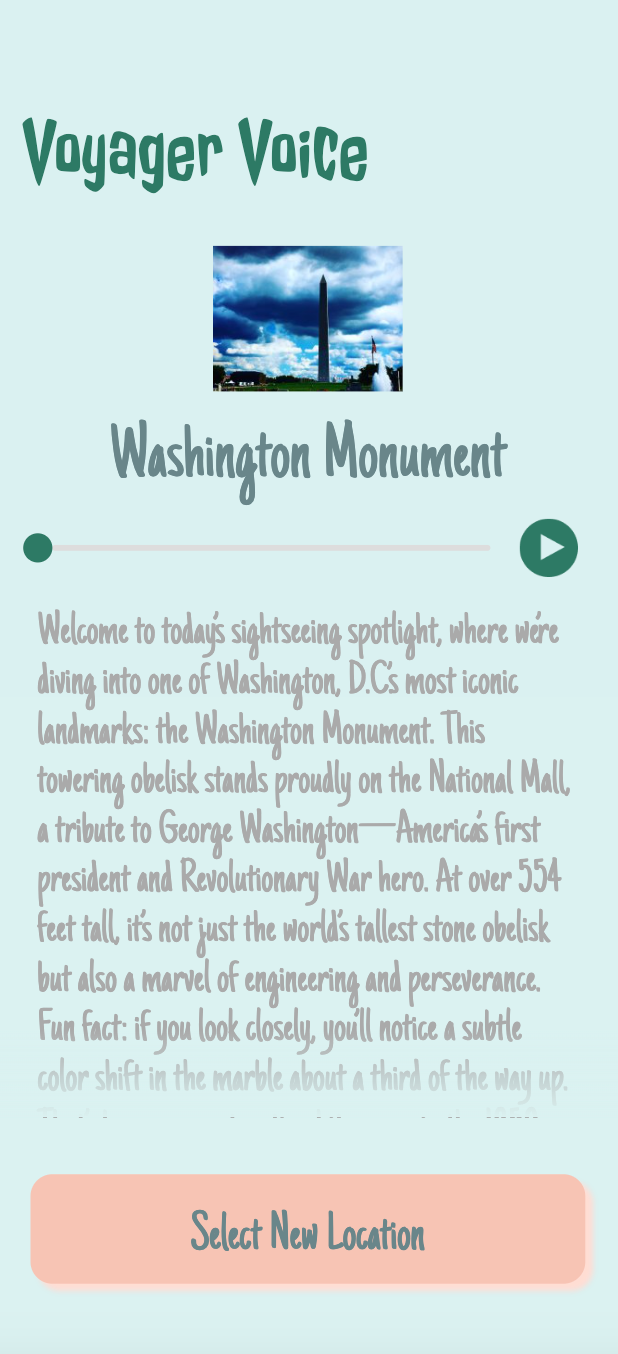
Podcast Screen

Inspiration
Our inspiration stemmed from the idea of road trips. Often, when traveling to unfamiliar places with limited information, we thought it would be helpful to have an app that could provide engaging, educational content about the surrounding area. Imagine learning about a place through a podcast while you're exploring it—that’s what led us to create Voyager Voice. It’s an app that generates location-based audio podcasts, offering historical and contextual insights about nearby landmarks.
What it does
Voyager Voice enhances travel experiences by transforming location-based data into engaging audio content. Using the user's current location, the app retrieves nearby points of interest via the TripAdvisor API, displaying the name and image of the site. It then fetches relevant Wikipedia information and summarizes it using the DeepSeek language model. The summary is transformed into a podcast-style narration with Google Cloud Text-to-Speech, delivering fun facts and historical insights in a storytelling format.
How we built it
We built Voyager Voice with a React Native frontend and a Python Flask backend. The TripAdvisor API was used to gather location details like names and photos. During development, we used Jupyter Notebooks to prototype backend components. To create engaging summaries, we leveraged the DeepSeek Chimera model (combining DeepSeek-R1's reasoning capabilities with DeepSeek-V3's token efficiency) via the Chutes API, and Google Cloud Text-to-Speech helped convert the summaries into audio.
Challenges we ran into
We encountered several challenges, including missing authentication tokens when working with the TripAdvisor API. Integrating Intel Tiber's Jupyter Notebooks with our mobile app’s frontend and backend also proved complex, especially when dealing with tunneling and asynchronous response handling. We also faced time constraints debugging unexpected JSON and network errors. Unfortunately, we had to switch to hosting our own flask server to run the model.We also struggled with content summarization, with our outputs sometimes including self-referential or inaccurate narratives. That led us to adopt a reasoning model which, once its default chain-of-thought was stripped out via post-processing, fit our needs perfectly.
Accomplishments that we're proud of
Despite the tight 10-hour hackathon timeline, we successfully built a working prototype that integrates multiple APIs and technologies. We're proud of how much we accomplished in such a short time, especially the seamless combination of location services, AI summarization, and audio narration.
What we learned
This project reinforced the importance of clear team communication to avoid workflow gaps. We also gained hands-on experience with Intel Tiber and explored the capabilities and limitations of current AI summarization tools.
What's next for Voyager Voice
Moving forward, we plan to refine the podcast feature to ensure content accuracy and improve the naturalness of the narration. We also aim to expand support for more locations and enhance user customization for a richer travel companion experience.
Built With
- deepseek
- flask
- google-cloud-tts
- python
- react-native


Log in or sign up for Devpost to join the conversation.